1995-2009: PO Box 370, #4 Roy St, Ear Falls, Ontario P0V 1T0 Canada.
Produces the Baby Belle, first flown 1986 as a two-seat light helicopter for home assembly from kits or plans.
Helicopters
California Helicopter International
USA
Produced turbine conversion kits for Sikorsky S-58 helicopter, with rights purchased 1981 after earlier work.
B W Rotor Sky Cycle
A single-seat ultralight pressure jet helicopter.
B W Rotor Co Inc
USA
Offered plans to construct the Sky Cycle single-seat ultralight pressure jet helicopter.
Bristol B.203
In the mid 1950s Bristol Aircraft Ltd began work on a turbine-powered helicopter using a B.171 Syvamore Mk 3 with an increased fin area. Under the name Bristol 203 it was to be an 11-seat machine and parts from the incomplete 179th and 180th Sycamore airframes were used in the prototype machine. This project was abandoned when the company was taken over by Westland, although some of its finer points were later incorporated in the Lynx.
Bristol B.191 / B.192 Belvedere
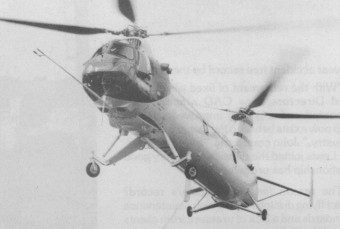
Undertaken by Bristol in response to Royal Navy and Canadian naval specifications were the models 191 and 193.
The Bristol 191 was a ship-based development of Type 173 with modified fuselage, u/c etc.
The Bristol 192 was the production version of Model 191 for RAF use with two cabin windows only, starboard cargo hatch, cargo hoist beneath fuselage, large anhedralled tailplane and powered by two 1465shp Napier Gazelle 2 turboshafts, derated to 920shp. In the initial configuration, the 192 had a purely manual system of control and wooden rotor blades but power controls and metal blades were standardized on the fifth prototype built in 1960. The prototype Type 192 (XG447) first flying on 5 July 1958 at Westonsuper-Mare, was demonstrated at the Farnborough air show in September 1952. That year, three pre-production aircraft were assigned to the RAF for a series of trials for which they were based at Odiham.
As the Westland Belvedere this entered service with the Royal Air Force, though this was only after the 191 and 193 had been cancelled by the RAF and Royal Canadian Air Force respectively.
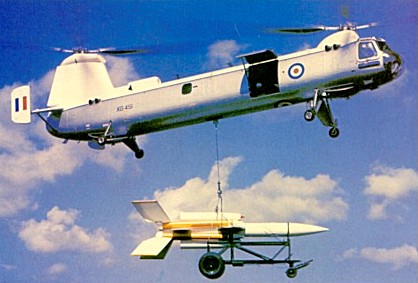
Twenty-six of these helicopters were ordered and used for some years for military transport, not only in the United Kingdom, but also in the Middle and Far East. The Belvedere was withdrawn from service in March 1969.
The production Bristol 192s had an all-metal, skinned fuselage and an anhedral tailplane, compared with the dihedral one of the Type 173. The two rotors had four metal blades and the front wheels of the fixed quadricycle landing gear were self-castoring. The helicopter’s maximum capacity was 30 seats or 2700kg internal payload. The instrumentation also permitted night flying.
As the 192C it was tested by BEA and offered its 24 passengers a unique high-speed service between London and Paris. British European Airways leased a Belvedere briefly but never used it in commercial service.
On May 30, 1961, C T D Hosegood flew from London to Paris in 1 hour 41 min 28 sec and on June 2, 1961, from Paris to London in 1 hour 40 mm 55 sec. This is the equivalent of 202.32km/h outwards and 203.51 km/h on the return flight.
Bristol B 192 Belvedere HC Mk I
Engines: 2 x Napier Gazelle 2, 1627 shp, 1092kW
Fuselage length: 54.134 ft / 16.5 m
Length with rotors turning: 27.36m
Height: 17.388 ft / 5.3 m
Rotor diameter: 48.885 ft / 14.91 m
Max take off weight: 18522.0 lbs / 8400.0 kg
Empty weight: 5277kg
Max. speed: 119 kts / 220 km/h
Service ceiling: 13123 ft / 4000 m
Range: 378 nm / 700 km
Crew: 2 + 25 PAX / 2700kg
Bristol B.173
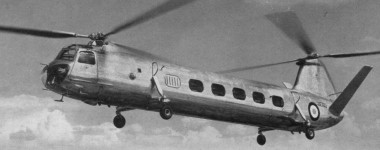
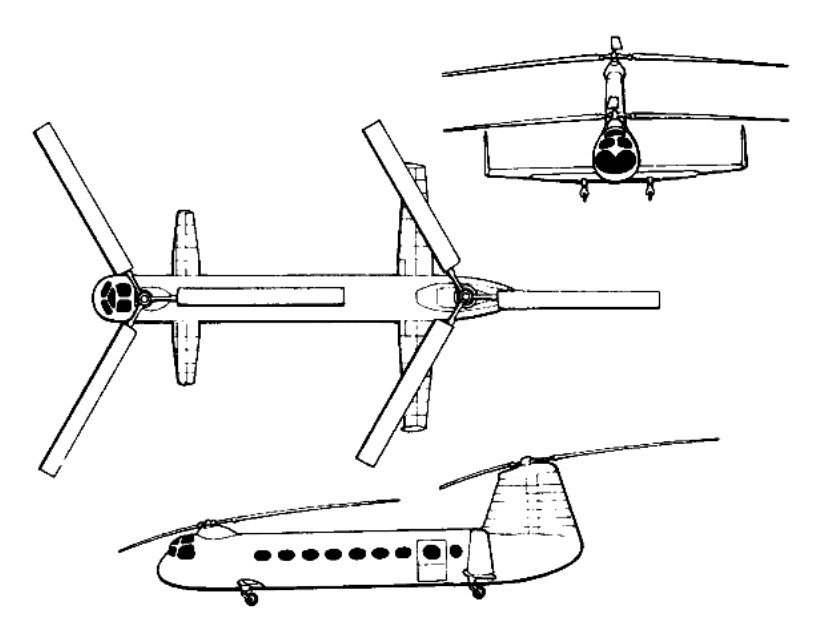
The Bristol 173 was the first helicopter specifically designed for commercial operation and passenger transport in particular. Two Mk.1 prototypes were begun in 1948 to Ministry of Supply Specification E.4/47.
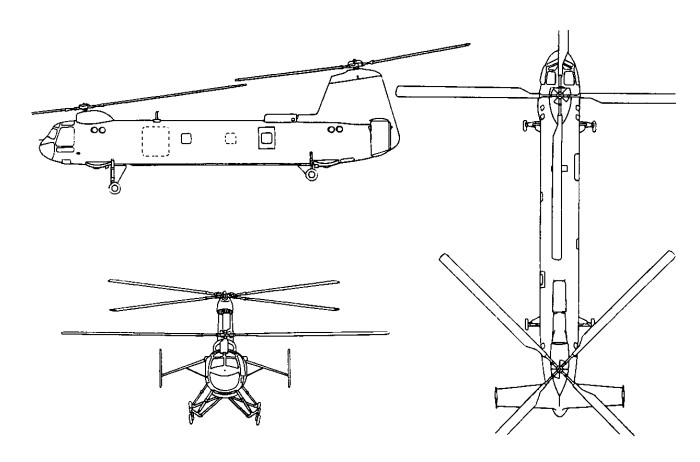
Ground tests started in 1951. It had two three-blade counter-rotating rotors, but it could fly on one Alvis Leonides 73 engine and the centre of gravity could be displaced. The two rotors were synchronized by a shaft in conjunction with a gearbox. In the event of a breakdown the shaft could transmit power from the working engine. The rear rotor was carried on a pylon which was part of the vertical fin structure. Two tailplanes were set at a sharp angle to improve longitudinal and lateral stability.
The 173 had virtually the 171 Sycamore Mk. 3’s transmission system, rotor assemblies and engine installation, except that one engine rotates in the opposite direction to the other.
Ground resonance originally caused some trouble. The problem was overcome by linking the right- and left-hand oleo-struts of the undercarriage by small-bore hydraulic piping. The latter formed the two arcs of a circle seen above the upper part of the legs.
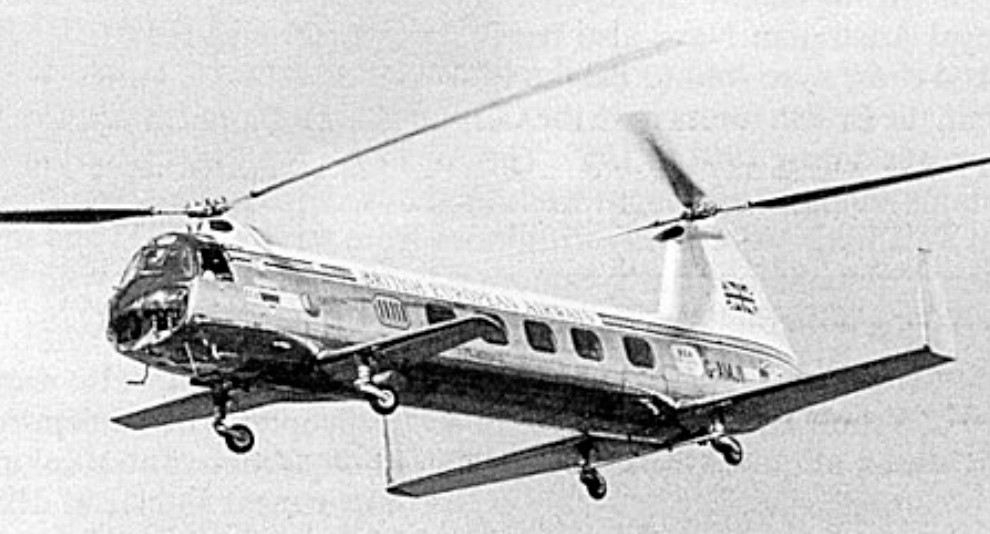
The first, G-ALBN, made its maiden flight on 3 January 1952, after some eight months of ground trials and tethered flights. It was Britain’s first tandem-rotor helicopter design, and in this early form was powered by two 575hp Alvis Leonides 73 piston engines and could carry ten passengers. In 1953 this machine was handed over to the Admiralty for Naval trials. Trials were carried out with this aircraft in 1953, from the aircraft carrier HMS Eagle.
On 31 August 1953 a prototype 173 Mk.2 (G-AMJI) was flown, differing from the first machine in having two pairs of stub wings to off-load the rotors, the rear pair carrying upright fins at their extremities. These features were later removed, G-AMJI reverting to the Vee-tailed configuration of the Mk.1 and joining its stablemate for Naval trials as XH379. On 20 July 1956 it was delivered to BEA and returned to the civil register for handing trials in BEA colours.
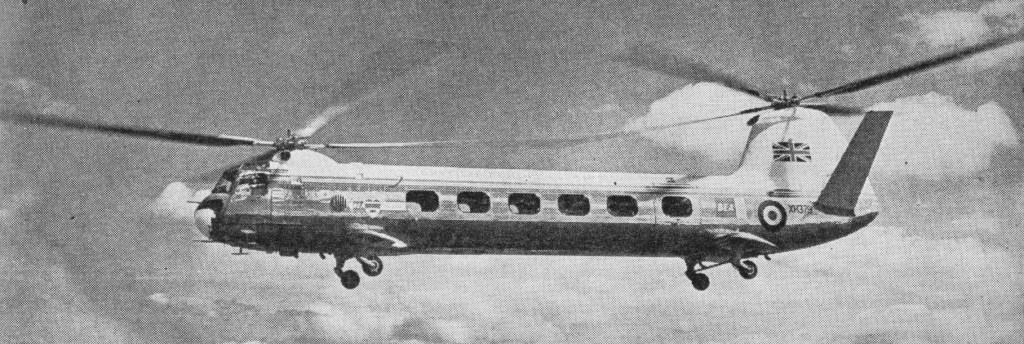
It was based at Gatwick for the period of the trials before being written off in a landing accident in 1956.
The Mk.3, with more powerful engines, (two Alvis Leonides Majors rated at 850shp each) as well as metal instead of wooden four-bladed rotors, marked a greater advance. Seating was up from 14 in the Mk.1 and 2 to 16 in the Mk.3. three were ordered but the Mk.3 suffered from cooling problems and its service trials in 1956 were not entirely successful.
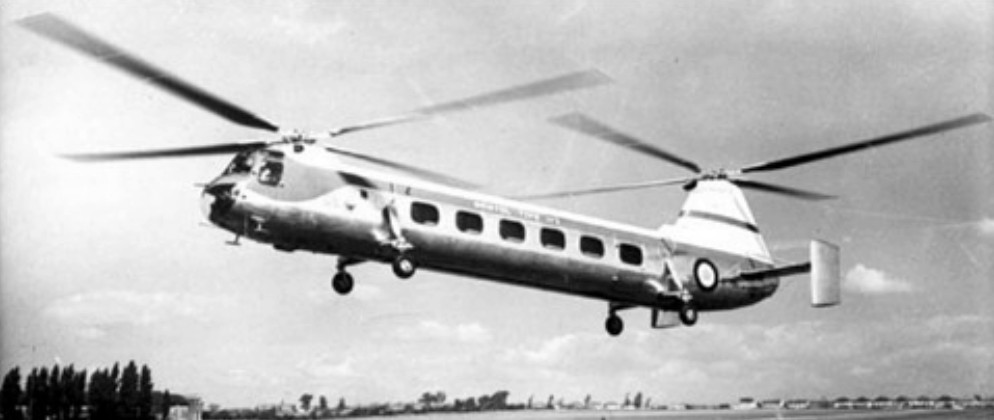
In the event, only one (XE286) was flown, the other two being utilised for ground testing. In 1956 the Royal Navy decided to adopt the Bristol machine for the antisubmarine role, placing an order for sixty-eight aircraft. The production version, to be known as the Bristol 191, was to have folding rotor blades and a shorter fuselage, to enable it to use existing carrier deck-lifts, and the rear legs of the quadricycle undercarriage shortened to facilitate loading of an external torpedo.
The Bristol 173 Mk.3 was offered to BEA.
In July 1958 the Bristol 192 made its maiden flight and this marked the successful climax to the development of the 173.
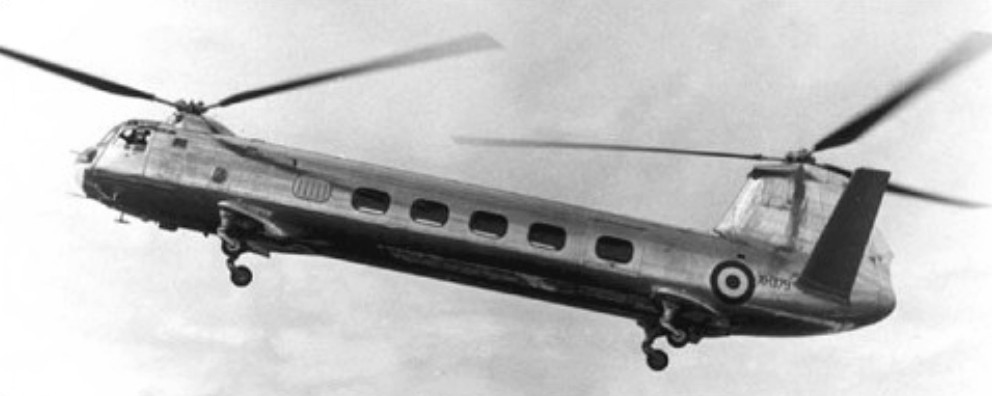
Bristol 173 Mk.1
Engines: two 550 b.h.p. Alvis Leonides 73 radial
Rotor diameter: 48 ft. 6.75 in. / 14.81m
Overall length: 23.83m
Fuselage length: 54 ft. 2 in.
Weight fully loaded: 4808kg / 10,600 lb
Empty weight: 3537kg
Cruising speed: 137km/h
Inclined climb: 360m/min
Absolute ceiling: 5975m / 19,600 ft
Range: 450km / 281 miles at 85 m.p.h. with full load
Pax seats: 14
Bristol 173 Mk.2
Engines: two 550 b.h.p. Alvis Leonides 73 radial
Pax seats: 16
Bristol 173 Mk.3
Engines: two Alvis Leonides Majors, 850shp
Pax seats: 16
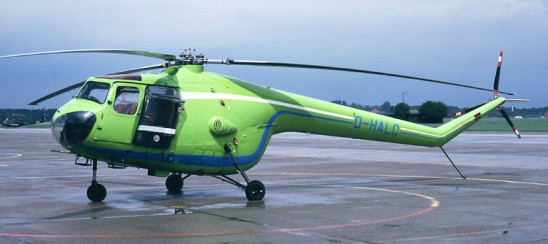
Bristol B.171 Sycamore
A helicopter department was set up in 1945 as part of the aircraft division at Filton, and Austrian-born Raoul Hafner, who had devoted himself to rotary wing research in the thirties, moved to England before the Second World War and took charge in 1944.
Design studies, under Raoul Hafner, were started in June 1944 and, since no suitable British engine was available at that time, the two Mk.1 prototypes (VL958 and VL963) were built with 450hp Pratt & Whitney 11-985 Wasp Junior radial engines. These were 2-seaters, conforming to Ministry of Supply specification E.20/45.
The design featured a light alloy cabin section and a stressed-skin tailboom attached to a central engine and gearbox mounting, the rotor head being fitted with three wooden monocoque blades. The crankshaft lay horizontally, with power transmitted to the vertical driveshaft through a gearbox. The three rotor blades were made of wood with leading edges in hardwood.
After component testing, ground running of the completed airframe began on 9 May 1947, the first flight (VL958) was made by H. A. Marsh on 27 July 1947.
Bristol B.171 Sycamore Article
The second aircraft (VL963) joined the test programme in February 1948 and on 25 April 1949, to facilitate its flight to the Paris Salon, it became the first British helicopter to be granted a civil certificate of airworthiness.
The third airframe appeared in the static park at the 1948 SBAC exhibition at Famborough.
This was followed by the first flight on 3 September 1949 of the one and only Mk.2, built as a 4-seater to specification E.34/46 and powered by a 550hp Alvis Leonides 71 LE 21 HM piston engine in a horizontal position with the crankshaft running vertically. This eliminated the lower gearbox which not only saved weight but made the engine more accessible for checking and repairs, and increased the seating from two to five. It was of metal construction with a three-blade main rotor and was designed as an air taxi (four-five seats) and for military tasks such as air observation and casualty evacuation. This aircraft formed the basis for the first production series, although numerous detail modifications were made to individual machines in these batches, some becoming standard on later production aircraft. Seating was increased to six.
A second take-off attempt ended abruptly when the rotor disintegrated. With a strengthened rotor, development flying was resumed while work continued on the assembly of 15 production Mk 3s with a smaller Alvis Leonides 73 engine. Airframe changes included a shortened nose and an 0.20m increase in cabin width to accommodate three passengers on the rear seat; in order to maintain essential systems in the event of engine failure, and the accessory drive was transferred from the engine to rotor gearbox. The Sycamore had a simple auto-throttle which the pilot could override.
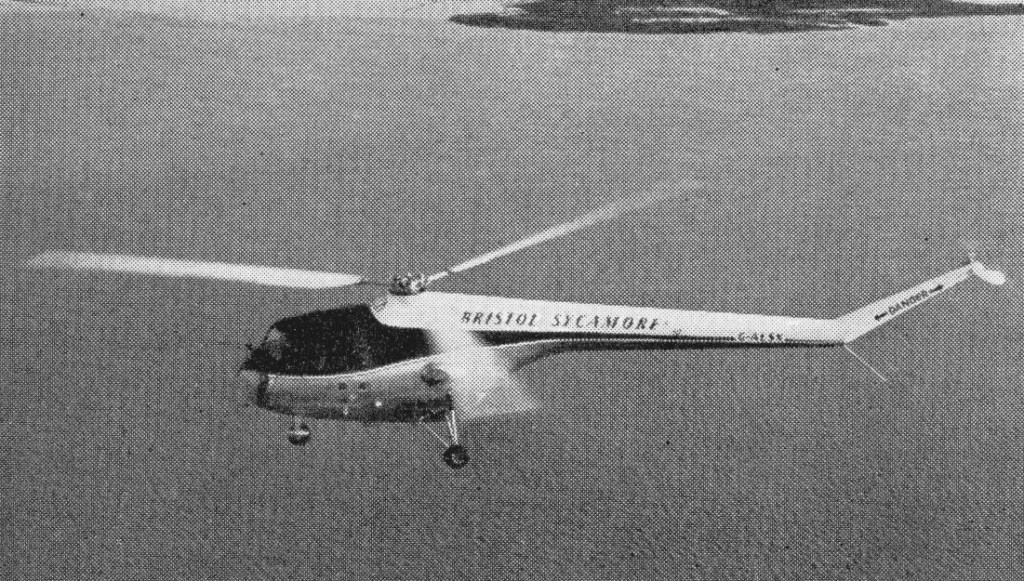
The Type 171 was manufactured at Filton and Weston-super-Mare.
Two Mk 3A were bought by British European Airways. They had a slightly superior performance to the Mk3 and greater baggage capacity, with a freight hold behind the engine bay. BEA began an experimental service with these helicopters between Eastleigh and Heathrow airport in 1954, which lasted for about two years.
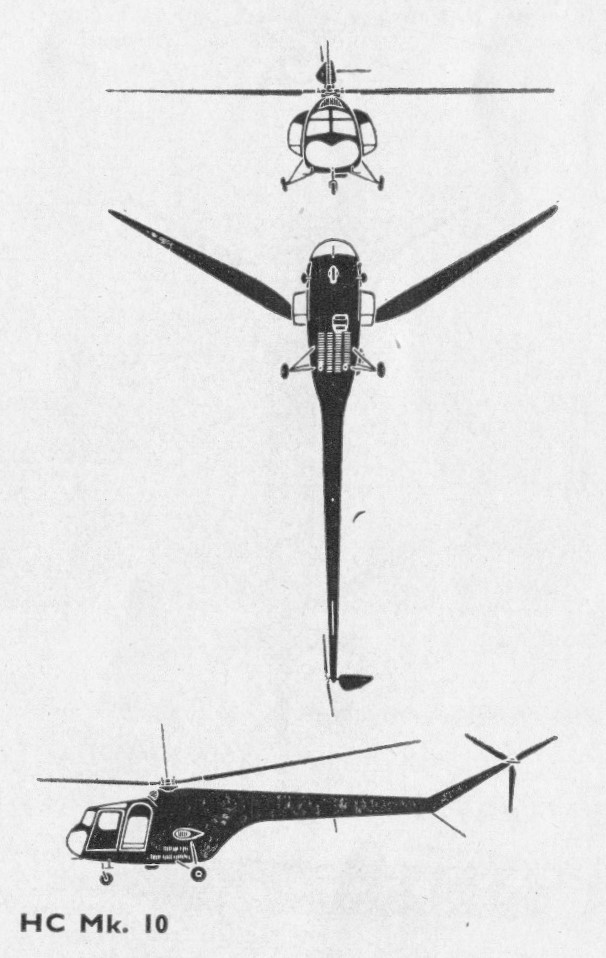
The first two production batches, totalling twenty-five aircraft, included one HC Mk.10 ambulance for evaluation by the Army Air Corps; four HC Mk.11’s for Army communications work; four HR Mk.12’s for RAF search and rescue duties, evaluated by Coastal Command; and two winch-equipped HR Mk.13’s for similar trials with Fighter Command. These were collectively to Mk.3 production standard, with 520hp Leonides 73 engines. Two Mk.3A’s with improved performance, a shorter nose and extra baggage space behind the engine bay, were completed for British European Airways. Of the remaining dozen machines, five were to Mk.4 standard, also with Leonides 173 engines and having four cabin doors; these were built for the Royal Australian Navy (three HR Mk.50), Royal Australian Air Force (one) and RAF (one HR Mk.14). All of these were completed to Mk.3 standard with a Leonides 173 engine. The remaining seven aircraft were a mixture of Mk.3 and Mk.4 reserved for military trials or civil demonstration.
The 1950 Mk.4 with four access doors, a longer-stroke landing gear, a bigger baggage compartment and an hydraulic winch and the pilot’s position moved from port to starboard. This was primarily intended for search and rescue and air ambulance duties, and was supplied to the RAF (two HR.13s and 80+ HR.14), Belgian Air Force (three Mk.14B), Royal Australian Navy (three HR.50 & seven HC.51, equipped with winches for air-sea rescue duties, initially with No. 275 Squadron) and West German Government (50 Mk.52).
No. 275 Squadron, RAF. received its first helicopter on 13 April 1953. Sycamores also operated in the light assault and reconnaissance roles in Malaya, Cyprus and Borneo, joining No.194 Squadron in Malaya in 1954 and No.284 in Cyprus late in 1956.
In August 1955 a 171 took part in the first British air-to-ground television transmission involving the use of a helicopter.
The Bristol Type 171 Sycamore Mk.4 was the final production version of this machine. 178 examples of which had been completed when the last was delivered in 1959. Of these 50 were built in 1957-1959 for the Federal Germany as the Sycamore Mk.52, most serving with the Luftwaffe but 4 being delivered to the Navy, joined later by a further four from the Luftwaffe stocks. The German Sycamore Mk.52 helicopters were withdrawn from service in 1972-1973.
In the mid 1950s Bristol Aircraft Ltd began work on a turbine-powered helicopter using a Mk 3 with an increased fin area. Under the name Bristol 203 it was to be an 11-seat machine and parts from the incomplete 179th and 180th Sycamore airframes were used in the prototype machine. This project was abandoned when the company was taken over by Westland, although some of its finer points were later incorporated in the Lynx.
Mk.1
Engine: 450hp Pratt & Whitney 11-985 Wasp Junior radial
Seats: 2
Mk.2
Engine: 550hp Alvis Leonides 71 LE 21 HM
Main rotor: three-blade
seats: 4-5.
Mk.3
Engine: 520hp Leonides 73
Length: 46.161 ft / 14.07 m
Rotor diameter: 48 ft 6.75 in / 14.81 m
Max take off weight: 5600.7 lb / 2540.0 kg
Max. speed: 93 kt / 173 km/h
Range: 232 nm / 430 km
Crew: 2+3
Mk.3A
Engine: 520hp Leonides 73
Mk.4
Engine: Leonides 73, 520 hp
Cabin doors: 4
Fuselage length: 46 ft. 2in.
Loaded weight: 5,400 lb.
Max. speed: 141 m.p.h.
Ceiling: 15,500 ft.
Typical range: 268 miles at 92 m.p.h.
Seats: 4-5
HR.13
Engine: 1 x Alvis Leonides 73 radial, 410kW
Rotors: 3-blade main; 3-blade tail.
Rotor diameter: 48 ft. 6.75 in.
Fuselage length: 46 ft. 2in.
Loaded weight: 5,400 lb.
Max. speed: 141 m.p.h.
Ceiling: 15,500 ft.
Typical range: 268 miles at 92 m.p.h.
Seats: 4-5
HR.14
Engine: 1 x Alvis Leonides 73 radial, 410kW
Main rotor diameter: 14.81m
Rotors: 3-blade main; 3-blade tail.
Length with rotor blades folded: 14.07m
Height: 3.71m
Max take-off weight: 2540kg
Empty weight: 1728kg
Loaded weight: 5,400 lb.
Max speed: 204km/h
Cruising speed: 169km/h
Ceiling: 15,500 ft.
Endurance: 3h
Typical range: 268 miles at 92 m.p.h.
Seats: 4-5
Bristol Sycamore HR 50/51 (RAAF)
Ordered: 1952
Number purchased: 13
First delivered: 1953
Last delivered: 1961
Engine: One 520 hp Alvis Leonides Mk72 7 cylinder radial
Rotor diameter: 48 ft 6.75 in
Rotors: 3-blade main; 3-blade tail.
Loaded Weight 5,600 lb
Fuselage length: 46 ft. 2in.
Height: 12 ft 2 in
Initial Rate of Climb: 1,300 ft/min
Ceiling: 4,000 ft
Speed: 127 mph (max sea level), 91 mph (cruising)
Range: 238 miles
Armament: Nil
Seats: 4-5
Crew: 2
Experience:
Hal Jowers
Back in 1968, I was hired by Associated Helicopters in Bankstown, NSW to ferry their one flyable, of 5-hulls & a hanger-full of spare parts they had bought surplus at the time, up to Port Keats Mission (about 200nm S.W. of Darwin) and work a mineral exploration contract.
The ole Sycamore was a more-than-interesting bird – to say the least! With that short-arm collective (+/- 15-inches fulcrum to end) / rt. angle throttle and direct NO hydrolic-assist linkage to the swash-plate: it was like physically lifting the bird WITH ONE ARM!!! … Add to that; a fully-castering nose gear and a 40-gal. liquid ballast system that had to be transferred during lift-off, so extra collective friction was necessary to hold it while reaching for the transfer-pump handle – otherwise; you were instantly back on the ground with a much bigger, LIFE-FULL OF GROUND RESONANCE problem to handle!!! … Albeit; once you had her in the air, all you had to be concerned with was the sporadic – no plausible answer why – 0.5 – 1.5 second engine STOPS that gave your heart its EXTRA exercise for the day.
Having acquired some 85-hours flt.time in the course of that experience; upon return to Sydney I was fortunate to be in conversation with some old RAN Sycamore drivers who expressed no small amount of chagrin that I had been so successful, as to still be alive to enjoy that moment with them. I allowed as how My Holy Spirit keeper obviously had other things for Me to do, before He punches My “ticket”. … All of that was at +/- 2,200, of the final 13,420 flt.hrs. He has blessed Me with. … God Speed!!!
Bristol / British & Colonial Aeroplane Company Ltd
In 1910 Sir George White, the wealthy owner of the Bristol Tramways Company, formed the Bristol and Colonial Aeroplane Company Ltd. With head offices in Bristol and a factory at nearby Filton, the aircraft produced by the company were generally known as ‘Bristols’.
Founded at Bristol, Somerset, in February 1910 as British & Colonial Aeroplane Company Ltd, a factory was set up in two sheds in the village of Filton in south Gloucestershire, just north of Bristol. Sir George White was a wealthy Bristol businessman and his company was registered on 19 February 1910 with a capital of £25,000.
First began construction of a number of biplanes under license from Societe Zodiac, but these were not completed because the sample aircraft bought from France could not be induced to take to the air.
First aircraft produced were Bristol biplanes, usually known as the Boxkite, which initially were little more than copies of the Henry Farman biplane. The first of these, the Boxkite, was based on a Henri Farman design. The Boxkite made its debut at the Third International Aero Exhibition in 1911 and went on to become the first commercially produced aircraft in Britain with two per week rolling out of the factory. It was sold to the British and Russian military as well as being exported throughout the British Empire.
Flying schools established at Larkhill, on Salisbury Plain, and at Brooklands, Surrey, 1911. February 1911 Deutsche Bristol-Werke established at Halberstadt, Germany, to operate a flying school and build Bristol airplanes; arrangement canceled June 23,1914.

First military aircraft were monoplanes designed by Henri Coanda; No. 105 shared third place with a Deperdussin in the Military Aeroplane Competition of 1912. Bristol Scout, or “Baby Biplane”, evolved by Frank Barnwell 1914. The two-seat Bristol Fighter entered service in 1917 and became regarded as the best general-purpose combat aircraft of the First World War.
During the final year of the war the company produced 2,000 aeroplanes from its own factories. By the Armistice the payroll had risen from 200 in August 1914 to 3,000 and the original tram sheds were now part of a factory with eight acres of floor space.
Following the acquisition of the Cosmos Engineering Company in 1920, the Bristol Company was also a major builder of aero engines.
Renamed the Bristol Aeroplane Company on 9 February 1920. Problems of readjustment and survival were intensified by the general world wide economic depression that succeeded the brief postwar boom. Diversification was one of the expedients adopted to keep the nucleus of the skilled workfiorce in being at Filton. Aircraft manufacture was augmented by produc¬tion of bus and coach bodies and later of motor car bodies.
Between the wars Bristol Bulldog biplanes had equipped nine RAF Squadrons by 1932 and were most widely used fighter until 1936.
In 1935, Bristol’s directors, realising that the company’s capital resources were inadequate, resolved on 15 June to re organise the firm as a public limited liability company with a share capital of £1.2million.
Bristol Type 138A of 1936 captured world altitude record in September, 1936, then regained it from Italy in June 1937 with an altitude of 16,440m. Bristol Type 142, built as executive aircraft for Lord Rothermere, became the military Blenheim, an important light bomber in the early Second World War period. Beaufighter, first flown July 1939, became RAF’s first nightfighter, subsequently an important antishipping aircraft armed with rockets, torpedoes, and bombs.
Designed and built prototype of eight-engined 100- passenger Brabazon I, first flew September 4, 1949; scrapped 1953 for financial/political/technical reasons. Type 170 Freighter first flown December 2, 1945 and 213 built subsequently.
Turboprop powered Britannia first flew August 16, 1952, made the first non-stop airliner flight London, Vancouver (8,208km), June 29, 1957, and first North Atlantic passenger service to be flown by a turbine-powered airliner on December 19 of the same year.
A helicopter department was set up in 1945 as part of the aircraft division at Filton. Austrian born Raoul Hafner headed a research and development team which produced the Type 171 Sycamore. Subsequently entering service with RAF as its first British-designed helicopter in 1952.

In January 1956 the Bristol Aeroplane Company had reorganised into three wholly owned companies; Bristol Aircraft Ltd, Bristol Aero-Engines Ltd, and Bristol Cars Ltd.

Four years later Bristol Aircraft Ltd joined with Vickers Ltd and English Electric to become the British Aircraft Corporation.
In 1960 Westland Aircraft took over the Bristol Helicopter Department.
In 1960 Bristol Aircraft Ltd joined with Vickers Ltd and English Electric to become the British Aircraft Corporation.
Bristol Aero Engines (formerly Bristol Engine Company) merged with Armstrong Siddeley Motors in 1959 to form Bristol Siddeley Engines Limited (BSEL) which in turn was taken over by Rolls-Royce in 1966.
Research and development ot the tandem-rotor helicopters resulted in Type 192 Belvedere which entered service with the RAF, in 1961.
On 28 December 1963 the separate companies merged their identities and Bristol Aircraft Ltd became the Filton Division of BAC. Four years later the Bristol title was lost from the engine side when Bristol Siddeley Engines Ltd became the Bristol Engine Division of Rolls Royce Ltd. The nationalisation of the aircraft industry in 1977 resulted in the formation of British Aerospace (BAe) and the works at Filton became part of the Weybridge Bristol Division of BAe Aircraft Group while the BAC Guided Weapons Division at Fillon became part of the Stevenage Bristol Divi¬sion of the BAe Dynamics Group.
Bristol Aero Engines (formerly Bristol Engine Company) merged with Armstrong Siddeley Motors in 1959 to form Bristol Siddeley Engines Limited (BSEL) which in turn was taken over by Rolls-Royce in 1966.
Brennan 1924 helicopter
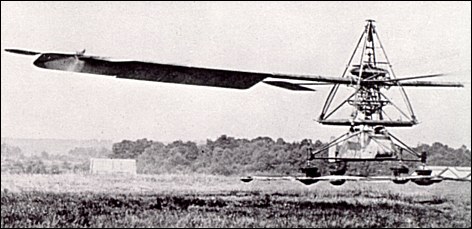
In Great Britain, serious efforts to build a full scale rotary wing machine began in 1916, although design work on the Brennan Helicopter was initiated by Louis Brennan in 1884. At the Royal Air Establishment in Farnborough, England, Louis Brennan conducted experiments on the propeller-driven rotor concept from 1919 to 1926.
The 1360kg empty weight machine used a single 18m rotor. Propellers at the rotor tips produced torqueless rotation and were powered by a 230 hp / 170kW Bentley BR-2 driving transmission shafts that ran down the length of the rotor blades. Compressed air was used to control the rotor pitch angle, through cyclic control.
On 22 December 1921, indoor tethered lift tests were carried out with the assistant engineer, Robert Graham, as pilot.
Outdoor tethered flights took place on 16 May 1924. A year later the Brennan Helicopter was making short flights of 18-27m at heights up to 1.5m. Power was sufficient to lift four “passengers” when tethered, but stability and control were still very poor. Over 80 take-offs were made, but the maximum altitude was only 2.4m and maximum distance only about 183m. On 2 October 1925, during the seventh small flight, the machine lurched at a height of about 1m and the rotors struck the ground, ending the tests.
At this critical time in the helicopter’s development Juan de la Cierva arrived in England with his promising “autogiro” and official interest in the Brennan Helicopter rapidly faded. Finally, in March 1926 funding ceased, and Louis Brennan, at the age of 74, moved on to other inventions.
 All Aero