Centra Tecnico de Aeronautica, established at Sao Jose dos Campos as aeronautical research center in late 1950s by Brazilian Air Ministry; CTA originally had two divisions. A group within the IPD (Research and Development Division), Departamento de Aeronaves or PAR, was responsible for the BF-1 Beija-Flir (Humming Bird) two-seat helicopter, first to be designed, built and flown in Brazil.
Helicopters
Carson Helicopters Inc
USA
Formed in 1963 at Perkasie, Pennsylvania, to develop conversion schemes to improve payload and performance of standard U.S. light helicopters, i.e., Bell 47 and Hiller UH-12. A four-seat conversion of three-seat Bell 47G called the Carson Super C-4 was also produced. Company later became a helicopter overhaul organization and charter operator.
Caribe Doman Helicopter Inc
Puerto Rico
Acquired assets of Doman Helicopters Inc. in August 1965. Tooling began in January 1966 to produce Doman D-10B helicopter; however, rights repurchased by parent company in late 1967, emerging as Berlin Doman Helicopters Inc.
Cardoen, Dr. Carlos Cardoen Cornejo
Another modification of the Bell LongRanger was proposed by Dr. Carlos Cardoen Cornejo of lndustrias Cardoen.
Capital Helicopter C-1 Firefly
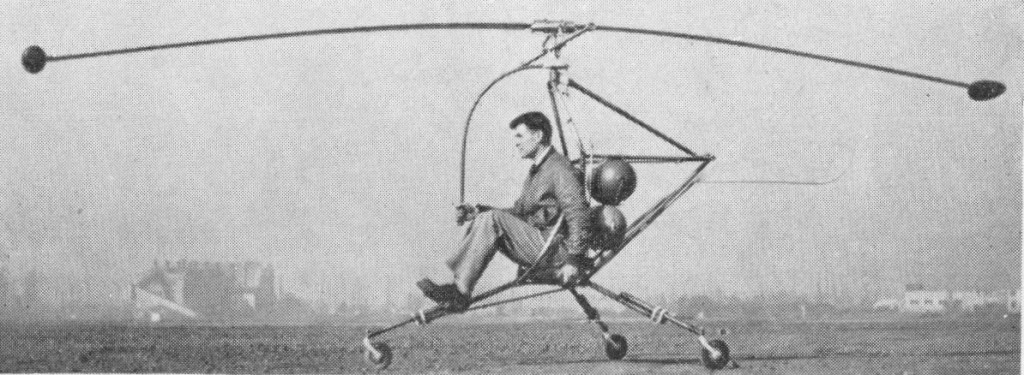
An experimental development of the series of Hoppi-copter personal runabout, designed by Horace Penticost.
Power: 2 x 23 lb. thrust N.R.L. pulse. jets.
Rotor diameter: 18 ft.
Rotors: 2-blade tip-powered main rotor
Loaded weight: 450 lb
Ceiling: 10,000 ft
Typical range: 100 miles at 60 m.p.h.
Seats: 1
Capital Helicopter Corp
USA
Established January 1954 for continued development of C-1 Hoppi-Copter, built previously by Hoppi-Copters Inc. C-1 L, first flown 1954, was a redesigned and simplified version of original 1945 prototype.
Cantinieau C.100

Aerotecnica helicopters goes back to the original research carried out in the early 1950s by Jean Cantinieau in France. Cantinieau, an engineer with Sud Ouest (SNCASO), designed his C.100 in cooperation with M. Decroze. It was an open frame single-seat machine with a triangulated tube structure surrounding the pilot and carrying the engine and rotor installation at its apex above the pilot’s head. The engine was mounted just forward of the rotorhead so as to reduce the extent of mechanical linkages and the C.100 had a three-wheel undercarriage and high-set tubular tailboom structure carrying a small tail rotor. The C.100 made its first of a total of three flights on 10 Novembers-1951 at St. Cyr and performed reasonably well.
Canamerican S.G.VIE / Omega Aircraft Corp Sznycer-Gottlieb SG VI / Sznycer-Gottlieb SG VI
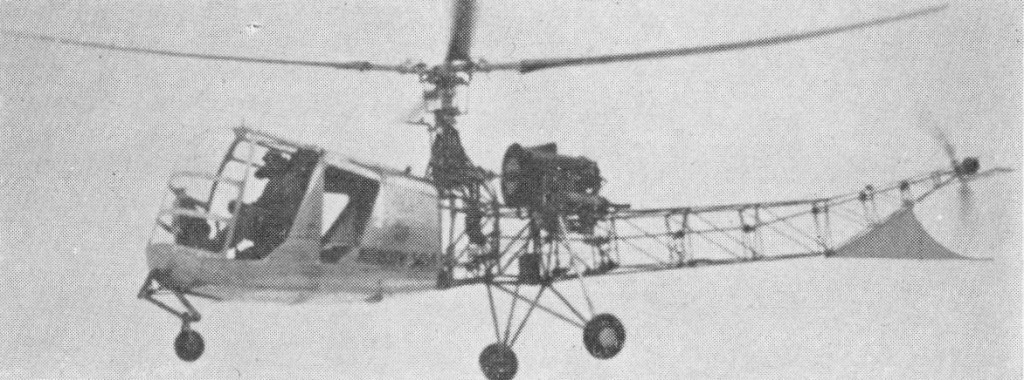
Designed by Bernard Sznycer and Selma Gottlieb as the S.V.IV in 1946, the 1947 Canamerican S.G.VIE was the first helicopter of all-Canadian construction. The prototype was certificated by civil authorities and developed through A, B, C and D versions by Engineering Products of Canada Ltd.
Omega Aircraft Corp was founded 1953 as a subsidiary of Allied Aero Industries for further development of the Sznycer-Gottlieb SG VI helicopter.
The Canamerican company was formed to produce it in the United States, the S.G.VI-E was essentially an improved model of the -D powered by a 200 hp Franklin 6A4-200-C6 engine.
S.G.VIE
Engine: 200 h.p. Franklin 6A4-200-C6
Rotor diameter: 35 ft.
Rotors: 4-blade main; 3-blade tail
Fuselage length: 32 ft.
Loaded weight: 2,550 lb
Cruise: 78 mph
ROC: 760 fpm
Typical range: 200 miles at 78 m.p.h.
Seats: 3
Canadian Vertol Aircraft Ltd
Wholly owned subsidiary of Vertol Aircraft Corporation; formed February 1954 at former RCAF air base Arnprior, west of Ottawa, to repair and overhaul RCAF/RCN Vertol helicopters. Also produced in 1957 small number of Vertol Model 42A, exclusively Canadian civil conversion of RCAF H-21B helicopters used to supply stations of the mid-Canada radar chain.
Canadian Home Rotors Baby Belle Safari
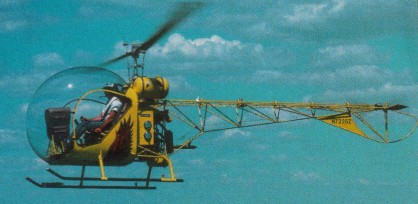
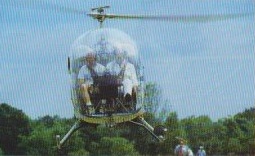
Canadian Home Rotors Inc. (CHR) are the manufacturers of the Safari helicopter. A scaled Bell 47G look alike, that has consist¬ently placed at the top of the custom built helicopter pile. Originally called the Baby Belle, but after objection from Bell Helicopters the name was changed to Safari.
A two seat side by side enclosed helicopter, the 4130 steel tube frame cabin monocoque and boom can be made up in the home workshop while awaiting delivery of the factory built main rotor and tail rotor gearboxes along with the main rotor head and blades. Main rotor is gear driven, tail rotor is shaft driven. Tail boom is steel tube. The main rotor blades are skinned all-aluminium with extruded aluminium leading and trailing edges. Blades are shaped by one solid rib each 6 inches from the root to three feet outboard, then one rib per 12 inches to the tip. Each blade contains 16 ribs. The main rotor flies at 500 rpm, and tail-rotor at a 5.4:1 rpm ratio.
The four foot diameter, 4 inch chord tail rotor blades are stainless steel, with a solid steed spar running out 6 inches from each blade root and wrapped with stainless sheeting to form the airfoil.
The main rotor gearbox includes clutches and engine fan. The cabin bubble is sourced from Nordam Plastics, manufacturers of the original Bell 47 item. The bubble is an actual Bell 47 series enclosure.
A Delta teetering system provides the control. Aluminium castings are used in the swashplate-controlled main rotor system.
The instrument panel carries operational instruments and a main transmission temp indicator and chip detectors for the main and tail rotor gearboxes. Engine, seats and cockpit fittings were generally the items sourced from written off Robinson R22.
Fuel capacity of 28 US gallons is carried in two 14 USG aluminium tanks aft of the cabin.
Skid landing gear is built with 2 inch diameter tubing, the bottom horizontals black anodised.
In 1996 the kit price was US$38,000.

CHR are constantly improving the Safari with experience, including increased service intervals on the main rotor gearbox. Build weight is always slightly different between machines but generally just under 1,000 lbs., which allows a useful load of better than 500 lb. The 12 foot span blades feature an eight inch chord and weigh 40 lb. each.
The Safari is powered by a Lycoming 160 hp aircraft engine, maintaining the highly trustworthy flying abilities of this classic design. Cruising speed is 80 mph with climb rate of 1,000 fpm & an operating ceiling of 10,000ft. Max. speed is 100mph.
A US corporation, CHR International Inc acquired Safari Helicopter. The owners of CHR International Inc., Bobby and Delane Baker, have been involved with Safari for several years. Murray Sweet, one of the original developers of the Safari, was to remain involved with the new company as a technical consultant, as will other long time members of the Safari team.
Much of the production was to remain in Canada, with assembly and flight training continuing in Marianna, Florida. They reduced the dealership requirements in most parts of the world, with positive results.
Engine: Lycoming O-320, 150 hp.
HP range: 150-180.
Disk span: 25 ft 11 in
Rotor Blades chord: 8 in
Disk area: 490.6 sq.ft.
Width 6 ft
Height 8 ft
Length 29 ft 8 in
Weight empty: 920-945 lbs.
Gross: 1450 lbs.
Speed max: 100 mph.
Cruise: 80 mph.
Range: 200 sm.
ROC: 1000 fpm at 45 mph.
Service ceiling: 10,000 ft.
HIGE: 7000 ft
HOGE: 2000 ft
Fuel cap: 28 USG.
Seats: 2.
Landing gear: skids.
Engine: Lycoming O-320, 150 hp
Rotor span: 7.30 m
MAUW: 750 kg
Empty weight: 372 kg
Fuel capacity: 108 lt
Max speed: 160 kph
Cruise speed: 145 kph
Minimum speed: 0 kph
Climb rate: 5 m/s
Seats: 2
Price (1998): $88,500
Plan price (1998): $150
Kit price (1998): $38,430
 All Aero