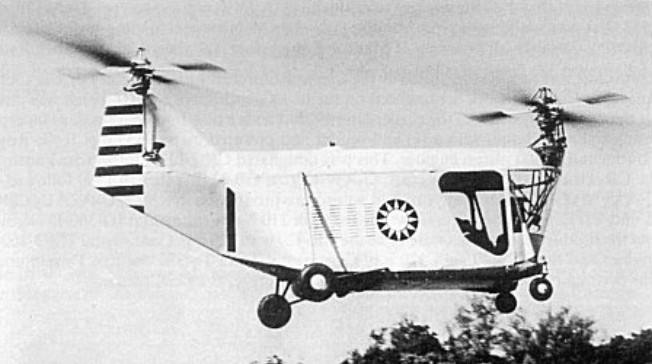
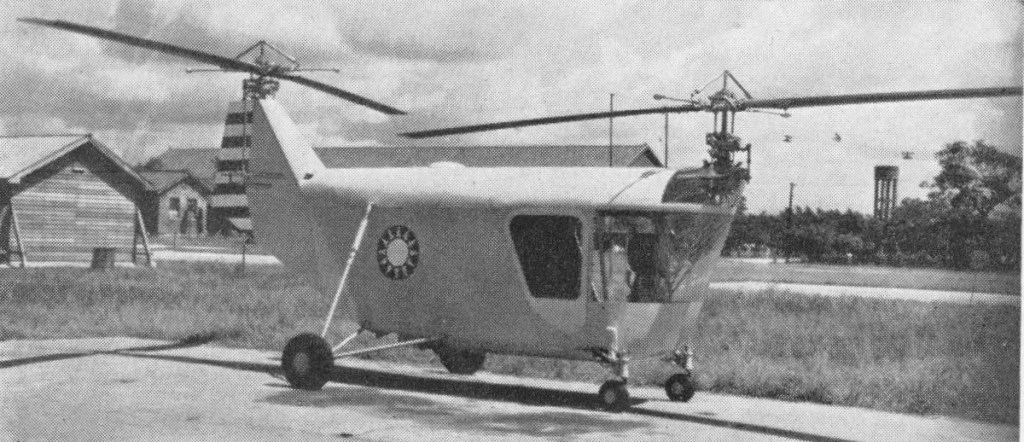
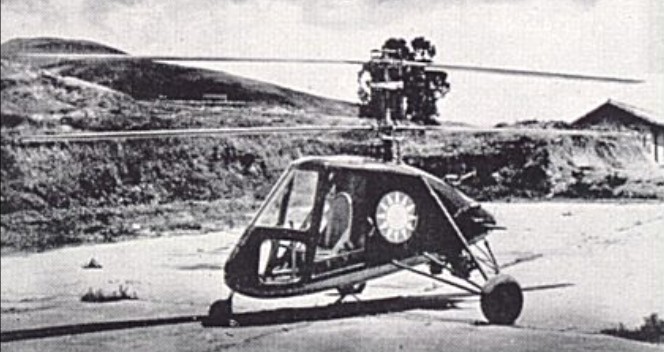
In 1952 Major-General C.J. Chu produced a small tandem-rotor helicopter known as the CJC-3 which was a side-by-side two-seater with a centrally-mounted 190hp Lycoming engine and fixed four-leg undercarriage.
CJC-3 Engine: 1 x Lycoming, 190hp Rotor diameter: 6.47m / 25 ft Overall length: 32 ft. 10 in. Gross weight: 930kg Empty weight: 680kg Maximum speed: 180km/h Cruising speed: 136km/h Inclining climb: 466m/min Ceiling: 3660m / 16,800 ft Range: 216km / 130 miles at 68 m.p.h. Seats: 2
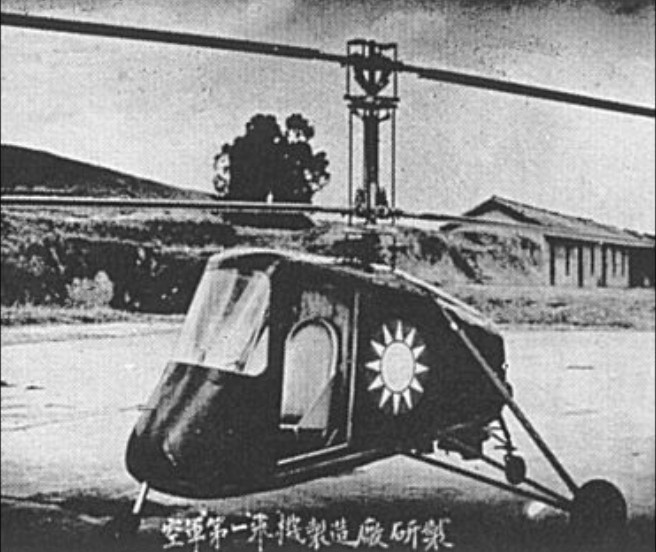
Though the helicopter principle, as is shown by the Chinese top, has been known in China for centuries, the first true Chinese helicopter goes back only as far as 1945. It was produced by Major-General Chu.
G.J.Chu studied aviation technology in the U.S.A, returned to China and was for thirteen years director of an aircraft manufacturing plant at Yunnan, which built various American aircraft and also the Soviet I-15 under licence.
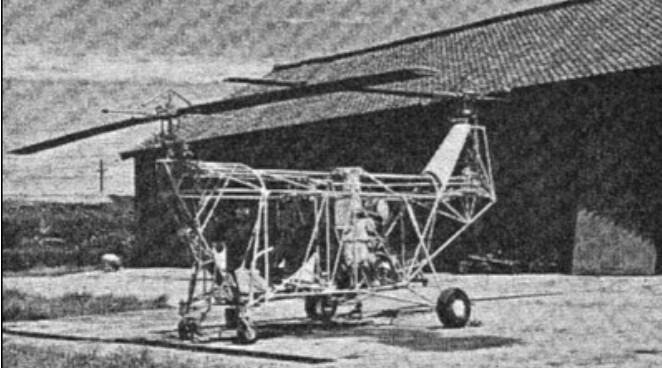
In 1945 C.J.Ghu turned his attention to rotorcraft and designed a co-axial helicopter, known as the Humming Bird Model A. During the tie-down test, the ground screw came off with the rope, the Humming Bird tipped over and both its rotors were broken.
A start was immediately made on building a second version, the Humming Bird Model B.
Chu Humming Bird B
But, as the general tells the story: “Just as it was finished, however, I was sent to Formosa and for a variety of reasons we had to leave the ship on the mainland …”
While in Formosa, Chu became interested in the tandem configuration and set to work again. After eighteen months’ work, the aircraft was ready.
Humming Bird Model B Engine: 1 x Kinner B-5, 125 hp Rotor diameter: 7.62m Width: 2.34m Height: 2.63m Gross weight: 725kg Empty weight: 590kg Maximum speed: 136km/h Cruising speed: 112km/h Inclining climb: 140m/min Hover ceiling: 910m Range: 219km
The CAIC WZ-10 (Changhe Aircraft Industries Corporation / Wuzhuang Zhisheng) is an attack helicopter, with this particular model being produced for use by the People’s Republic of China. The two crew members sit in tandem with the pilot in the rear and seated higher than his gunner at front. Wing stubs provide the ability for the system to wield munitions of various sorts and center around anti-tank missiles. Additionally the WZ-10 is believed to possess anti-aircraft abilities. Standard armament includes a chin-mounted 23mm cannon.
Power is derived from twin turboshafts centering on the Pratt & Whitney Canada PT6C-67C series. These two engines produce 1,531 horsepower each. The systems drive a five-blade main rotor and a four-blade tail unit. The transmission development is based on help from Agusta Westland. In all, the helicopter is believed to be in the same class as modern systems such as the Denel Rooivalk and Eurocopter Tiger and is slated for operational service beginning 2008.
CAIC WZ-10 Engines: 2 x Pratt & Whitney Canada PT6C-67C turboshaft, 1,531hp Main rotor: five-blade Tail rotor: four-blade Length: 46.26ft (14.1m) Height: 12.63ft (3.85m) Maximum Speed: 168mph (270kmh; 146kts) Maximum Range: 497miles (800km) Service Ceiling: 19,685ft (6,000m; 3.7miles) Armament: 1 x 23mm cannon in undernose position Accommodation: 2 Hardpoints: 4 Empty Weight: 12,214lbs (5,540kg) Maximum Take-Off Weight: 13,228lbs (6,000kg)
Development by Chinese Helicopter R&D Institute began in 1991, the Z-11 (Zhishengji-11 / Vertical take-off aircraft 11) appears identical externally to Eurocopter AS 350B Ecureuil except for nose contours, but CHAIG publicity in mid-2001, stated that “China owns its independent intellectual property rights”. Eurocopter (which sold eight Ecureuils to China in 1996) declines to comment on its provenance.
First details officially released at China Air Show in Zhuhai November 1996, together with photographs showing one or two Z-11s in flight, the quoted first flight date of 22 December 1994 is thought to refer to re-engined modification of two secondhand ex-US AStars (Ecureuils) acquired earlier that year. In early 1997, a Chinese government agency announced that the Z-11 had flown for the first time on 26 December 1996.
Technical appraisal was completed in 1996, and small batch production began in 1997. Test programme included flights totalling 1332km in temperatures from —43 to +6°C, including a 2-hour sortie cruising at -38°C. Design was finalised in December 2000, and the Z-11 received CAAC certification in April 2001. CAAC approval for series production for civilian use was announced on 23 December 2002. Power was one 510kW WZ8D turboshaft (licence-built Turbomeca Arriel ID), reportedly produced by Liming engine factory.
Eight said to have been completed by late 1996, of which four had been delivered. All photographs released before late 1998 showed Z-11 in military camouflage with PLA insignia. One report from Aviation Expo China in October 1997 stated that the PLA had ordered 20 military Z-11s, these apparently going to Army Aviation’s training school. Production amounted to ‘several dozen’ by mid-2001, at which time some 10,000 hours flown and 50,000 take-offs and landings. Chongqing Three Gorges General Aviation Airlines (one ordered) reported as first civil customer in mid-2001; China Central Television of Jiangxi Province received one on 25 August 2002.
An armed version, equipped with cannon, ATMs, unguided rockets and a roof-mounted low-light/infra-red sight, has been reported. Later version to be announced is the Z11-MB1, which made its first flight on 7 Match 2003 powered by a 632kW Turbomeca Arriel 2B1A turboshaft.
CHAIG Z-11 Engine: WZ8D turboshaft, 510kW Main rotor diameter: 10.69m Tail rotor diameter: 1.86m Length overall, rotors turning: 13.01m Fuselage length: 11.24m Height over tailfin: 3.02m Height to top of rotor hub: 3.14m Empty weight: 1120kg Max take-off weight: 2200kg Max level speed: 278km/h Cruising speed: 240km/h Hovering ceiling IGE: 5240m Hovering ceiling OGE: 4500m Max range: 600km Endurance: 3 h 54 min
Changhe began producing coaches and commercial road vehicles in 1974. These and other automotive products still account for much of output, but batch-produced helicopters have included the Z-8 and Z-l 1. First flew in December 1985 a heavy commercial/military transport and anti-ship helicopter as the Z-8, based on the French Aerospatiale Super Frelon. More recently developed a small multipurpose single-turboshaft helicopter as the Z-11, first flown 1996 and possibly based in part on Eurocopter Ecureuil. Name changed to Jingdezhen Helicopter Corporation in 1998.
CHAIG (formerly Changhe Aircraft Factory), occupied a 433 ha site at Jingdezhen, had a workforce of more than 10,000 in 1998.
CHAIG is responsible for manufacture of the tailcone vertical fin and horizontal stabiliser of the Sikorsky S-92 helicopter. The tail for the first S-92 was delivered to Sikorsky in May 1997. Changhe is also thought likely to become the centre for any Chinese licensed manufacture of the AgustaWestland A 109E Power, which was the subject of Sino-Italian negotiations in late 2002/earIy 2003.
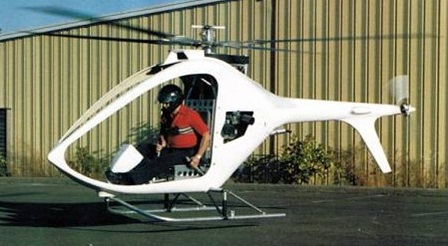
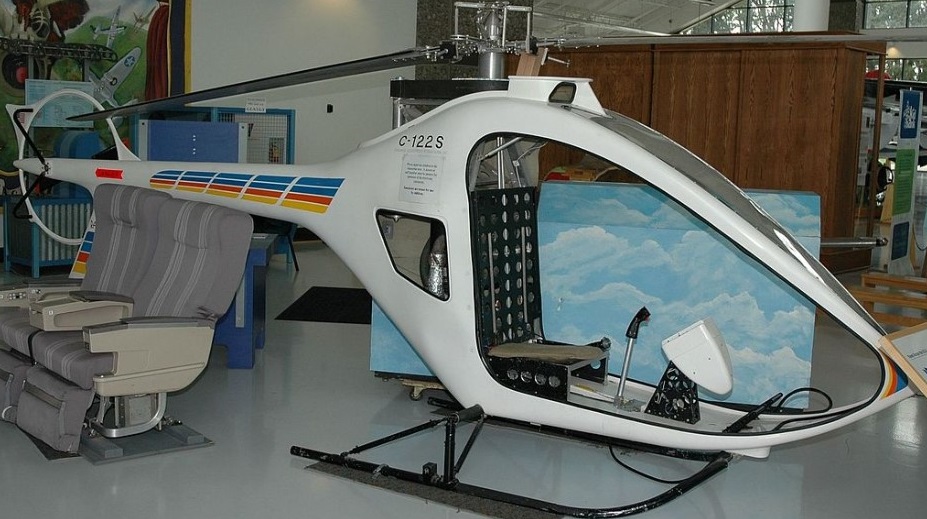
The single-seat C-122 Rainbow helicopter was a design of Russell Chadwick, and was intended to be available in kit form for amateur construction. Powered by a 40 hp Rotax 503 two-stroke piston engine, the prototype started tethered tests late 1985 and was mainly intended as a proof of concept/technology demonstrator.
The design consists of a fibreglass shell enclosing a truss structure to which the engine, rotor mast, landing gear, and pilot’s seat were attached. The skid-type undercarriage could be quickly fitted with wheels for ground-handling, or floats for operations from water.
A prototype was constructed in 1985, and publicly unveiled at the Helicopter Association International annual convention the following year. Flight testing continued through 1987, with deliveries anticipated for that Autumn.
In 1986 Chadwick formed Chadwick Helicopters International, Inc. at Sherwood, Oregon for development, marketing and production of the type in ready-to-fly form. These were to have a longer tail boom, new rotor blades and a tail rotor guard ring, but reportedly only two C-122S machines were built and further development was halted.
Chadwick C-122 Engine: Rotax 503, 40 hp Rotor diameter: 18 ft 6 in (5.64 m) Rotor disk: 268.8 sq.ft (24.97 sq.m) Length (rotors turning): 22 ft 6 in (6.86 m) Length: 19 ft 0 in (5.79 m) Height: 7 ft 2.25 in (2.19 m) Weight empty: 253 lb (115 kg) Weight loaded: 500 lb (227 kg) Max speed: 94 mph (151 kmh) Cruise speed: 74 mph (119 kmh) Climb: 945 ft (288 m)/min Service ceiling: 13,480 ft (4,110 m) Range: 120 mls (193 km) Seats: One pilot
USA Founded as subsidiary of Chadwick Inc. (established 1964 to produce helicopter components and equipment) to produce C-122S single-seat ultralight helicopter (completed 1985), with two-seaters then anticipated.
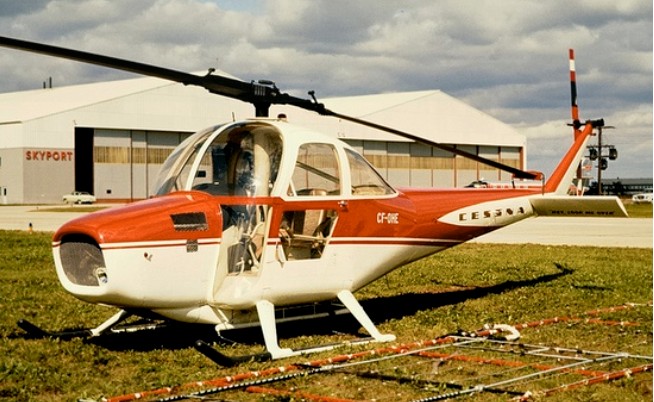
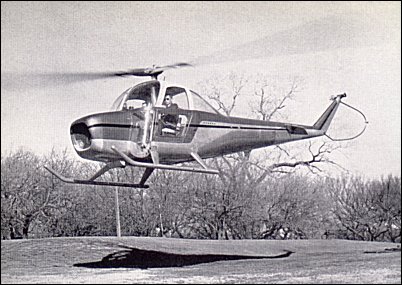
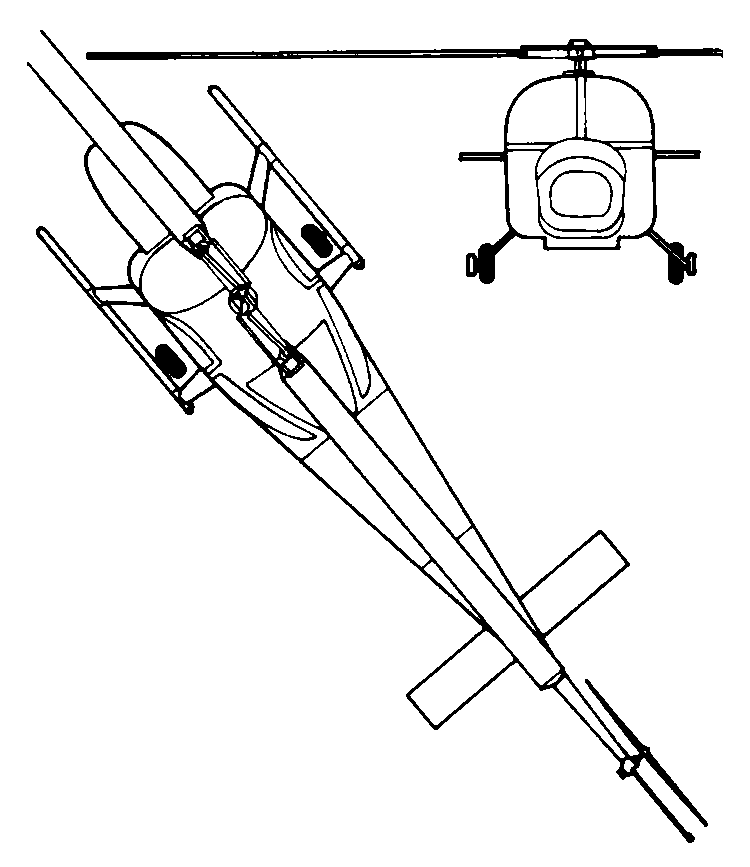
Cessna acquired the patents and rights owned by Seibel, Seibel himself becoming chief designer of the Cessna Helicopter Division. Shortly after its 1952 acquisition of the Seibel Helicopter Company, Cessna undertook development of a light helicopter it designated the CH-1. A test vehicle first flew in July 1953, with a refined model – the CH-1 – airborne a year later. The CH-1 was of all-metal construction, and the two-bladed rotor was designed by Seibel. The rotor blades are attached to the hub by light-weight stainless steel L-shaped angles, which carry the blades’ centrifugal load: the short leg takes up the loads due to blade weight, the long leg the bending load caused by drag. As in the Seibel helicopter, this assembly not only provides angle movement for changing blade pitch but also eliminates trunnions, thrust bearings, hinges, etc. The 260hp Continental supercharged engine is placed in the front of the fuselage driving the two-bladed main and anti-torque rotors via a shaft which passed between the two forward seats. Seating was provided for a pilot and up to three passengers in a cabin.
The first prototype flew in July 1953, receiving FAA type certification in 1955. In 1955 a CH-1 successfully landed on, and took off from Pike’s Peak, Colorado, at a height of 4300 metres. By May 1957 the Skyhook held three world altitude records in several weight classes by climbing to close on 30,000 feet.
Cessna CH-1 Skyhook
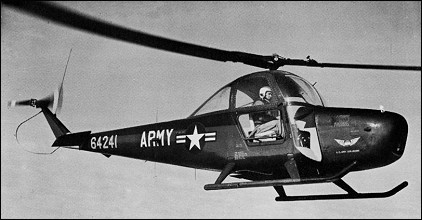
In 1957 the Army purchased ten examples of the advanced commercial model CH-1B for test and evaluation. These machines, serials 56-4236 through -4245, were allocated the designation YH-41 Senecas. Capable of a 90 knot cruise, it could range over 350 miles with an auxiliary tank and lift 800 lbs on the sling.
The Army’s evaluation of the YH-41 showed it to be an excellent high altitude performer, though the type’s limited payload and rather complex maintenance requirements precluded its large scale procurement by the Army. The ten YH-41’s were eventually relegated to miscellaneous flight test duties, most having to do with high-altitude helicopter operations, and in 1962 the surviving aircraft were redesignated NH-41A’s.
In 1960 the Skyhook was introduced to the civil market, becoming the first helicopter to receive single pilot IFR approval from the FAA. Production began in 1961 with three CH-1A (four seat) versions being offered at the same price, US$79,000.00. The price, US$20,000.00 more than Cessna’s most expensive fixed wing single at the time, proved the stumbling block. Competing Hiller E4 and Bell 47J models were available US$10,000.00 cheaper. After several million dollars and a decade of development, Cessna only sold 23 before ceasing production in 1962 and, in an unprecedented move, purchased them all back and scrapped them; a move followed by the United States Army shortly therafter. Only one survives, at the United States Army Museum at Fort Rucker, Alabama.
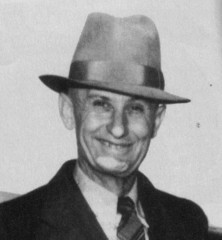
Clyde Vernon Cessna was born in Iowa on December 5th, 1879. His family moved to Kansas when he was two years old, and he grew up on a farm and began helping out as soon as he was able. Clyde had a natural mechanical ability and loved to take equipment apart and reassemble it. Even from an early age, he used his self-taught skills and a natural aptitude to both improve the efficiency of farm equipment and develop better methods of farming. Eventually, Clyde’s love for the mechanical spread to cars, and he became a successful car dealer in Enid, Oklahoma.
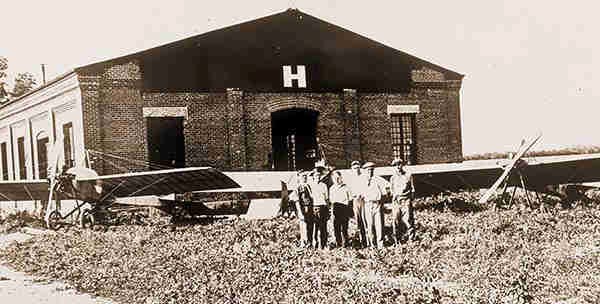
Clyde Cessna built his first aircraft at Enid, Oklahoma, in the spring of 1911. Built and flew several more before moving to Wichita, Kansas, in 1917. Founded Travel Air Manufacturing Company with Walter Beech and Lloyd Stearman on February 5,1925. The Travel Air Manufacturing Company was in es¬sence Waiter Beech, Lloyd Stearman and Clyde Cessna, all backed by Walter P. Innes. In 1926, Stearman quit to go it alone. Cessna followed a year later. Cessna’s bone of contention was that he thought the monoplane was the way to go, while Walter Beech felt there was life left yet in the biplane.
In 1910, Clyde witnessed an aerial exhibition that would dramatically change the course of his life. He was amazed by what he saw at the exhibition and decided to learn everything he could about flying and aviation. Moving to New York, he worked at the Queen Aeroplane Company for a short time, experiencing hangar life and learning how aircraft were constructed. Though Clyde wasn’t there long, he soaked up all the information he could and would use that knowledge to create his first monoplane.
In 1911, finding inspiration from the American version of the Bleriot XI, Clyde created his first monoplane using linen and spruce. This initial creation was known as the “Silverwing,” and was powered by an Elbridge 4 cylinder motorboat motor with 40 hp.
Between 1912 and 1915, he created a number of monoplane designs, all powered by an Anzani 6-cylinder engine, providing between 40 and 60 hp. During this time, he also took to the skies flying for holiday events and county fairs, something which proved surprisingly lucrative. This also earned Clyde Cessna the distinction of being the only man to construct and fly an aircraft between the rugged Rocky Mountains and the great Mississippi River.
In 1916, Clyde acquired a vacant building where he planned to build aircraft for the upcoming 1917 aviation exhibition season. Seeing the demand for aviation growing, he also opened a flight school that ran out of his new factory, quickly enrolling five students. Unfortunately, after the US entered World War 1 in 1917, the exhibition flying market came to a halt, putting a damper on Clyde’s primary source of income. And so he relocated back to his family farm in Kansas and resumed a farming lifestyle.
After WWI ended, there was a huge push for new aircraft and private flying, so in 1925, Clyde Cessna partnered with Lloyd Stearman and Walter Beech to create the Travel Air Manufacturing Company in Wichita, Kansas. Clyde served as the company’s president, and it soon became one of the leading US aircraft manufacturers. This was due in large part to Clyde’s advanced design ideas and the attention brought to their aircraft as the aircraft were used to set a variety of distance and speed records.
Clyde remained with Travel Air Manufacturing Company for 2 years but found his own interests gravitating toward monoplane designs while his partners were more interested in biplane designs. When he proposed a monoplane design without wing struts, his Travel Air associates dismissed the idea, claiming it was folly. This prompted Clyde to resign from the company and build a fully cantilevered wing monoplane on his own. This aircraft, known as the Comet, inspired him to start a new business focused on monoplanes.
Clyde Cessna started the Cessna Aircraft Company on 22 December 1927 in Wichita, Kansas, delivering his self-financed first aircraft on 28 February 1928 to a Pittsburgh customer for $6500. The aircraft was a Series monoplane, which developed into Airmaster and Model 195 series of four-seat cantilever high-wing cabin monoplanes.
Clyde V. Cessna and Victor H. Roos formed a partnership leading to the formation of the Cessna-Roos Aircraft Company on September 8,1927. Roos backed out, on December 22 the secretary of state approved a name change to Cessna Aircraft Company, and on December 31 the Cessna company was incorporated.
In September 1927, Clyde partnered up with aviation entrepreneur Victor Roos to create Cessna-Roos Aircraft. This partnership turned out to be very short-lived and only one month in, Roos chose to resign and sell back his interest in the company to Clyde. Finally in December that year, Clyde was able to drop Roos from the name and the Cessna Aircraft Company was born.
Clyde continued to perfect his monoplane design which included enclosing the cockpit. In late 1927, the company released the AW model, followed by the CW-6 which flew in 1928, and the DC-6 in 1929.
Production of “A” series (again with cantilever wings) began 1928, as did BW three-seater. Built DC-6 prototype 1929, followed by four-seat DC-6A and 6B.
Cessna tried to keep factory functioning during the Depression, producing 300 CG-2 primary gliders, but finally had to close in 1931.
In 1929, Clyde began collaborating with his son Eldon on the CR series of racing aircraft. However, the Great Depression hit and even though the company was able to keep its doors open longer than most, the Cessna Aircraft Company eventually declared bankruptcy and closed its doors in 1931.
Though they closed the company, Clyde and Eldon started a new business building custom racing aircraft for few years.
In 1934, Clyde’s nephew’s, Dwane and Dwight Wallace approached him with a plan and persuaded him to reopen the company and take control once more. The pair contacted all of the Cessna Aircraft Company stockholders and let them know that if they allowed Clyde to come back as president and resume construction of aircraft, then they and Clyde would all work for free until the company began to show a profit. After being forced out of the company in 1931, Clyde is re-instated as president January 17, 1934. Clyde returned to his role as president, with Dwane Wallace serving as the general manager at the young age of 23.
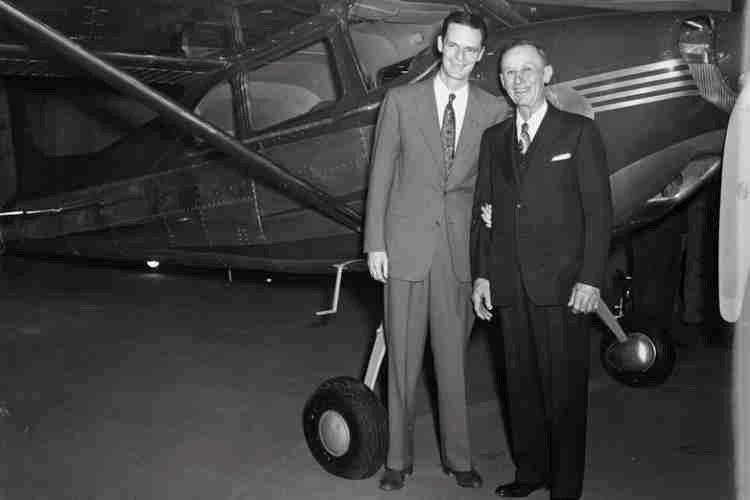
Dwane Wallace and Clyde Cessna
It’s not known exactly why, but whether because of a family dispute, a lack of interest in working for free or some other reason, Eldon did not rejoin the company and instead moved to California where he began working as a design engineer for first the Douglas Aircraft Company, then North American Aviation, and finally Rockwell International. During this period, he helped with the designs for both the P-51 Mustang and the F-86 Fighter Jet.
Finally, in 1936, Clyde Cessna retired from the aviation business, selling his interests to his nephews and returning to a life of farming. During his two-year return from 1934-36, it is said that Clyde had served more in a ceremonial capacity and stayed out of the day to day functioning of the company.
Factory reopened 1934, but Clyde sold his interests and company continued to be run by his son, a nephew, and T. Salter. Went on to develop highly successful Airmaster series and in 1939 the first Cessna twin, the T-50 five-seat cabin monoplane. Latter built in large numbers including nearly 1,200 Crane trainer versions for the RCAF. Adopted also by USAAF, U.S. Army and Navy, and over 5,000 produced during Second World War, serving in all theaters. After the war Cessna began building light aircraft for private and business use. The most successful early models were Models 140 and 170, plus later Models 172, 305,180, and others which became world renowned. Model 305 used widely for liaison duties during Korean War and later as L-19/OE-1 Bird Dog (over 3,500 built). In 1952 Cessna acquired the Seibel Helicopter Company and the CH-1 four-seat helicopter was developed and built in small numbers.
1958 Cessna production included (from top to bottom) Model 310B, Skylane, Model 182, and Model 172.
In 1960 Cessna affiliates itself with Reims Aviation, S.A., Reims, France, and acquires McCauley, a manufacturer of propellers and other aircraft components.
In 1978, Clyde Cessna was posthumously inducted into the National Aviation Hall of Fame, and Flying Magazine placed him at number 27 on their list of “51 Heroes in Aviation.”
In 1972 Cessna became the world’s first company to have produced 100,000 aircraft. Production has included nearly 2,000 twin-engined jet trainers and A-37 strike aircraft for the U.S.A.F. and U.S. Military Assistance Program. Company’s Pawnee and Wallace divisions taken into Aircraft division in 1984, but company sold to General Dynamics in 1985 and then to Textron Inc in 1992. In July 1996 Cessna Single Engine Piston Facility opened in Independence, Kansas, to reintroduce production of single-engined light aircraft to Cessna range. Available Cessna aircraft were Cessna 172R and 172SP Skyhawk four-seat lightplanes as much refined versions of previous Skyhawk, four-seat 182S Skylane as refinement of previous Skylane versions, six-seat 206H Stationair and T206H Turbo Stationair as refinements of previous versions, 208 Caravan (first flown 1982) as single-turboprop commuter, business and cargo aircraft (among other uses) offered in four civil versions plus as U-27A for U.S. foreign military sales, and a range of business jets as six/seven-seat Model 525 CitationJet (first flown April 1991), nine/12-seat Model 550 Citation Bravo (first flown April 1995), nine/ten-seat Model 560 Citation Ultra and latest Ultra Encore (latter first flown July 1998), eight/ten-seat Model 560-XL Citation Excel (first flown February 1996), 15-seat Model 650 Citation VII (first flown February 1991), ten-seat Model 680 Citation Sovereign (for certification in year 2002), 11/14-seat Model 750 Citation X (first flown December 1993), CJ1 (for delivery from year 2000 as successor to CitationJet), and eight-seat CJ2 (to fly 1999).
On 27 November 2007, Cessna purchased Columbia Aircraft from bankruptcy for US$26.4M including its Columbia 350 and 400 line
Blanket title: Czech Automobile and Aircraft Works, National Corporation, covering all national manufacture from 1945 until mid-1950s. The Zavody Letecke (aircraft works) incorporated the former Aero, CKD-Praga and Letov factories, plus Walter (engines), while Avia, Mraz and Zlin plus the Skoda car works came under Zavody Automobilove. Built under license several Soviet types (llyushin 11-14 and -28, MiG-15). Czech designations for MiG-15 were CS-102, S-103; 11-14 built as Avia 14. Early indigenous products included theTom-8 (or L-208) two-seat trainer; L-40 Meta- Sokol four-seat light trainer/tourer; L-60 Brigadyr three/four-seat light STOL monoplane; Zlin 226 Trener and 326 Trener-Master; Aero 145 and Super Aero; L-200 Morava four/five-seat twin-engined air taxi/business aircraft; and HC-2 Heli-Baby and HC-3 light helicopters.







 All Aero