Cierva W.11 Air Horse

In September 1945 Pest Control Ltd had discussed the last possibility with Cierva and the W.11 design was modified to meet this role. As a result, Cierva received a development contract for one W.11 in July 1946, drafted to Specification E.19/46, and a second was ordered in early 1947. Cunliffe-Owen Aircraft Ltd were contracted to build the two aircraft at Southampton/Eastleigh Airport under the technical and financial control of the Cierva company.
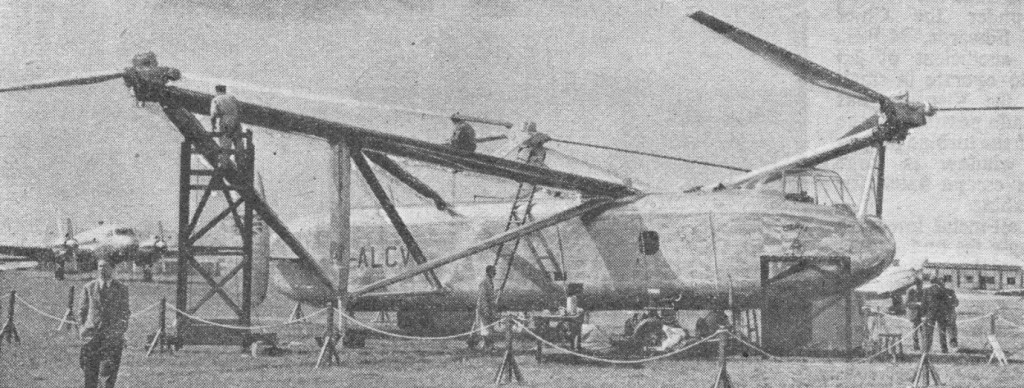
1948

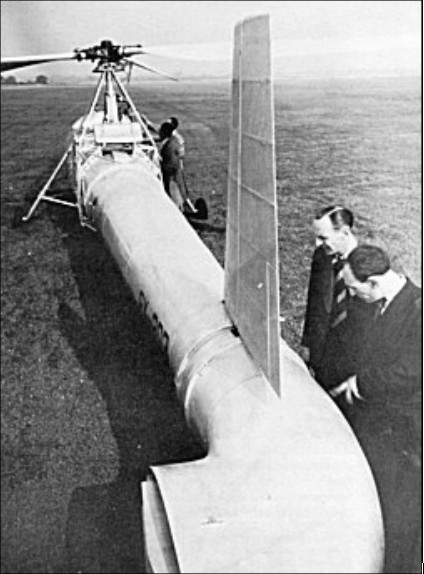
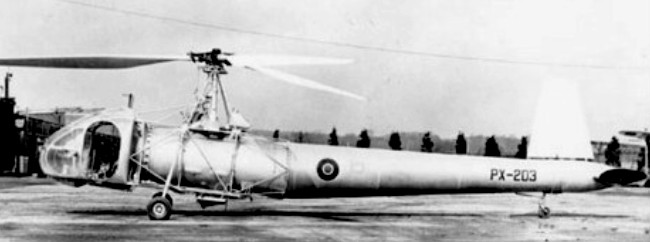
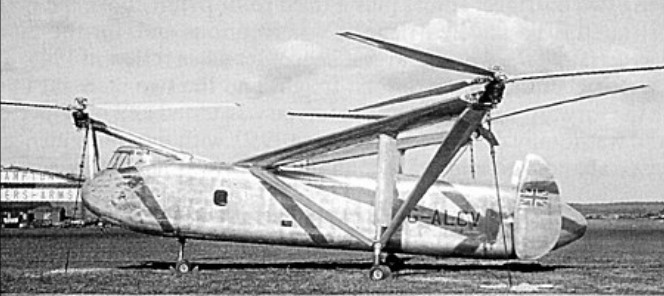
The Cierva W.11 Air Horse, built in 1948, featured three tri-bladed rotors mounted on outriggers from the fuselage and driven from a centrally-installed engine. Two prototypes were built for the British Ministry of Supply.
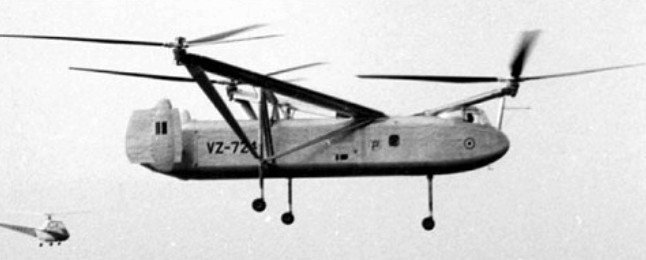
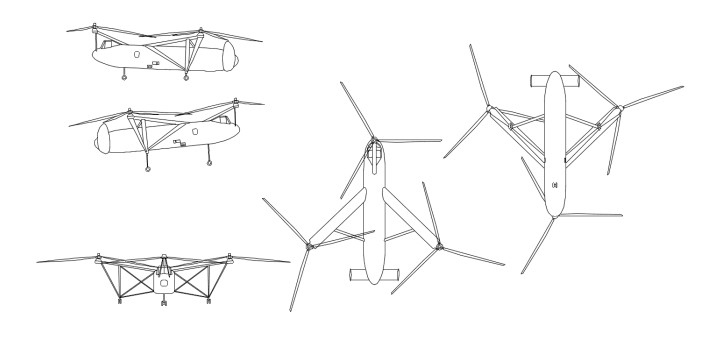
Power from a single Rolls-Royce Merlin 24 engine of 1208kW was transmitted through shafting to three-bladed rotors mounted on outriggers, each at the tip of a triangle. All three turned in the same direction, but their plane of rotation was sufficiently tilted to compensate for torque. Each rotor hub had a control spider which ensured cyclic and collective pitch control. The engine with its distribution gearbox to drive the rotors was situated just behind the cockpit in the fuselage. The fuselage was designed to carry twenty-four passengers in a compartment measuring 5.79 x 2.31 x 1.77 metres.

There was a tricycle landing gear, each leg of which was fitted with an oleo-pneumatic shock absorber. Twin fins were carried at the end of a mid-mounted tailplane on the rear fuselage and there was accommodation for a crew of three.

The prototype, the largest in the world at that date, made its maiden flight on 7 December 1948, but shortly after being displayed at the Farnborough Show it crashed, and work did not start on it again until the Gierva Company was taken over by Saunders Roe.

The Colonial Office made a grant of GBP45,000 to assist in the development costs since the type offered prospects of overseas use in the spraying role (total Ministry of Supply development costs were estimated at GBP350,000), but before the second W.11 had flown the first crashed on 13 June 1950, killing the three flight test crew members; the second W.11 never flew and was scrapped in 1960. The designation W.11T was allocated to a project for an enlarged W.11 with two 1208kW Rolls-Royce Merlin 502 engines and the W.12 was a projected freighter development with Rolls-Royce Dart turboprops. Neither of these materialised since by that time Cierva, not having used the number W.13, was involved in development of the W.14 which became the Skeeter and was built by Saunders-Roe Ltd.

Cierva W.11
Engine: 1 x Rolls-Royce Merlin 24, 1208kW
Rotor diameter: 14.33m
Length with rotors turning: 27.0m
Width with rotors turning: 28.96m
Max take-off weight: 7938kg
Loaded weight: 5507kg
Max speed: 225km/h
Cruising speed: 153km/h
Service ceiling: 8535m
Range with max fuel: 531km
Crew: 4-5
Passengers: 24
Cierva W.9 / Weir W.9

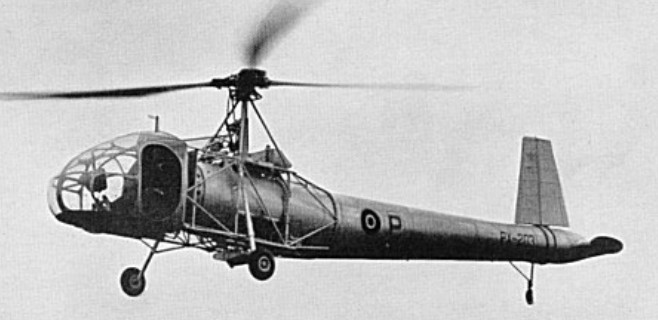
The W.9 was an experimental helicopter to E.16/43, with a three-blade main rotor. Torque compensation was achieved by a jet of air discharged from the port side of the rear fuselage and supplied by a fan which also cooled the engine. The jet was controlled by two vanes. The air from a multi-bladed fan which cooled the engine was ducted through the inside of the fuselage, heated by the exhaust gases and then ejected through an opening on the port side. Two horizontal shutters controlled the flow of this air. The controllable efflux was also used to impart turning movements to the rotorcraft, which had neither fin nor rudder. The multi-bladed variable-pitch fan was coupled to the rudder pedals and thus provided yawing control.

First flown in 1945, only one was built.

W.9
Engine: 1 x Gipsy Six Series II, 155kW
Main rotor diameter: 10.98m
Max take-off weight: 1200kg

Cierva

Juan de la Cierva was born in Murcia, Spain on September 21, 1895, and by 1908-9, had decided to make aviation his career. In 1911 he enrolled at the Civil Engineering College of Madrid (Caminos, Canales y Puertos) and in 1912 with his friends “Pepe” Barcala and Pablo Diaz constructed the first Spanish airplane, the BCD-I, known as “EI Cangrejo” – the “Red Crab”, becoming the “Father of Spanish Aviation.”

By the mid 1920s Cierva’s success became known worldwide, and he was invited to Britain to demonstrate his machines to the Air Ministry.

Transferring operations to England in 1925 and forming Cierva Autogiro Ltd. on March 24,1926 with prominent Scottish industrialist James G. Weir, his brother Viscount William Weir of Eastwood and Sir Robert M. Kindersley, Cierva continued to improve the Autogiro and in early 1929 licensed the technology and rights to his patents to Harold Frederick Pitcairn of Bryn Athyn, P A. Early models of which were based on surplus Avro 504Ks. British, French, German, American, Japanese and Russian companies built Cierva type autogiros.

Two best known craft were C.8L, first rotorcraft to fly the English Channel, and C.30A, built by A. V. Roe as Rota for RAF. Production of other Autogiros licensed by Cierva to Airwork (C.30, C. 30P); Avro (C.6, C.8, C.9, C.12, C.17, C.19, C.30A, C.30P); British Aircraft Manufacturing Co (C.40); Comper (C.25); de Havilland (C.24, C.26); George Parnall & Co. (C.10, C.11); and Westland (CL.20).

Weir formed a separate company (G. & J. Weir Ltd.) in 1933, and reestablished Cierva Company in 1944.

In 1936, Cierva was killed in the Croydon KLM airliner accident when the aircraft in which he was a passenger crashed after taking off in fog. From 1936 to 1939 James Allan Jamieson Bennett was Chief Technical Officer of the company. Dr. Bennett carried through with Cierva’s intention to offer the Royal Navy a gyrodyne, which Cierva had argued would be simpler, more reliable and efficient than the proposed helicopter. Bennett’s design, the C.41, was tendered to the Air Ministry (Specification S.22/38) but preliminary work was abandoned with the outbreak of World War II. Bennett joined Fairey Aviation in 1945, where he led the development of the Fairey FB-1 Gyrodyne.

After Second World War evolved (jointly with above company), the W.9, a two-seat helicopter using jet thrust to counteract torque. The W.11 Air Horse three-rotor design was built for Cierva by Cunliffe-Owen; designed specifically for crop-spraying, it was first flown December 8,1948. The first prototype of the Air Horse crashed killing Alan Marsh, Cierva’s manager and Chief Test Pilot John “Jeep” Cable, Ministry of Supply Chief Helicopter Test Pilot, and J. K. Unsworth the Flight Engineer. This led Weir to cease further investment in the company and its development contracts were transferred to Saunders-Roe.

The W.14 Skeeter, small two-seat helicopter, first flown October 8,1948. Both designs taken over in 1951 by Saunders-Roe, together with other Cierva projects. Company then concentrated on research; eventually reemerged as Cierva Rotorcraft Ltd, and bought up Rotorcraft Ltd. in April 1966 and Servotec Ltd. in 1968.The prototype CR.LTH-1 flew October 18,1969, but was not produced due to lack of funds.

J.Weir maintained a working association with J.S.Shapiro, and in 1961 63 Servotec built a man carrying helicopter model to embody Weir’s ideas of a non stalling rotor, which emerged from many years of model tests. In the course of this collaboration, Weir became aware of the CR Twin development and in 1965 decided to give this development financial support. This combination of interests was cemented in a take over of Rotorcraft Ltd by the Cierva Autogiro Co, which was thereupon renamed the Cierva Rotorcraft Co. The largest shareholders were Weir and Shapiro.

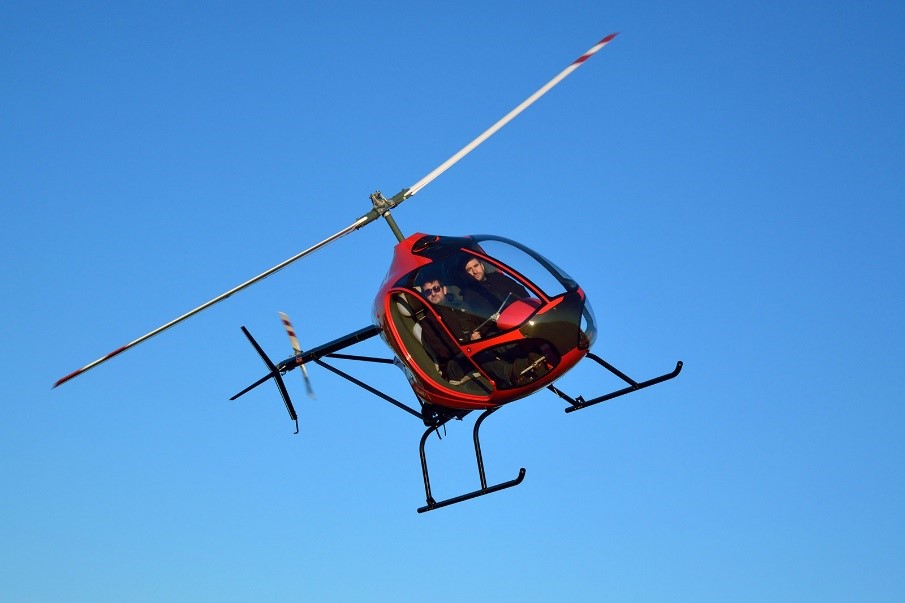
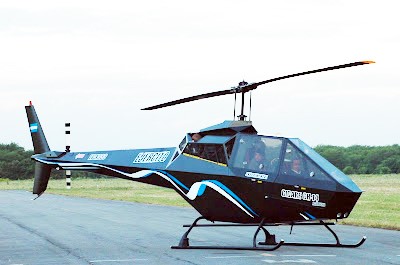
Cicaré CH-8       

Cicare CH8

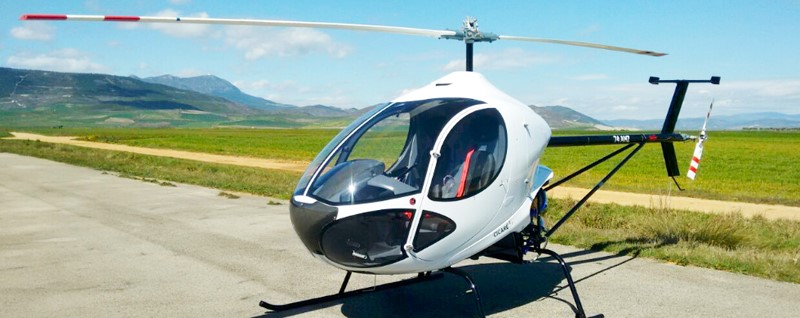
The objective of this project was to develop a two seat helicopter that fitted the ULM category, based on the platform of the Cicaré 7B and 7T, also to be sold as a kit.

The Cicaré 8 is built with aeronautical SAE 4130 chrome molybdenum steel and welded in spatial reticulated configuration and the cabin is a semi-monocoque made of composite carbon fiber and epoxy resin. The T-Shaped stabilizerhas a semi-monocoque type structure, built entirely in AL-2024 T3 and AL6061 T6.

Based on the ROTAX 900 series, with improved performance and features, the EPA POWER 917 is a block of Rotax engine with dual injection and carbon fiber components, which ensure a reliable and safe flight.

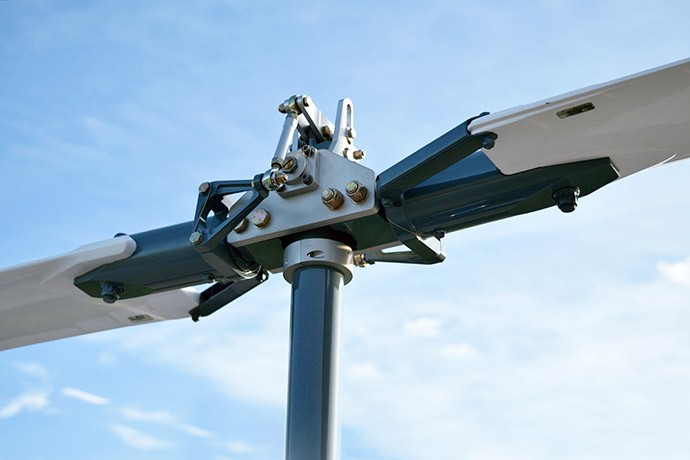
A semi-rigid, simple and optimum rotor, which is reflected in a soft and highly controllable helicopter. One highlight of the Cicare helicopters is the command system that was designed and patented by Augusto Cicaré under US PATENT: 5.165.854

The system ensures a smooth and seamless linkage between the engine and the transmission, allowing a gradual engagement which is almost imperceptible to the passengers in the cabin.

The kit price in 2021 was USD 121.500.

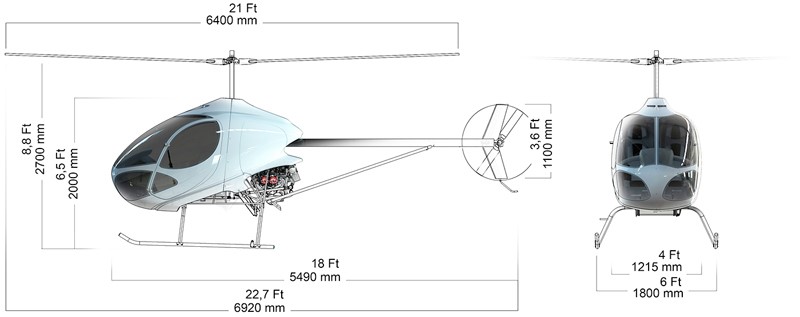
Engine: EPA R917 Ti, 135 hp
Empty Weight: 280 Kg (620lb)
MTOW: 480 Kg (1060lb)
VNE: 194 Km/h
Cruise speed: 150 km/h
Climb rate: 7 m/s / 1400 ft/min
Service Ceiling: 4500 m
Fuel: 95 octane
Endurance: 2,5 hrs

Cicaré CH-7       

Augusto Cicare CH-7B

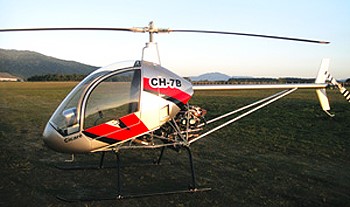
The Cicare CH-7B is yet a further refinement of the CH-7 single seat kit helicopter designed for sport and recreational use.

Flying the Cicaré CH-7 Angel

It is an evolution of the Ch-6 and CH-7 Angel helicopters with a notable increase in performance with the new refined version having been repowered with the Rotax 912 ULS 100HP four stroke engine adding to endurance, performance and reliability.

The CH-7B helicopter also features minor cabin changes along with engineering improvements. Quality Aeronautical components are used throughout its construction.

Augusto Cicare CH-7 2000VL

In 1996 Augusto Cicare created the Cicare CH-7 2000VL. It was later presented to the public in 2010.
This was an ultralight helicopter with two separate and independent engines that can land with only one of the engines operating, thus giving greater security and minimizing risks from engine failure during flight.

CH-7B
Powerplant: Rotax 912 uls (100 hp)
Empty Weight: 250 kgs (550 lbs)
Gross Weight: 430 kgs (950 lbs)
Vne: 105 kts / 194 kmh / 120 mph
Cruise Speed: 80 kts / 150 Kmh / 94 mph
Climb Rate: 7 m/s / 1380 ft/m
Service Ceiling: 3500 m / 11,500 ft
Endurance: 2.5 hrs

Cicaré CH-14 Aguilucho

The Augusto Cicare CH-14 light two-seat tandem helicopter development began in January 2005 under an Argentine Army request in conjunction with CITEFA, La Plata University and Army Aviation Maintenance Batallion.

First revealed Nov 23, 2007 during the Army Aviation Day and is intended to be used in both civilian and military applications.

Powerplant: Rolls Royce Allison 250-C20-B, 420 hp
Maximum Continuous Power: 370 hp
MTOW: 1450 kg
Empty Weight: 750 kg
Useable Load: 700 kg
Vne: 240 km/h
Cruise Speed: 210 km/h
Range: 630 km
Climb Rate: 8 m/s
Service Ceiling: 4500 m

Cicaré CH-12     

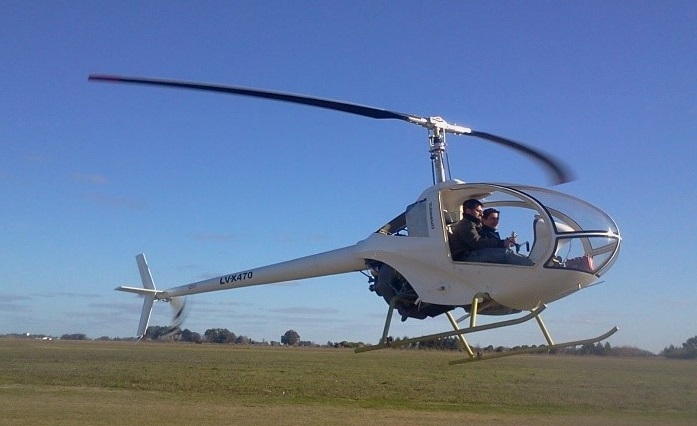
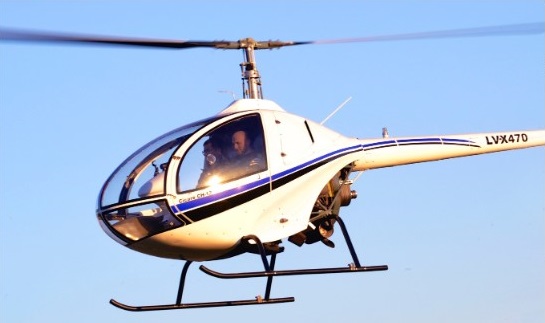
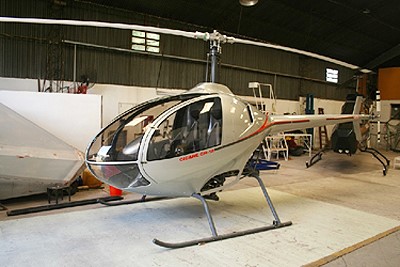
The Cicaré CH-12 side by side seat helicopter is built in the Argentne Republic, for private and recreational use. This particular design seems to incorporate the traditional style of helicopter swash plate along with a new composite cabin and tail boom.

It is equipped with a Subaru EJ25 engine, however it has been designed to also accept a Lycoming O-360.The airframe is made of SAE 4130 steel tubes. The skids are made of SAE 4130 steel tubes and aluminium.

The main and tail rotors are with composite blades. The vertical and horizontal stabilizer are aluminium and the cabin is composite. Dual controls are standard and two fuel tanks are fitted.

CH-12
Engine: Subaru EJ25 or Lycoming HIO-360- G1A
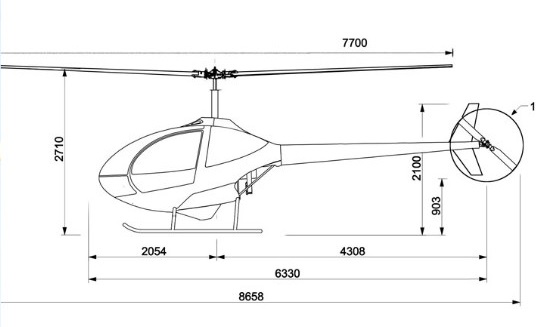
Rotor diam: 7,70m
Height: 2,71m
Width: 2,20m
MTOW: 700 Kg (1540 lbs)
Empty Weight: 430 Kg (946 lbs)
Maximum Speed (VNE): 205 Kmh (128 mph)
Cruise Speed: 160 kph (100 mph)
Climb Rate: 7 m/s (1380 ft/m)
Service Ceiling: 3500 m (11,500 ft)
Endurance: 3.0 hr
Seats: 2
Fuel: AVGAS 100LL

Cicaré CH-1

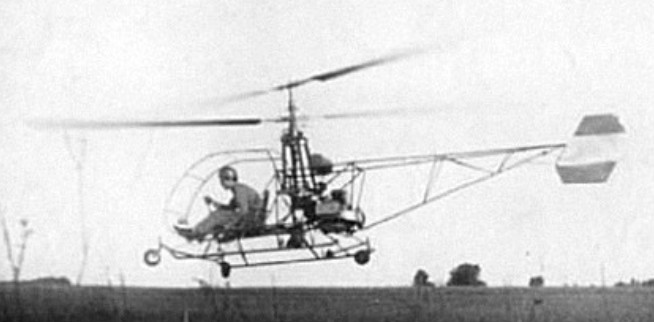
The first (1961) helicopter designed and built by Augusto Cicare is a single-seat single-engine with two counter-rotating coaxial rotors. Each rotor has two blades. The cyclic control varies the inclination of the rotors axis. The airframe is made of steel tubes. The four stroke, four opposite cylinders engine was also designed and built by Augusto.

Cicare CH-1
Engine: 1 x Cicare 4-cylinder air-cooled piston engine, 45kW
Rotor diameter: 6.0m
Length with rotors turning: 6.80m
Height: 2.15m
Width: 1.60m
Max take-off weight: 330kg
Empty weight: 225kg
Max speed: 129km/h
Cruising speed: 95km/h
Hovering ceiling, OGE: 1500m
Crew: 1

Cicaré, Augusto / Cicaré Aeronautica / Cicaré Helicópteros

Founded by Fernando Cicaré in 1972 in Argentine, Cicaré Helicópteros S.A. (originally Cicaré Aeronáutica S.A.) is an Argentine helicopter manufacturer.

From late 1960s Cicare designed and built the Cicare I and II experimental light helicopters. Followed September 1976 by C.K.1 (originally CH-III) two/three-seat light helicopter for training and agricultural use, aimed mostly at the South American market.

A number of prototypes were constructed, including one under contract from the Argentine Air Force, but no great successes were achieved until the CH-7 light sporting helicopter in the 1990s. In March 2007 the first prototype of Cicaré CH-14 a light helicopter for the Argentine army was ready.

On March 18, 2010 they presented the CH-7B and CH-12 during the EAA Argentina Annual Meeting.