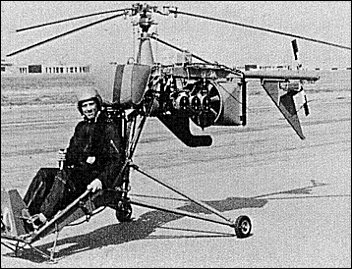
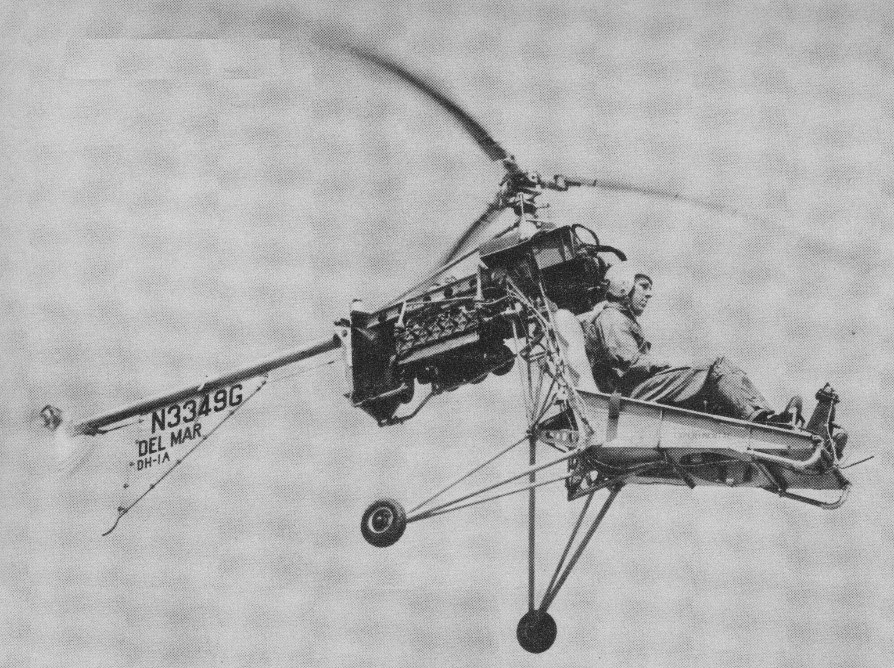
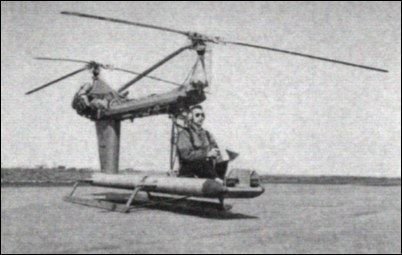
Del Mar Engineering Laboratory was a weapons system support and training systems designer/manufacturer of Los Angeles, California; produced a series of very original experimental ultralight helicopters from 1940, as well as a helicopter training system. Production ended by 1974.
USA A weapons systems support and training systems designer/manufacturer of Los Angeles, California; produced a series of very original experimental ultralight helicopters from 1940, as well as a helicopter training system. Production ended by 1974.
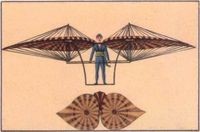
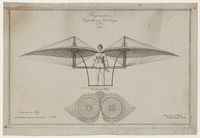
Ornithopter built by Jakob Degen – a Swiss watchmaker living in Vienna – first drafted and published in 1807. Degen made his earliest somewhat successful flights by using a counterweight to assist his lift, indoors at the Winter Riding School of the Spanish Riding School in Vienna on April 18, 1808. That same year, on November 13 and 15, he gave two outdoor performances with his Flying machine at the Wiener Prater using a small hydrogen-filled balloon to aid his ascensions. Later on over the years, three times Degen staged his performance in Paris and is also known to have visited Berlin with his apparatus. These attempts generally resulted in complete failure accompanied with personal injury.
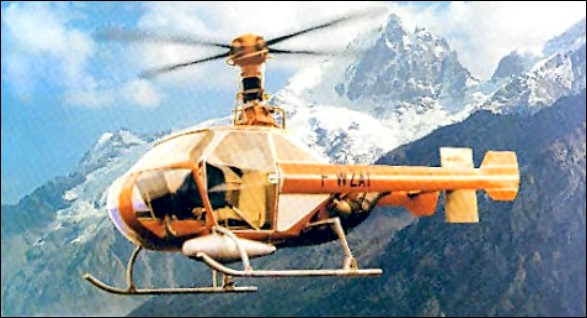
The Hélicop-jet was an original design helicopter of Mr. Charles Déchaux and employed the so called pressure-jet principle (compressed air from turbine engine was channelled to exhaust nozzles at the tips of the rotor blades and extreme tail). The aircraft had a rotor as used in the Sud Aviation SO-1221 Djinn and also featured a twin tail boom configuration and used cabin doors of the Panhard PL-24c car.
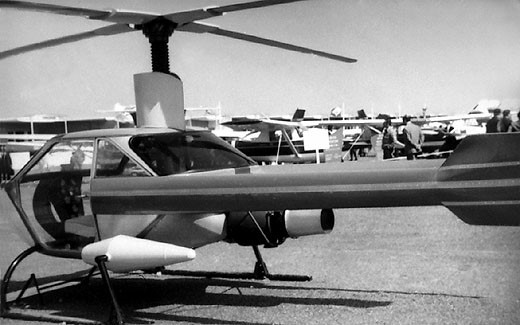
A full-size model was exhibited at the 1969 Paris Air Show.
mock up in Salon du Bourget 1969
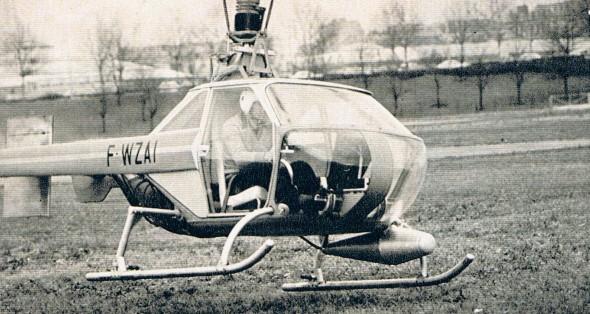
The first example of the Hélicop-jet, F-WZAI, had one 250-260hp Turboméca Palouste IV turbine and it made the first flight in December 1976 at the Issy-les-Moulineaux heliport with Mr. Heurtau, technical director of Héli-Union at the controls.
Trials with this first aircraft showed that only the pilot could be lifted.
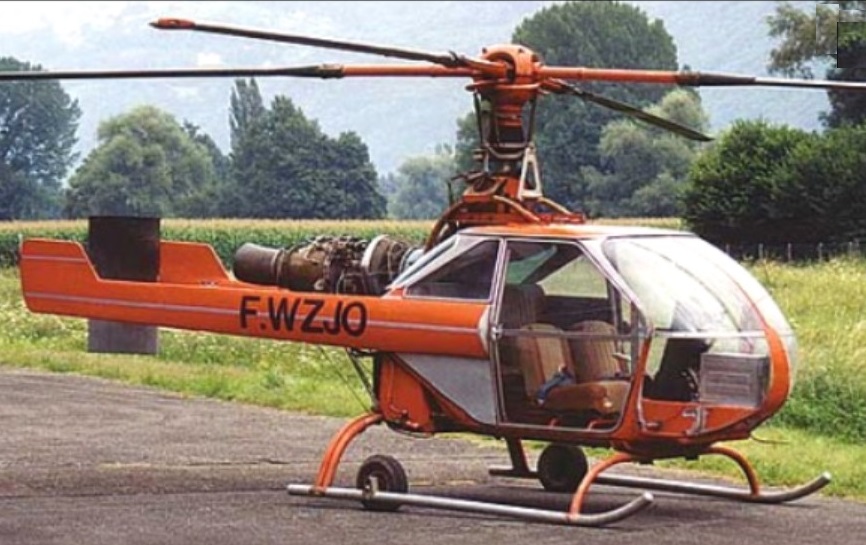
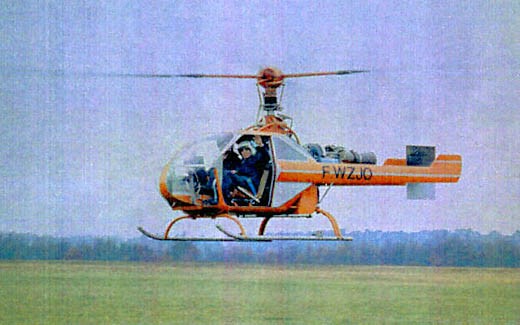
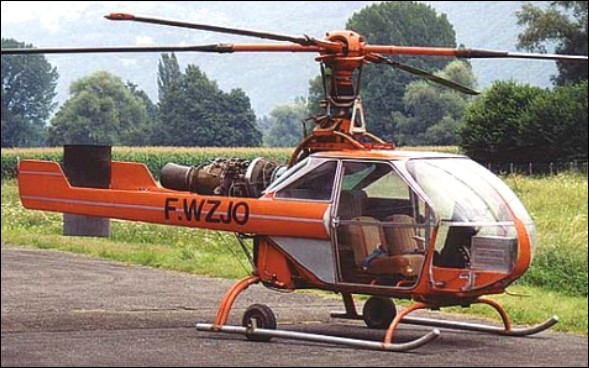
The second prototype, F-WZJO made its maiden flight on December 12, 1984, still in Issy-les-Moulineaux. This time it is equipped with a Turbomeca Astazou IIIA 600 hp turbine and a more rounded windshield.
Tests continued at La Ferté-Alais, under the direction of engineer Jean Richard and piloted by Philippe Fouquaux. As with the first prototype, the second seemed largely underpowered. The tests of no 2 ceased in 1985.
Hélicop-Jet Project Management Co was formed in Montreal in 1984 with the objective the production of a helicopter derived from the Hélicop-Jet, without success. Plans for versions with Turboméca TM.319, P&W PT6 and Allison 250 turbine engines were abandoned.
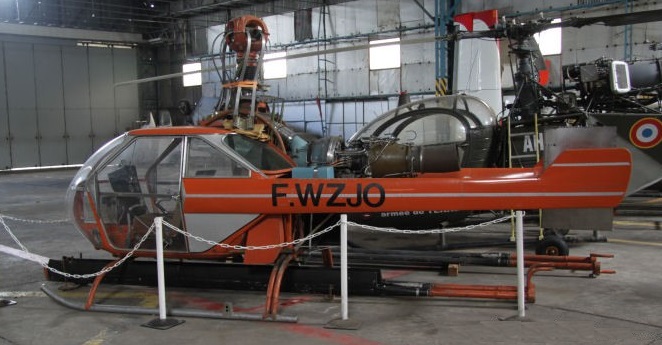
The prototype no 2 was given to CELAG (Center for Studies and Leisure Aerospace Grenoble) in July 2001. Since July 2007, it has been exhibited in the collections of the Lyon-Corbas Aviation Museum. This prototype arrived at the CELAG on July 25, 2001, after a long period of immobilization at Ferté-Alais, where it had been stored by 1985. It was in excellent state, and almost complete.
No 2 prototype, F-WZJO Engine: Turbomeca Astazou IIIA 600 hp Rotor diameter: 10.08 m Number of blades: 4 Fuselage length: 5.30 m Height: 2.72 m Empty weight: 450 kg MTOW: 1060 kg Cruise speed: 200 km / h Range: 450 km Seats: 4
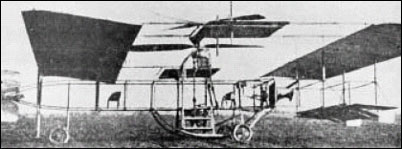
Around 1902, Viscount Decazes and G. Besancon had conducted tests of a 6m diameter vertically mounted propeller in Paris for a planned concept that would have used two of these vertical thrusting propellers, in addition to fixed wings and a propeller for forward thrust. The “rotor” tested produced 67kg of lift at 60 rpm, requiring 10hp. Without a flight weight engine, however, Decazes would have to weight ten more years to build his idea. In 1912, Decazes built his prototype “Helicoplane” at the Loire et Olivier Aircraft plant, and it was tested the following year by Commandant Dorand at Villacoublay. It used two 50hp Gnome rotary engines, one for the co-axial four-bladed rotors and one for the propeller. Two wings in tandem had approximately 25sq.m surface area each. Although it was not intended to hover without a head wind, it was planned to have minimum speed of 18km/h. A transmission failure, however, ended the tests prematurely, prior to flight.
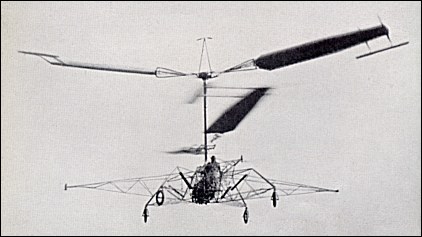
In 1928 in Italy, Corradino D’Ascanio built a helicopter with two 13m counter-rotating coaxial rotors, each with a trailing elevator which could be used to vary the rotor blade angle of attack. Two small propellers at the ends of extra arms were used for additional control. Powered by a 95hp Fiat engine, the craft set three Federation Aeronautique Internationale (FAI) world records on October 8, 1930: an altitude of 18m, a distance of 1078m, and endurance of 8 minutes and 45 seconds. D’Ascanio worked for the Piaggio company, and designed also the Vespa scooter.
Engine: 1 x Fiat A-505, 95-100hp Rotor diameter: 13-15m Take-off weight: 800kg Achieved height: 18m Achieved endurance: 8min 45s
Founded in November 1998 as the aerospace division of the DaimlerChrysler Group, following the merger of Daimler- Benz and Chrysler Corporation. Headquartered in Munchen, civil aircraft business unit includes Daimler- Chrysler Aerospace Airbus; helicopter activities are via Eurocopter SA and Eurocopter Deutschland GmbH; the military aircraft business unit comprises DaimlerChrysler Aerospace AG. and Dornier Flugzeugwerft GmbH, while other business units include Aero Engines via MTU, Space Infrastructure, Satellites, and Defense and Civil Systems. Programs include the AT-2000 Mako role-flexible military aircraft.
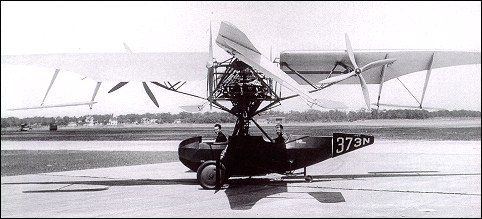
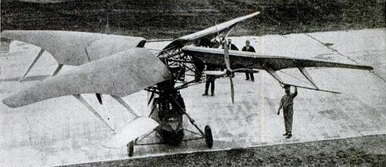
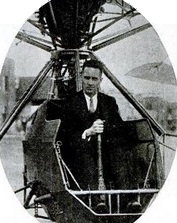
American engineer, Virginian M. B. Bleecker idea of a rotor driven by airscrews on the blades differed from the others in that his airscrews did not have individual engines but were connected by gearing and chains to a single central Pratt and Whitney 420hp radial power unit.
As constructed by the Curtiss Wright Corporation in 1926, each of the wing-shaped blades had auxiliary trailing strut-mounted control surfaces which, when operated collectively, were to make the aircraft rise or descend, and when operated differentially, to ensure stability. The landing gear consisted of three fixed wheels.
Designer Maitland B. Bleecker at the controls
This helicopter successfully made a few “hops” inside the hangar where it was built, but it was abandoned because of its lack of stability and the failure of attempts to eliminate vibration.
Curtiss-Bleecker Engine: 1 x Pratt and Whitney, 420hp Rotor diameter: 14.42m Gross weight: 1500kg Number of seats: 2
Curtiss, who was a motorcycle fiend and engine genius, had actually asked the Wright Brothers if they wanted one of his 50 hp engines when he went to discuss some aviation data, but they said no, unaware that Curtiss and the AEA would soon be a major competitor.
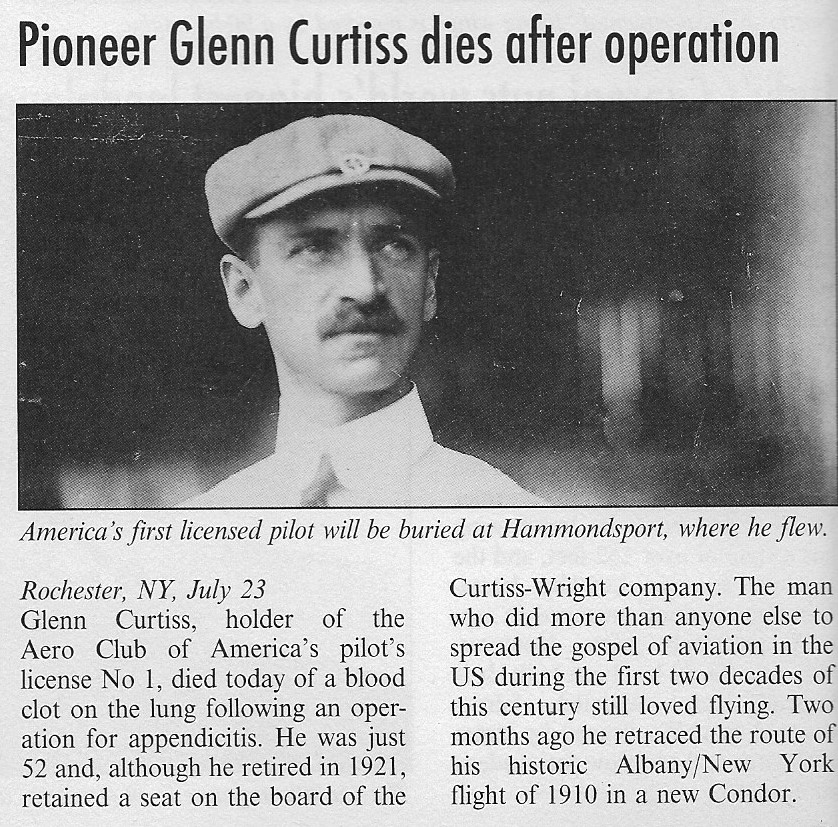
As a member of Alexander Graham Bell’s Aerial Experiment Association (AEA), Glenn Curtiss built the engines for the Red Wing and the White Wing early in 1908, piloted his first plane, and built and flew the June Bug that June.
The AEA disbanded in 1909, and Curtiss formed the Herring-Curtiss Company on 20 March 1909 with Augustus Herring. Its first customer was the Aeronautic Society of New York. Curtiss delivered his first plane to them, the Curtiss No. 1, built to their specifications, on May 29, 1909.
When the Herring partnership split up, Curtiss founded the Curtiss Exhibition Company, the Curtiss Aeroplane Company in December 1911 in Hammondsport, New York, and the Curtiss Motor Company.
As business expanded, the Hammondsport factory became unable to fill all the orders. Curtiss extended its operation to Buffalo, where it rented the site of the company that had supplied Curtiss with his first bicycle engine years before. Curtiss also opened a new plant in Toronto. The quarters in Buffalo quickly became inadequate, and a new 120,000-square-foot (1,115-square-meter) building was constructed that became the company headquarters. Soon after, a new plant that sprawled over 72 more acres was added.
1909-early 1911 – While A, B, and C models are known (or thought) to have existed during this historically important period for Curtiss, where they were applied is not. Numerical assignments, as well, were guesses—Model 2 has appeared for both Rheims Racer and Charles Willard’s Banshee Express but not verified (Willard unjustifiably claimed authorship of that design). By 1910, Model D had been established, in some references tied to Curtiss-Herring, which was actually built after the partners’ dissolution. But there were at least 9 aircraft known to have been produced in this period, the “official” Model D, in one of its many forms, formally appeared in the first company catalog on mid-1911 along with its companion Model E. Production of concurrent Curtiss-Aero Society Model Ds unknown but the design quickly evolved into the Curtiss D (Standard). A Herring-Curtiss, for which plans were published for home-builders of the time, differed from Curtiss D with its ailerons on the front wing struts instead of the rear wing struts. Herring’s contribution, besides that as a temporary partner, was his alleged invention of a gyroscopic stabilization device (claimed, but unsubstantiated, 1909 US patent #12,256), which would circumvent the Wright’s aileron patents, but which was never used on any Curtiss machine.
Curtiss designed and built the following planes during 1908 – 4, 1909 – 2, 1910 – 4, 1911 – 5, 1912 – 3, 1913 – 3, total – 21.
In 1916, the Curtiss Aeroplane & Motor Company, Ltd. went public with Curtiss as president. By that time Curtiss had become the world’s largest aviation company, employing as many as 18,000 at Buffalo and 3,000 at Hammondsport.
The Curtiss Aeroplane and Motor Company was created 13 January 1916 from the Curtiss Aeroplane Company of Hammondsport, New York and Curtiss Motor Company of Bath, New York. Burgess Company of Marblehead, Massachusetts, became a subsidiary in February 1916. In 1916 the company moved its headquarters and most manufacturing activities to Buffalo, New York, where there was far greater access to transportation, manpower, manufacturing, and much needed capital. It became the largest aircraft manufacturer in the world during World War I, employing 18,000 in Buffalo and 3,000 in Hammondsport, New York. Curtiss produced 10,000 aircraft during that war, and more than 100 in a single week. A third factory (Garden City, Long Island, NY) became boat hull department for flying-boat production. Burgess Company of Marblehead, Massachusetts, became a subsidiary in February 1916. Aircraft built during First World War included A and AH biplanes for USN, Models D and E for U.S. Army, Model F flying-boats for USN, H-4 Small Americas, H-12 Large Americas and H-16 Large Americas (plus 150 by Naval Aircraft Factory). Best-known were JN-4/JN-6 “Jenny” trainers (5,000 built, plus 1,200 by Canadian Curtiss), HS flying-boats, MF flying-boats, N-9 floatplanes, British S.E.5a fighters, Orenco D fighters, and 5L flying-boats. Total wartime was 4,014 aircraft and 750 aero engines.
After the war, Curtiss, fell on hard times. In August 1920, the company was forced into receivership. Clement Keys, a Canadian financier, obtained funds to manage the company’s debt and led it again to sound financial status. The Buffalo facility became the major facility, and the company remained the largest U.S. aircraft company through the 1920s.
Postwar production, mostly in 1920s, included NC- 1/2/3/4 transatlantic flying-boats (four only); Oriole, Eagle, and Seagull civil types (little success achieved with the few built). Followed by a series of Army (R-6/R-8 etc.) and Navy (CR/R2C/R3C etc.) racers. Twelve B-2 Condor biplane bombers were followed by PW-8 biplane fighters, P-1/P- 6 U.S. Army Hawks, F6C U.S. Navy Hawks, and O-1/11/39 and A-3 Falcons for U.S. Army. The few Carrier Pigeons and Larks were followed by one Tanager biplane, which won 1929 Guggenheim Safe Airplane Competition. Subsequently produced N2C Fledgling, F8C/OC Falcon, and F8C/02C Helldivers for USN.
Foundation of Curtiss-Robertson division in 1928 was followed by, on July 5, 1929, Curtiss Aeroplane and Motor Company became part of Curtiss-Wright Corporation, together with 11 other Wright and Curtiss affiliated companies. In 1929, shortly before Curtiss died, the Curtiss Aeroplane & Motor Company, Ltd., merged with the Wright Aeronautical Corporation to form the Curtiss-Wright Corporation.
1930
Neither Curtiss or Wright successfully made the transition to the jet age and substantially all aircraft assets were sold to McDonnell and North American by 1950.

 All Aero