Flettner Fl-282 Kolibri

In 1940, Hitler ‘s Kriegsmarine (German Navy) made a request for a naval helicopter for operate from its units.

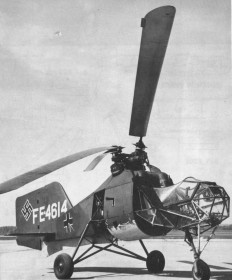
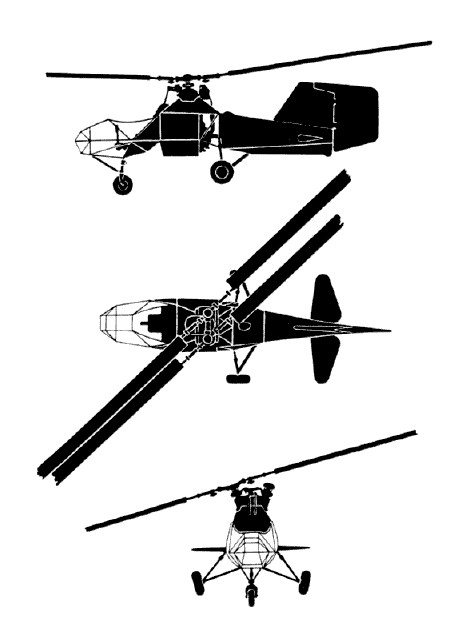
The Flettner Fl 282 Kolibri was designed from the outset as a two-seater, so that, at the expense of range, an observer could be carried, with obvious benefits in the roles of army and navy spotting and anti-submarine work. The observer was to be accommodated in a seat facing rearwards and positioned behind the rotor shafts, and the design provided for a permissible c of G travel which allowed the helicopter to fly with or without the observer without trim changes. The design was finalized by about July 1940 and work began on 30 prototypes and 15 pre-production machines at Flettner’s Johannisthal and Bad Tolz factories. For early flight trials, which began in 1941, the first three Fl 282 prototypes were built as single-seaters and had enclosed Plexiglas-panelled cabins.

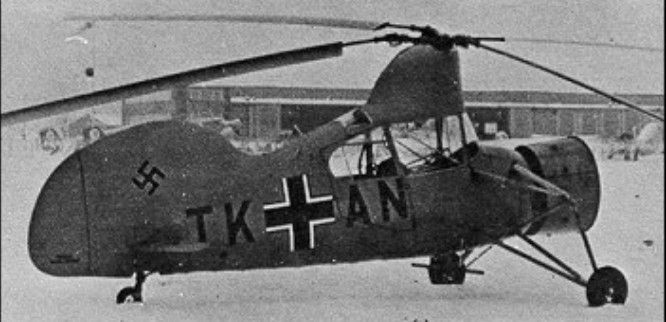
The first three prototypes were completed as single-seaters and had fully enclosed cabins made up of a series of optically flat Plexiglas panels, faired-in rotor pylons and well-contoured fuselages. The Fl 282V3 was fitted with endplate auxiliary fins and a long underfin beneath the rear fuselage. Later two-seater machines had more utilitarian bodies and some had semi-enclosed cockpits; others, like the example illustrated, had a completely open pilot’s seat.
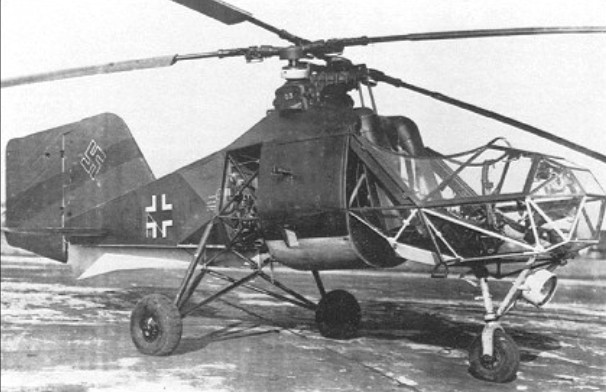
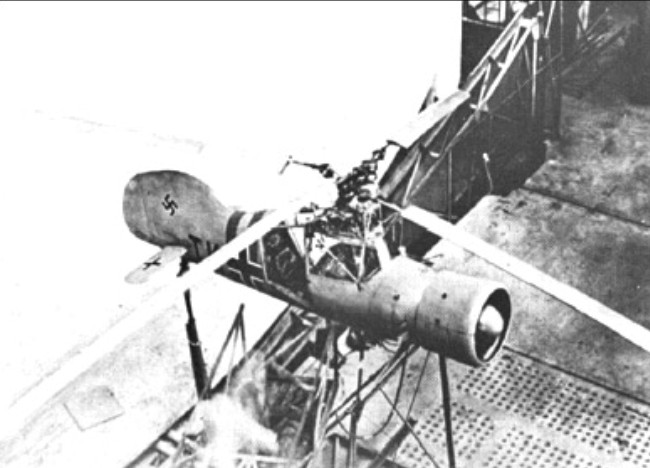
By mid-August 1941 work on the Fl 282 V1 had progressed to the point where it could be used on the ground as a transmission unit test bed. The test bed was anchored but could climb the length of the restraint to a certain height and hover. 125 hours and 39 minutes were spent in these tests, which lasted until November 21, 1941. In the event of the destruction of the V1 or a lengthy interruption of testing due to some other problem, it was planned to use the Fl 282 V4 as a replacement test bed.

For early flight trials the first three Fl 282 prototypes were built as single-seaters and had enclosed Plexiglas-panelled cabins.

The first three prototypes were completed as single-seaters and had fully enclosed cabins made up of a series of optically flat Plexiglas panels, faired-in rotor pylons and well-contoured fuselages. The Fl 282V3 was fitted with endplate auxiliary fins and a long underfin beneath the rear fuselage. Later two-seater machines had more utilitarian bodies and some had semi-enclosed cockpits; others had a completely open pilot’s seat.

The first free flight was made by the Fl 282 V2 on October 30, 1941. At the controls was test pilot Ludwig Hoffmann, who had joined Flettner as the successor to company pilot Perlia. Tests resumed in March 1942 following design changes to the cardan shaft; the tests revealed a significant improvement in the helicopter’s handling. The Fl 282 V2 was taken out of service on May 25, 1942; the aircraft’s transmission and engine were removed for use in other prototypes.

Hoffmann carried out two altitude flights in the Fl 282 V3 on April 27, 1942. On the first he reached a height of 3,500 meters over the takeoff point and on the second (from 1517 to 1610 hours) 3,800 meters in 36 minutes.

The Fl 282 V5, which featured a number of changes compared to the V3 (tail surfaces, fuselage, pilot seat), began flying in January 1942. It also remains to be mentioned that the Fl 282 V2 and V3 had a fully-glazed cockpit. From the V5 on the pilot seat was either entirely open or had a plexiglass shield in front or on the sides.

Various empennage arrangements were also tested. The V3 had a horizontal stabilizer right and left with end fins. A V-shaped stabilizer, similar to that of the Cierva C 30, was installed on the V23.

Calculations revealed that reversing the direction of rotation of the rotor should significantly improve directional stability, especially at low power settings. The V8 was rigged up as a test bed to confirm this. Flight tests with the V9 and V15 began in September 1942 and confirmed the theoretical findings. Directional stability was so good, that the entire fuselage section aft of the firewall was simply left off the V9. Flight tests were problem free. The V9 was the prototype for a version to be operated by the Navy from large submarines and designated “Modified Model in Form of a Standing Cylinder” (Fl 282 U).

The Fl 282 was more highly developed and flew more hours than any other German helicopter, and very extensive tests and measurements were made of all flight aspects. Most of this test work was done by Flettner’s chief pilot, Hans E. Fuisting, who also undertook blind flying and trained many of the 50 pilots who learned to fly the Fl 282. Some new pilots ran into trouble when flying near the ground, because, as they turned with the wind, they lost lift and struck the ground. One new pilot had a fatal accident when flying his Fl 282 blind in cloud, and the assumed cause of the accident was that the machine had been dived and the controls then pulled back so violently that the blades were forced into each other or into the tail. The diving speed thereafter was restricted to 175km/h. On occasions, the Kolibri was landed autogyro fashion and without the use of collective pitch. This was done by descending vertically, diving nose-down and then pulling back on the controls to land, but, on one occasion at least, the tail hit the ground and was damaged.

Extremely manoeuvrable and very stable, even in gusty conditions, the machine could be flown hands-off in forward flight above 60km/h for indefinite periods by making an adjustment to neutralize the loads on the controls. However, in forward flight at speeds below 60km/h there was some longitudinal instability which reached a maximum at about 40km/h. Another slight criticism of the Fl 282 was that it vibrated rather badly while the rotor was running up on the ground, but this vibration decreased upon lifting off, although there was still a certain amount of vibration transmitted to the control column, which was sluggish and tended to overshoot the requisite amount of movement. Although many of the mechanical components were unnecessarily complicated and heavy, the general design and workmanship were of excellent quality, and, as an endurance test, one machine was flown 95 hours in all without replacements or repairs. The engine was said to be capable of 400 hours between overhauls.

The Fl 282 V21 and V23 were built as two-seaters; an observer sat with his back to the pilot in the fuselage behind the engine block. This made necessary the removal of the fuselage fuel tank; it was replaced by two unprotected, cylindrical tanks mounted externally on both sides of the pilot seat. Furthermore, a different rotor arrangement – two three-blade rotors – was tried out on the test bed. It proved to run extraordinarily smoothly, however this was not a consideration for military use.

The entire Fl 282 flight test program was not conducted at Rechlin, as was customary for land-based aircraft; instead, from August 1942, trials were carried out at E-Stelle See Travemünde. In charge of helicopter and autogiro testing there was Fliegerstabsingenieur Dipl. Ins. Hans Fischer; his assistant was Fliegerstabsingenieur Dipl. Ing. Otto Dumke. After Fischer was badly hurt in the crash of one of the E-Stelle’s Do-217’s, Fliegerstabsingenieur Dipl.lng. Gerhard Geike assumed responsibility for the workings of this group.

Travemünde was selected because the air traffic safety ship Greif was based there and could be used for deck landing trials. The site also simplified helicopter sea trials with the navy, it was also imperative to move the site of the trials from Flettner’s facility in Berlin, where there was a greater risk from the growing Allied bombing raids.

One special experiment took place in cooperation with the DVL’s Institute for Marine Aviation. It involved “towing tests with a 50kg gliding body.” The proposal originated from the director of the Erprobungs- und Lehrkommando (Testing and Instruction Detachment) 20, Hauptmann von Winterfeldt, who carried out the towing flights from an antisubmarine vessel in Gotenhafen on May 3 and 4,1943. In addition to its role as a reconnaissance aircraft in support of the sub-chasers, armed with bombs the Fl 282 was also to participate actively in the anti-submarine role.

The following extract from the E-Stelle Travemunde’s monthly report of June 1944 is also worthy of mention:

“A mock combat between the Fl 282 (Flettner company pilot Fuisting) and a Fw 190 (pilot Ltn. Eisenlohr of E.Kdo.25) took place at Schweidnitz on 22.06.1944, in order to investigate the chances of a fighter hitting a helicopter. At present the evaluation of the film and the pilot reports have not yet arrived. At heights above 100 meters the fighter was able to get the helicopter in its sights briefly. Near the ground, especially in difficult terrain, the fighter has little chance against a helicopter.”

Vulnerability to gunfire was also investigated, whereby they proceeded on the assumption that the mathematical probability of a moving rotor blade being hit was much less than that of a fixed wing. Another consideration was that it should be extremely difficult to fire on and hit the slow-moving helicopter from a fast fighter. The latter could escape by making brief evasive movements, which the fighter could not follow. Furthermore, tests involving ground firing at the moving rotor blades were carried out, as the helicopter was felt to be more vulnerable to gunfire from the ground than from the air. An unmanned, tethered Kolibri was used; in spite of several hits in the rotor blades ground fire failed to bring down the helicopter.
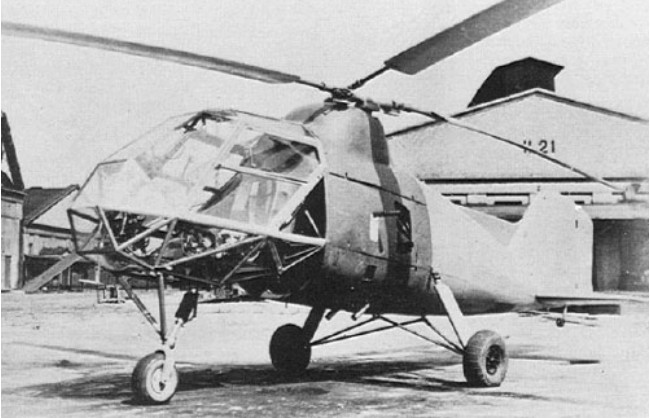
Fl 282 V2 with fully glazed cockpit. First flight October 30, 1941

The Fl 282 was more highly developed and flew more hours than any other German helicopter, and very extensive tests and measurements were made of all flight aspects. Most of this test work was done by Flettner’s chief pilot, Hans E. Fuisting, who also undertook blind flying and trained many of the 50 pilots who learned to fly the Fl 282. Some new pilots ran into trouble when flying near the ground, because, as they turned with the wind, they lost lift and struck the ground. One new pilot had a fatal accident when flying his Fl 282 blind in cloud, and the assumed cause of the accident was that the machine had been dived and the controls then pulled back so violently that the blades were forced into each other or into the tail. The diving speed thereafter was restricted to 175km/h. On occasions, the Kolibri was landed autogyro fashion and without the use of collective pitch. This was done by descending vertically, diving nose-down and then pulling back on the controls to land, but, on one occasion at least, the tail hit the ground and was damaged.

Extremely manoeuvrable and very stable, even in gusty conditions, the machine could be flown hands-off in forward flight above 60km/h for indefinite periods by making an adjustment to neutralize the loads on the controls. However, in forward flight at speeds below 60km/h there was some longitudinal instability which reached a maximum at about 40km/h. Another slight criticism of the Fl 282 was that it vibrated rather badly while the rotor was running up on the ground, but this vibration decreased upon lifting off, although there was still a certain amount of vibration transmitted to the control column, which was sluggish and tended to overshoot the requisite amount of movement. Although many of the mechanical components were unnecessarily complicated and heavy, the general design and workmanship were of excellent quality, and, as an endurance test, one machine was flown 95 hours in all without replacements or repairs. The engine was said to be capable of 400 hours between overhauls.

Beginning in 1942 with the Fl 282 V5, the German Navy held a series of trials in the Baltic, the machine behaving well under the worst weather conditions. The Fl 282s in these trials operated from a platform mounted on one of the gun turrets of the cruiser Köln.

The German navy, finding the type extremely manoeuvrable, stable in poor weather conditions, and so reliable that in 1943 about 20 of the 24 prototypes were operating from warships in the Aegean and Mediterranean for convoy protection duties. It was discovered that as pilots gained experience the Fl 282s could be flown in really bad weather, leading to an order for 1,000 production aircraft.

The fuselage consisted of a welded tubular-steel structure with metal panelling enclosing the centre (engine) section and fabric the rear section and vertical surfaces. The undercarriage was of the non-retractable tricycle type with the nosewheel connected to the rudder pedals for steering.
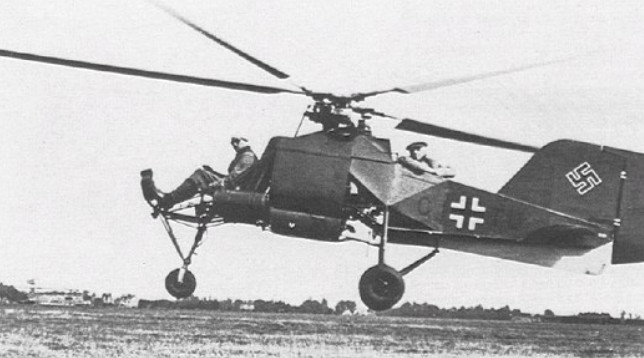
Fl 282 V21, a two-seater, with company pilot Fuisting at the controls. In the rear seat is Anton Flettner

It is known that Luft-Transportstaffel 40, based at Ainring in April 1945, had at least three Fl 282s (and also three Focke Achgelis Fa 223s) at its disposal. It was possibly one of this unit’s Fl 282s that flew Gauleiter Hanke out of besieged Breslau just before the capture of that city.

The great success of the Kolibri, which was even better than the Fl 265, resulted in a production order for 1,000 machines being given in 1944 to the Bayerische Motorenwerke (BMW), which prepared the requisite tooling-up only to have production forestalled by Allied bombing of the Munich and Eisenach works. The Flettner Johannisthal factory was also bombed, and, by the end of the war, only 32 preproduction aircraft in all were completed. Of these, only three were discovered by the Allies in a serviceable condition for testing, the Fl 282 V15 and V23 being taken to the USA and a third machine to the USSR. The remainder having been destroyed to prevent them being captured. Examples known to have survived are the Fl 282 (c/n 28368) at the Cranfield Institute of Technology, and the Fl 282 V23 at the United States Air Force Museum, Dayton, Ohio.

During 1944, when the Fl 282 was considered fully developed, Anton Flettner turned to the design of the Fl 339, using all the experience gained with the Fl 282. The Fl 339, which never got beyond the project stage, was to have been a much larger helicopter weighing some 3,000kg empty, carrying about 20 passengers and being powered by a single engine.

Technical description of the Fl 282 B-0 and B-1 (as of 23.12.1943)

  1. Purpose: I. Reconnaissance aircraft (land); II. Shipboard reconnaissance aircraft.
  2. Designation: Fl 282 B-0 (with no cockpit glazing). Fl 282 B-1 (plexiglass glazed canopy).
  3. Crew: one pilot
  4. Design: Single-engined helicopter and gyroplane of mixed construction with two rotors.

(a) Fuselage: Welded steel tube, truss-type construction. Forward section with open (B-0) or enclosed (plexiglass] cockpit (B-1). Recess for back-type parachute in rear wall of seat. The fuselage center-section contains the entire power plant, the outer skin consists of removable doors, hoods and panels. Oval cross-section. The rear fuselage is fabric-covered with a rectangular cross-section.

(b) Rotor Blades: A tubular steel spar with riveted-on wooden ribs and plywood skin with fabric covering. Rectangular outline with rounded tips. Attached to rotor head with delta and alpha hinges. Receptacle for balance weight at end of spar (scrap). The axes of both rotors are angled outboard at 12° from the vertical. Seen from above, the right rotor rotates clockwise, the left counterclockwise.

(c) Control Surfaces: No elevator. Two-part horizontal stabilizer with single spar. Tubular steel spar with riveted-on wooden ribs. Plywood leading edge, fabric-covering, cantilever construction. Angle of incidence adjustable between -15 and +5° from cockpit.Rudder: wooden construction, fabric-covered, deflection to 40°. Vertical stabilizer: wooden construction with plywood leading edge and fabric covering, bolted to fuselage frame. No ailerons.

(d) Undercarriage: Braced fixed nosewheel with VDM oil shock-absorber leg, coupled with rudder foot pedals (steerable nosewheel). Nosewheel: EC tire 350 x 150mm. Mainwheels: EC tires 465 x 165mm.

  1. Power Plant

(a) Engine Type: 1 BMW 314 E. Output: 160hp, compression ratio 1:6.0, rotor reduction ratio: 1:12.

(b) Transmission: Lower transmission flange-mounted on front of engine, in front cooling fan on extended crankshaft. Upper transmission, linked to the lower by a double cardan shaft. Firewall over and behind the engine.

(c) Fuel Tank: An unprotected metal tank located behind the firewall in the aft fuselage, consumable content 105 liters.

(d) Oil Tank: An unprotected 10-liter metal tank flange-mounted on the lower gearbox. Oil content of upper gearbox = 5l.

(e) Type of Fuel: 87 octane aviation gasoline.

(f) Cooling System: Continuous cooling provided by an eight-blade wooden cooling fan with direct drive from the engine. Oil cooler which is switched off for cold-weather operalion.

(g) Control System: Control about all three axes by means of periodic or constant changes in angle of incidence of the rotor blades by means of stick and rudder pedals, to which the rudder is connected. Change-over from helicopter to autogiro (autorotation) flight and reverse achieved by means of a speed-sensitive hydraulic regulator controlled by a hand-operated control lever; change-over to autorotation mode is automatic in the event of engine failure.

  1. Equipment:

(a) Flight Instruments and Navigation Equipment: 1 airspeed indicator, 1 altimeter, 1 vertical speed indicator, 1 turn-and-bank indicator, 1 RPM indicator for rotors, 1 rotor blade angle indicator, 1 master compass, 1 dash-board clock.

(b) Safety and Rescue Equipment: 1 back-type parachute, 1 first-aid kit, 1 one-man inflatable raft (shipboard reconnaissance version).

(c) Radio and Signalling Equipment: 1 FuG 19 radio installation, 1 rigidly-mounted single-barrel flare pistol, 1 rigidly-mounted signal lamp (shipboard reconnaissance version).

(d) Bomb-Release Mechanism: 1 bomb magazine for two 5kg explosive devices (ship board reconnaissance version). 1 magazine for smoke buoys (shipboard reconnaissance version).

  1. Special Equipment: Deck-landing equipment, consisting of: 1 tether with landing cable and electrical release.
  2. Dimensions: Length of aircraft: 6150mm. Width, including undercarriage and tail surfaces: 2400mm. Height with rotor blades removed: 2400mm. Rotor diameter: 12000mm.
  3. Technical Data: (a) construction group: H 3; (b) maximum allowable flying weight: 1.000kg; (c) wing loading: 8.84 kg/m2 (based on rotor surface area); (d) maximum allowable speeds: as helicopter: forward: 80 km/h, backward: 30km/h, sideways: 20km/h; as autogiro: 60km/h; (e) minimum allowable speeds: as helicopter: no limitations; as autogiro: 40km/h, aerobatic forbidden!
  4. Performance: (a) Speed: Speed is temporarily limited to 80km/h in horizontal flight in helicopter mode for reasons of structural strength, 60km/h in autogiro mode.

(b) Rate of climb: 4.5m/s at sea level, 3.5m/s at 1000m, 3.0m/s at 1500m. Maximum altitude temporarily restricted to 1500 meters for flight safety reasons.

(c) Takeoff and Landing Performance: Takeoff and landing are made vertically. Autorotation landing in event of engine failure. Landing distance from height of 20m: 50m, stopping distance 15m (with wind speed of 5m/s).

  1. Range: Endurance of 2 hours 5 minutes at maximum allowable speed of 80km/h and a range of 168km. The “Technical Description Fl 282 B-0 and B-1” presented above was prepared with the Fl 282 V12.

Flettner FL 282 Kolibri
Engine: Bramo Sh 14A radial 7 cylinders, 160 hp
Speed: 150 km/h
Service Ceiling: 3300 m
Range: 170 km
Empty weight: 760 kg
Max weight: 1000
Width: 25.55 m
Length: 6.56 m
Height: 2.20 m
Rotor Span: 11.96 m
Disc Area: 224 sq.m each

Fl 282 V21
Engine: 1 x Bramo Sh.14A 7-cylinder radial, 119kW
Rotor diameter: 11.96m
Fuselage length: 6.56m
Height: 2.2m
Max take-off weight: 1000kg
Empty weight: 760kg
Max speed at sea level: 150km/h
Hovering ceiling: 300m
Service ceiling: 3300m
Range with one pilot: 300km
Range with full crew: 170km
Flettner Fl 265

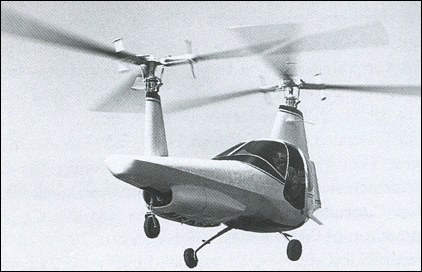
In 1937 Flettner began to design the first helicopter to use intermeshing contra-rotating synchronized rotors. Many of his advisers thought that the airflow disturbed by the intermeshing blades would make this system less efficient than one using a single rotor; but Flettner believed that any problems thus encountered would be more than offset by the reduced drag resulting from having no external rotor-carrying structure.

Six Fl 265’s were ordered in 1938 with a view to developing a machine suitable for shipboard reconnaissance and anti-submarine patrol for the German Navy. They were to be powered by a 7-cylinder air-cooled engine to drive its two intermeshing two-bladed rotors and with an inertia damping system to reduce the shake of the control stick. The six prototypes were built (Werk-Nr. 1579 -1584), one of which (TK+AN) was tested in the large wind tunnel at Chalais Meudon (Paris) in the summer of 1940.

This was of similar airframe configuration to the Fl 185, but dispensed with the outriggers and propellers, and introduced two two-bladed counter-rotating inter-meshing and synchronised main rotors which, because they were rotating in opposite directions, each cancelled the effects of the other’s torque. To simplify control problems a tail unit incorporated an adjustable tailplane for trimming purposes, and for steering a large fin and rudder to augment the use of differential collective-pitch change on the two rotors.

The 160hp Bramo Sh 14A radial engine provided the power for the two two-blade rotors, which had inclined shafts mounted close together and had an inertia-damping system to reduce the vibration reaching the control column.

The Fl 265 V1 D-EFLV took off on its maiden flight in May 1939 in the hands of Flugkapitan Richard Perlia following an extensive series of ground tests (first full-power run on 17.01.1939, first tethered flight at a height of 20 cm on 14.03.1939). D-EFLV made its first autorotative descents the following August, The aircraft was lost in an accident some three months later when the counter-rotating blades struck each other, but the Fl 265 V2 was used successfully for a variety of military trials. It was used for extensive military testing in conjunction with the Kriegsmarine (for example deck landings on an approximately 25-meter-square landing platform on the cruiser Köln and even made landings on U-boat decks) in the Baltic and Mediterranean. The aircraft was removed from service on April 29, 1940.

One Fl 265 was lost due to its refuelling being overlooked. The Fl 265 V3 crashed due to pilot error on August 21, 1939 and was destroyed in the ensuing fire. The Fl 265 V5 (retired on 26.11.1941) and the Fl 265 V6 (retired 25.03.1942) were still on hand at the Flettner Company in November 1942. Their return to service was postponed and eventually abandoned.

The Fl 282 exhibited significant improvements compared to preceding designs, for example the double rotor with intermeshing blades, automatic changeover from helicopter to autogiro flight (autorotation, from the V4), and the ability to switch back to helicopter flight.

Although the Fl 265 had performed its duties well, had flown in adverse conditions and had no trouble going into and out of autorotation, natural doubts were expressed concerning its vulnerability to aerial attack. Consequently, a test was made in which a Messerschmitt Bf 109 and a Focke Wulf Fw 190 fitted with camera guns made determined simulated attacks on an Fl 265 for 20 minutes but failed to score one hit because of the helicopter’s manoeuvrability.

All the Fl 265 prototypes accumulated the following in the course of testing: pure flight time 126 hours, 32 minutes; takeoffs 1.180; running time 518 hours, 44 minutes (flight time + tethered flights + engine run-up time). At the time this represented a record number of hours of operation for a helicopter.

In 1940, an order was placed for quantity production. By then, however, Flettner had designed a more advanced two-seat helicopter and it was decided instead to proceed with the development and manufacture of this improved aircraft.

Flettner Fl.265
Engine: 1 x Bramo Sh.14A, 119kW
Rotor diameter: 12.3m
Max take-off weight: 1000kg
Empty weight: 800kg
Speed: 160km/h

Flettner Helicopter / Gigant

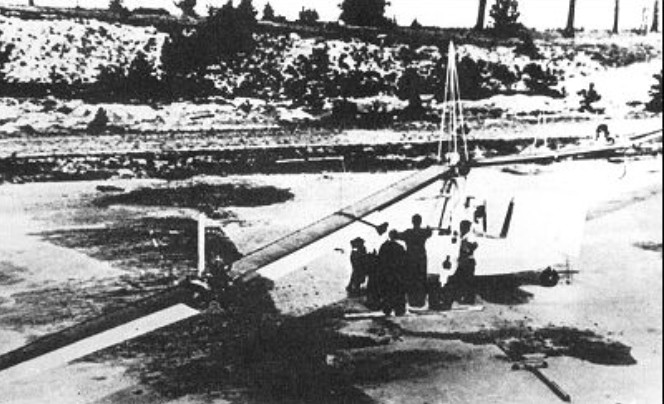
Flettner began work on his first experimental helicopter in 1930. Arranged over a relatively small fuselage was a twin-blade rotor of 30.5 meters diameter; the blades were supported by bracing wires extending from a bracing tower above the rotor axis which rotated with the rotor. A 30hp Anzani engine driving a puller propeller was mounted rather far outboard on each blade. As a result of this direct drive of the rotor blades there was no torque moment to compensate for. Fuel was drawn from a tubular tank mounted fore or aft of the engine.

The prototype, of wood and plywood construction, was built by “Segelflugzeugbau Edmund Schneider” of Grunau in 1934. A gust of wind destroyed this prototype while in tethered flight.

Flettner GmbH

Anton Flettner G.m.b.H
Anton Flettner (1885-1961) was born in Germany and attended the Fulda State Teachers College in Germany. On finishing his studies, he was employed by Zeppelin on development work into remote-control systems for lighter-than-air craft. When he was teaching mathematics and physics in a high school in Frankfurt, he began to develop ideas leading to his work for Germany in World War I.

After the war, he was named managing director of the Institute for Aero and Hydro Dynamics, Amsterdam, The Netherlands. He held that post until 1931.

From 1926 to 1945, Mr. Flettner was president of the Anton Flettner Aircraft Corporation in Berlin.

The “Anton Flettner G.m.b.H.” was a small engineering company dedicated to helicopters. It is believed that the firm was founded in Berlin in 1935. The earliest document the author has been able to find is a letter from the Military Economics inspectorate (W.I.) III, Berlin to the RLM concerning firms involved in production for the Luftwaffe and dated October 2, 1936. The letter states that the W.I. III first became aware that the firm had been given important work by the RLM (LC II) as the result of a formal application for an exemption from military service for one of Flettner’s skilled workers.

The same inspectorate sent the secrecy agreements to the Flettner Company, Berlin-Johannisthal, Segelfliegerdamm 27, for signature on January 22, 1937.

Due to the growing number of air raids on Berlin, in August 1943 the company began transferring its operations to Schweidnitz in Silesia (approx. 50 km SW of Breslau); due to the deterioration of the transportation system the operation took several months. The Fl 282s on hand with the company were also flown to Schweidnitz to continue the test program. In February 1944 the workforce reached approximately 120 men, its highest level ever.

With the Red Army approaching Silesia, in January/February 1945 the company moved back to Berlin-Tempelhof. Any systematic work or further production was of course out of the question under these circumstances. To make matters worse, two days after its arrival the rest of the company’s equipment was destroyed in a night raid on Tempelhof. What was left of Flettner was subsequently evacuated to Bad Tolz (Upper Bavaria); two Fl 282s were also flown there. The history of the Anton Flettner G.m.b.H. ended there with the arrival of American troops.

Firestone XR-9 / GA-45

In 1943 Firestone absorbed G and A Aircraft of Pitcairn Field, Willow Grove, and this included the CG-4A, a troop-carrying glider, and the XO-61, a pusher-type autogyro. Between 1943 and 1945 the G and A was modified and developed into a dual tandem helicopter, the XR-9B.

G&A Aircraft had previously built six examples of the XO-61 two-seat gyroplane for the U.S. Army. This experience was applied to the design of a new helicopter for the U.S. Army, designated Model 45.

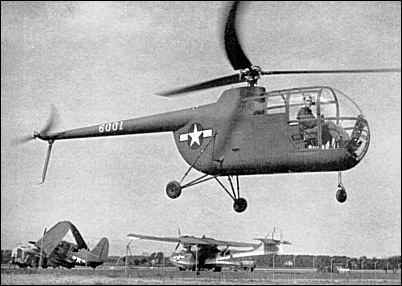
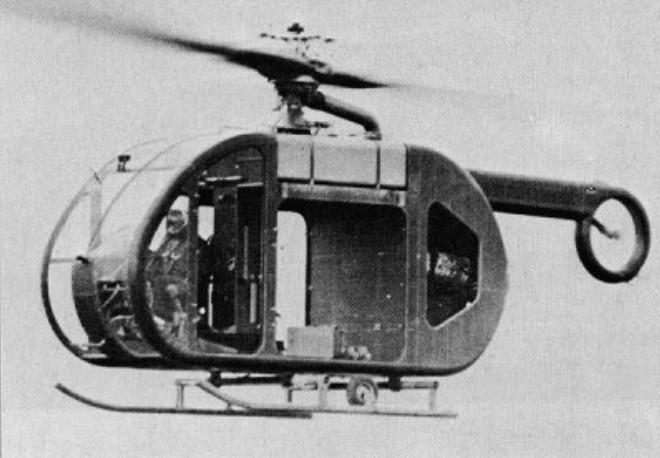
Conceived in 1943, the Model 45 was a conventional pod and boom helicopter with tandem seating, a fixed tricycle undercarriage and a three-blade main rotor. Completed in 1944 with co-operation from the Army Air Force’s Air Technical Service Command, the main rotor had three blades (and a fixed-type head); the tail rotor was 1.98 metres in diameter.

The helicopter was made of welded steel tube covered with an alloy skin, while the tail boom had a balsa-wood core covered with alcad. For storage purposes this helicopter could be broken down into three parts: rotor blades, fuselage and boom assembly.
The prototype incorporated an experimental electro-hydraulic governor, which by acting on the simultaneous pitch control maintained a constant predetermined rotor speed, irrespective of the power used. With automatic assistance from this governor, the pilot could rise or descend vertically just by using his throttle.

The original Model 45B design used a 126hp XO-290-5 engine and the Model 45C (military XR-9A) was a development with a two-blade rotor. Neither of these were actually built and the prototype (which carried the identity 6001) was designated XR-9B and was fitted with a 135hp Lycoming O-290-5 engine.
Firestone also built a civil version, the Model 45D (NX58457), with side-by-side seating but development of helicopters was abandoned by Firestone in 1947.

XR-9B
Number of seats: 2
Engine: 1 x Lycoming O-290-7, 135hp
Rotor diameter: 8.53m
Length: 8.41m
Width at landing wheels: 2.74m
Height: 2.6m
Gross weight: 800kg
Cruising speed: 128km/h
Inclined climb: 305m/min
Absolute ceiling: 3050m
Range: 400km

Firestone / Pitcairn Autogiro Co / Pitcairn-Larsen Autogiro Co Inc / Pitcairn-Cierva Autogiro Company (PCA) / AGA Aviation Corp / G&A Aircraft Inc

The youngest son of John Pitcairn, co-founder of Pittsburgh Plate Glass Company, Harold was born in 1897 and took an early interest in aviation. Inspired by the first flight of the Wright brothers in 1903, he began flight training as an air cadet in the last days of WWI, and would eventually earn a pilot’s license signed by Orville Wright.

1924: (Harold F) Pitcairn Air Service
air field, flight school, FBO
Bryn Athyn PA.
USA

Pitcairn was established in the mid-1920s in Philadelphia, Pennsylvania. Pitcairn and Agnew Larsen, who he had met in pilot training, produced the Mailwing airmail series biplanes including PA- 5 Mailwing high-performance single-seat mailplane used on U.S. Air Mail routes.

1925: Pitcairn Air Lines
sold to Eastern Air Transport in 1929 as origin of Eastern Air Lines
1925: Pitcairn Aircraft Inc
Pitcairn Air Field #2
Willow Grove PA.
USA

In 1928 Harold Pitcairn ordered a Cierva C.8W (the W was for the American Wright Whirlwind engine), which arrived at Pitcairn Field, Willow Grove, Philadelphia, PA and on December 18, 1928. It made the first rotary-wing flight in America, piloted by Cierva pilot H. C. A. “Dizzy” Rawson, followed the next day by Pitcairn.

In early 1929, Cierva and Pitcairn negotiators agreed that the Pitcairn-Cierva Autogiro Company (PCA) would be formed in America with the rights to license Cierva’s patents. Pitcairn threw himself into the development and promotion of the Autogiro – and the results of the next 16 months would earn him and his associates the Collier Trophy for the greatest aviation achievement for 1930.

1929: Autogyro operations as Pitcairn-(Juan de la) Cierva Autogiro Co.

c.1930: Autogiro Co of America (aka AGA) as patent licensee (to Buhl, Kellett, Sikorsky, etc).

Pitcairn Aviation Inc turned to autogiro construction with PAA-1 of 1931 and the name changed to Pitcairn Autogiro Company in the early 1930s. They sold a number of PA-18 and -19 autogiros, including a military version of the PA-34 two-seater to the USAAC. Plant and contracts were taken over in 1940 by Pitcairn-Larsen Autogiro Company, in turn succeeded very shortly afterwards by Aga Aviation Corporation.

Feb 1941: Pitcairn-(Agnew E) Larsen Autogiro Co Inc.

Dec 1941: Renamed AGA Aviation Corp (pres: Virgil H Frazier).

In 1943 G and A was acquired by the Firestone Aircraft Company of Akron, Ohio, together with almost 200 patents concerned with rotary-wing aircraft. G and A built gliders and experimental autogiros in the Second World War, and carried out subcontract manufacture.

1946: Acquired by G&A (Gliders & Aircraft) Div, Firestone Rubber Co.

After the company became the G & A Aircraft Division of Firestone, the emergence of Bell and Sikorsky in a depleted post-war market discouraged continuing the helicopter development in the early 1940s.

Firestone was formed in 1946 by name change from G&A Aircraft Inc., a subsidiary of Firestone Tire and Rubber Company.

1947: Firestone Aircraft Co.

Filper Beta 400

The Beta 200 prototype (N5000F) was first flown on 26 May 1966. Filper planned several versions of the Beta with either two seats (Model 200A and 300) or four seats (Model 400A and 600A). The four-seat models had a fuselage which was stretched by 36-inches and the first Beta 400A (N5003F) was flown on 13 July 1967. The Beta 400A had a 250hp Continental IO-520. Details of the Model 600A are unknown.
A former N.A. test pilot and a flight test engineer were killed in the stretched version.
Registration records show that 32 Betas were completed, comprising two Model 100As, 29 Model 400As and one Model 600A, but there is some doubt as to whether all of these were completed. It is believed the company ceased operations in 1969.

Filper Beta 100 / Beta 200 / Beta 300

Beta 200

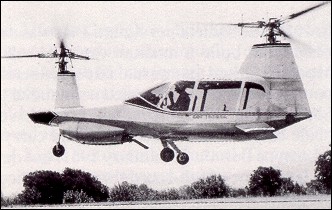
Under the direction of William Orr, Filper Research designed a novel helicopter using the ‘Gyroflex Rotor’, which employed special balance weights fitted to the roots of the rotor blades instead of conventional flapping or lead-lag hinges, or other hub stability devices. Filper was in the peach-pitting machinery business. This concept was tested on the Filper Helicopter (N9712C) which had fore and aft rotor pylons and the pilot sitting astride a central beam which also carried the engine.
A commercial development was the Filper Beta 100A. This was a tandem rotor machine with a two-seat cabin and pylon at the rear, and the engine with the forward pylon in front. This arrangement resulted in the pilot being unusually far from the front of the helicopter. The Beta 200 prototype (N5000F) was first flown on 26 May 1966. Filper planned several versions of the Beta with either two seats (Model 200A and 300) or four seats (Model 400A and 600A).
The Beta models had various powerplants – namely the 210hp Continental IO-360-E (Model 200A), Allison 250-C18 turbine (Model 300) and 250hp Continental IO-520 (400A). Details of the Model 600A are unknown. Registration records show that 32 Betas were completed, comprising two Model 100As, 29 Model 400As and one Model 600A, but there is some doubt as to whether all of these were completed. No Filpers were ever sold to the public and never received FAA certification. It is believed the company ceased operations in 1969.

Fiat 7002

In 1959, the Societa per Azioni Fiat was awarded an Italian Defence Ministry contract to design and build a medium capacity helicopter for use by the Italian Air Force.

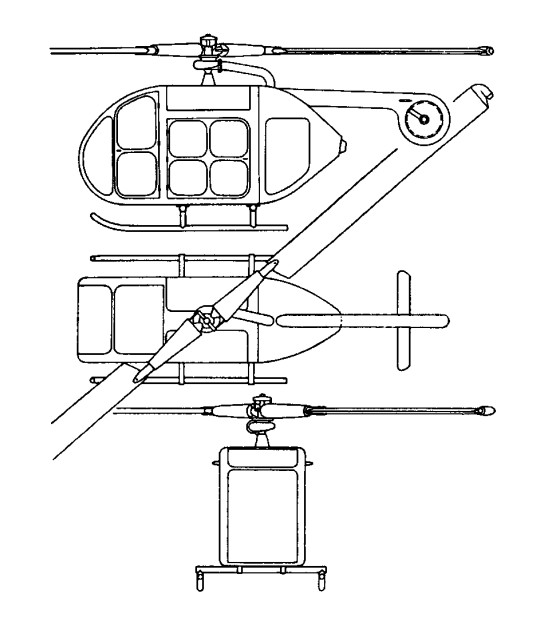
The Fiat 7002 is a medium-capacity dual-control helicopter for passenger transport and general-purpose duties. The main rotor is of the “cold jet” type, and is turned by ejecting compressed air, without any form of combustion, from nozzles at the blade-tips. Compressed air is provided by a Fiat 4700 turbogenerator. A small ducted tail rotor, mechanically-driven by the main rotor, ensures good manoeuvrability at low forward speeds and in autorotation.

The rotor system has a two-blade main rotor on tilting hub. Blades have leading-edge and spar of welded stainless steel sheet. Ducts in leading-edge and spar carry compressed air to propulsion nozzles at blade-tips. Blades linked together by steel strips which bear centrifugal loads and permit pitch variation. Blade chord 0.43m. Small ducted two-blade tail rotor.

The fuselage is light alloy sheet structure in three portions. Front portion accommodates side-by-side pilot’s seats; centre portion accommodates passengers or payload; rear portion carries power plant. Short semi-monocoque tail-boom carries ducted tail rotor and small horizontal stabiliser. Twin tubular-skid type.

Power is from one Fiat 4700 turbogenerator with equivalent power of 530hp housed vertically in rear of fuselage. Fuel in tanks above cabin, with total capacity of 525 litres.

Two pilots, or pilot and passenger, sit side-by-side in front portion of fuselage, with dual controls. Large sideways-opening door on each side. Centre cabin for five passengers or 2.5cu.m of freight, etc. In casualty evacuation role can carry pilot, attendant, two litters internally and two externally. Very large door on each side of main cabin.

The sole prototype flew on 26 January 1961, but development was discontinued in 1963. Fiat then designed a new high-speed three-seat helicopter, designated Fiat 7005, which had a pusher propeller mounted immediately behind the rotor pylon. This was not built and Fiat discontinued helicopter development in 1967.

Fiat 7002
Engine: Fiat 4700 turbo-compressor, 405kW
Main rotor diameter: 12.0m
Fuselage length: 6.12m
Height: 2.88m
Max take-off weight: 1400kg
Empty weight: 650kg
Max speed: 170km/h
Cruising speed: 140km/h
Ceiling: 3400m
Range: 300km
Crew: 2

Fairey Ultra-Light Helicopter

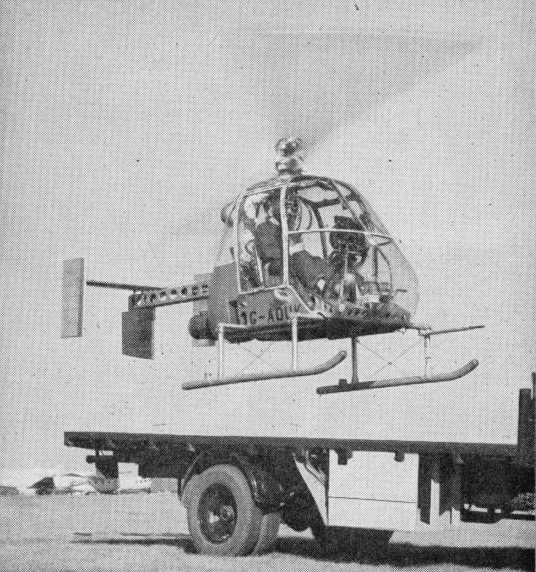
During 1953 the War Office collaborated with the Air Ministry and the Ministry of Supply in the formulation of a specification for a simple and relatively inexpensive small helicopter for use by the Army for reconnaissance and other secondary duties such as casualty evacuation and training. The requirements were severe in terms of vertical climb performance, in tropical as well as temperate conditions, though endurance and speed were less stressed. The helicopter had also to be capable of being dismantled and assembled easily and quickly and of being transported on a standard Army three-ton truck.

The specification was sent to helicopter manufacturers in the British aircraft industry, with requests for tenders, and some half-dozen designs were submitted. Fairey eventually won the contract in July 1954 and a preliminary order for four prototypes, to specification H.144T, was placed. Two more were planned as a private-venture investment.

Fairey believed that a rotor-tip drive would be ideal for the Ultra-light Helicopter (as it was named), and preliminary studies showed that a tip-jet-driven version could be designed to do better than meet the requirements. A suitable small turbojet power source was already available in Britain — the French Turbomeca Palouste BnPe.2, which had been re-engineered with the turbine in Nimonic 90 alloy and was built under licence by Blackburn and General Aircraft.

To provide tip-jet air pressure in addition to residual thrust an oversize centrifugal compressor was fitted, and the excess delivery was bled off from the casing surrounding the annular combustion chamber. Untainted air was thus obtained at an initial maximum pressure of about 2.8kg/sq.cm. With this available pressure it would have been possible to design the rotor for operation using simple air jets, but, with their background of experience of fuel-burning pressure-jets, these were employed.

The compressed air was delivered, via a lagged duct, to the rotor head and, with metered fuel from the same tank as that supplying the gas turbine, and carried by centrifugal force to the tip-jets. There was a manually-operated blow-off valve for use when the engine was being ground-run, and, later in the test development, when rotor-power needed to be cut so that rapid autorotative descents could be made.

With the ample power available the rotor was designed to operate at high revolutions and to have a small diameter (8.53m), thus meeting the need for compactness. Two of the later variants were fitted with a slightly bigger diameter rotor (9.75m) so as to improve the performance. The small diameter of the rotor permitted the mechanical design and control system to be simplified. No drag hinges were employed and the two blades formed a see-saw combination without individual flapping hinges.

A direct tilting-head type of control was employed in the first prototype, but an irreversible hydraulically-powered system for the cyclic-pitch control was designed (together with a flexible pylon) and fitted to this and to later aircraft. The pilot’s controls were those normal for helicopters — with a collective-pitch lever which carried a twist-grip throttle for increasing engine revolutions and consequent air pressure for the tip-jets, and a stick for control in roll and pitch, but the rudder-pedal directional control was through a steel-skinned rudder on which the jet efflux impinged.

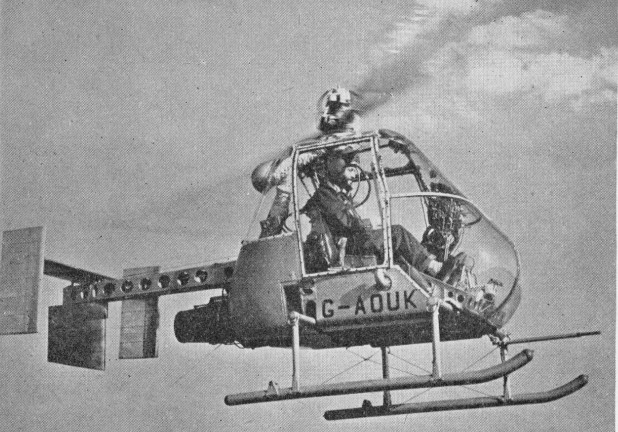
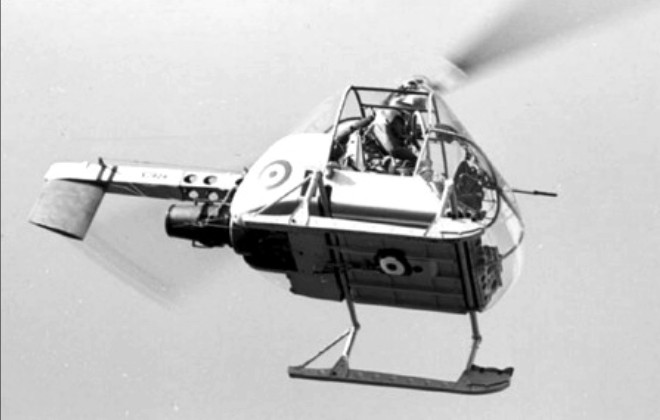
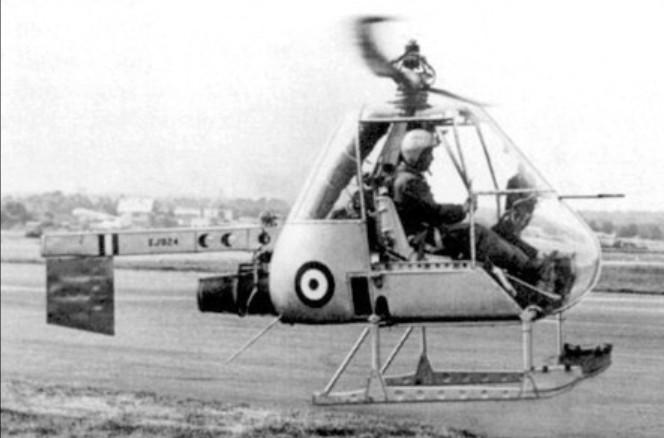
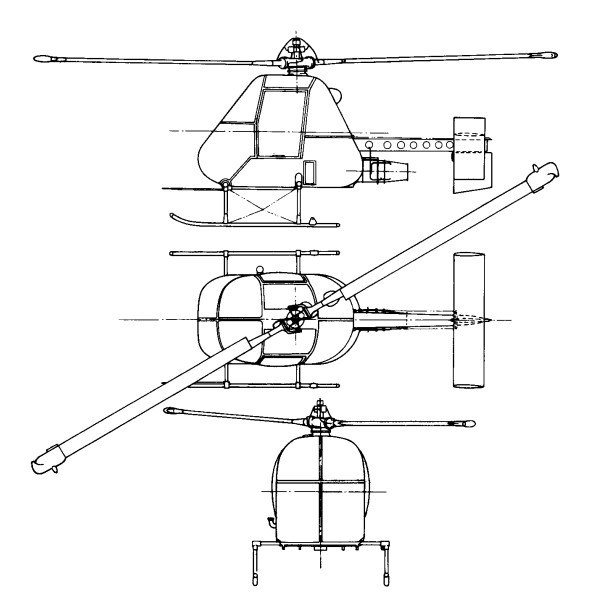
The Ultra-light was very simple in construction, the basis of which was a large light-alloy box containing the bag-type fuel tank. From the centre of this box rose the rotor pylon on which the remainder of the aircraft was, so to speak, hung. To the rear was attached a box-girder boom, under which the engine was slung, carrying the rudder — or rudders and an adjustable tailplane in later versions. This boom had a transport joint aft of the engine mounting. The crew’s seats (the observer facing aft in the proposed Army version) were on the basic box structure. The undercarriage consisted of a pair of skids attached to tubes running across the underside of the box.

The initial flight of the first prototype, XJ924 (F.9423), was made at White Waltham by W. R. Gellatly, on 14 August, 1955 – only about 13 months from the start of design work — and it was shown and flown at the SBAC exhibition and display at Farnborough early in the following month.

Progress on the original basis was, however, to be overtaken by events. Before mid-1956 the Ministry of Supply had, for reasons of economy, ceased to support the Army project, and development of the Ultra-light was continued by Fairey on a private-venture basis, with considerable and expensive efforts to develop the original design and to sell it to prospective Service and civil operators.

There have been some considerable differences, among semi-official and other records, of the actual identities of the various Ultra-lights, of the total number completed and of the sequence in which they were produced. The principal difficulty in straightening the records has been caused by the fact that the original order ‘bookings’ were changed. Four (F.9423—9426) were planned to meet the original Ministry of Supply contract and two more (F.9427—8) were built by Fairey on a private-venture basis. After a certain amount of work had been done there were interchanges of components and then, following the Ministry cancellation, Fairey increased their private-venture programme.

Some uncertain confirmation of the sequence of the completion of the Ultra-lights can be found in the press reports of the SBAC displays of the period. One such report for 1956 said that four had by then been built, the fourth being G-AOUK; another, after the 1957 display, said that five had been built, including G-AOUJ, which was at the show with G-AOUK, and that a sixth, G-APJJ, was under construction.

The serials XJ924, 928, 930 and 936 were allotted to the first four and three of the six were civil-registered following the withdrawal of official support. In order of c/ns, but not necessarily of completion or of initial flights, the six appear to have consisted of the following individual aircraft. The first prototype, XJ924 (F.9423), was the first to fly and was later modified with the hydraulic cyclic-pitch control and flexible pylon already mentioned. The second prototype, XJ928 (F.9424), became a Fairey de velopment aircraft for which a modified cabin was designed so that different loads, such as a stretcher case, could be accommodated; this was registered G-AOUJ and fitted with the hydraulic controls, flying for the first time in the revised form on 1 September, 1957. The third prototype, XJ930 (F.9425), was delivered to the Ministry of Supply. The fourth, XJ936 (F.9426), flown on 24 August, 1956, was the first to be fitted with the hydraulic controls and the flexible pylon; it appeared at die SBAC Display in September 1956 registered G-AOUK, and was the company’s principal demonstration and trials aircraft. Operating from the back of a standard truck, it demonstrated a rate of climb of 6.75m/s and a rate of descent in autorotation of 20m/s. The first of the two original private-venture aircraft, F.9427, was apparently used only for resonance tests and for ground-transport trials.

In the autumn of 1957 G-AOUJ underwent trials aboard the frigate HMS Grenville to determine the practicability or otherwise of operating small reconnaissance helicopters from platforms at sea. More than 70 landings and take-offs were made in winds of up to 62 knots, with the deck sometimes pitching through 3.05-3.66m and rolling up to 14 degrees each way. During 1958 both G-AOUJ and G-APJJ were being evaluated by the Royal Navy. The second, F.9428, was registered G-APJJ and flown initially in 1958; this had a cabin similar to that of G-AOUJ and was used for trials by the Royal Navy, operating from the deck of a destroyer, HMS Undaunted, before going to the Royal Aircraft Establishment, Bedford, and later to the College of Aeronautics at Cranfield.

In 1957 the Piasecki Aircraft Corporation of Philadelphia, USA, had obtained an option to build and the US Army was evaluating it for uses similar to those originally envisaged by the British authorities. Nothing, however, was to follow from these developments.

Typical of the continuous effort being put into Ultra-light demonstrations was the use, early in October 1958, of the stretcher-carrying G-AOUJ, flown by Peter Twiss, in a nuclear-war casualty exercise by the RAMC near Aldershot; the Rotodyne also took part in this exercise. Interest in the Ultra-light had been shown in Canada, and G-AOUJ, with its bulged nose to take a stretcher, and with special navigation and heating/ventilating equipment, was shipped out there later in 1958 for cold-weather trials and demonstrations by Lt-Cdr J. G. P. Morton. In the spring of that year a new draft specification was being drawn up for a version suitable for operation from small ships on anti-submarine duties both in attack (with a homing weapon) and communication roles. This proposal was based on a draft naval staff requirement and was a variation of the aircraft described in a brochure of April 1957 in which a naval strike version had been offered. The three civil-registered Ultra-lights were necessarily designed to meet airworthiness requirements and G-AOUJ and G-APJJ were duly certificated in the autumn of 1958. Work on the project was finally abandoned in 1959.

G-AOUJ has returned to the Helicopter Museum and restoration continued at Weston super Mare, but various parts, and drawings, are missing. A particular problem now is the swash-plate mechanism, of which there are no details.

Gallery

Engine: 1 x Turbomeca Palouste turboshaft, 185kW
Main rotor diameter: 8.61m
Fuselage length: 4.57m
Max take-off weight: 817kg
Empty weight: 290kg
Max speed: 153km/h
Hovering ceiling, IGE: 3109m
Range: 300km