USSR
Designed the G-1, a single-seat helicopter powered by Irbit two-cylinder motorcycle engine, in the spring of 1961. The aircraft is said to have gone into production for flying clubs following successful tests at Kirovograd in the Ukraine.
Helicopters
Galaxie XRG-65 Glaticopter / G-100
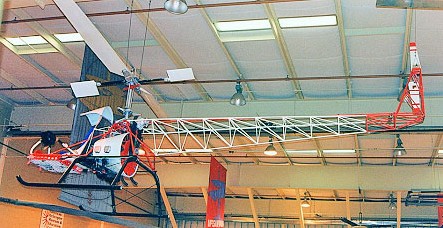
The XRG-65 Glaticopter is a one-of-a-kind research helicopter intended to evaluate new ideas in rotor control and drive systems. The fuselage is of welded steel tube construction with an aluminum bucket seat forward of the main rotor shaft.
In 1968 the XRG-65 was modified into G-100 helicopter with a 65hp Continental A-65 engine. There was also a two-seat version G-100A with 100hp Continentel O-200-A.
XRG-65 Glaticopter
Rotor diameter: 7.82m
Fuselage length: 6.1m
Max speed: 120km/h
Cruising speed: 105km/h
Fuji Jukogyo Kabushaikikaisha
1961:
So 18,
2-chrome,
Marunouchi,
Chiyoda-ku,
Tokyo
Successor to Nakajima Aircraft Company, established 15 July 1953 with factory at Utsunomiya City. Built Cessna L-19E Bird Dog observation aircraft under license. Concluded agreement with Beech in November 1953 to manufacture Beech B45 Mentor trainers; total of 124 built, deliveries commencing August 1954. From Mentor Fuji developed LM-1 Nikko four-seat liaison aircraft, first flown June 1955. Similar two-seat KM-2 developed. KM-2B with widened fuselage and tandem seating for two selected as JASDF primary trainer in August 1975. Fuji assembled or built more than 120 Bell 204B/B2 helicopters from 1962.
Fuji T-1 two-seat jet trainer was first postwar Japanese jet aircraft. Forty T-1 As built with Bristol Orpheus engines, and 20 T-1 Bs with Japanese engines. FA-200 Aero Subaru four-seat light aircraft first flown August 31,1965 (nearly 300 built). Work on FA-300 twin-engined light transport began 1971, continued as joint venture with Rockwell International, U.S.A., following agreement signed June 28,1974, as Rockwell Commander 700; prototype first flown in Japan on November 13,1974 and 30 delivered before cooperation ended in 1980 (also development of the higher-powered FA-300/Commander 710 then ended). Current programs include production of the T-5 primary/basic trainer for the JMSDF (as turboprop development of the KM-2, with KM-2Kai prototype flying in April 1988) AH-1S attack helicopter, 205B/UH-1J general purpose helicopters (205Bs from 1995, military UH-1s from 1993), participation in the Mitsubishi F-2 program, subcontract work on the Mitsubishi F-15J and Kawasaki P-3C and T-4, manufacture of assemblies for a range of Boeing airliners, production of UAVs, and participation in space programs.
Frontline Helicopter Corp
Frontline Helicopter was acquired by Glenview Metal Products circa 1950.
Froebe Helicopter
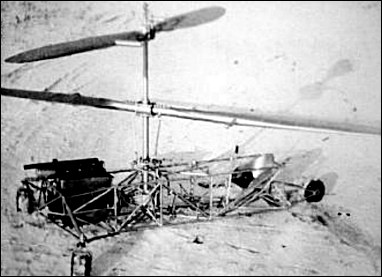
Canada’s first helicopter was built by the Froebe brothers of Manitoba in the early 1930s. It is preserved in Western Canada Aviation Museum in Winnipeg.
Forlanini Helicopter

In 1877, Enrico Forlanini developed an early helicopter powered by a steam engine. It was the first of its type that rose to a height of 13 meters, where it remained for some 20 seconds, after a vertical take-off from a park in Milan.
Forlanini / Società Leonardo da Vinci Forlanini
Enrico Forlanini was born to Francesco Forlanini, a physician and director of the Ospedale Fatebenefratelli in Milan. After elementary school he attended one of the three Milan Regie Scuole Tecniche, in 1863 he entered the Military College of Turin.
In 1866 he enrolled at the Military Academy of Turin, and become a Lieutenant of Engineers. Enrico enrolled in the Scuola di Applicazione Artiglieria e Genio (Application School of Artillery and Engineers) in Turin in 1868.
Upon graduation in 1870, he was assigned to Casale Monferrato, where he was able to work in the police station’s workshop. He began working on a systematic testing of propellers. He subsequently studied at Politecnico di Milano and graduated in Industrial Engineering.
In 1877, he developed an early helicopter powered by a steam engine. It was the first of its type that rose to a height of 13 meters, where it remained for some 20 seconds, after a vertical take-off from a park in Milan.
Later he designed and built a series of dirigibles, notably, designed in 1901 and launched in 1909, the Leonardo da Vinci that he dedicated to the Renaissance inventor and, in 1912, the Città di Milano, dedicated to his beloved home town. The latter showed exceptionally good characteristics of stability and controllability that won Forlanini international renown. A further four airships were constructed: F3, F4, F5 and F6. A seventh, named Omnia Dir was only completed after his death in 1930.
Fogle V333 Sky Cat
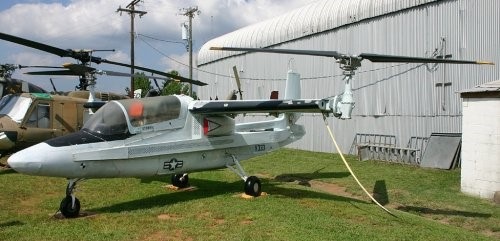
The Fogle V333 Sky Cat tilt-rotor was built in 1982 but never been flown. It was designed and built by Hal Fogle, who also worked on the SR-71 Blackbird program.
The prototype (above) is now on display at the Carolinas Aviation Museum.
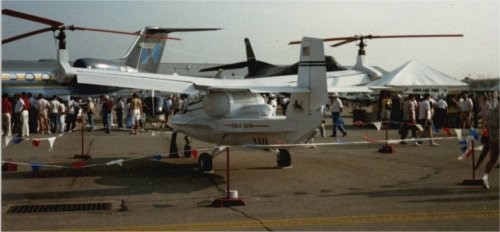
A full-scale mockup was displayed at some airshow.
Focke-Borgward BFK.1 Kolibri
Experimental Helicopter, Germany, 1958
The automobile manufaturer Borgward in Bremen tried to expand its operations with helicopters and the Kolibri was designed together with Prof. Heinrich Focke.
The project was shut down because of economical problems of the Borgward factories.
Engine: Lycoming, 237 hp
Rotor diameter: 30.84 ft / 9.4 m
Max take off weight: 2646.0 lb / 1200.0 kg
Crew: 1+2
Focke-Achgelis Fa.336
After termination of the work on the Fa.330 “Wagtail” it was next decided to transform the Fa.330 into a helicopter with engine. It was soon determined as unfeasible. Instead the Focke Achgelis engineers developed a new helicopter, which received the designation Fa.336. It was a single-seat device with outside features, reminiscent of the Fa.330.
Like the Fa.330, the Fa.336 could be stowed away and dismantled in a similar manor. Instead of a swash plate, a new design was applied to increase blade angle. This new design was developed for Focke Achgelis by Mr. Wewoloschky, an engineer who was conscripted to help solve this problem.
Deviating from Focke’s building principle, the Fa.336 had a tail rotor with horizontal drive shaft. The construction from steel tube corresponded to that of the Fa.330. The Fa.336 remained only a design, because there were very few specialists in the whole design engineering department, and those were divided and indispensable for the care of the Fa.223 and its development.
Engine: Zuendapp Z9-92, 60hp / 45kW
Total length: 6.8m
Marin rotor: three-blade
Rotor diameter: 7.5m
Tail rotor: 1.5m
Crew: 1
 All Aero