Główny Instytut Lotnictwa GIL-4 / BŻ-4 Żuk

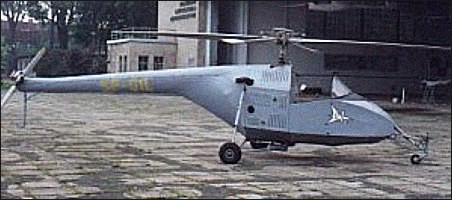
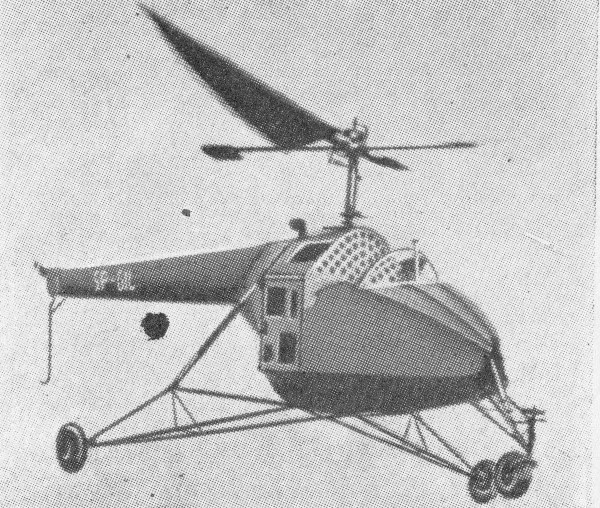
Work on the BŻ-4 Żuk began at the research institute Główny Instytut Lotnictwa – Main Aviation Institute in Warsaw in 1953, under the leadership of Dipl. Ing. Bronisław Żurakowski, who had earlier designed the experimental BŻ-1 GIL helicopter. Due to the delicate political situation in postwar Poland (Soviet influences and centrally planned economy), progress was slow. The main object was to produce a simple and inexpensive general use light helicopter. Its purpose was also to develop and test the novel rotor and transmission system, which eliminates vibration and improves control. Initially it was designated GIL-4.
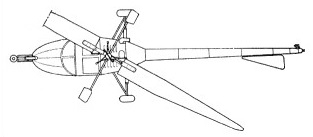
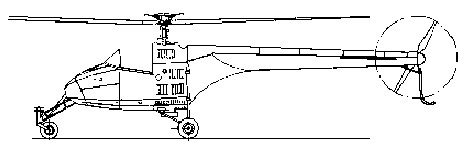
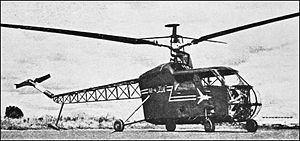
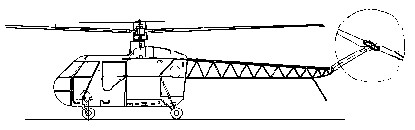
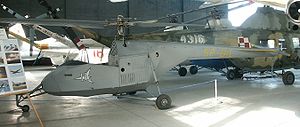
The BŻ-4 Żuk was based on a single main three-blade rotor powered by an indigenous one 320 hp Narkiewicz WN-4 piston engine in a fuselage made of a steel frame, behind a cabin section. It had an open frame rear boom structure and a fixed four-wheel undercarriage. Main rotor was atypical, for it had a smaller upper steering rotor and was fitted with an automatic stabilization system, of the Hiller principle. The cabin had four doors with two front seats and a rear bench. There were two fuel tanks, 220 litre in total.
Four main variants were planned: a passenger version accommodating a pilot and three passengers, an ambulance variant carrying pilot, one stretchers and an attendant, an agricultural variant carrying pilot and spraying or dusting equipment and a dual control trainer.
The first prototype of the BŻ-4 Żuk four-seat helicopter was manufactured and displayed publicly in the Polish Aviation Day Exhibition in August 1956. Due to a long program of ground testing and fixing faults, it flew first only on 10 February 1959 and completed 17 flights for a total of 3 hrs, 40 minutes. The Żuk was still in the development stage when further work was cancelled in favor of the licence production of the Mil Mi-1, that had already started in WSK PZL-Świdnik. The prototype was damaged during landing on 31 August 1959, and despite being repaired, it was not used again. Two additional prototypes were not completed.
One damaged and incomplete prototype is preserved in the Polish Aviation Museum in Kraków.

Powerplant: 1× Narkiewicz WN-4 7-cylinder air cooled radial engine, 320 shp (237 kW)
Fuselage length: 10.55 m
Rotor diameter: 12 m (39 ft 4.5 in)
Height: 2.8 m
Empty weight: 1,050 kg (2,313 lb)
Loaded weight: 1,500 kg (3,307 lb)
Useful load: 450 kg
Maximum speed: 156 km/h (97 mph)
Range: 260 km (161 miles)
Service ceiling: 3000 m
Rate of climb: 4.6 m/s, 276 m/min
Crew: one, pilot
Capacity: three passengers
Główny Instytut Lotnictwa BŻ-1

The BŻ-1 was designed at the research institute Główny Instytut Lotnictwa – Main Aviation Institute in Warsaw, from an initiative of Zbigniew Brzoska. The Polish aviation industry was destroyed after World War II, and in addition, the principal of the Institute was the only person who had seen a helicopter (Sikorsky R-4 in England).
Despite severe material shortages, work on the experimental design started in 1948, and the main designer became Bronisław Żurakowski (brother of test pilot Janusz Żurakowski), who designed the helicopter rotor and the control system. It used simpler Hiller rotor type, with two auxiliary blades. The structure of the fuselage, tail boom, auxiliary rotor and tricycle undercarriage were designed by Tadeusz Chyliński. The power unit and final drive were designed by Zbigniew Brzoska. The design utilized some components left by the Germans, like a piston engine Hirth HM 504 (configured for vertical use) and wheels from a glider’s landing gear.
Initially, the helicopter had no name. It only received the registration SP-GIL, from the Institute abbreviation, and soon it became known as GIL (gil also means bullfinch in Polish). Later it was also given the designation BŻ-1, from Żurakowski’s initials.
The helicopter was completed by the end of 1949. During the first flight trial on 15 January 1950, it was overturned by a wind gust and had to be repaired. The test pilot was Bronisław Żurakowski, who taught himself fly a helicopter. The helicopter first flew on 4 April 1950, restrained on tethers by two men for a measure of safety.
During 1950-1953, it underwent a test program and was often modified. At first it had elastic rotor blades. In 1950, it was fitted with rigid blades and an efficient simple custom designed resonant vibration eliminator. During tests, for different reasons, it crashed or was damaged without casualties, at least seven times and was repaired each time.

On 20 July 1952, the BŻ-1 GIL was first displayed to the public, during an air show at Okęcie airfield (it was one of first public helicopter presentations in the Eastern Bloc). On 16 November 1953 the helicopter was damaged when the main rotor was bent by the wind and cut off the rear pylon, thus ending the test program. By then, the prototype had completed 169 flights, 20 hours 21 minutes in total.

In 1956, the helicopter was repaired and used for training flights by helicopter pilots. On 28 June 1957, a tail rotor gear (originally from a World war II Zündapp motorcycle) broke and it could not be replaced, consequently, the helicopter never flew again, being written off in 1960. During 1956–1957 it had completed 185 flights, for a total of 12.5 hours.
Currently, the sole BŻ-1 GIL prototype is preserved in the Polish Aviation Museum in Kraków.

Powerplant: 1× Hirth HM 504, 105 hp
Length: 8.5 m
Rotor diameter: 8.8 m / 28 ft. 11 in
Rotors: 2-blade main; 2-blade tail
Height: 2.29 m
Disc area: 60.8 sq.m
Empty weight: 380 kg
Loaded weight: 610 kg / 1,276 lb
Maximum speed: 140 km/h / 87 m.p.h
Cruise speed: 120 kph
Service ceiling: 2000 m
Absolute ceiling: 3000m / 9,840 ft
Range: 275km / 112 miles at 73 m.p.h.
Rate of climb: 4.5 m/s
Seats: 2

Główny Instytut Lotnictwa / GIL

Technical Research Institute of Aviation
Institute of Aviation

Institute of Aviation
al. al. Krakowska 110/114 Krakow 110/114
02-256 Warszawa 02-256 Warsaw
Poland

Aviation History of the Institute goes back to the beginnings of Polish independence, but the official start date of the Institute is 1 August 1926. In the initial phase of its operation, acted as the Institute of Technical Research Institute of Aviation. This name survived to the beginning of World War II. Activity in the period 1926-1939 focused primarily on testing and certification of aircraft. All the pre-war Polish military aircraft were tested and certified at the Institute, including the PZL P.11 , PZL.23 Karas , PZL.37 Moose , PZL.38 , and PZL.44 Wind.

In 1948 the Institute changed its name to the Central Institute of Aviation, and 1952 was named Institute of Aviation. In the post war period, constructors dealt mainly with the design and manufacture of licensed Po-2 and MiG-15. The Institute developed pulse motors and jets. In the early years of its operation activities of the Institute focused on the study of equipment derived from the Soviet Union and placed on the license production.

In 1946, the LWD Szpak , a year later, the first glider IS-1 Vulture , after which they were SZD-6 Bat , SZD-8 Swallow , SZD-9 Bocian , Marshmallow SZD-19 , SZD-24 Foka . The Institute of Tadeusz Sołtyk designed the PZL TS-8 Bies and the first Polish jet aircraft TS-11 Iskra , the engine designed in the Institute

Institute engineers also designed the first helicopter: BZ-1 GIL, BZ-4 Zuk and JK-1 Bumblebee. The Institute also, in 1972, designed and built a flying laboratory, the Lala-1. It was a heavily modified aircraft An-2 , which later tested technologies used in the construction of the PZL M-15 (Belphegor) .

In addition to aircraft construction facility began to specialize in designing and testing flying objects such as rockets and flying targets, including the Meteor 1 meteorological rocket project. Subsequent years of the Institute was developing a training-combat aircraft for the military, which resulted in the I-22 Iryda. The institute designed a four-seat, composite passenger aircraft, the I-23 Manager (flown in October 1998, for deliveries from 1999), two-seater trainer, the I-25 ace, two-seater helicopter patrol trainer IS-2 and a rescue patrol-hovercraft, the PRP-560 Ranger.

Proposed the Kobra 2000 in 1993 for air – to- ground combat operations in the next century, but abandoned.

Glenview GMP.I Flyride

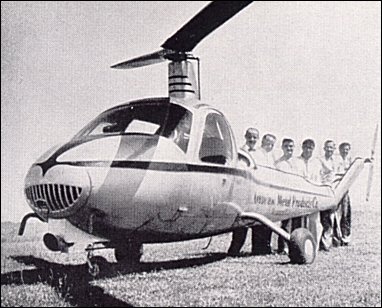
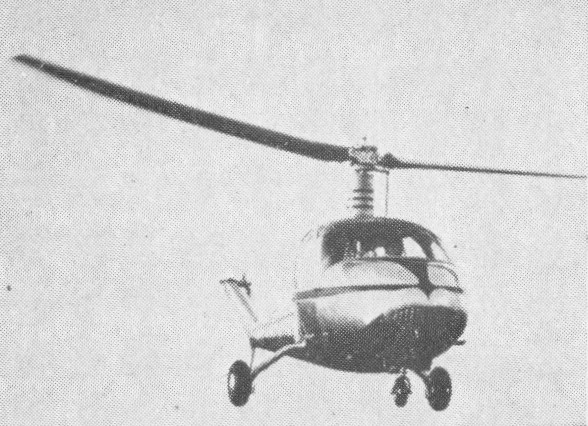
The two-seat ‘Humming Bird’ was originally designed by William E. Hunt. It was developed in 1947 by Frontline Helicopter Corp. as the ‘Flyride’ and the prototype (N544A) made its first flight in January 1948. It was a streamlined all-metal monocoque helicopter with an automobile-style forward fuselage and forward-swept rotor pylon. Power was provided by a 125hp Lycoming engine. The engine is in the aircraft’s nose, but instead of the five controls common to conventional aircraft, the Flyride has only two primary control units: a stick with a motorcycle grip, and a throttle. The stick, which rests on an arm between the two seats, governs all movements on the horizontal plane: an accelerator of the type used in motor vehicles controls upward and downward movement by means of a governor geared to the engine, and the pitch of the blades is regulated by the engine’s output in terms of revolutions per minute.

Since the cyclic control system is replaced by a fully tilting head, the rotor has no hunting hinges or drag hinges.

Frontline Helicopter was acquired by Glenview Metal Products and the machine became the GMP-1 Flyride. Glenview Metal Products Aircraft Division includes Robert Mattox, who was formerly aircraft designer with the Pitcairn Aviation Corporation and works manager with Piasecki Helicopter Corporation. In 1954 Glenview revived the prototype helicopter designed by William E. Hunt, with Hunt himself as consulting engineer. It was upgraded with a 135hp Lycoming in 1953 and was advertised to the public as the ideal personal helicopter.

GMP.I Flyride
Number of seats: 2
Engine: Lycoming, 135hp
Rotor diameter: 9.3m / 30 ft. 6 in
Rotors: 2-blade main; 2-blade tail.
Length: 10.82m
Height: 2.62m
Weight fully loaded: 750kg / 1,655 lb
Empty weight: 522kg
Cruising speed: 144km/h
Inclined climb: 366m/min
Absolute ceiling: 3810m
Range: 448km
Typical range: 280 miles at 90 m.p.h.

Georges G 1 Papillon

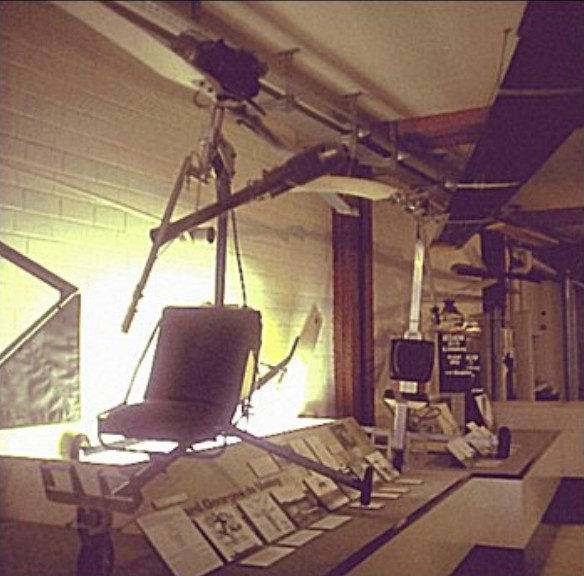
A 1965 simple light construction of Ing. Gerard Georges de Vastey, which specialty was the propulsion system. The rotor was driven by a self developed mini jet engine which was mounted directly to the rotor blades with some 35hp of power. Small but sufficient.

Length: 11.811 ft / 3.6 m
Height: 6.89 ft / 2.1 m
Rotor diameter: 19.685 ft / 6.0 m
Max take off weight: 374.9 lb / 170.0 kg
Crew: 1

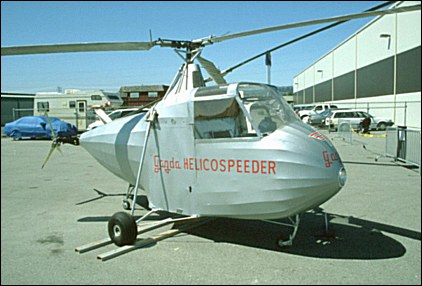
Gazda Helicospeeder

During a general conversation, Harold E. “Hal” Lemont told Gazda of his work with Igor Sikorsky; Gazda asked if Lemont would like to design and build a helicopter for him. They
agreed that Lemont would lay out a design for a two-pJace helicopter, and thus the Gazda Model 100 was begun.

The Gazda Model 100 Helicospeeder NX69154 was designed and developed in 1943, 1944, and 1945 by Antoine Gazda of Wakefield, Rhode Island. It was a single motor and torque aircraft with unique concepts which had the following features:
A swing tail for forward flight was designed to permit flight as a gyrodyne (V. Isaoco, J. Bennett) at higher than manual helicopter speeds with the rotor axis vertical.
To control blade inplane motion to prevent ground resonance a rotor azimuthal blade positioning system was included.
A wheel/stick installation was used so that positioning of the aircraft was achieved by one appropriate motion of the pilot control.
An internal swash plate below the main rotor gearbox actuated push rods going up to the rotor head which controlled blade collective and cyclic pitch as a low drag solution.
Belt drives were used between its engine, the cooling fan, and the main rotor gearbox. A drive shaft from the gearbox to the swinging tail rotor was also included with a torseinal damper as part of this shaft.

An all-aluminum single-seat helicopter, it was powered by a Continental A-75 engine.

Two assistants for detail designs were hired from previously known engineers who had attended RISC – Mr. S. Fitzpatrick in 1944 who was later replaced by Mr. H. Sadler in 1945.

The Helicospeeder was manufactured by Helicopter Engineering & Construction Co. and designed in accordance with general practice at that time. The fuselage was welded steel aircraft tub­ing. Main rotor blades were steel tubular spars, wooden leading edge wire cable training edge and airplane fabric covering. Cast aluminum gear cases and industrial/automotive gears, bearings, belts, and pulleys were used. The wheels came from a Piper Cub. Considering the limited pool of knowledge and experience in helicopter design, and Mr. Lemont’s earlier background with the Sikorsky VS-300, it is natural that there would be considerable similarity between these two machines.

Its Cierva-type rotor hub, with hydraulic-interconnect links between blades, made ground resonance impossible.

Initially, attempts were made to use a jet of air from the tail to counter torque. However, due to difficulties, a tail rotor was used that could be turned 90 degrees by the pilot, and thus serve as a push propeller for added thrust.

The Model 100 was constructed in the Rhode Island area during World War II, incorporating some surplus aircraft items. Powered by a 75 hp (56 kW) Continental A-75 engine, it was specified to carry one person and publicity releases claimed an ultimate goal of a 300 mph (483 km/h) maximum airspeed. Flight testing was done by Mr. Gazda himself, whose limited experience at the controls of a rotorcraft may have been detrimental to success of these tests. The designer/constructor carried out test flights and a more modest actual speed of 100 mph (161 km/h) was reached.

Production examples were expected to sell for 5,000 U.S. dollars, but no firm sales were made. As Gazda came to understand the difficulty in learning to fly the aircraft, plus the cost of further development, he decided to discontinue further work on this aircraft, and only one example of the initial version was completed.

The Helicospeeder was sold at auction after Mr. Gazda passed away, and was purchased by HAl Past-Chairman Vincent Colicci, who eventually sold it to Dr. Voss. After some years at AgRotors in Pennsylvania, Stanley Hiller took it on loan for his aviation museum in San Carlos, California, and had it restored to its original condition (it would appear that the Model 100 was also placed on public display at some point in time in the Owls Head Transportation Museum at Knox County Regional Airport—located two miles south of Rockland, Maine.)

Helicospeeder
Engine: 1 x Gazda, 130hp
Rotor diameter: 7.62m
Length: 5.79m
Height: 2.54m
Gross weight: 544kg
Cruising speed: 224km/h

Gazda

Mr. Antoine Gazda was an Austrian count who had been previously a race car driver (his wife was his mechanic who could change a tire in 11 seconds by count!), a World War I ace, and Chief of Sales for the Swiss Oerlikon Machine Tool Company. He sold their 22mm Oerlikon to the Germans, the Japanese, the Italians, the English, and the Americans. He helped setup production in the Pontiac Division of General Motors and the Oerlikon-Gazda Corporation in Rhode Island during World War II. I had engineered two fuel tank gliders for Mr. Gazda to be towed behind bombers to extend their range while a senior student at RISC. He had earlier witnessed the Pescara helicopter (Coastal-biplane blades) in its flight when in hovering it turned over striking the top of the mast first on the ground. Also he knew about the Asboth helicopter development from a European association with the Company.

Gasturbine101 The Swarm

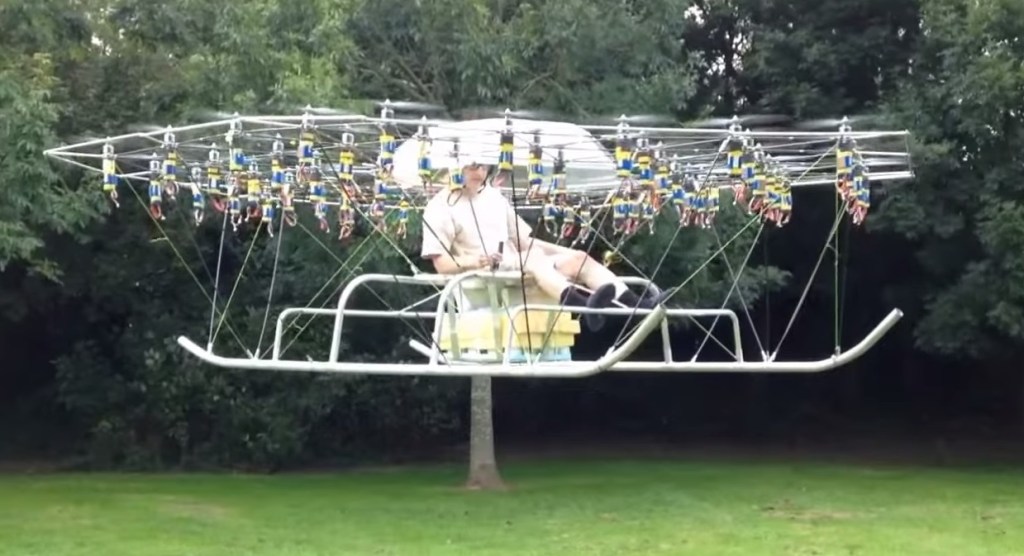
A man living in the UK known only as “Gasturbine101” created a 54-propeller drone not only capable of sustaining ordinary flight, but sustaining flight with him on board.

The drone contains 54 counter-rotation propellors and six grouped control channels with Hobbyking KK2.15 stabilization. The craft’s maximum takeoff weight is around 148 kg (326 lbs) while possessing the ability to sustain flight for roughly ten straight minutes. Power is approximately 22KW.

The Swarm cost about £6,000 to build and is powered by four cell batteries.

There is a flaw in the design of the vehicle. The large number of props running at high speed means the net torque reactions are relatively low, so the craft has little yaw authority. It probably needs a tail rotor for spot turns.