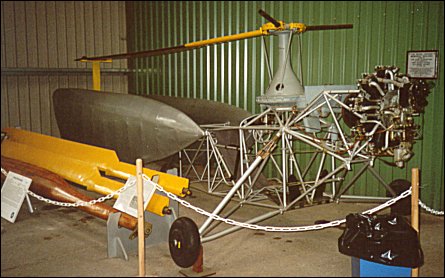
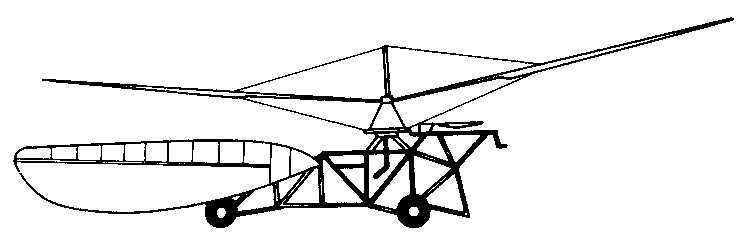
Built in 1930 at Vienna, Austria, was a second variant of the R.I, powered by a single Salmson 9 Adr radial piston engine. A single seat experimental helicopter, the initial tests in Vienna proved little more successful than those with the R.I and in 1932 the team with the R.II moved to Heston Airport in Middlesex. The R.II was under-powered to do more than just hover inches of the ground, and eventually went into storage.
The Austrian Bruno Nagler began work in the rotory-wing field in 1929 when, with Raoul Hafner, he built his RI Revoplane at Aspern Airport, near Vienna. This was a single seat machine with a rotor driven by a 45 hp engine and had a vertical torque-balancing surface acting in the rotor downwash. This machine, and also similar RII machine of 1932, was successfully tested in Great Britain.
In 1934, Nagler brought out his Heliogyro which had a 90hp Pobjoy radial air-cooled engine, a two-blade rotor and a pusher propeller. The engine could drive the rotor for hovering, when torque was balanced by a vertical surface, or the propeller could be driven for forward flight leaving the rotor to generate lift by autorotation. This single-seat aircraft was tested in Great Britain in 1937.
Raoul Hafner was a young engineer who had started the design of his first aircraft in Austria in 1929. This, the R.I helicopter, flew at Aspern Airport. Vienna, in 1930 and was followed by the R.II in1931. Hafner then came to England where he designed and flew, with some success, his A.R.III gyroplane, a jump start autogyro. There then followed a series of design projects, several of which were tendered to the requirements of the earliest Air Ministry specifications for helicopters.
In 1956, Gyrodyne XRON-1 experiments led to development of the QH-50 unmanned drone versions of the XRON-1 and Gyrodyne delivered over 60 production QH-50Cs for operation from Naval frigates.
QH-50C Engine: 1 x T50-BO8A turboshaft, 243kW Rotor diameter: 6m Take-off weight: 1036kg Empty weight: 524kg Max speed: 148km/h Ceiling: 5000m Range: 132km Armament: 2 x Mk-44 torpedos or 1 x Mk-46 torpedo
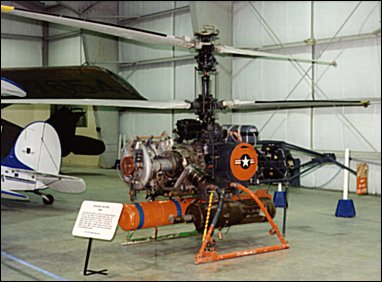
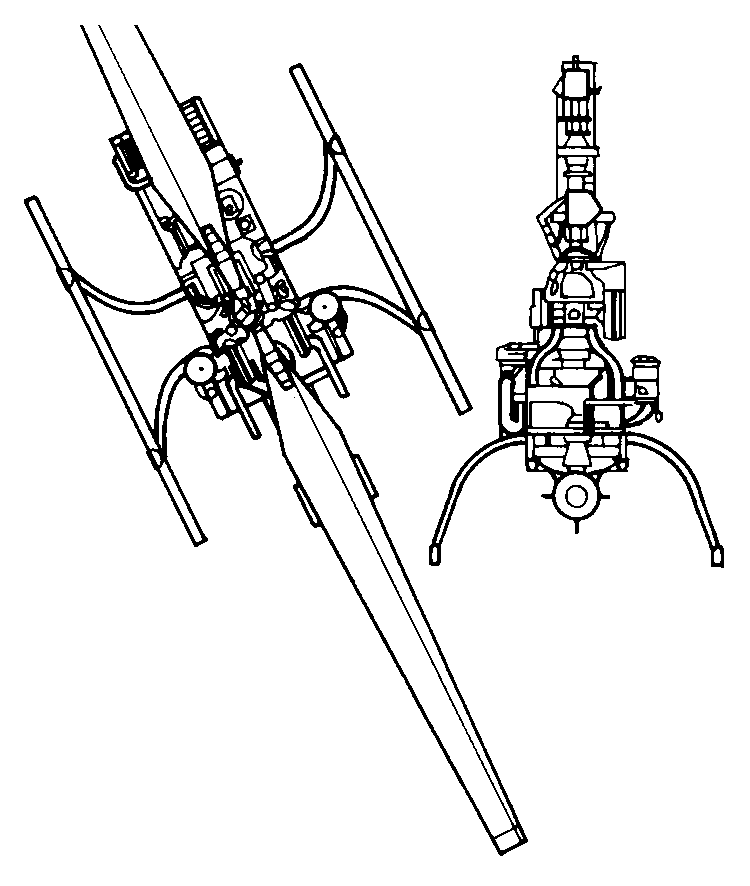
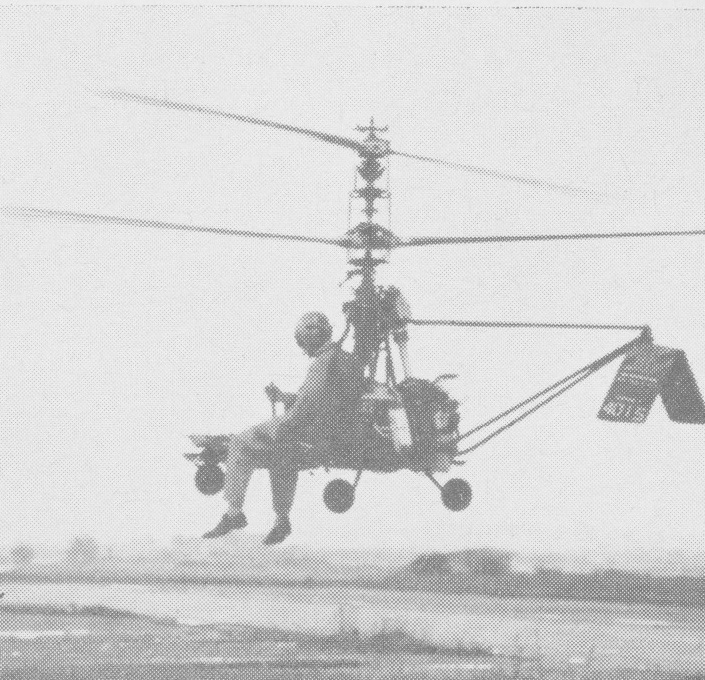
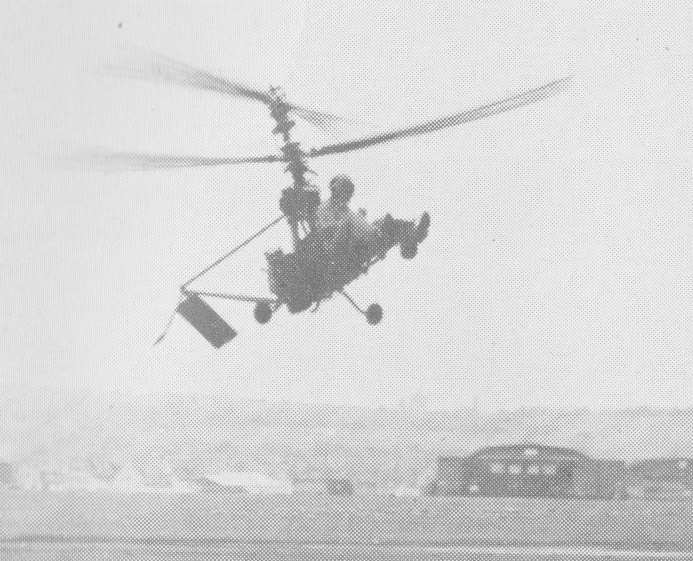
In 1956, Gyrodyne entered the competition to produce a single seat “personal” helicopter for operation off destroyer heli-decks for fleet observation, and for battlefield support, and built ten examples of the XRON-1 for the U.S. Navy. These also had a coaxial rotor layout and a 40hp Nelson H.59 engine – later replaced by a 60hp Porsche. This experiment led to development of the QH-50 unmanned drone versions and Gyrodyne delivered over 60 production QH-50Cs.
The inverted V-tail assembly is for stability only. All control is achieved through the overhead rotors. A feature is tip brakes mounted on the ends of the rotor blades which provide smooth directional control.
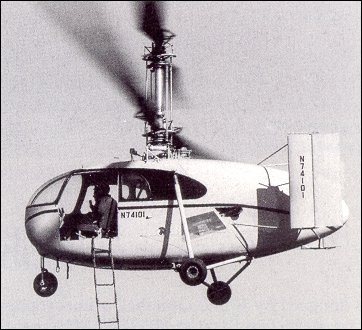
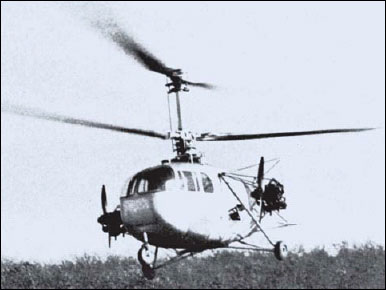
The Gyrodyne Company of America was established by Peter J. Papadakos in 1946. Gyrodyne acquired rights to the five-seat Helicopters Inc. (Bendix) Model J and developed this as the Gyrodyne GCA-2 (N74101). The GCA-2, an all-metal helicopter, had a coaxial twin rotor layout, with a five-seat cabin and a rounded fuselage with twin fins. It was subsequently modified to become the GCA-2A “Helidyne”, with twin 100hp Continental auxiliary engines mounted externally on strutted outriggers to give additional forward speed. It flew in this form on 30 November 1949.
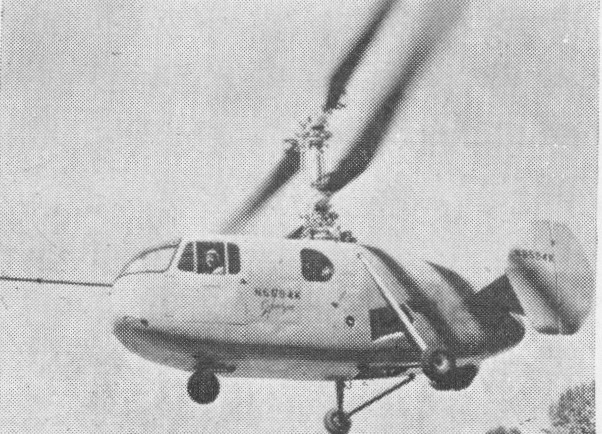
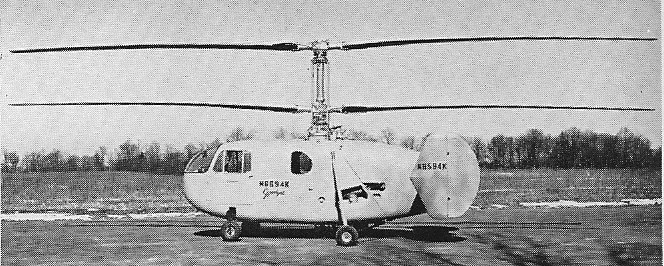
Gyrodyne GCA-2C
A further development of the GCA-2, serial number N6594K, first flew on April 25, 1952 piloted by Jim Ryan as the GCA-2C. Convertible to an ambulance with three litters.
G.C.A.2C
GCA-2C Engine: 1 x P&W R-985-134, 450hp Rotors: 2x 2 blade co-axial Rotor diameter: 14.64m / 48 ft Height: 14 ft 4 in Fuselage length: 21 ft 6.5 in Empty weight: 3800 lb Loaded weight: 5,750 lb Max. speed: 140km/h / 87 mph Cruising speed: 110km/h / 70 mph ROC: 1030 fpm Ceiling: 9,200 ft Typical range: 250 miles at 69 mph with full load Number of seats: 6-8
Known originally as P. C. Helicopter Corporation, the Gyrodyne Company was incorporated in New York in August 1946 for the development of advanced rotary-wing aircraft. Bought a five-seat coaxial design from defunct Helicopters Inc., and developed it into the G.C.A.2. Projected G.C.A.7 Helidyne with stub wings and two engines with pusher propellers mounted above wings. One-man portable helicopter, XRON-1 Rotocycle, developed for U.S. Navy Bureau of Aeronautics in mid-1950s, plus some ground-cushion vehicles.

 All Aero