1997: PO Box 8974, Fountain Valley, CA 92728-8974, USA.
In addition to helicopter maintenance and modification, offered the RotorMouse EH 1 -01 as a single-seat turbine experimental-category helicopter for construction from a kit (first flown August 1993), RotorMouse EH 1 -02 tandem two-seat version, and RotorMouse (Baby Huey) four-seater. Also built the T-4 Turbine as a four-seat turbine helicopter, and produced a retrofit kit for the RotorWay Exec to provide a turbine engine (first flown 1997).
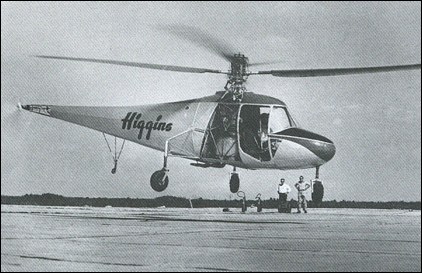
In 1942 an Aircraft Division was formed in Higgins Industries Inc, owned by Andrew Higgins, with the object of manufacturing transport aircraft for the United States Air Force. There was also a Helicopter Division concerned with building and perfecting a helicopter designed by Enea Bossi. This small two-seater helicopter had a main four-bladed rotor, consisting of two two-bladed rotors a few inches apart, and a small two-bladed tail rotor. The latter was fixed to the end of the upward-rising tail so that the tail rotor hub was at approximately the same level as the main rotor. The two-place, side-by-side cabin interior was designed to resemble as closely as possible that of a lightweight aircraft with a wheel control column and a standard panel of flying instruments. The fuselage is entirely covered, has a forward section with metallic skin, while the tail is covered with fabric. There is a small, two-bladed, vertical tail rotor and a fixed tricycle landing gear. The pitch-control and clutch-control levers look much like the gearshift on a car. The rudder pedals resemble brake and clutch pedals of an automobile.
In 1942 an Aircraft Division was formed in Higgins Industries Inc, owned by Andrew Higgins, with the object of manufacturing transport aircraft for the United States Air Force. There was also a Helicopter Division concerned with building and perfecting a helicopter designed by Enea Bossi.
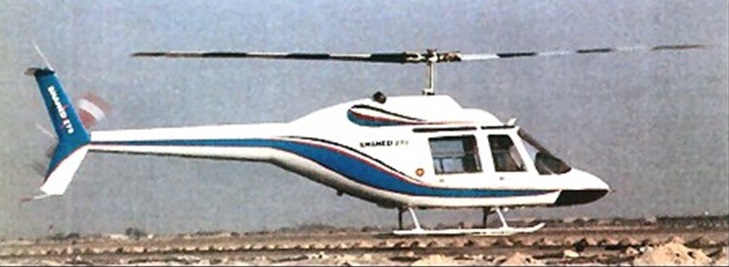
Three prototypes, first of which made maiden flight late 1997 or early 1998; most-flown prototype had accumulated 200 hours by March 2001. Public debut late 2002 as HESA 278, having previously been reported as Panha 287.
A fonr-seater; intended for dual military/civil use, though designed primarily to meet military requirements. Designed entirely in Iran, according to manufacturer, although some sources report use of locally made airframe and dynamic components of Bell 206 JelRanger.
Power is by a single turboshaft. Prototypes have evaluated Rolls-Royce 250 and equivalents from Turbomeca and a Russian supplier, but final selection apparently not made by late 2002. Fuel capacity 287 litres.
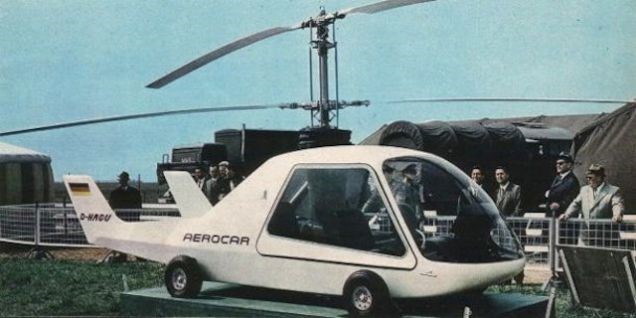
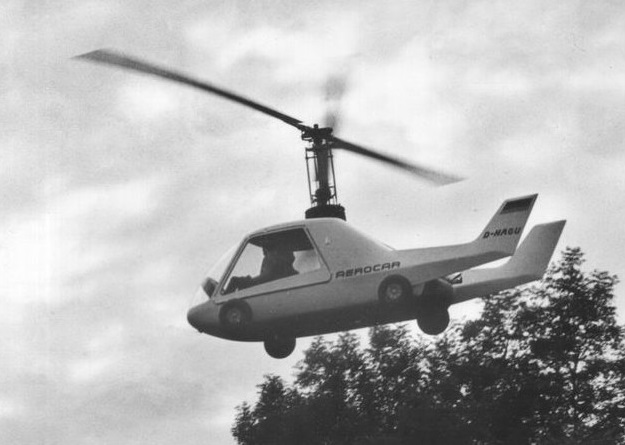
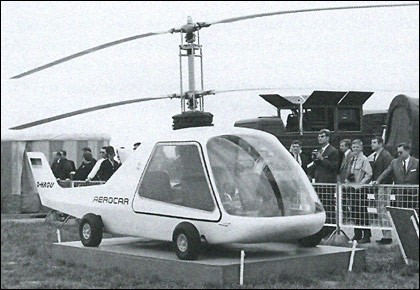
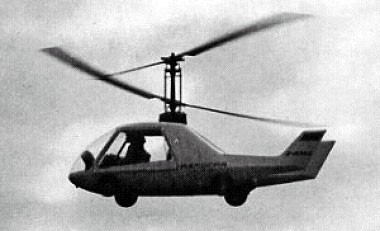
The Rotocar III has developed into the Aerocar. This has a 4-seat cabin, a twin tail assembly, and four road wheels hydraulically driven from the Oredon IV engine mounted behind the rotor pylon.
Wagner built a prototype (D-HAGU) Aerocar roadable helicopter, powered by a 260hp Franklin 6AS-335-B engine, which had a complete body shell. It was first flown in 1965. It was subsequently rebuilt with a Turbomeca Oredon turbine engine.
After extensive development work had been carried out, the Wagner designs were passed to a new company, Helikopter Technik Munchen (HTM) in 1971. HTM abandoned the Aerocar.
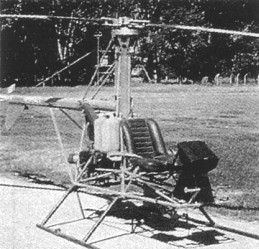
The first five designs evolved by Alfred Vogt of the Helicopter Technik Wagner since the company’s formation in 1960 included two experimental helicopters, each powered by a 95hp rotary engine. One was a simple 2-seater with a skid undercarriage and pod-shaped body. From this Wagner produced the Sky-Trac torque-less helicopter, which is basically a chassis frame carrying the engine and rotor system, to which a variety of cabins or equipment can be fitted to fulfil different roles.
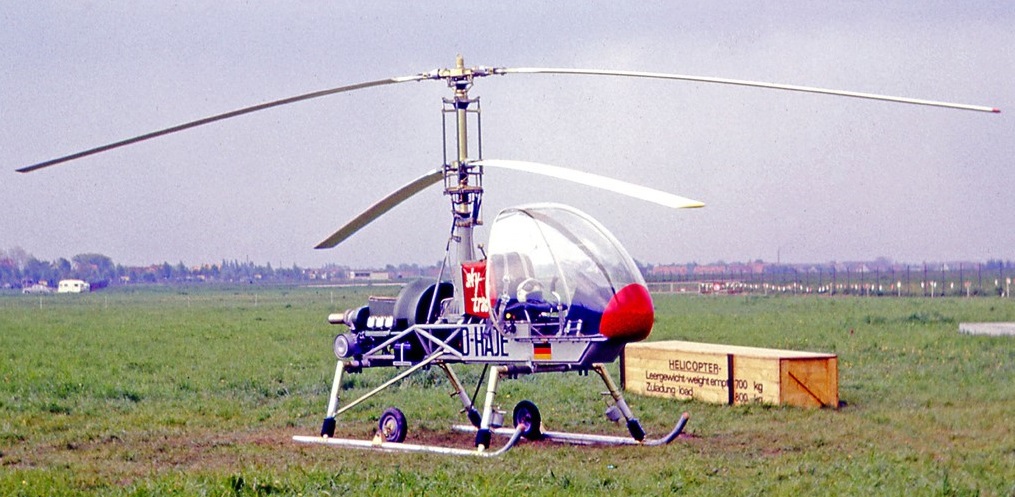
Development commenced in the mid-1960s as an offshoot of the Wagner firm’s attempts to develop a roadable helicopter, and utilised the same coaxial dynamic components that had been developed for that project. Each design utilized a contra-rotating rotor system in which the lower three-blade rotor was attached to the crankcase of a 95 hp three-cylinder rotary engine, rotating around the rotor pylon, with the upper two-blade rotor driven by the crankshaft. The Skytrac featured a narrow single-seat cabin at one end of a box-like “keel” structure, a horizontally mounted Franklin flat-6 engine at the other end, and the transmission and rotor mast between them. The pilot’s seat was enclosed by a sliding, bubble canopy. The prototype flew in this form in July 1965. The Wagner Sky-Trac 1 (D-HAJE), still had a frame structure but was fitted with a 260hp Franklin 6AS-335-B engine, and had a sliding canopy forming an enclosed cabin for the single pilot.
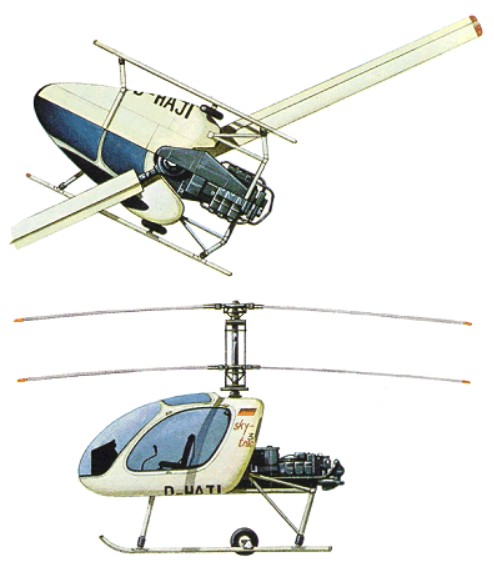
Prototypes of the Sky-Trac 1 (D-HAJE) and Sky-Trac 3 (D-HAJI) were exhibited publicly for the first time at the Hanover Air Show in May 1966.
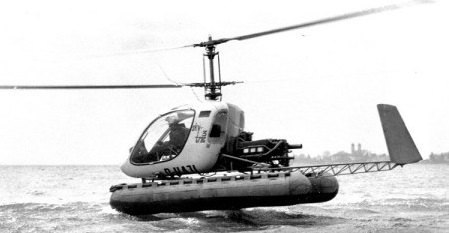
The second machine built (D-HARB) was fitted with a pontoon landing gear and a longer boom with a V-tail. Both are powered by similar 260hp Franklin 6AS-335-B piston-engines, the Sky-Trac 1 being a single-seater with a ‘goldfish bowl’ moulded canopy, open at the rear.
The three-seat Sky-Trac 3 (D-HAJI c/n 11), also flown in 1965, had a more complete cabin structure, faired-in at the back and underneath, and was fitted with spray bars and under-slung tanks for agricultural chemicals. The Sky-Trac 3 can lift loads at least equivalent to its own weight, an under-fuselage hook permitting slung loads of over 700kg to be transported. Alternatively, the heart-shaped cabin can accommodate a stretcher and medical attendant in addition to the pilot, or for agricultural use can be fitted with spray bars and an under-slung tank holding 650 litres of liquid chemicals.
The HTM FJ-Skytrac received both German and FAA certification in 1969.
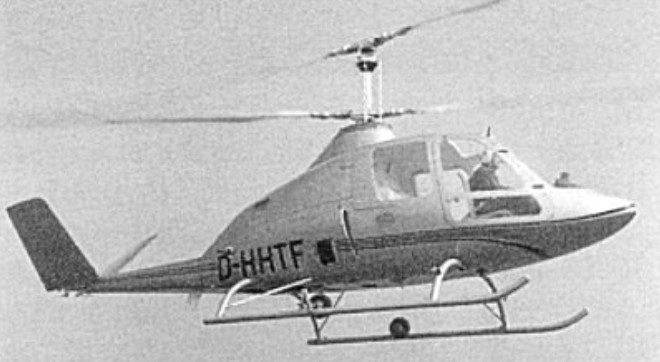
The company developed a kit to convert the Skytrac into a four-seat light helicopter known as the HTM Skyrider. On 21 February 1974 Helicopter Technik München flew the prototype (D-HHTF) of the HTM Skyrider four-seater powered by a 260-hp (194-kW) Avco Lycoming engine.
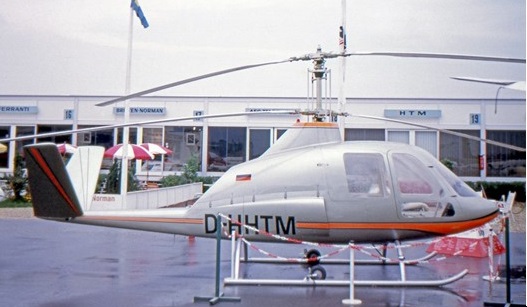
After extensive development work had been carried out, the Wagner designs were passed to a new company, Helikopter Technik Munchen (HTM) in 1971. HTM abandoned the Aerocar, but built a new prototype of the FJ-Sky-Trac (D-HHTM) in tandem two-seat configuration, as a utility helicopter with a 260hp Lycoming IO-540 engine. This still had the coaxial rotor system but was extensively redesigned to accommodate the new engine and cockpit layout.
In 1971, the newly formed Helikopter Technik München (HTM) took over the manufacture and marketing of the Skytrac, announcing in mid-1972 that a production line was being established at Jesenwang with the intention of producing 35 machines by the end of 1973, all of which had found buyers. After this initial batch, HTM planned to sell licences to produce the design in batches of 30 machines each. None of this was to come to pass, however, as HTM was unable to finance the production of the first batch of aircraft.
HTM then went on to build two examples of the HTM Skyrider (D-HTMS and D-HHTF) which reverted to the configuration of the Sky-Trac with a four-seat cabin and a fully enclosed streamlined structure. Mockups of this configuration were displayed at the Hanover and Cannes airshows in 1972 and a prototype was exhibited at the June 1973 Paris Air Show. The Skyrider had a skid undercarriage and V-tail, which commenced flight testing on 21 February 1974. It was possible to convert the basic Skytrac into a Skyrider in a matter of only a few hours’ work.
The Sky-Trac 1 and Sky-Trac 3 were used by HTM to demonstrate the concept, and a new prototype of the Sky-Trac (D-HHTM) was built in tandem two-seat configuration, as a utility helicopter with a 260 h.p. Lycoming 10-540 engine. This still had the coaxial rotor system but was extensively redesigned to accommodate the new engine and cockpit layout.
HTM Skyrider exhibited at the 1973 Paris Air Show
Since 1992 all the rights for production and design of the Skytrac and Skyrider helicopters are owned by Mr. P. Chrobak.
I worked in the Montege des Skytrack and Skyrider from 1972 to 1974 as a group leader and was one of the few co-riders who was allowed to get into a Skyrider. Unfortunately, the company HTM then went into insolvency and I still have a title from the insolvency administrator about 5000 DM that was never enforced. The helicopter was moved in Moosbach / Lohrbach airfield in the Odenwald. Franz Wenninger
Skytrac Engine: 1 × Franklin 6AS-335-B, 195 kW (260 hp) Length: 4.00 m (13 ft 2 in) Main rotor diameter: 10.40 m (34 ft 1 in) Height: 3.80 m (12 ft 6 in) Main rotor area: 84.9 m2 (914 ft2) Empty weight: 850 kg (1,870 lb) Gross weight: 1,500 kg (3,300 lb) Maximum speed: 160 km/h (100 mph) Range: 400 km (250 miles) Service ceiling: 3,500 m (11,000 ft) Rate of climb: 2.0 m/s (400 ft/min) Crew: One pilot Capacity: 2 passengers
Wagner Sky-Trac 3 Engine: 1 x Franklin 6AS-335-B, 195kW / 260 hp Rotor diameter: 10.0m Fuselage length: 4.0m Height: 3.80m Max take-off weight: 1500kg Max speed: 166km/h Service ceiling: 2200m Max range: 200km
The Helikopter Technik Wagner of Friedrichshafen, Germany, was formed by Josef Wagner with the objective to develop a torque-free basic vehicle which could be fitted with a variety of cabins and specialized equipment for different applications. Founded to produce the Skytrac two-seat lightweight multipurpose helicopter, designed originally by Wagner Helicopter Technik.
Development was started in 1960 and designed by Chief Engineer Alfred Vogt, the earliest simple two-seat pod-shaped test models with coaxial rotors and skid landing gear were fairly rudimentary machines built to test the concept, and one design was a roadable machine titled the Rotocar III.
The HTM FJ-Skytrac received both German and FAA certification, and the company developed a kit to convert the Skytrac into a four-seat light helicopter known as the HTM Skyrider. Production terminated owing to lack of capital.
De Bothezat who, after abandoning his first helicopter in 1923, had created a firm for the design and manufacturing of industrial fans, returned in 1937 to the helicopter: he created then the Helicopter Corporation of America and built a coaxial helicopter whose testing was entrusted to a Russian ace of World War I Captain Sergievsky.
Helicopteros Do Brasil sa was founded 1978, with partial Aerospatiale of France shareholding, to assemble Aerospatiale SA 315B Lama and AS 350B Ecureuil helicopters, known locally as HB 315B Gaviao and HB 350B Esquilo respectively. Programs encompassed assembly of Esquilo plus the military AS 550 Fennec version, and AS 365 Dauphin and military AS 565 Panther (all Eurocopter types).

 All Aero