The UH-5 had proved very unstable during trials and had subsequently been fitted with a new stability system patented as the Hiller ‘Rotormatic’. It entailed fitting the two-blade rotor with two small paddles which acted as a control rotor and were also connected to a hanging stick. This servo ‘paddle control’ system tilts the rotor head and actuates the cyclic pitch control.
The UH-4 was a development of the XH-44, which retained the co-axial contra-rotating two-bladed rotors, though the diameter was considerably increased. A two-seat all-metal helicopter with tricycle undercarriage, three were built. The prototype was registered N67706.
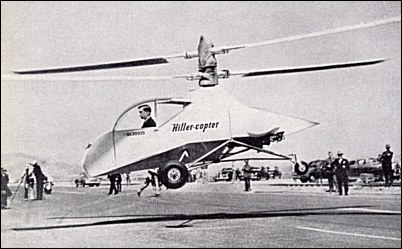
The FH1100 originated from Hiller Aircraft Company’s entry for the US Army requirement of a Light Observation Helicopter (LOH). Designated OH-5A for the technical “fly-off’ it competed against Bell’s OH-4A (B206) and Hughes OH-6A (H369).
Fairchild Stratos Corporation acquired Hiller in 1964 believing they were about to secure a large military contract as the OH-5A stood out the preferred winner. Leaked production data of the OH-5A resulted in Howard Hughes successfully under bidding with the OH-6A. The first FH1100, N81005, flew on 21 January 1963, powered by the Allison T63 turbine engine. Fairchild meanwhile announced they would begin civilian helicopter production of a refined OH-5A, designated the FH1100, offered for sale in June 1966 with either 4 or 5 seats. It became the first US civil turbine helicopter to go into production with a modest 246 units completed by 1971. A small number were produced between 1983 and 1985. This utility helicopter has a semi-monocoque fuselage and conventional tail boom. The semi-rigid two-blade main rotor, able to be stored folded, is controlled by dual hydraulics, with the primary assisting cyclic and collective, the secondary pump actuating the cyclic only. A prototype was constructed by Helicopter Technology Inc. in Century, Florida, in 2002 for the new FH1100 to go back into production as the FHoenix.
RH1100
Under development in 1991 by Rogerson Hiller, the RH1100S features a lengthened and widened cabin and a LCD instrument display.
Stanley Hiller flew the first successful American co-axial helicopter, the XH-44, in July 1944, when he was only 19 years old. It also featured the world’s first successful all-metal rigid-rotor blades. Hiller had learned to fly from his father at an early age, and at 16, Hiller had started a business building small gasoline engine model cars; revenue eventually grew to $100,000. Hiller became interested in helicopters in 1937 when he saw pictures of the Focke Wulf Fw 61 and Sikorsky’s VS-300 in 1939. Hiller felt the tail rotors used on the VS-300 and the outriggers on the Fw 61 were wasteful and possibly unnecessary. The XH-44 evaluated three different rotor configurations: rigid, articulated, and semi-rigid, which was selected. The engine was uprated from a 90hp Franklin to a 125hp Lycoming. The XH-44 was the first successful helicopter west of New York, and Hiller made public demonstrations of the XH-44 in nearby San Francisco.
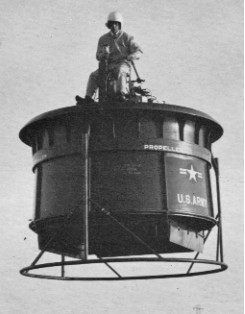
The first of the Army’s designated VTOL research aircraft was a continuation of the work to develop a ‘flying platform’. The idea for a machine of this kind, making use of kinesthetic control (in which the pilot leans in the direction he wishes to go) is attributed to Charles H. Zimmerman and dates back to 1940.
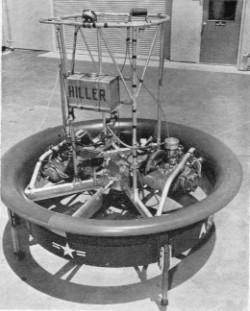
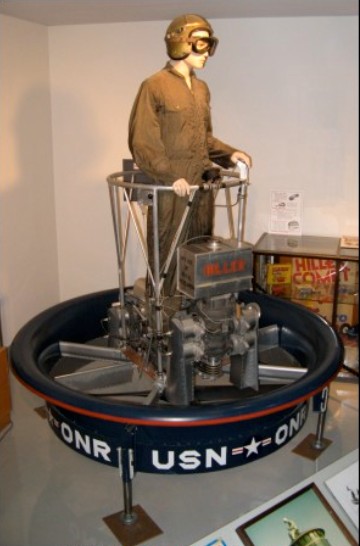
In the early 1950s, N.A.C.A. (the forerunner of N.A.S.A.) undertook a research programme at Langley Laboratory to prove the idea. Three types of aircraft were studied, each capable of carrying one man who stood on a platform, and supported, respectively, by a rotor, a ducted fan and compressed air. Subsequently, the Army placed contracts for further development of a rotor type flying platform by de Lackner (the Aerocycle) and of the ducted fan type by Hiller. The Hiller Helicopter Company had by this time already completed some studies in conjunction with Charles Zimmerman, in 1947, but no free flights were then achieved. A contract was placed with the company in 1953 for the construction of a prototype under Office of Naval Research supervision and this flying platform achieved its first successful untethered flight in February 1955.
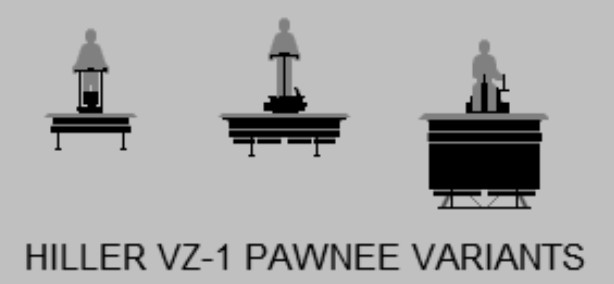
The Pawnee featured a pair of contra-rotating rotors spinning inside a duct with a diameter of 1.5 meters (5 feet). Each rotor was driven by its own 30 kW (40 HP) two-stroke engine. The pilot stood above the duct, surrounded by a circular handrail and protected by a safety harness. He controlled the engines with a twist-grip throttle and leaned to guide the aircraft. The duct improved safety during takeoff and landing. The duct also provided additional lift, since there was a horizontal “lip” around its top edge that curved down into the duct. The airflow into the duct resulted in low air pressure above the lip, and the pressure difference between the top and bottom of the lip generated a net upward force, providing as much as 40% of the total lift of the aircraft.
In practice, speeds of up to 15 m.p.h. were achieved. Hand controls included the throttles to control vertical movement and a control to apply power deferentially to the two propellers in order to keep the platform headed in the right direction.
The Pawnee handled very well in flight tests. The machine was then modified with longer landing gear legs to increase ground clearance, and eight vanes were mounted underneath the duct to improve flight control.
Results of the trials with their early platform were sufficiently promising for the Army to award Hiller a second contract, in 1956, for two larger examples of the flying platform. These were designated W‑ I E (serials 56‑6944 and 56‑6945).
VZ-1E
In the W 1E, the diameter of the duct was increased to 8 ft. and the chord was more than doubled. Three interconnected 30 kW (40 HP) Nelson H 56 engines supplied power to the counter rotating propellers. Controls were modified to be similar to those in a helicopter and the pilot had a rudimentary seat.
First flight of the W 1E (56 6944) was made on February 4th, 1955. It was delivered to the Army in 1959 but no further development occurred.
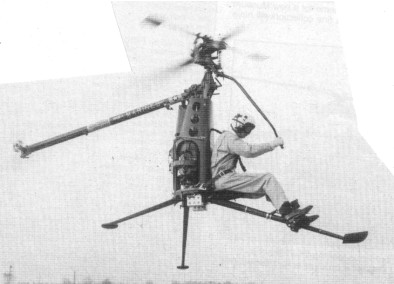
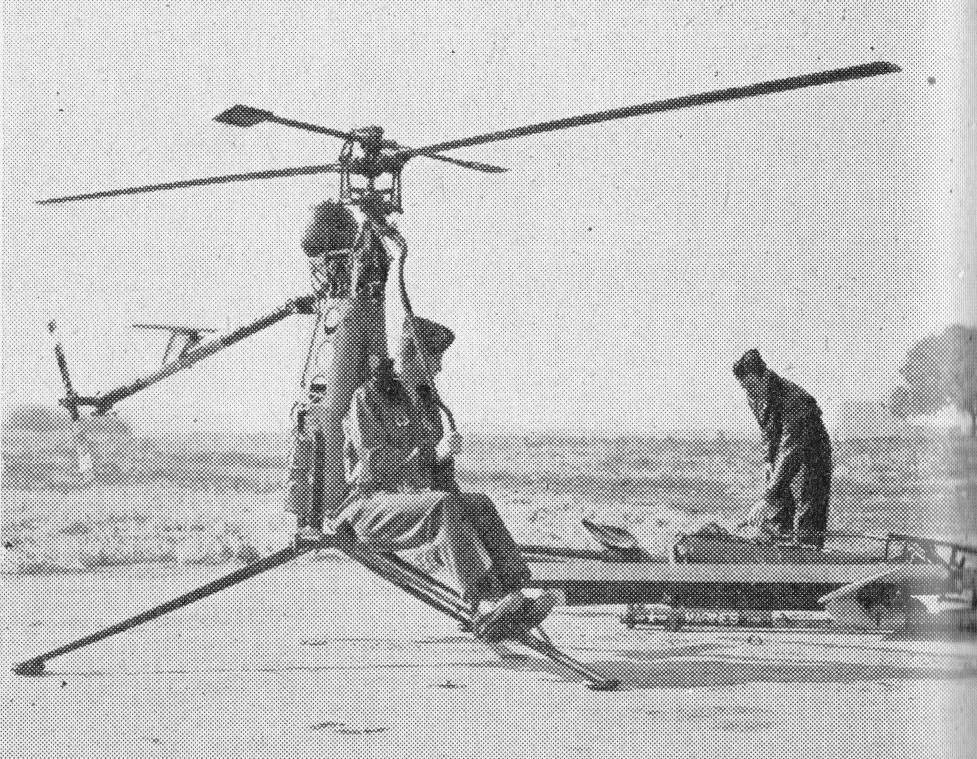
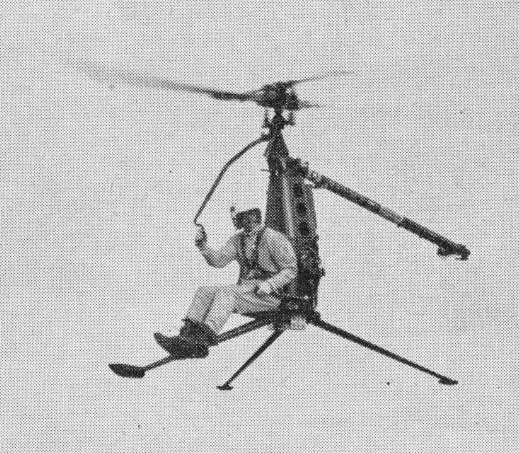
On January 10, 1957, the US Navy announced the successful first flight of the one man collapsible Rotorcycle, developed for the US Marine Corps by Hiller Helicopters of Palo Alto, California. Hiller was one of two companies selected during 1954 to design and build a one man helicopter but the idea was not wholly successful and it failed to achieve full production status after initial flight testing was completed by July 1957. Designated XROE 1, this was a unique one-man helicopter which could fold into a small package for easy transportation or parachute delivery. Weighing less than 250 lbs it was powered by a Nelson four cylinder opposed, two cycle, air cooled petrol engine manufactured by Barmotive Products Inc a single rotor, eighteen feet in diameter and positioned above the pilot’s head, provided lift, with a small tail rotor located in a tubular boom compensating for torque. The entire helicopter was held together by quick release pins and could be assembled by one person. Although not literally a ‘strap on the back’ machine, the XROE 1 approximated closely to this idea, since the pilot sat on what appeared to be a bicycle seat, with the engine just behind him. The US Marine Corps intended to use the XROE 1 for observation, liaison, small tactical missions, such as escape and evasion, pilot rescue and any other James Bond’ type drama.
Transmission of the Rotorcycle incorporated a single spiral bevel gear set and an over-running clutch while the fuel system was of the gravity feed type. Official Marine Corps specification data indicated that the XROE 1 could be folded or assembled in the field in less than five minutes and, for aerial drops to downed pilots or stranded troops, the folded Rotorcycle fitted into a streamlined container suitable for external transportation on a fixed-wing aircraft. It was expected to enter service by Septembr 1959.
During May 1958, while on a European sales tour, the Hiller XROE 1 Rotorcycle was demonstrated at Elstree aerodrome, Herts. On this occasion, two men assembled the machine in just three minutes, a rather slow time according to the manufacturers who stated that the record stood at one minute fifty seconds. Although based around a Marine Corps specification, the XROE 1 was evaluated by both Germany and Switzerland, the licensee in Europe being Helicop Air of Paris and the estimated cost was $10,000 for production machines.
Demonstration in England 1955
In November 1958, a contract was signed for a batch of ten Rotorcycles to be built by Saunders Roe at its Eastleigh, Southampton factory, on the basis that it would cost less to build a small batch of XROE 1s in the United Kingdom than in the USA. Helicop Air of Paris, Hiller’s agent in Europe, was responsible for handling the contract which was quite unique.
Using materials from the USA, Saunders Roe built the jigs and tools, manufactured the gearing, transmission components and the structure. All proprietary items, including the engine, electrics, main rotor blades and instruments, were also supplied from the USA. The Rotorcycles were completed in accordance with Hiller drawings.
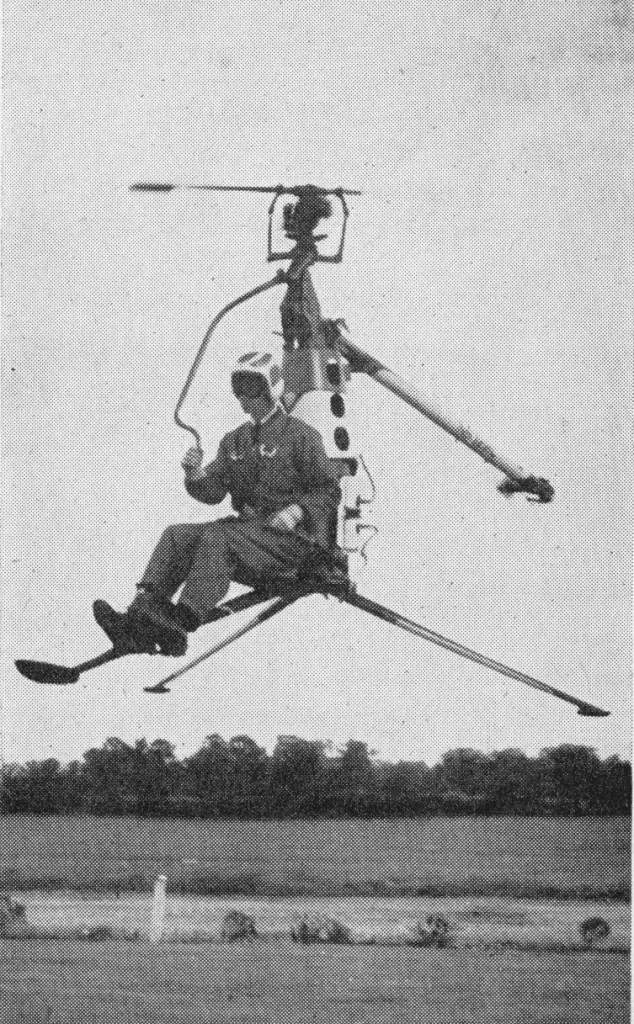
Saro-built Rotorcycle
The control technique was known as the Hiller Rotormatic system while, in place of a landing gear, the Rotorcycle was supported on three tapered aluminium alloy spring tubes.
The fate of the majority of the XROE 1 Rotorcycles after leaving the Eastleigh factory of Saunders Roe is not known, but the type was evaluated for the Marine Corps at the Naval Air Test Centre and the published performance figures are based on this evaluation. Three Rotorcycles all designated YROE 1 were also assessed by NASA at their Ames facility at Moffett Field, California, YROE 1s ‘4020’ ‘4021’ and ‘4024’ being delivered there on November 16, 1962. The serial numbers applied to the YROE 1s tonsisted of four digits only, this system not conforming to the more familiar BuNo’s as used by the Bureau of Aeronautics to identify US Navy and US Marine Corps aircraft and helicopters. Two examples of the Hiller YROE 1 Rotorcycle reside in museums situated within just a few miles of each other. The first specimen ‘4020’ is in a private museum owned by James S Ricklefs of Rick Helicopters Inc. of San Carlos, California. This one has an intact manufacturer’s plate which revealed the following interesting information: Manufacturer’s model 1033: Customers model YROE4: Serial No 6: Customer’s serial No 4020: Contract No 59 6022: Engine type YO 65 2. Accepted 21 June 1960. Manufactured by Saunders Roe Lid. England under agreement from International Engineering Research & Development, Luxembourg under licence from Hiller Aircraft Corporation, USA. Restored by John Trome 1980. The second YROE 1, 14021′, was discovered in The Flying Lady Museum which is owned by Irv and Jan Perch and located at Morgan Hill, near South County Airport, some 65 miles south of San Francisco.
Hiller Helicopters Inc. was formed in 1942 for the development and production of rotary-wing aircraft. Early work on the Hiller Model XH-44, UH-4 Commuter and the UH-5, which introduced a newly-developed ‘Rotor-Matic’ rotor control system, led to the Hiller Model 360 prototype. Stanley Hiller flew the first successful American co-axial helicopter, the XH-44, in July 1944, when he was only 19 years old. It also featured the world’s first successful all-metal rigid-rotor blades. Hiller had learned to fly from his father at an early age, and at 16, Hiller had started a business building small gasoline engine model cars; revenue eventually grew to $100,000. Hiller became interested in helicopters in 1937 when he saw pictures of the Focke Wulf Fw 61 and Sikorsky’s VS-300 in 1939. Hiller felt the tail rotors used on the VS-300 and the outriggers on the Fw 61 were wasteful and possibly unnecessary. Formed 1942 as a division of Hiller Industries. Name changed to Hiller Helicopters in 1948.
In 1948 Hiller Helicopters produced the Hiller UH-12, subsequently supplying it to civilian operators and, as the H- 23B and OH-23C/D Raven, to the U.S. Army and to foreign air arms under the MDAP program . Three-seat UH-12E (first flown 1958) and four-seat UH-12E4 variants also developed. The Hiller HOE-1 Hornet ramjet ultralight helicopter and “Flying Platform” were two military experimental types devised by the company.
In 1964 Fairchild-Stratos Corp purchased Hiller Aircraft with cash, not stock transactions. Hiller capabilities fitted into one of Fairchild’s primary goals – vertical takeoff and landing aircraft. The Hiller plant was to remain in Palo Alto.
Fairchild Stratos Corporation acquired Hiller in 1964, hence the FH designations, believing they were about to secure a large military contract as the OH-5A stood out the preferred winner. Leaked production data of the OH-5A resulted in Howard Hughes successfully under bidding with the OH-6A. Fairchild meanwhile announced they would begin civilian helicopter production of a refined OH-5A, designated the FH1100. Hiller Aviation Inc was formed in 1973 after acquiring the design rights, tooling and spares for Hiller 12E light helicopters from Fairchild Industries. The company provided support for operators of Hiller helicopters and produced three-seat UH- 12E and four-seat UH-12E-4 turbine conversions of the UH-12E, developed in conjunction with Soloy Conversions. Also introduced former Fairchild Hiller FH-1100 in 1984 (later as RH-1100). Became subsidiary of Rogerson Aircraft in 1984, reviving first the name Hiller Helicopters and later becoming Rogerson Hiller Corporation.
Hiller Aircraft Corporation was founded 1994 by Jeffrey Hiller (son of the founder of the original Hiller Aircraft company) and a consortium, to repurchase assets from Rogerson Hiller Corporation. First flight January 1995 of the UH-12E5 five-seat helicopter, and June 1995 for first newly built UH-12E3.
1995: 2140 West 18th St, Port Angeles, Washington 98362, USA.
The Turbine Exec is a turbine kit to repower the Rotorway Executive kit helicopter. First flown in April 1997, the US$20,000 kit included the engine, gearbox reduction drive and tail rotor gearbox.
Max speed: 125 mph Cruise: 100 mph Range: 225 sm Rate of climb: 1500 fpm Service ceiling: 13,500 ft Engine: Solar T6Z-T32 hp range: 150-170 Fuel capacity: 35 USG Empty weight: 750 lb Gross weight: 1425 lb Height: 8 ft Length: 22 ft Disk span: 25 ft Seats: 2
The first flight was scheduled for the Spring of 1998. Kits were to include everthing except radios, with plans selling for US$350, and kit for US$68,000.
Max speed: 170 mph Cruise: 130 mph Range: 390 sm Rate of climb: 1500 fpm Service ceiling: 13,500 ft Engine: Solar T6Z-T32 hp range: 150-400 Fuel capacity: 45 USG Empty weight: 900 lb Gross weight: 1800 lb Height: 8 ft Length: 28 ft Disk span: 25 ft Seats: 2
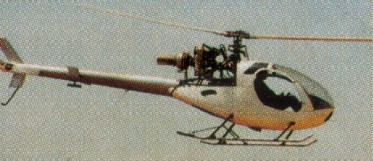
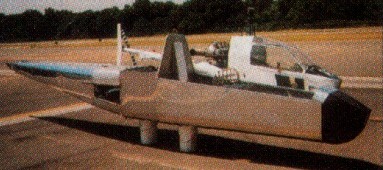
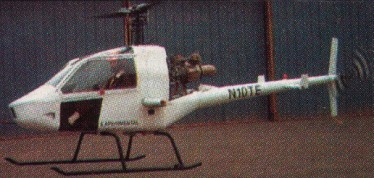
A turboshaft powered helicopter first flown in 1994. The first kit was shipped in January 1998. Plans were selling at US$350 and the kit price was US$68,000. Of aluminium construction, the Solar T62T32 or other engines with 150-225 hp are suitable.
Max speed: 160 mph Cruise: 130 mph Range: 300+ sm Rate of climb: 4700 fpm Engine: AiResearch, 145 hp hp range: 145-250 Fuel capacity: 32.9 USG Empty weight: 635 lb Gross weight: 1300 lb Height: 7.4 ft Length: 20.1 ft Disk span: 20 ft Disk area: 314.2 sq.ft Seats: 1


 All Aero