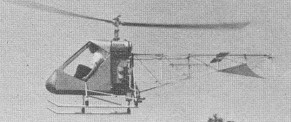
International Helicopter Commuter IIA

The commercial rights to the Helicom H-1 Commuter Junior were sold to Southern Pacific Aircraft Co and then to International Helicopter Inc of Mayville, New York, with the machine being refined along the way as the Commuter II – a two-place, 125 hp Franklin engined helicopter. First built in 1970. The creator of that design, Harold “Pop” Emigh, went on to develop the popular 2-seaters—the Commuter-IIA and -IIB.
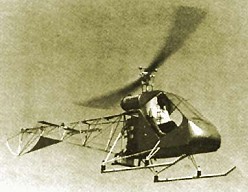
The Commuter IIA main rotor and tail rotor are both gear driven, and it is powered by the proven 150-hp Lycoming aircraft engine with a dual ignition. Such complicated parts as the main rotor transmission, tail rotor gear box, rotor blades, etc., are assembled at the factory. The airframe is of Chrome-Moly steel tubing. With engine off it descends at a rate of only 1200 to 1400 fpm.
Commuter IIA price in 1982: $12,000 (Excludes engine). Plans available for $75. Aircraft kit with engine costs $18,000. Units delivered to June 1982: 89.

Vortech offered the large, thick manual containing the building plans for the classic Commuter-II. The airframe, control system, main- and tail-drive system, engine mounting, cabin construction, etc. are all detailed. Bear in mind that the control head was sold as an assembled, tested component and the drawings for this unit are somewhat general.

Commuter II
Engine: Franklin, 125 hp

Commuter IIA
Engine: Lycoming 150 hp
Rotor Diameter: 25 ft
Length: 22 ft
Height: 8 ft
Width: 5.7 ft
Empty Weight: 700 lbs
Gross Weight: 1,300 lbs
Useful Payload: 600 lbs
Maximum Speed: 100 mph
Cruise Speed: 70 mph
Rate of Climb: 900 fpm
Range: 225 miles
Service Ceiling: 11,000 ft

Commuter IIA
Gross weight: 1,375 lbs.
Empty weight: 800 lbs.
Useful load: 575 lbs.
Fuel capacity 22 USG.
Rotor span 25 ft.
Length 29 ft.
Engine 150-hp Lycom¬ing.
Top speed 100 mph.
Cruise 90 mph.
Climb rate 1071 fpm.
Ceiling 13,000 ft.
Range 225 sm.

Commuter IIB
Engine: Lycoming O-320, 150 hp.
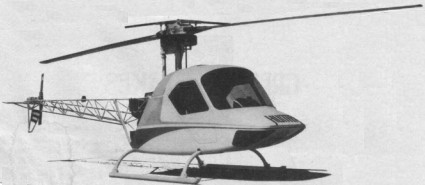
Industrias Cardoen Ltda

Chile
Following demise of program to develop single-seat attack helicopter from BO 105, company developed C206L-III multipurpose helicopter from Bell LongRanger (first flown 1989), featuring pilot only in cockpit behind flat-plate glazing, plus cabin accommodation. Took new name Industria Metalurgica del Norte Ltda 1992.

Indian Helicopters The Indian

A small helicopter, it can be stored in a single car garage, can be built in any home workshop with simple tools.
It has full cyclic, full collective, tail rotor pedals, twist grip throttle and is capable of vertical take-off and landing – a VTOL helicopter. The Indian is capable of hovering, forward, backward with sideward flight and autorotation.
A homebuilt helicopter using “off-the-shelf components” it can be built as an ultralight helicopter.
It is constructed with bolt together 4130 chromoly steel tubing frame (and 6061-T6 aluminum tubing) and could be built for under $8,000 including engine using off-the-shelf components. The build time was estimated at 300-800 hours depending on ability.

Dual carb, dual CDI 50-65 hp engine, 2 cycle, two cylinder inline, fan cooled
Compact Radial, Rotax or Hirth aircraft engines – recommended
A 55hp+ motorcycle engine with mount or other engine may be used
Main rotor blades are NACA 0012 – 21′ x 8″ 425 RPM
Tail rotor blades are NACA 0012 – 36″ x 3.5″ 3000 RPM
Empty weight – 254 lbs
Gross weight – 525 lbs
Useful payload – 273 lbs
Length – 15′ 9″
Width – 7′
Height – 7′ 6″
Cruise speed – 63 mph
Top speed – 75 mph
Ceiling – 9000′
Fuel – 5 gallons/1.25 hrs
Range – 100 miles

Hunt Helicopter 1910

A helicopter designed and built by A. E. Hunt of Kansas, identifiable by the two large drum-like constructions that were the rotors. Hunt, a blacksmith, appeared to have put most of his stock of pipe and angle iron into the machine, as it ended up weighing 3 tons. Since the rotors generated 400 pounds of lift, performance was somewhat below what he might have been hoping for.