USA
Heli-Air became Jaffe Aircraft Inc / Jaffe Helicopter Inc.
Jaffe Aircraft Inc. intended to manufacture the Swearingen- developed SA-32T Turbo Trainer, but abandoned the program. Jaffe Helicopter Inc. at same San Antonio address marketed the 222SP as an upgrade of the Bell 222.
Helicopters
Jacobs 104
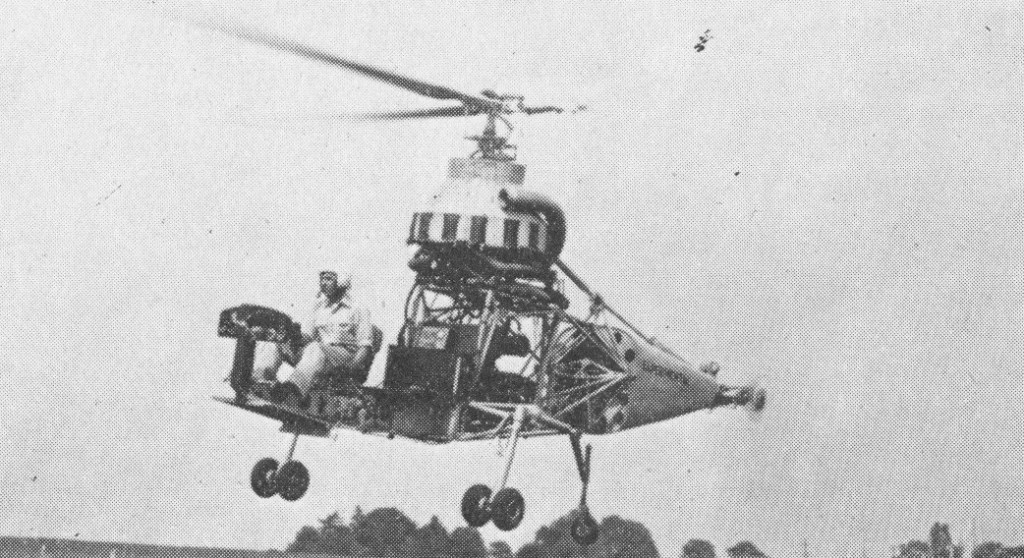
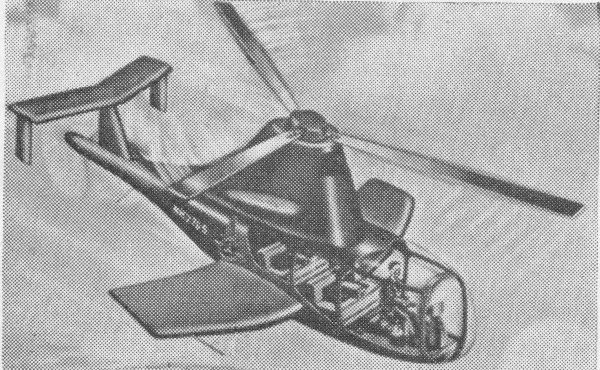
Designed circa 1958 as a high-speed short-haul aircraft, the Jacobs 104 was originally flown as a pure helicopter, as shown in the photograph above. Subsequently, a pusher propeller was fitted at the extreme tail.
It will take off as a helicopter; but in cruising flight it will be possible to transfer power to the pusher propeller, with the rotor auto-rotating and the majority of the lift coming from the fixed wings.
A feature of the Model 104 is the use of a Jacobs-designed engine “package”, consisting of the engine and complete transmission system. It is claimed to be 20 per cent lighter than conventional helicopter power plants, enabling one extra passenger to be carried. Also, by using moulded fibreglass and Plexiglass panels to cover the forward fuselage, high strength is combined with light weight, and the surface requires no painted or doped finish.
Engine: 350 h.p. Jacobs R-755EH
Rotor diameter: 36 ft.
Rotors: 3-blade main; 3-blade tail; 3-blade propeller.
Overall length: 26 ft. 4 in / 22 ft
Height: 10 ft 10 in
Empty weight: 2360 lb
Loaded weight: 3,475 lb.
Max. speed: 175 m.p.h.
Cruise: 157 mph
ROC: 1400 fpm
Typical range: 300 miles at 157 m.p.h.
Seats: 4-5.
Jacobs Aircraft Engine Co
The Jacobs Aircraft Engine Company was formed in 1929 in Philadelphia. Later the company moved to Pottstown, Pennsylvania after purchasing the machine workshop of the Light Manufacturing and Foundry Company.
An early product was the Jacobs L-3, a small 55 hp 3 cylinder engine of 1929.
The Cessna UC-78 Bobcat used the L-4 engine
By 1933, Jacobs had developed the L-4 seven-cylinder radial air cooled engine with a power rating of 225 horsepower and a displacement of 757 cubic inches (12.4 litres). It was better known as by its military designation, the R-755. At the time it became known as the best producer of engines in the 200-400 horsepower range. Jacobs was the first to start making engines using forged aluminum pistons, sodium-filled exhaust valves and magnesium alloy crankcases.
The L-4 was used mostly on the Cessna UC-78 Bobcat, Cessna 195 and Stearman PT-18 Kaydet.
Due to the tendency of the L-4 engine to vibrate heavily at low rpms it was given the nicknames Shakin’ Jake and Shakey Jake.
Later developments included the 285 hp L-5 or R-830, and 330 hp L-6 or R-915.
Jacobs engines were fitted to many US-built aircraft of the inter-war period, including several Waco models. They were in use in 26 different countries including in Canada, where 330 horsepower L6-MB engines were used to power the Royal Canadian Air Force’s Avro Anson Mk. II aircraft.
In 1941 the American War Department gave the contract to Jacobs to produce Pratt & Whitney R-985 and R-1340 engines until 1945. Jacobs ranked 87th among United States corporations in the value of World War II military production contracts.
After World War II, Jacobs became a division of Republic Industries (not Republic Aircraft).
Products:
Jacobs LA-1
Jacobs LA-2 (R-590)
Jacobs L-3
Jacobs R-755/L-4
Jacobs R-830/L-5
Jacobs R-915/L-6
Isacco Helicogyros
Italian Vittorio Isacco developed his ‘helicogyros’ in the U.S.S.R. in the 1930s.
IRGC Shahed 274 / X-5
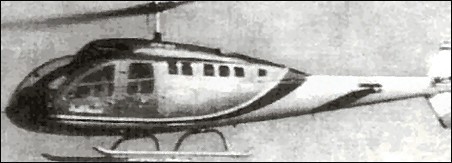
Development of the Shahed 274 light utility helicopter is reported to have been undertaken by the Pasdaran, or Revolutionary Guards. The organisation may also be responsible for a new transport helicopter.
Sponsored (as X-5) by the Institute ol Industrial Research and Development of the IRGC; reportedly due to have made its first flight in 1997.
Power is from one 313kW Roils-Royce 250-C20B turboshaft. Featuring a two-blade main and tail rotors; fully enclosed cabin and tailboom; upper and lower vertical fins. Landing gear is a twin-skid type. Seats for five persons including pilot. Forward-opening crew door and passenger door each side; baggage door aft of latter on port side.
First aircraft (71-832) handed over to IRGC 16 September 1999. International public debut, in Tehran, 30 December 2000. At least two more (74-001 and -002) in service by end of 2001. Further public appearance in air show on Kish Island, October/ November 2002.
A total of 20 (some sources suggest 30) were reportedly planned to be built by end of 2004.
Shahed 274
Engine: 1 x Rolls-Royce 250-C20B, 313kW
Main rotor diameter: 10m
Fuselage length: 9m
Height overall: 3m
Max. take-off weight: 1500kg
Empty weight: 1000kg
Max. level speed: 180km/h
Service ceiling: 5200m
Max range 600km
Iranian Aviation
Iran’s aviation industry infrastructure was by and large established in the 1930s, at the time of the Shah Reza Pahlavi, where the German Junkers & Co Aviation provided the foreign expertise and assistance.
The Iran Aviation Industries Organization (IAIO) (Persian: سازمان صنایع هوایی ایران) was established in 1966 for the purpose of planning, controlling, and managing the military aviation industry of Iran.
The IAIO was responsible for directing five aviation organizations: SAHA, HESA, PANHA, GHODS, Shahid Basir Industry. These five organizations have different and complementary roles in the Iranian defense industry and Iranian civil aviation, and have progressed, with the exception of Ghods, from repair and maintenance facilities to larger defence enterprises with several thousands employees.
The Iran Helicopter Support and Renewal Company (IHSRC), or PANHA, was formed in 1969, the Iranian Aircraft Industries (IACI) in 1970, and Iran Aircraft Manufacturing Industries Corporation (IAMI), also known under its Persian acronym HESA, in 1974. Two other companies, Iran Aviation Industries Organization of the Armed Forces, (also known as the Iranian Armed Forces Aviation Industries Organization (IAFAIO)), and GHODS Research Center were formed in the early 1980s.
The industry was later expanded in the 1970s in the reign of Shah Muhammad Reza Pahlavi, benefiting from the boosted oil revenues. Not only did the Shah order vast quantities of America’s most advanced weapons, he was also acquiring the capability to produce them in Iran. Under a multibillion-dollar industrialisation programme, the Shah commissioned US arms firms to build entire weapons factories from scratch in Iran.
Thus Bell Helicopter (a division of Textron, Inc.) was building a factory to produce Model-214 helicopters in Isfahan. Northrop Corporation was also a joint partner in Iran Aircraft Industries, inc., which maintained many of the US military aircraft sold to Iran and was expected to produce aircraft components and eventually complete planes. These efforts represented a large share of US industrial involvement in Iran, and were a centrepiece of the Shah’s efforts to develop modern, high-technology industries.
After western sanctions following the Iranian Revolution, the general official policy of Iranian government changed from having the best available in the world to being able to manufacture independently in order to meet domestic needs, specially of technological products and therefore becoming “sanction-proof”.
In no other field this urgency was higher than aeronautics. Therefore Iran has avoided the need to purchase better western aircraft available to it from time to time in favor of inferior ones that could be manufactured in Iran through arrangements of purchasing licenses and technologies as well as reverse-engineering parts, mostly to avoid situations that Iran has gone through during 1980s till now by not being able to maintain what it had due to domestic technological starvation.
Major Projects
Former Iranian President Mahmoud Ahmadinejad had favored the purchase of aircraft such as Iran-140 which are manufactured in Iran. An agreement for licence production of the Antonov An-140 by Iranian Aviation called ‘Iran-140’ was signed in 1993. The first aircraft, supplied as a kit, flew on 7 February 2001.
Negotiations were underway to manufacture 50 An-148 under licence to be named Iran-148. Agreements were signed with Russia for co-development and co-manufacture of an uncertain amount of Tu-334 airliners in Iran with production to commence simultaneously both in Iran and Russia.
Another agreement with Poltava Helicopter Company of Ukraine allows Iran to manufacture the Aerokopter AK-13 ultra-light multi-purpose helicopters in Iran. Yet, Iran says it is prepared to order passenger planes from Boeing and Airbus if the United States lifts sanctions against Iran. In 2010, Iran’s Defense Ministry said it will begin the production phase of a domestically-manufactured medium-size passenger plane designed to carry up to 150 passengers.
Qaher-313, single-seat stealth fighter aircraft publicly announced on 1 February 2013.
In 2006 Textron sued IAIO, for producing counterfeits of six types of its Bell unit helicopters without licenses thereby using trade secrets and patented designs without permission and demanded compensation for damages. In another lawsuit (Bell Helicopter Textron Inc. v. Islamic Republic of Iran, Case No. 06cv1694, in U.S. District Court for the District of Columbia) brought by Iran against Textron earlier, Iran had sought damages against unfulfilled contracts dating back before revolution. Textron ultimately sent five commercial helicopters to Iran in addition to providing spare parts and training in 1994 to settle the dispute.
IPTN / Industri Pesawat Terbang Nusantara
Indonesia
IPTN was created August 1976. Partner with CASA of Spain in the Airtech CN 235 regional transport program, plus CN 295. Developed N-250 50/68-passenger twin-turboprop -regional airliner (first flown August 1995), and has proposed the 70-passenger N-270 variant. N2130 expected to fly in the year 2002 as a 132-passenger medium-range airliner. Produces NC-212 version of CASA C-212, NBO-105 version of Eurocopter BO 105, NSA-332 version of Eurocopter Super Puma, and various Bell helicopters as NBell types. Subcontract work includes parts for Lockheed Martin F-16 fighter and Boeing 737/767 airliners.
Intora-Firebird Atlas Firebird
The enclosed fuselage Atlas Firebird two-seater helicopter.
Intora-Firebird Firebird
The Firebird open-frame single-seat helicopter was also available in UAV form.
Intora-Firebird Plc
Offers the Firebird open-frame single-seat helicopter, also available in UAV form, and the enclosed-fuselage Atlas Firebird two-seater.
 All Aero