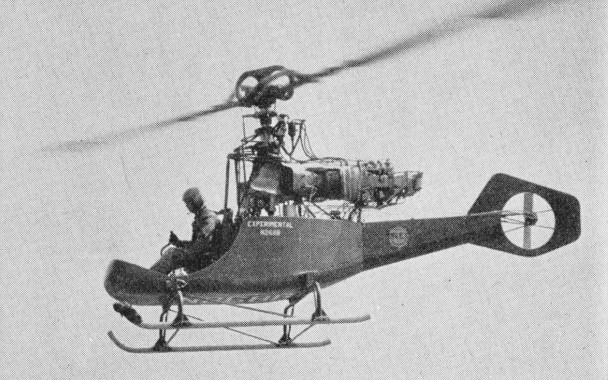
The Kaman K-17is powered by a Blackburn Turmo 600 turbine engine. This engine drives a Boeing compressor which supplies air to pressure jets at the rotor tips. The K-17 first flew in the Spring of 1958.
The Kaman K-17is powered by a Blackburn Turmo 600 turbine engine. This engine drives a Boeing compressor which supplies air to pressure jets at the rotor tips. The K-17 first flew in the Spring of 1958.
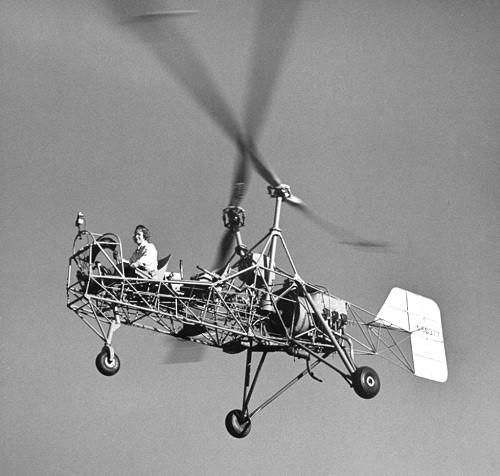
The K-190 was built in 1948.
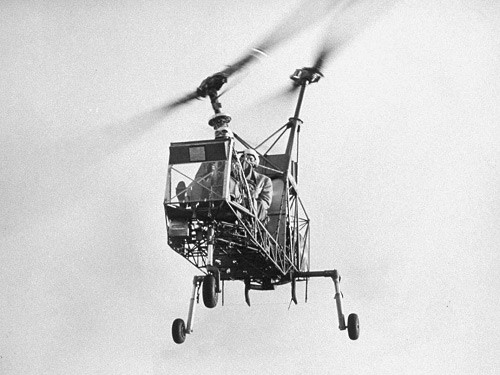
This was an improved version of the earlier K-125 – a utility helicopter given a CAA type certificate in April 1949.

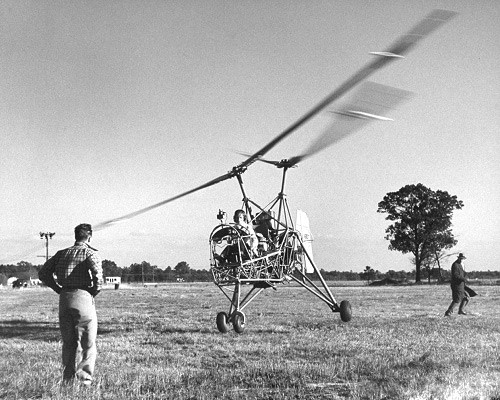
Kaman’s first helicopter which first flew on 15 January 1947.
Formed in 1945 by Charles H. Kaman as Kaman Aircraft Corporation to develop a special servo-flap control system for helicopter rotors and “synchropter” lntermeshing twin rotor system, with aim of eliminating anti-torque tail rotor. K-125A built in 1947; K-190 in 1948; K-225 built in small numbers as YH-22 from 1949. HOK-1 delivered in quantity to U.S. Navy and Marines during 1950s; HTK-1 to Navy as trainer/ambulance, and also adopted as remote-controlled drone. By late 1960s well over 200 H-43 Huskie turbine-powered rescue helicopters were serving with the USAF. H-2 Seasprite naval rescue and utility helicopter first flown July 1959, retaining servo-flap system, though on a conventional main rotor. Seasprite developed in many versions, early production models using a single turboshaft engine and later models with twin turboshafts; experiments included stub wings serving as sponsons and gunship version with Minigun chin turret among other weapons.
In the late 1960s much subcontracting undertaken, together with development of Rotorchute and allied devices. Became Kaman Group in 1965 with extended activities, with Aerospace subsidiary subsequently taking the present name Kaman Aerospace Corporation as part of Kaman Group. Current programs include producing upgraded SH-2Fs as SH-2G Super Seasprites for antisubmarine/ anti-shipping, over-the-horizon targeting, SAR, mine countermeasures, vertrep and other roles, for delivery to Royal Australian Navy, Royal New Zealand Navy, Egypt, and U.S. Navy Reserve; production of K-MAX “Aerial Truck” single-seat, turboshaft-powered and twin intermeshing rotor external-lift helicopter (first flown December 1991); and subcontract work on Boeing airliners and for various military aircraft including AH-1, C-17, Comanche, F-22, and V-22.
1995: Old Windsor Rd, PO Box 2, Bloomfield, Conneticut 06002, USA.
In 2000 Kaman Aerospace was se¬lected by MD Helicopters (MDHI) to be the sole supplier of fuselages for its line of single-engine helicop¬ters, including the MD600N, MD520N, MD530F and the MD500E. The agreement is worth a reported $100 million.
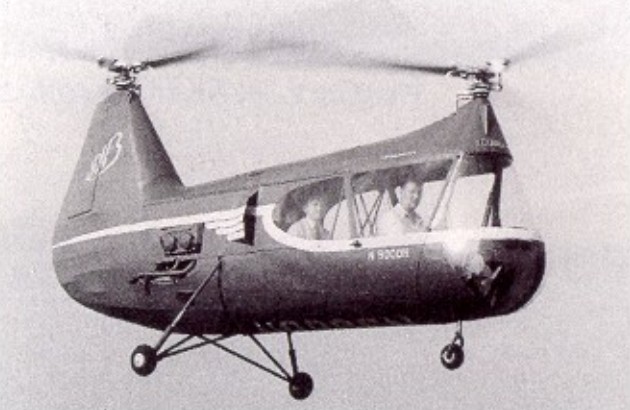
Development began in 1946 with the Helicopter Engineering and Research Corporation headed by D.K. Jovanovich and F. Kozloski, where a small 2-seat prototype (N9000H) was built with the designation JOV-3. This aircraft, powered by a 125hp Lycoming O-290, was flown successfully in 1948. It had 3-blade rotors of 5.64m diameter, a gross weight of 618kg, a maximum speed of 161km/h and a range of 221km.
The JOV-3 Tandem rotor machine was powered by a 100hp Franklin engine. It had a neat fuselage of steel tube covered with aluminium and fabric, with a tricycle undercarriage and a forward cockpit for two occupants seated in tandem. The rear pylon allowed the rear rotor to turn on a higher plane than the forward rotor so that the arcs could overlap safely.
In 1949 Helicopter Division of McCulloch Motors Corporation appointed as chief designer D. K. Jovanovich, formerly of Helicopter Engineering and Research Corporation, who developed his JOV-3 as McCulloch MC-4 tandem rotor two-seat helicopter, first flown Los Angeles March 20, 1951.
The Helicopter Engineering Research Corp was formed in 1947 by D.K. Jovanovich and F.J. Kozloski who were former employees of the Piasecki Helicopter Corp. Their first design, the two-seat tandem rotor Jov-3, flew in 1947. The company was renamed J.O.V. Helicopters in 1948. The design rights were sold to McCulloch Motors in the same year for their new Helicopter Division, with Jovanovich as Chief Engineer.
The Aircraft Division of McCulloch Motors Corporation developed a slightly larger model, the MC-4C. Jovair Corporation was formed some years later and took the design a stage further, resulting in the Sedan 4E (certificated 1963), of which limited production began in 1965. In June 1962 Jovair flew the prototype J-2 two-seat light autogyro; both programs were taken over 1969-1970 by McCulloch Aircraft Corporation.
Jovanovich and Kozloski left McCulloch when the Airplane Division was closed, and formed Jovair Corp in 1957 to continue their work on helicopters.
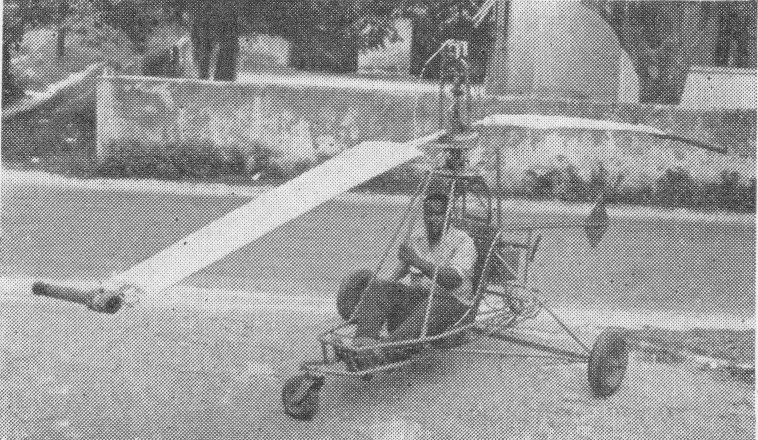
Built as a flying test bed for the Jervis tip-powered rotor system, the Baby J was flown in Nassau, Bahamas, in 1952.
Power: 2 x Jervis pulse-jets
Rotors: 2-blade, tip-powered main rotor
Seats: 1
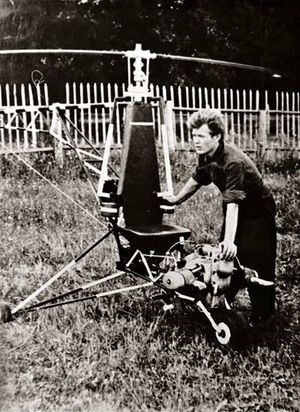
The JAI-22 helicopter (Russian: ХАИ-22) was developed by the Bureau Student Building (SKB) of the JAI between 1966 and 1968 as light experimental. V. Revinov was in charge of the design and construction.
This helicopter was designed from a tubular structure attached to a seat, installed on a tricycle skeleton train. The main rotor and transmission system were attached to this seat.
The main rotor featured two parallel, counterbalanced chord blades. The landing gear had small wheels.
The powerplant consisted of a 36-hp M-62 motorcycle engine, located at the front, under the pilot’s feet. The angular momentum of the crankshaft axis was transmitted through a double level reducer to a cardan system, an angle reducer, to the vertical axis and from there to the rotor blades. To compensate for the reactive moment at the end of the tail bar, a small 1.1 meter diameter two-bladed anti-torque rotor was placed, moved in the test bed by a small “Druzhba” motor and then in the JAI-22A by a transmission system from the main rotor.
The JAI-22 was built as an experimental test bed with the aim of developing the lift system to be used in the future construction of light helicopters. The 5.4 meter diameter main rotor blades, constructed of fiberglass, were tested on this test bed. The tests were carried out at the JAI aerodrome, where a special test station was set up.
After some modifications, the JAI-22 test bed was converted into the JAI-22A light helicopter operational model with a take-off weight of 220 kg.
The JAI-22A was tested in a captive configuration in 1968, showing low motive power, so free flight was not authorized at low ground level.
Despite this, in 1968 itself it was shown at the Exhibition of Economic Achievements (VDNJ) of the USSR and its authors were awarded.
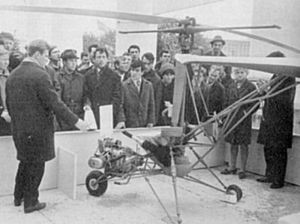
In 1969 the production of a small pre-production series was studied, which would never be carried out.
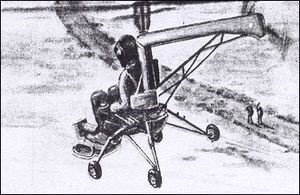
JAI-22A
Engine: 36 hp M-62 motorcycle
Main rotor span: 5.40 m
Rotor disc: 22.90 m²
Tail rotor span: 1.10 m
Empty weight: 90 kg
Loaded weight: 220 kg
Fuel Weight: 40kg
Maximum speed at 500 m: 100 km / h
Cruising speed: 70 km / h
Static ceiling: 1000 m
Range: 200 km
Rotor load: 9.61 kg / m²
Power load: 5.85 kg / hp
Seats: 1
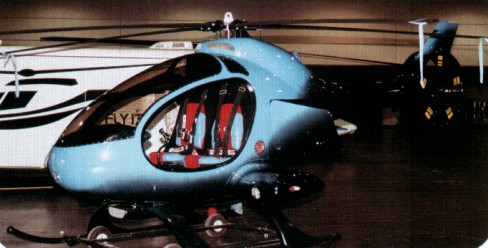
Of composite construction and sold as a self-assembly kit in 2002.
Engine: 1 x 317 shp RR/Allison 250-C18 turboshaft.
Blades: up to 8.
Max speed: 178 mph.
Cruise: 145 mph.
Range: 399 sm
Ceiling: 14,500 ft.
2002: Roseville, Minnesota, USA.
Helicopter builder
 All Aero