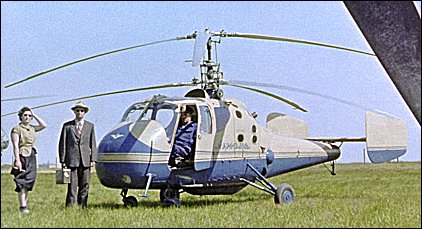
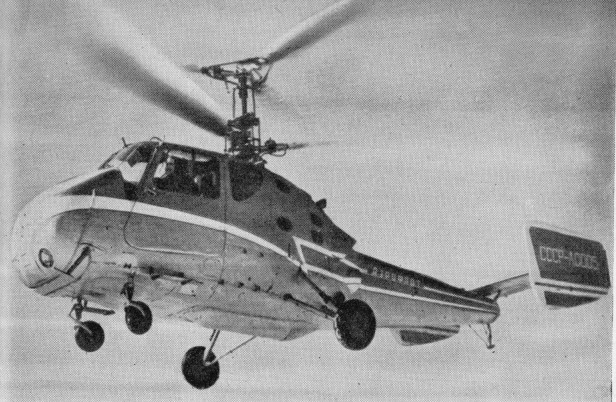
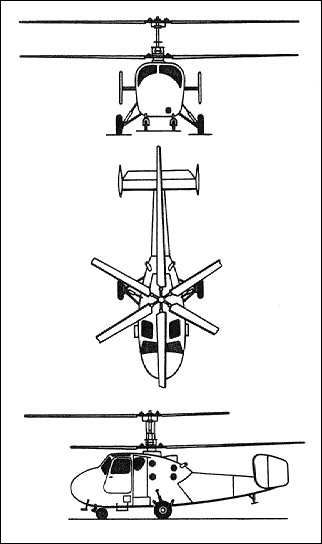
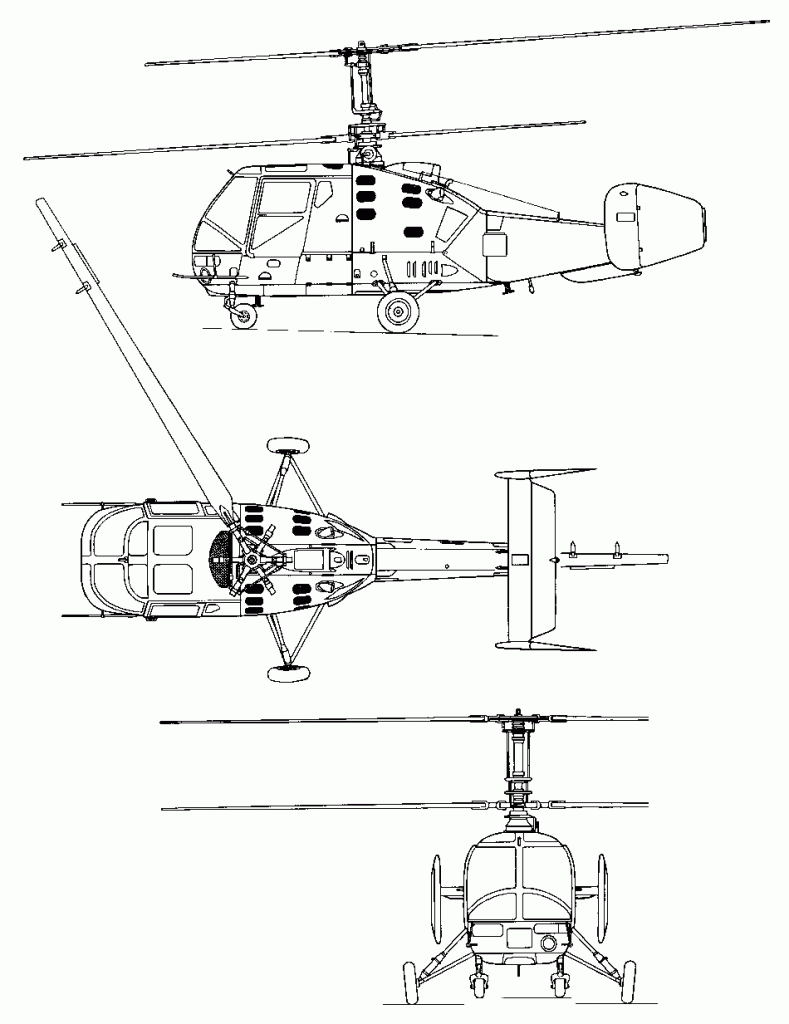
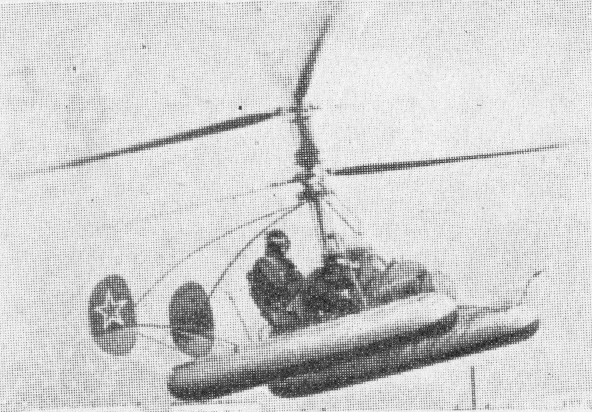
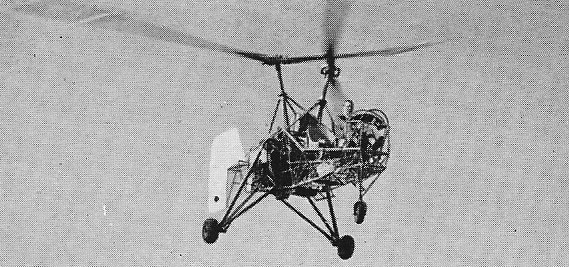
The Kamov Ka-18 (NATO reporting name Hog) was a four-seat development of the Ka-15M. Retaining the same engine, rotor, transmission, control systems and landing gear, the main changes were to the fuselage, which was stretched to make room for two passengers and a baggage compartment (up to 200kg). The doors hinged at the rear, and 176 litres of fuel was in floor tanks. De-icing of the blades and windscreen used alcohol, and an exhaust heater muff fed hot air on demand to the cabin. The prototype was completed in 1956 and flight testing began early in 1957.
In 1958 the Ka-18 was awarded a Gold Medal at the World Exhibition in Bruxelles. The Ka-18 was produced with blind-flying instruments and an optional 70-litre ferry tank for AV-MF, VVS and Aeroflot. A limited number of the Ka-18 were built for use as air ambulances and for forestry patrol, geological survey and agricultural work. Towards the end of 1960, the production aircraft were given a 275hp AI-14VF engine (VF stands for Vertolet Forsirovannie meaning helicopter with turbocharger) instead of the AI-14V, thus enabling the payload to be increased by about 100kg and the ceiling by 300-500m. The chord of the end plate fins was also enlarged. There was a Uka-18 dual control variant. Approximately 200 were built.
Ka-18 Crew: 1 Passengers: 3 Engine: 1 x Ivchenko AI-14VF, 200kW / 280 hp Rotor diameter: 10.0m Length: 10.0m Height: 3.4m Max take-off weight: 1502kg Max speed: 160km/h Cruising speed: 130km/h Service ceiling: 3500m Range with max fuel: 450km Range with max payload: 300km
Shipboard operations with the Ka-10 showed the necessity to start the construction of a new rotary-wing machine capable of lifting greater loads and less restricted by weather conditions. In 1950 AV-MF wrote an outline requirement for a larger two-seat helicopter with an enclosed cabin and much greater endurance.
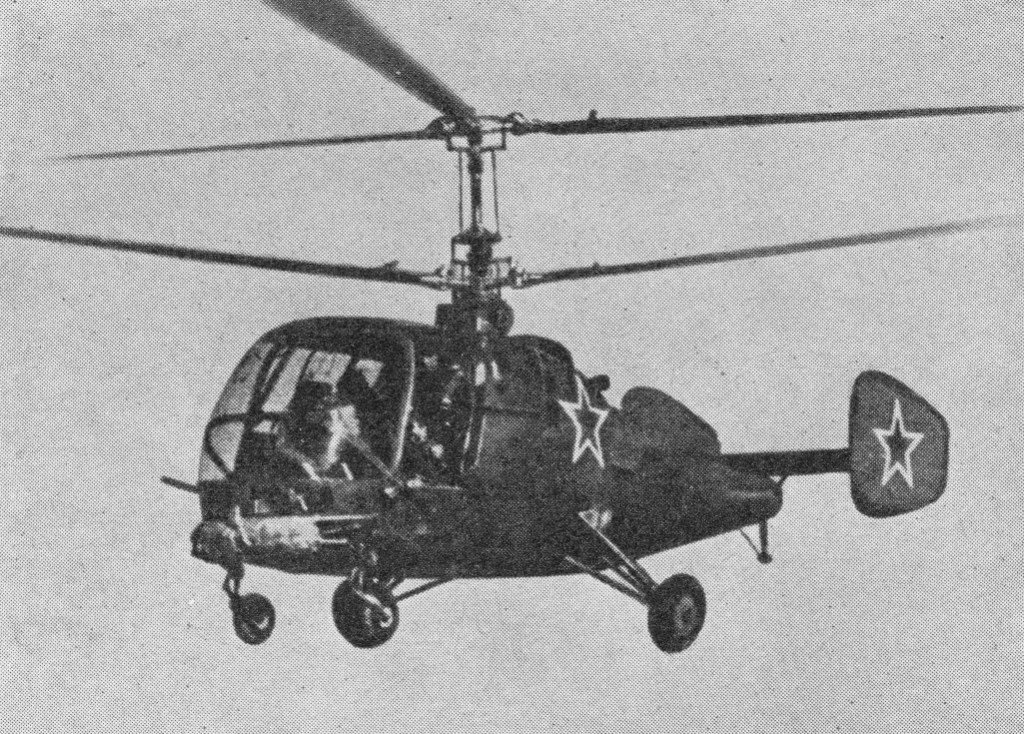
These requirements were met by the Ka-15 which, like its predecessors, featured the co-axial layout. It was a two-seat helicopter with side-by-side seating for the pilot and a mission equipment operator or a passenger. The rotor hubs and blades were scaled up but compared with Ka-10M, the only significant change was low-density foam filling the blades between ribs and taper of blades towards the tip. The airframe was welded steel tube, with a covering of ply or dural removable panels and thin plastic glazing and sliding side doors round side-by-side cockpit ahead of rotor, with the engine behind. The powerplant was a 225hp AI-14V air-cooled radial engine installed at the center of the fuselage, but towards the end of 1960, most Ka-15Ms were given uprated 275hp AI-14VF engines. The engine was mounted with the crankshaft horizontal, driving a cooling fan, 90 degree angle drive to the rotor via over-running clutch, and DC generator starter. From the engine to tail was of stressed-skin dural construction, with a fixed tail comprising braced tailplane and two endplate fins toed in at front (parallel on some Ka-15s), with pedal-driven rudders for yaw control. The Ka-15 made its first flight on April 14, 1953 at the hands of test pilot D.K.Yefremov. State acceptance trials were completed in 1955, and next year the helicopter entered production at aircraft factory No.99 in Ulan-Ude. Most fitted with two main and two nose landing wheels, plus tail bumper. The nose wheels were castoring and the main wheels were braked. At least one had pontoons and one with three skis. AV-MF used substantial number for liaison, ship-based recon and dual Uka-15 for training. Ship trials in 1954 included dripping sonar, but it was unable to carry the equipment needed for ASW missions. The leadership of the Soviet Navy ordered a fly-off between the Ka-15 co-axial helicopter and the Mil Mi-1 single-rotor helicopter, during which both types operated from the cruiser “Mikhail Kutuzov”. By virtue of its small size and manoeuvrability the Ka-15 successfully performed take-offs from and landings on the ship’s small helipad even in sea state 6 conditions. Conversely, the Mi-1 was considerably hampered by its long tail boom and tail rotor and could not operate when air turbulence and pitching and rolling motion of the ship were present. The results of the fly-off finally convinced the Navy that choosing the co-axial layout for a shipboard helicopter was the right decision.
The ASW version the Ka-15 was fitted with two RGB-N sonobuoys or with the SPARU-55 automatic airborne receiver unit. One of such helicopters dropped sonobuoys in the designated part of a sea, the other received information from them about the presence or absence of a submarine. Once a submarine was detected, a third Ka-15 equipped with the OPB-1R sight and two 50-kg depth charges entered service. The first units equipped with Ka-15 helicopters were formed in 1957-58. In 1958 work commenced on equipping the destroyer “Svetly” (Project 57) with a helipad. In 1960-1961 the Navy took delivery of eight Project 57 ships featuring helipads, support equipment for helicopter operations and accommodation for pilots and maintenance personnel.
The Ka-15 evolved into a number of specialized versions, including the multi-purpose Ka-15M, the UKa-15 dual-control trainer version and the four-seat Ka-18. In each case prototype construction began at factory No.82 in Tushino and was completed at the OKB’s own experimental shop near Ukhtomskaya railway station.
The Ka-15 and its versions remained in service for almost 20 years. Between 1958 and 1963, rotor blades of new design were developed, tested and introduced on the Ka-15M and the Ka-18. They were made of composite materials which improved the lift/drag ratio of the rotor and extended the service life of the blades. In 1958-59 test pilot V.V.Vinitsky established two world speed records on the Ka-15M (5 May 1959 170.455km/h over 500km). The Ka-15 marked the beginning of co-axial helicopters operations in the Navy and Civil aviation, the Soviet state airline. As was universally acknowledged, V.B.Barshevsky, M.A.Kupfer, N.N.Priorov, A.J.Vlasenko and D.K.Yefremov made major contribution to the development of the Ka-15. From 1958 civil Ka-15M used for many roles including ag-spraying; Ka-15S equipped to carry two external stretchers. The NATO reporting name for the Ka-15 is Hen.
Ka-15 Crew: 1 Passengers: 1 Engine: 1 x AI-14V, 188kW / 225 hp Rotor diameter: 9.96m Fuselage length: 6.26m Height: 3.35m Width: 2.85m Max take-off weight: 1370kg Empty weight: 968kg Internal payload: 364kg Max speed: 155km/h Service ceiling: 3050m Range: 350km
By 1948 Kamov had completed drawings an improved and enlarged (but still single-seat) machine. The structure was similar to the Ka-8 but refined. A co-axial helicopter for observation and liaison duties designated Ka-10, it was designed to meet a general operational requirement (GOR) submitted by the Naval Air Arm.
The rotor diameter was increased by 0.2m over the Ka-8, and blade camber was introduced. Significant changes were made to the helicopter’s control system.
The AI-4G engine was completely new, designed by Ivchenko for this application with two stages of reduction gearing, freewheel with centrifugal clutch and improved power split between rotors. It was fitted with electric start and engine-driven cooling fan.
The first Ka-10 was flown by D.K.Yefremov in September 1949. It was followed by three more prototypes and eight Ka-10M pre-production models; the latter were distinguished by the fact that they had a different rotor assembly and an endplate fin tail unit instead of the single fin of the Ka-10.
These helicopters were tested at length by AV-MF, and one made the first Soviet deck landing on 7 Dec 1950. ASCC reporting name “Hat”.
Ka-10 Crew: 1 Engine: 1 x AI-4G, 40kW Rotor diameter: 5.8m Fuselage length: 3.9m Height: 2.5m Width: 1.97m Max take-off weight: 370kg Max speed: 90km/h Service ceiling: 2500m Range: 170km
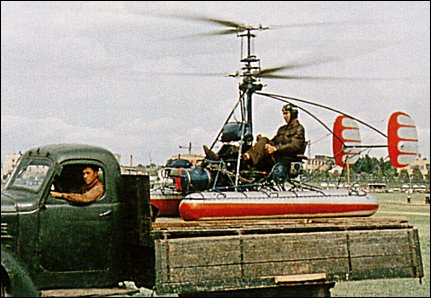
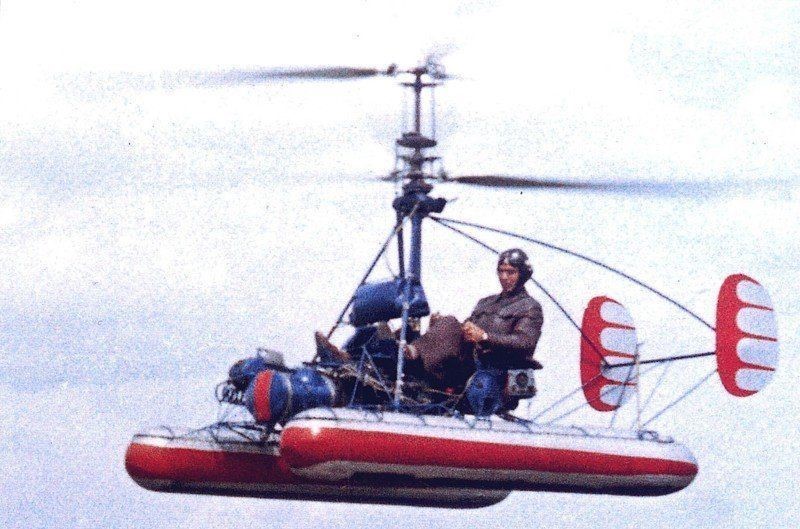
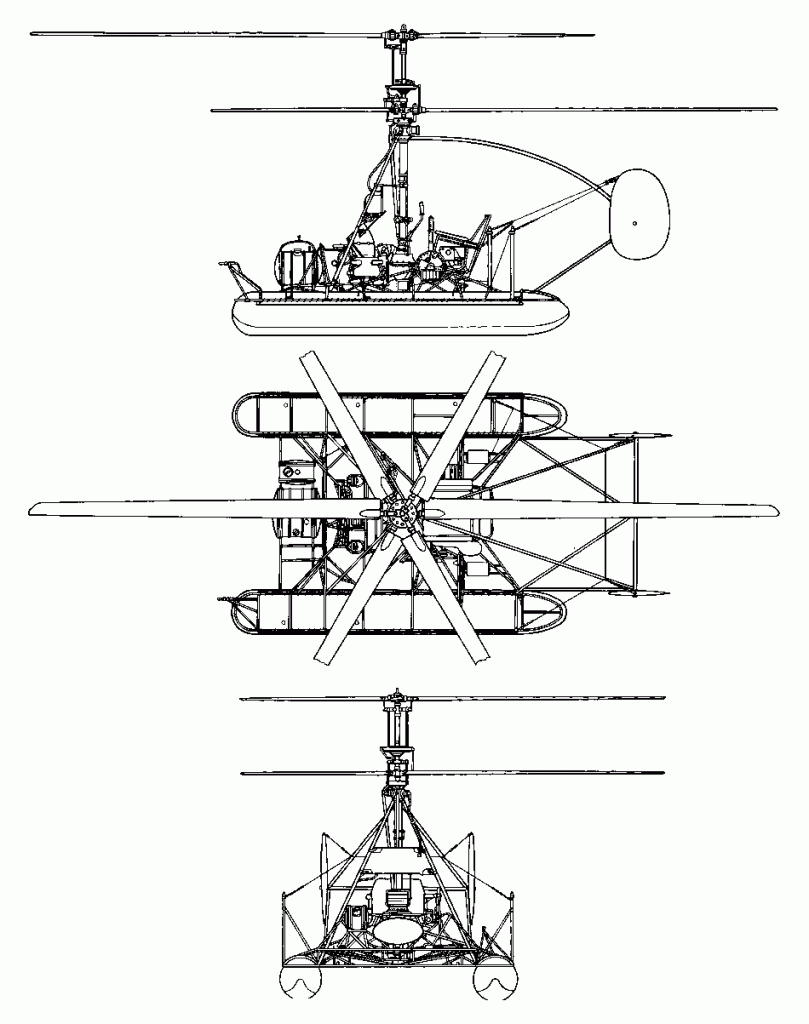
Official disinterest in autogyro made Kamov switch to helicopters, and he decided to build one-man Vozdushnii Mototsikl (flying motorcycle) for civil or military use in 1946. It is reported to have taken 18 months before permission was granted to organize a small informal group and build the Ka-8. The design featured coaxial rotors, each with three built-up wooden (mainly spruce) blades of NACA-230 profile with glued construction and fabric covering. Metal root of the blades was held in the hub with drag and flapping hinges driven by superimposed swashplates moved directly by pilot. The rest of the airframe was welded steel tube, with the pilot and fixed fin at the rear and the engine and fuel tank at front, resting on two pontoons of rubberized fabric.
The Ka-8 was powered with a 27 hp motorcycle engine, boosted to 45 hp by using alcohol for fuel. First flown in 1947, piloted by Mikhail Gurov, the low output of the two-cylinder motorcycle engine and its unsuitability for aeronautical use handicapped the aircraft. The handlebar flight control was replaced by a vertical collective and cyclic levers, pontoons tapered front to rear, and the fin was changed to rudder driven by pedals. It was the first single-place helicopter built in USSR. The Ka-8 “Irkut” performed on July, 25, 1948 at the Tushino airfield in Moscow during the airforce parade. Only three were built.
After this aircraft made its successful flights Nikolai Kamov was ordered to design the new helicopter for Soviet Navy.
Ka-8 Crew: 1 Engine: 1 x M-76, 20kW Rotor diameter: 5.6m Length: 3.7m Height: 2.5m Max take-off weight: 275kg Empty weight: 183kg Max speed: 80km/h Service ceiling: 250m Hovering ceiling: 40m-50m
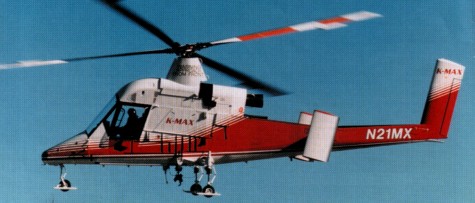
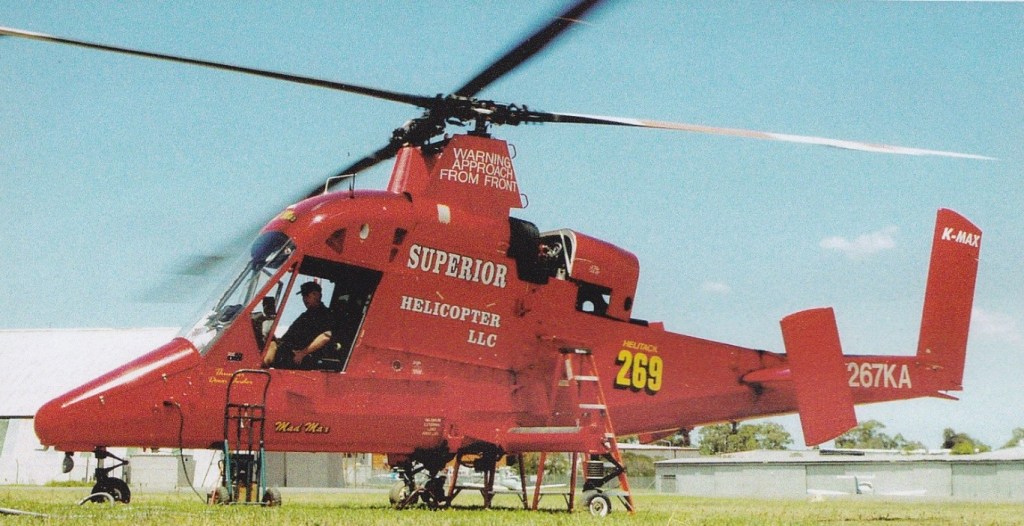
By July 1997, 23 K-Max had been built. Overall, the fleet had accumulated 26,000 hrs, with the highest time example reaching 4000 hr since delivery in October 1994. The production rate was six per year.
Kaman K-Max Engine: Textron Lycoming T 5317 A1, 1479 shp Instant pwr: 1118 kW. Length: 51.837 ft / 15.8 m Height: 13.583 ft / 4.14 m Rotor diameter: 48.228 ft / 14.7 m Max take off weight: 11501.3 lb / 5216.0 kg Weight empty: 4701.1 lb / 2132.0 kg Payload: 2722 kg Max. speed: 100 kts / 185 kph Max cruise: 100 kts Service ceiling: 25000 ft / 7620 m Crew: 1 Payload: max 2700kg ext.
The basic Seasprite design won a US Navy design competition during 1956 for a high performance, all-weather, multi-role utility helicopter, then designated the HU2K-1. The prototype Seasprite first flew on July 2, 1959 and an initial contract was for four prototypes and twelve production Kaman helicopters, now known as the UH-2A and given the name Seasprite. The initial production UH-2A models were powered by one engine, however, they were equipped for IFR operations and a total of 88 were ultimately built. The UH-2B was VFR equipped and 102 in total were built with fully retractable forward mounted main landing gears.
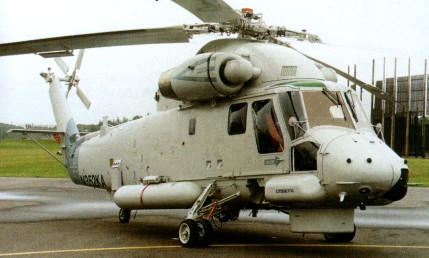
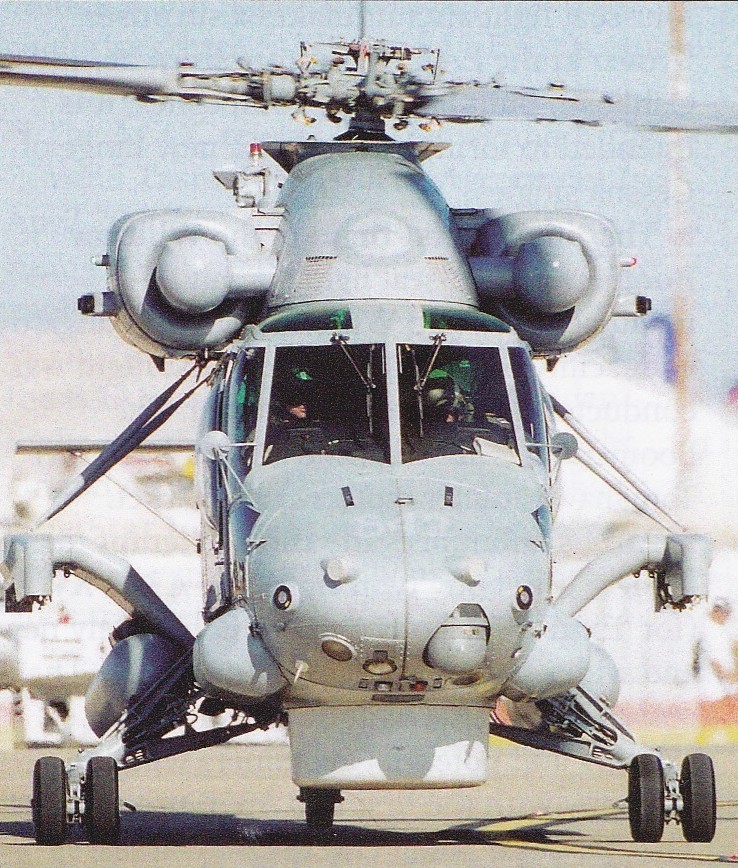
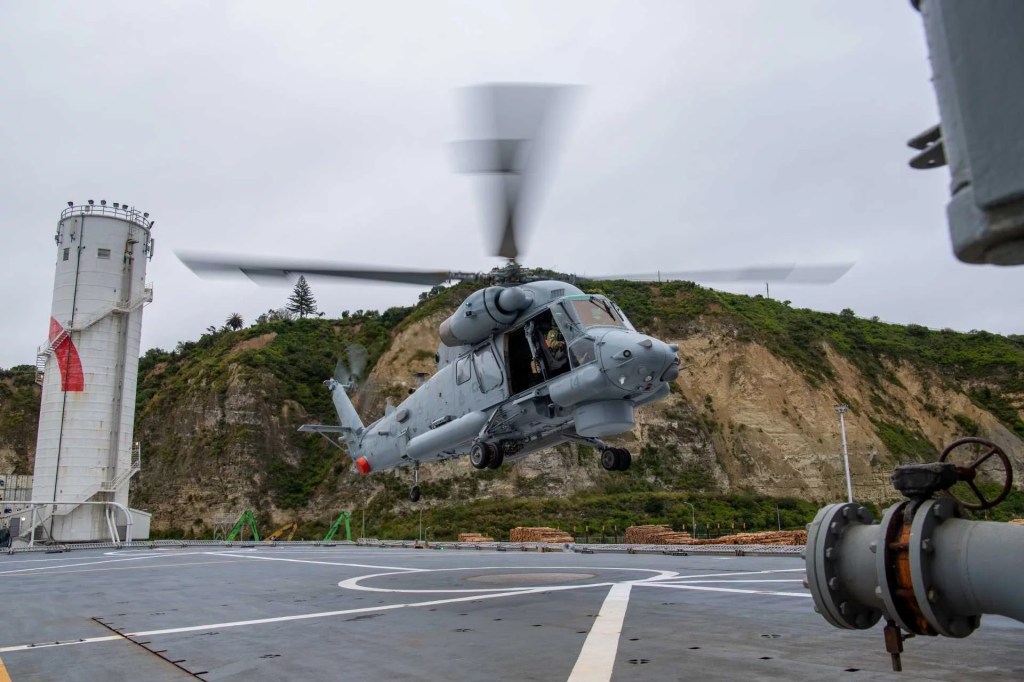
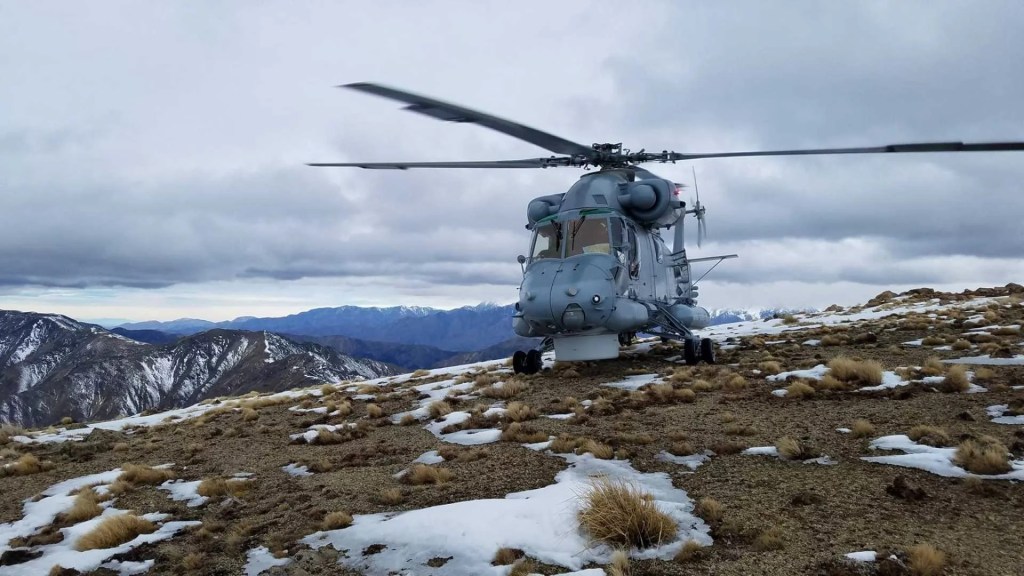
The UH-2A and UH-2B could each carry a 1814 kg (4,000 1b) slung load or 11 passengers, and work in planeguard, SAR, fleet reconnaissance, vertrep (vertical replenishment) and utility transport duties, operating from many surface warships as well as at shore bases. The UH-2C, a re-definition of the UH¬2 and UH-2B, was the first to be fitted with two engines. From 1967 Kaman converted of 88 earlier SH-2D Seasprites to the SH-2F version in May 1973. The SH¬2F “Super Seasprite” has “up-rated” engines and the LAMPS system (light airborne multi¬purpose system). Fifty-two new SH-2Fs were delivered from 1981. Deliveries of the SH-2F version began in May 1973 after completion of 190 early-model UH-2A/B SAR helicopters. Before manufacture was suspended 88 SH-2Fs were built. Deliveries from resumed production began in 1983, and Seasprites delivered after October 1985 have an increased gross weight of 6,124kg, compared with the 5,805kg of earlier SH-2Fs. With a crew comprising pilot, co pilot and sensor operator, the SH 2F can carry MASW gear including Canadian Marconi LN 66HP surveillance radar, towed ‘bird’ for the AN/ASQ 18 MAD, AN/ALR 64 passive detection receiver, Difar passive and Dicass active sonobuoys, and comprehensive nav/com and display systems. The 4,000 1b (1814 kg) cargo ability remains, and a 600 1b (272 kg) rescue hoist is standard. Production of the twin-turbine SH-2F Seasprite Mk.1 light airborne multipurpose system (Lamps I) restarted in 1982, to meet a US Navy requirement for up to 60 helicopters to equip vessels too small for the SH-60B Seahawk. Up to FY1986 54 new-build SH-2Fs had been authorised, and six more were requested in FY1987. These will join some 79 SH-2Fs from earlier production which were still in service at the beginning of 1986, some of which were upgraded SH-2Ds. Ten new SH-2Fs were delivered in 1986. A re-engined version of the Seasprite, the YSH-2G, flew on April 2, 1985, powered by two General Electric T700 turboshafts similar to those used in the SH-60B and giving improved range, reliability, and maintainability. Evaluation of the prototype YSH-2G was completed in 1985. In general terms, the SH-2G is a retrofit of the SH-2F model. The heart of the SH-2G(NZ)’s weapons platform is its Litton ASN-150/1553B tactical data system, APS-143 (V) 3 radar, Doppler APN-217 (V) 6 radar, FUR Systems AAQ-22 forward-looking infrared system, and Litton Amecon LR-100 electronic support measures ESM sensor system. These systems are operated from the two pilot analogue cockpit, with the observer (air¬borne warfare officer) occupying the left-hand seat. The helicopter’s missions are primarily surface sur¬veillance and anti-surface warfare, where the helicopter will conduct surveillance tracking and targeting and, if necessary, engage surface targets, but it is also capable of sub-surface weapon delivery and utility support, including search and rescue, replenishment, medical evacuation, naval gunfire spotting and troop transport for boarding operations.
SH-2G(A) Super Seasprite
In May 2006 the Royal Australian Navy’s fleet of 11 SH-2G(A) Super Seasprite was grounded with problems with their avionics and electronics systems. Service entry had been delayed by five years due to serious systems integration and software problems.
H-2 experiments included stub wings serving as sponsons and gunship version with Minigun chin turret among other weapons.
Kaman Aerosystems, are powered by two General Electric T700 turbines rated at 1,600 hp each. Measuring 16 meters in overall length with a 13.5-meter rotor diameter, they have a maximum take-off weight of 6,441 kg, a range of approximately 275 nautical miles, and a maximum endurance of around two hours and 45 minutes. Capable of reaching airspeeds near 130 KCAS, they feature a standard crew of three: a pilot, an observer responsible for warfare and mission coordination, and a helicopter loadmaster managing utility operations. Armament options include Penguin anti-ship missiles, Mk 46 torpedoes, and a door-mounted MAG 58 machine gun.
The SH-2G lineage traces its origins to the United States, where the type was developed in the 1980s as a modernized version of the SH-2F for use on naval vessels unable to accommodate larger helicopters like the SH-60B Seahawk. The SH-2G introduced more powerful engines, a reinforced upper fuselage, and improved avionics, including an Integrated Tactical Avionics System (ITAS) and digital automatic flight controls. Despite its eventual phaseout in the U.S. by 2001, the type continued to serve internationally, including with the Egyptian, Polish, and Peruvian navies.
The SH-2G(I)’s design emphasizes multi-role capability, supporting missions such as over-the-horizon surveillance using radar and FLIR systems, anti-ship strike with guided missiles, underwater warfare with torpedoes, as well as disaster response, medevac, and transport operations.
HH-2D Engines: 2 x General Electric T58 GE 8F turboshafts, 1,350 hp each. Length: 38 ft 4 in. Rotor dia: 44 ft. Speed: 168 mph. Ceiling: 22,500 ft. Range: 445 miles.
SH-2F Seasprite Engine: 2 x GE T58 8F turboshafts, 1,350 shp (1007 kW). Installed pwr: 2041 kW. Rotor dia: 13.4 m (44 ft 0 in). Main rotor disc area 141.25 sq.m (1,521.0 sq ft). Fuselage length: 12.3 m (40 ft 6 in), (folded): 11.7 m. Height: 4.72 m (15 ft 6 in). No. Blades: 4. Empty wt: 3193 kg (7,040 lb). MTOW: 6033 kg (13,300 lb). Max speed: 265 km/h (165 mph). ROC: 744 m/min. Ceiling: 6860 m. HIGE: 5670 m. HOGE: 4695 m. Fuel cap (+aux): 1500 lt ( 455 lt ). Range max¬ internal fuel: 680 km (422 miles). Crew: 3. Armament: one or two AS torpedoes (usually Mk 46).
SH-2G Super Seasprite Engine: 2 x GE T700-401. Instant pwr: 1259 kW. Rotor dia: 13.41 m. MTOW: 6124 kg. Payload: 2107 kg. Useful load: 987 kg. Max speed: 141 kts. Max cruise: 136 kts. Max range: 869 km. HIGE: 17,600 ft. HOGE: 14,600 ft. Service ceiling: 20,400 ft. Crew: 3. Pax: 8.
SH-2G(NZ) Engines: 2 x T700 GE-401 gas turbines of up to 1723 shp each, plus one Garret GTCP36-150 APU.
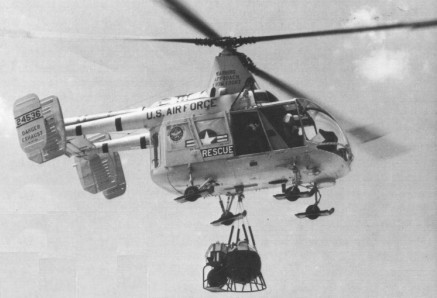
The H-43 was designed extremely compact because it’s inter-meshing rotors. Between 1958 and 1965 some 365 were built.
By late 1960s well over 200 H-43 Huskie turbine-powered rescue helicopters were serving with the USAF.
Kaman HH 43 B Husky Engine: Lycoming T53-L-1B, 848 shp Length: 25.164 ft / 7.67 m Height: 12.598 ft / 3.84 m Rotor diameter: 47.014 ft / 14.33 m Max take off weight: 9161.8 lb / 4155.0 kg Max. speed: 104 kts / 193 kph Service ceiling: 25000 ft / 7620 m Range: 240 nm / 445 km Crew: 1+8
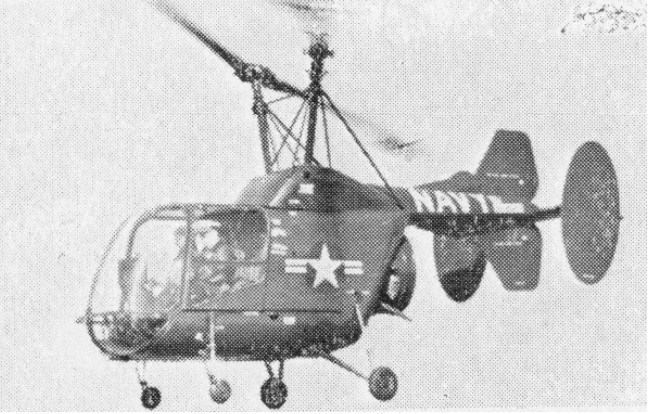
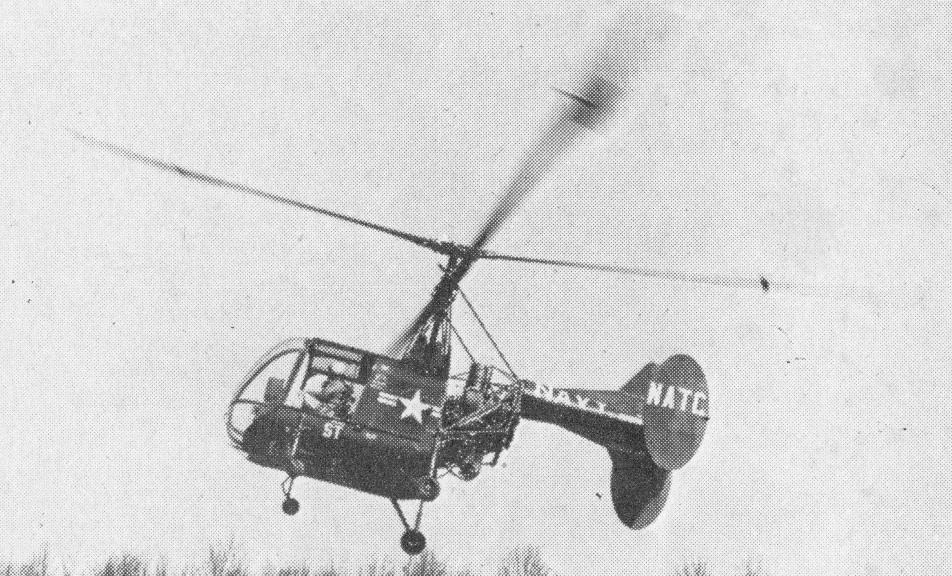
Ordered into production for the U.S. Navy at the same time as the HOK-1“off the drawing board “, the HTK-1 also uses the Kaman system of inter-meshing rotors, controlled through servo flaps.
The HTK-1 was delivered to the U.S. Navy as trainer/ambulance, and also adopted as remote-controlled drone. For ambulance work it can carry a stretcher and medical attendant in its cabin, and two casualties on Stokes litters externally, one on each side.
One HTK-1 has been fitted experimentally with two Boeing T50 gas turbines.
Boeing YT-50-BO-1 powered
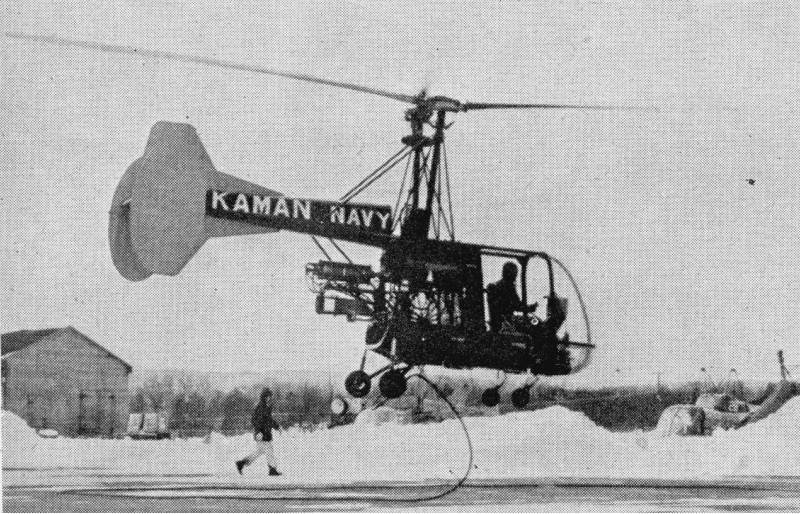
During 1958, Kaman completed a research project in which this HTK-1 was flown on electric power. The 240 hp Lycoming engine was replaced by an electric motor of equivalent power, connected to a ground power source by cable.
HTK-1 electric
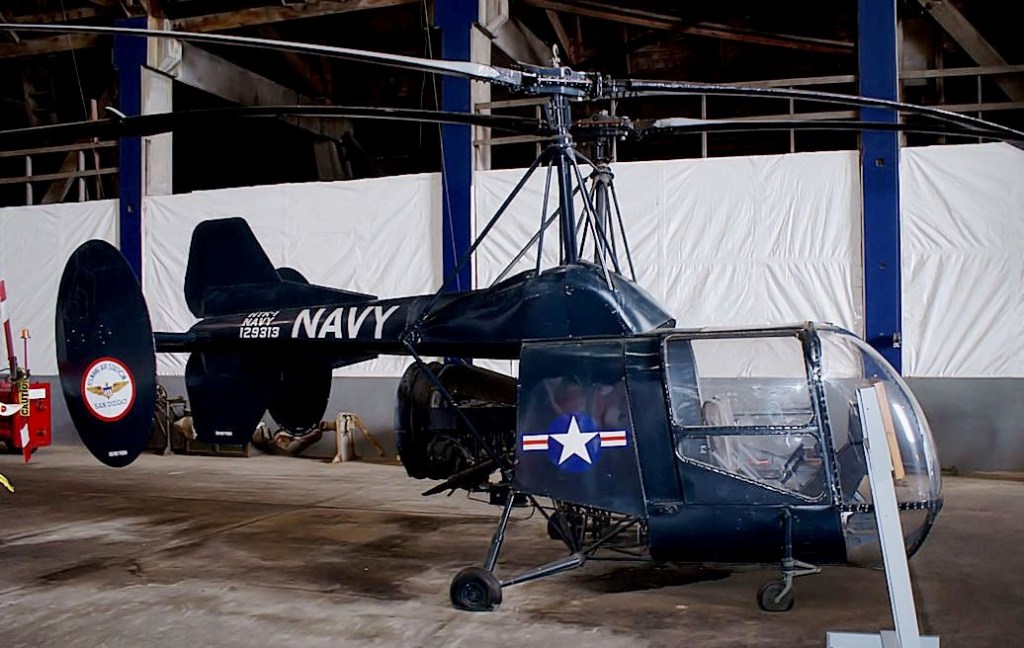
HTK-1 Huskie BuNo. 129313 C/N 422
Twenty-nine HTK-1s were built between 1951 and 1953. Powered by a 240 hp Lycoming O-435-4 piston engine, they served with the Navy at Pensacola until 1957.
HTK-1 Huskie BuNo. 129313 C/N 422
Engine: 235 h.p. Lycoming O-435-4 Rotor dia.: 40 ft Fuselage length: 23 ft Max Weight: 2,750 lb Max. Speed: 75 mph Ceiling: 10,000 ft Typical range: 194 miles at 70 mph with full load Seats: 3
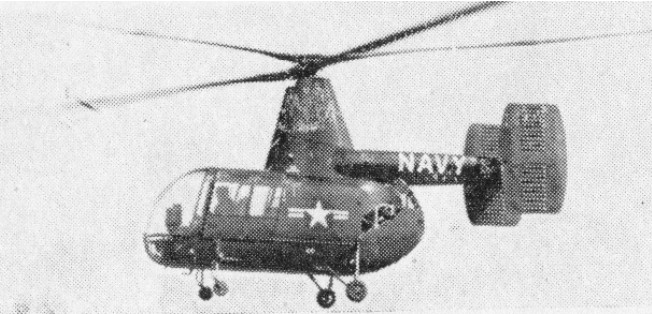
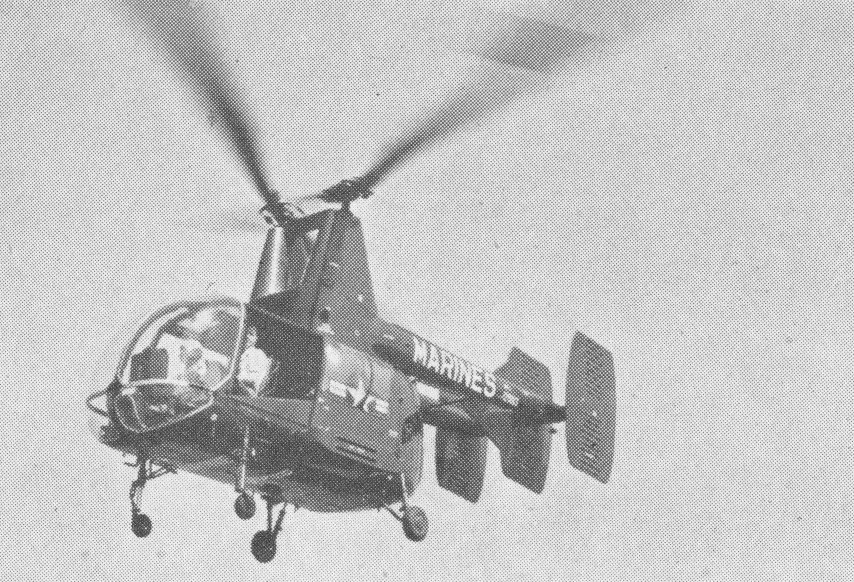
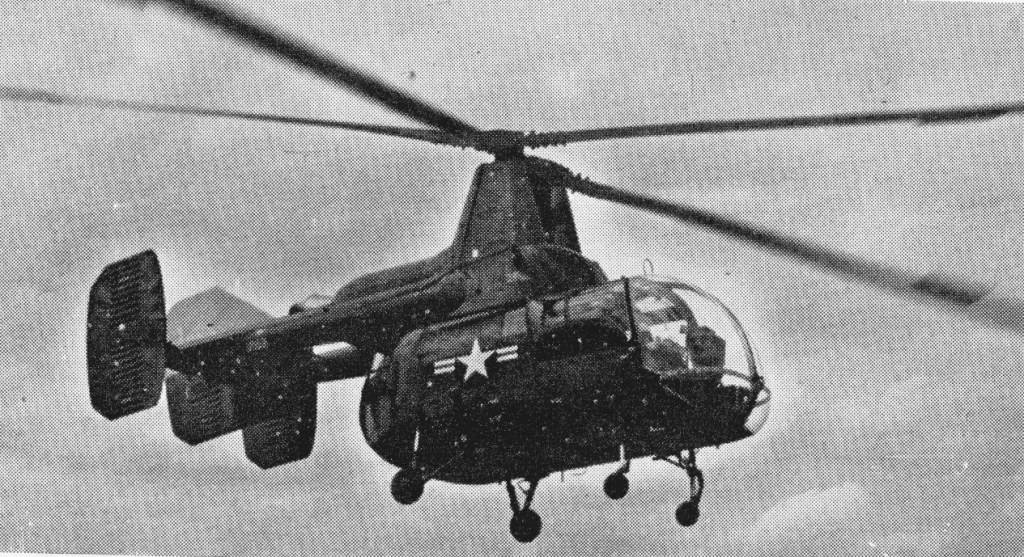
Following evaluation of the Kaman K-225, the US Navy chose the HOK-1 design as best of several submitted in competition for a liaison helicopter. Using the same rotor systems as the K-225, the HOK-1 was put into production off the drawing-board and delivered in quantity to the U.S. Navy and Marines during 1950s. It normally carries four people; but as an ambulance will accommodate two stretcher patients and one sitting patient or medical orderly, in addition to the pilot. Stretcher loading is through the nose, as on the HTK-1.
In service with the U.S. Navy in 1955 as a 4-seat liaison and casualty evacuation helicopter.
As part of a general development programme, several piston-engined helicopters, such as this Kaman HOK-1, were re-engined with gas turbines.
Engine: 800 hp Pratt & Whitney R1340-48 Rotor dia.: 46 ft. Max Weight: 3,500 lb. Seats: 4
A progressive development of the K-125A and K-190 of 1947 and 1948, Kaman’s second helicopter, the K-225, first flew on 10 December 1951.Kaman put the K-225 into limited production in 1949 as the YH-22.
The K-225 is powered by a 225 hp Lycoming O-435.
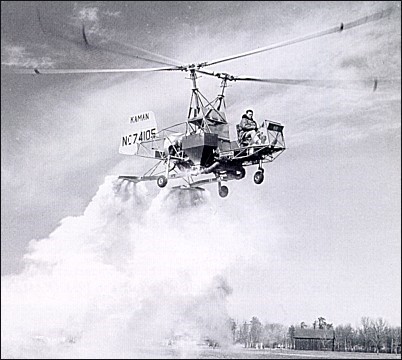
Certified by the CAA, there were eleven K-225s produced and they were used in the crop-dusting role.
As a single-seat crop duster, the K-225 was supplied to the Turkish Department of Agriculture.
Testing by the U.S. Navy influenced the award of contracts for the HOK-1 and HTK-1 to the company.
Under U.S. Navy contract, Kaman fitted a 175-h.p. Boeing YT-50 gas-turbine engine to a K-225, and this was the first helicopter, with turbine-driven rotors, flying on 10 December 1951.
Engine: 225 hp Lycoming O-435 Rotor diameter: 38 ft Fuselage length: 23 ft Height: 11 ft 6 in Empty weight: 1800 lb Loaded weight: 2700 lb Max speed: 73 mph Cruise: 65 mph ROC: 1000 fpm Ceiling: 12,000 ft Range: 194 mi at 65 mph Seats: 3





 All Aero