Japan
In 1939 a U.S.-built Kellett KD-1A autogiro was exported to Japan. K. K. Kayaba Seisakusho developed Ka-1 along similar lines for Japanese Navy; used for observation, antisubmarine patrol (incl. shipbome), and for testing rocket augmented rotors. Ka-2 was re-engined.
Helicopters
Kawasaki OH-X / OH-1 / AH-2
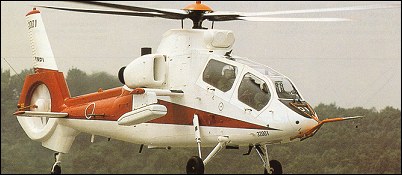
Developed to replace OH-6Ds of JGSDF, the Japan Defence Agency (IDA) awarded Y2.7 billion (US$22.5 million) in FY92 to cover the basic design phase of the helicopter then provisionally designated OH-X.
Requests for proposals were issued by JDA’s Technical Research & Development Institute (TRDI) 17 April 1992 and Kawasaki was selected as the prime contractor (60% of programme) on 18 September 1992, with Fuji and Mitsubishi (20% each) as partners. The Observation Helicopter Engineering Team (OHCET) was formed by these three companies, beginning with a preliminary design phase 1 October 1992. A mockup was made public on 2 September 1994 under the Japanese name Kogata Kansoku (new small observation [helicopter]).
The programme included six prototypes (four flying, two for ground test), and the first aircraft (32001) rolled out at Gifu on 15 March 1996 and made first flight 6 August 1996, followed by second prototype on 12 November. The OH-1 designation was assigned late 1996. The first two XOH-ls were handed over to JDA on 26 May and 6 June 1997. The third flown on 9 January 1997, at which time the earlier aircraft had accumulated some 30 and 20 hours, respectively. The third was handed over on 24 June 1997. The fourth was flown on 12 February 1997 and handed over 29 August 1997. The prototypes were renumbered by 1999 from 32001-04 to 32601-04.
The Japan Defence Agency’s Technical Research and Development Institute was looking to develop an attack version of the Kawasaki OH 1 armed reconnaissance helicopter which in 1998 was at the flying prototype stage. Consideration was being given to replacing the OH 1’s single Mitsubishi XTS1 10 engine with two LHTEC T800 or MTU/Turbomeca&Rolls-Royce MTR 390 turboshafts for the AH 2, together with a new gearbox and rotor system, plus a new integrated sensor targeting and weapon system.
The first three production OH-1s were funded FY97 and ordered in 1998. The first prototype was flown with more fuel-efficient TS1-10QT (replacing XTS1-10) engines, on 30 March 1998. By early 1999, four prototypes had flown 450 hours and were due to complete further 450 hours by end of 1999, including operational evaluation at Akeno JGSDF base. The first production OH-1 (32605) flown July 1999 and handed over to JGSDF at Gifu 24 January 2000.
Name ‘Ninja’ reportedly given in 2002, but not officially confirmed.
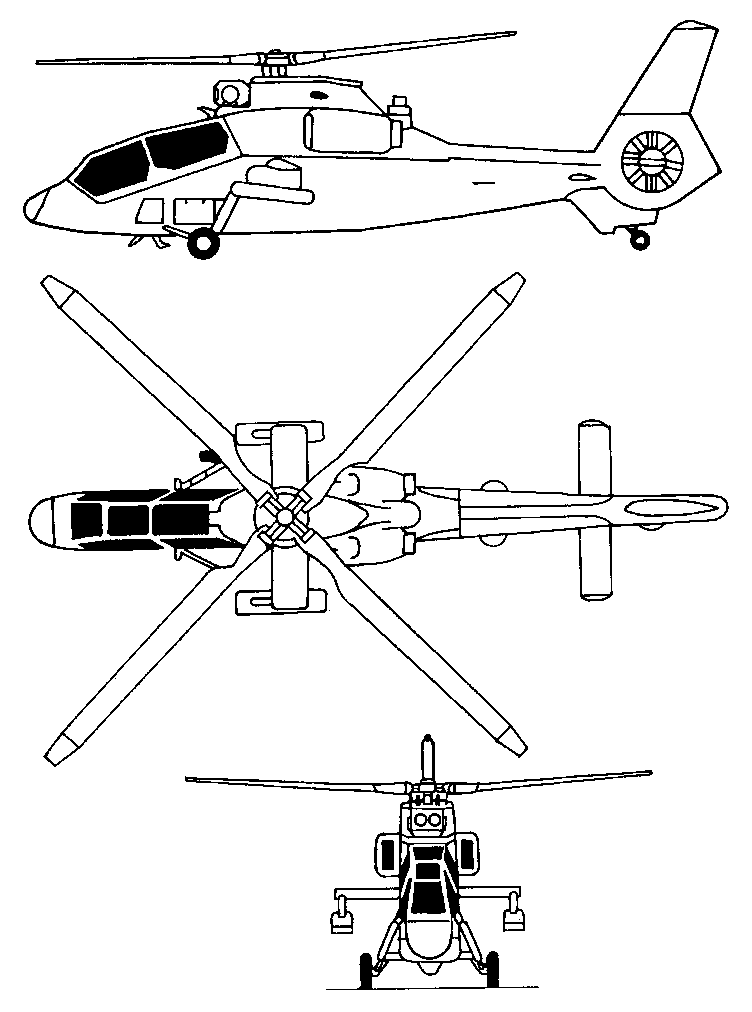
The OH-1 features Kawasaki hingeless, bearingless and 20mm ballistic-tolerant four-blade elastomeric main rotor and transmission system; Fenestron-type tail rotor with eight unevenly angled ‘scissor’ blades (35 and 55 degrees); stub-wings for stores carriage. Active vibration damping system. Flying controls are integrated AFCS and stability control augmentation system (SCAS). The rotor blades and hub are manufactured from GFRP composites; centre-fuselage and engines by Mitsubishi, tail unit/canopy/stub-wings/cowling by Fuji, rest by Kawasaki. Some 37% of airframe (by weight) in GFRP/CFRP.
The landing gear is a non-retractable tailwheel type, with provision for wheel/skis on the main units.
Power is from twin 662kW FADEC-equipped Mitsubishi TS1-10QT turboshafts (XTS1-10 originally in prototypes), and the transmission has a 30-rninute run-dry capability. Stub-wings can each carry a 235 litre auxiliary fuel tank.
The crew of two are on tandem armoured seats (pilot in front) with flat-plate cockpit transparencies, upward-opening on the starboard side for crew access.
Armament is four Toshiba Type 91 (modified) lightweight short-range, IR-guided AAMs on pylons under stub-wings for self-defence.
Funding for development, prototypes and flight testing Y2.5 billion in FY92, Y10.2 billion in FY93, Y50.1 billion in bY94 and Y23.3 billion in FY95. Unit costs of first four production lots Y1.924 billion (FY97), Y2.018 billion (FY9S), Y2.229 billion (FY99) and Y2.075 billion (FY00).
The Hiko Jikkentai (Flight Test Squadron) was formed at Akeno with first four production aircraft on 27 March 2001; other deliveries by late 2002 included small numbers to Kasumigaura Bunko, Utsunomiya Bunko and Kyoiku Shien Hikotai (at Akeno), all of which are departments of the Army’s Koku Gako (Aviation School).
A total of 20, including prototypes, were ordered by FY02, and at least 12 delivered by late 2002.
OH-1
Engines: 2 x Mitsubishi TS1-10
Main rotor diameter: 11.6m
Fuselage length: 12.0m
Height to top of rotor head: 3.4m
Height over tailfin: 3.8m
Empty weight: 2450kg
Normal take-off weight: 3550kg
Max take-off weight: 4000kg
Max level speed: 277km/h
Combat radius: 200km
Range: 550km
Kawasaki KH-4 / KHR-1

At the beginning of the sixties, Kawasaki began to develop a version of the three-seat Bell Model 47G-3B, with a stretched cabin to make room for two rows of seats.
Powered by a 201kW Lycoming TVO-435-B1A air-cooled engine, the first KH-4 flew in August 1962 and received Japanese type approval on 9 November of that year.
Apart from changes to the cabin to accommodate extra passenger, and new supercharged engine, the KH-4 had a new instrument layout, modified control system and larger fuel capacity.
The engine retained was a 270hp Lycoming TVO-435-B1A or -D1A.
By the beginning of 1972, 193 of the Kawasaki KH-4 had been built, 19 of which were assigned to the Japanese Army, 23 to the Thai armed forces, four to the South Korean armed forces and one to the Philippines.
A total of 338 built for civil and military customers between 1960 and 1975.
An experimental variant of the KH-4 was the KHR-1 which was modified to test a three-blade rigid rotor system. This aircraft flew for the first time on 26 April, 1968.
KH-4
Rotor diameter: 11.32m
Length overall: 13.30m
Length of fuselage: 9.93m
Height overall: 2.84m
Empty weight: 816kg
Maximum take-off weight weight: 1293kg
Maximum level speed: 169km/h
Cruising speed: 140km/h
Service ceiling: 5640m
Hover ceiling in ground effect: 5485m
Maximum range: 400km
Kawasaki
Kawasaki aircraft was formed in 1918 as subsidiary of the heavy-industrial complex Kawasaki Jukogyo to build aircraft and aero engines. Based at Kobe, in the early 1930s built Salmson biplanes and engines as well as own designs. Kawasaki had a Dornier license for all-metal construction, and in December 1924 the first Kawasaki-Dornier Wal flying-boat made a notable flight with a German pilot. Thereafter made aircraft mainly for the Japanese Army.
A designer of Kawasaki landplanes was German Dr. Richard Vogt, with the company from 1923 unitl 1933. Vogt designs were Type 88 reconnaissance biplane (1927), Type 92 single-seat biplane fighter (1930), and Ki-3 single-engined biplane bomber. Japanese designed were Ki-10 single-seat fighter biplane (1935), Ki-32 single-engined monoplane bomber (1937), Ki-45 fast and widely used twin-engined fighter (1939), Ki-48 twin-engined light bomber (1939), Ki-61 single-seat fighter (liquid-cooled engine and showing German influence (1941), Ki-100 radial-engined development (1944), and Ki-102 twin-engined fighter (1944).
After the war, in March 1954, a new company of the same name was founded by the merger of Kabushiki Kaisha Kawasaki Gifu Seisakusho and Kawasaki Kikai Kogyo Kabushiki Kaisha. The Kawasaki KAL-1 (July 1953) was the first postwar all-metal aircraft of Japanese design. Early production covered 210 Lockheed T-33 jet trainers, 48 Lockheed P-2H Neptunes and 239 Bell Model 47 helicopters, all built under license from the USA. Also made major components for the NAMC YS-11 turboprop transport.
1962:
38 Akashi-machi,
Ikuta-ku,
Kobe
The company reorganized in April 1969 as Kawasaki Jukogyo Kabushiki Kaisha. In November 1970 flew the C-1 twin turbofan military transport, production aircraft later going to the JASDF. Went on to complete 82 P-2Js (derived from Neptune), 211 KH-4 helicopters (derived from the Model 47), 160 KV107 helicopters (derived from the Boeing Vertol 107 Model II), and many Hughes/McDonnell Douglas Model 500D and OH-6DA helicopters (production continued through 1998). Produced the Lockheed Martin P-3C Orion for the JMSDF; 101st and final aircraft delivered in 1997, when four EP-3/UP-3D electronic intelligence/training variants remained to be delivered up to the year 2000. Kawasaki produced 16 CH-47J examples of Boeing Chinook for the JASDF and compled delivery of 52 CH-47JAs to the JGSDF. It was s prime contractor on the OH-1 Kogata Kansoku armed scout, observation and attack helicopter (first flown August 1996), and had almost completed manufacture of some 200 T-4 intermediate jet trainers and liaison aircraft for the JASDF by 1998. Also constructs components and assemblies for the F-15J and various Airbus and Boeing airliners. Kawasaki teamed with Eurocopter on the BK117 helicopter, and has engine and space programs.
Kawasaki Heavy Industries, Limited is an international corporation and has headquarters in both Chūō-ku, Kobe and Minato, Tokyo. As of 31 March 2013 Kawasaki had 34,010 employees, total assets of ¥ 1.3 trillion at March 31, 2012, and a nett income ¥ 23.3 billion at March 31, 2012.
Kamov Ka-226
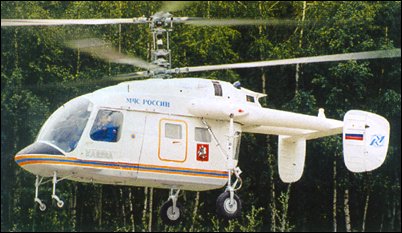
The Ka-226 as a derivative of the Ka-26, has gas turbine engines, installation of new, aerodynamically more perfect, rotors, arrangement of new on-board avionics package and provision for comfortable conditions for the pilot and passengers. The Ka-226 has a coaxial rotor scheme with two three-blade rotors of 13-m diameter. The polymeric composite blade with advanced aerodynamic profile is semi-rigidly attached to the hub by a torsion bar. The helicopter features modular design (detachable transport-passenger cabin) and four-leg non-retractable landing gear. The helicopter is equipped with up-to-date on-board equipment package and complies with the national aviation standards, as well as FAR requirements, categories A and B.
The Ka-226 was announced at the 1990 Helicopter Association International convention, Dallas, USA, and developed originally for the Russian TsENTROSPAS disaster relief ministry, which provided significant funding.
First flown (RA-00199), at Lyubertsy, on 3 September 1997, the “official” first flight was on the following day. The prototype flew four sorties by 31 December 1997, and began AP-29 certification testing on 28 March 2001. State ground testing of Ka-226 second prototype was completed at Strela’s Orenburg plant on 6 March 2000.
KAPP built two prototypes, of which the first was rolled out at Kumertau on 29 May 1998. The first production aircraft from KAPP was due to have flown in the first quarter of 2002 but remained under construction in mid-2002. Planned certification in third quarter of 2002 was not achieved, being reportedly “seriously delayed”. The prototype was destroyed in ground resonance incident in November 2002.
Named Sergei in 1999, honouring politician Sergei Shoigu, the programme was also guided by Sukhoi General Designer, Sergei Mikheev. By mid-2000, Moscow regional government had provided Rb 12 million in development funding and was beginning disbursements under second programme valued at Rb4 million. Initial deliveries due in first half of 2000, but not effected. Prototypes built jointly by Kamov, Strela, KAPP and Ufa Motors, with final assembly by KAPP and Strela for production aircraft.
Strela scheduled to have delivered five preproduction helicopters to Kamov at Lyubertsy by mid-2000; these for MChS Rossii but not supplied until 2003, when one exhibited at MAKS ’03. KAPP designated second production plant; first batch of five under construction by 2001. Motor-Sich of Zaporozhye, Ukraine, negotiated with Kamov in June 2000 to build Ka-226s powered by indigenous ZMKB AI-450 engine; agreement on AI-450 installation signed 15 August 2001. On 19 October 2001, however, Motor Sich announced it would source all Ka-226 components with Ukrainian industry, if decision to proceed were taken. Programme launch was reportedly imminent in late 2002. MoU on use of Turbomeca Arrius 2G signed in August 2001 with NPO Saturn and French manufacturer; collaboration agreement followed on 16 April 2002, with intention of certifying Arrius Ka-226 in September 2004 after trials of three prototypes.
Orders by January 2002 totalled 66: Gazprom 50, Moscow City 10, TsENTROSPAS five and Bashkiriya one.
Identified requirements include up to 20 for City of Moscow for patrol and medevac; some 250 for MChS Rossii/TsENTROSPAS disaster relief organisation; and up to 75 for Gazprom in gasfield support role. Firm order for 25 reportedly received from TsENTROSPAS by 1997, but quantity had reduced to 10 by 1999; by mid-2000 this quoted as five firm (to be first five production aircraft) and further 15 to be ordered by 2002; manufacture by Strela which had completed first two (including one in medevac configuration) by early 2002. Bashkiriyan local government ordered one Ka-226-50 in September 2001; this accepted 28 December 2001 (when still not cleared for flight) and due for trials at Zhukovsky before service entry. Funds for 22 of initial Gazprom order for 50 had been transferred by 2001, this initial batch, built by Strela, to have been received by 2005 (although formal signing of order for 50 was undertaken at Moscow Salon in August 2001).
Moscow city government signed US$1.5 million order for 10 in December 2001, delivery over two years, but later announcement indicated that funds had not been earmarked; Moscow’s helicopters to be built by KAPP. City allocated initial Rb33 million in 2002 and intends to receive three helicopters in 2003, four in 2004 and final three in 2005. Ka-226 was beaten by Kazan Ansat in competition to supply new training helicopter to Russian armed forces, announced September 2001, although small number of Ka-226s required by Russian Navy.
To 1999, development cost was Rb108 million.
Featuring interchangeable mission pods. Refinements of the Ka-26/126 include a new rotor system with hingeless hubs and glass fibre/carbon fibre blades, changes to the shape of the nose, twin tailfins and rudders. Payload modules include an agricultural systems with a hopper capacity of 1,000 litres.
The Ka-226 features contrarotating coaxial three-blade rotors, a hinge rotor head with ‘rake’-type blade attachment, the Ka-26 blades of the initial series were to be succeeded by GFRP and CFRP blades with twin-contour spar, load-carrying rear section and electrothermal anti-icing. A rotor brake WAS standard, and non-folding blades.
There was a three-stage gearbox with planetary gear trains, of alloy steel and aluminium casting, flange mounted with four load-carrying bolts. Accessories included cooling fan, hydraulic pump and AC generator. The engine input was 6,000 rpm.
The flying controls were mechanical with irreversible hydraulic actuators. An automatic rotor constant-speed control, with a conventional four-channel control (longitudinal, lateral, cyclic and differential pitch). The two endplate fins and rudders are toed inward 15 degrees, with a non-controllable horizontal stabiliser.
Airframe materials are primarily aluminium alloys, steel alloys and composite sandwich panels of GFRP with honeycomb filler. Rotor blade overhaul interval 2,000 hours; total life 6,000 hours, but to be extended by increments to 18,000 hours.
The landing gear is a non-retractable four-wheel type. Main units, at rear, are carried by stub-wings. All four units embody oleo-pneumatic shock-absorber, the forward wheels have no brakes. The rear wheels have pneumatic brakes. Mainwheel tyres size 595 x 185 mm, pressure 2.5 bars + 1.0; forward wheel tyres size 300 x 125 mm, pressure 3.43 bars. Skis optional. Provision for large inflatable pontoons, across front of aircraft forward of front wheels and under each mainwheel. Forward units of castoring type, without brakes. Rear wheels have pneumatic brakes.
Two 335kW Rolls-Royce 250- C20R/2 turboshafts are side by side aft of rotor mast, with individual driveshafts to the rotor gearbox. Two 335kW Rolls-Royce 250-C20B engines were in the prototypes. The transmission rating is 626kW. Alternatively, two Progress (ZMKB) AI-450 turboshafts, each 331kW or two Turbomeca Arrius 2G (500 kW) or Klimov VK-800 turboshafts (588kW) may be fitted. Standard fuel capacity is 770 litres, in tanks above and forward of the payload module area. Provision for two external tanks, on sides of fuselage, has a total capacity of 320 litres.
The fully enclosed cabin has a rearward-sliding door each side, and normal operation is by a single pilot. A second seat and dual controls are optional. The cabin is ventilated, and warmed and demisted by air from a combustion heater, which also heats the passenger cabin when fitted. An air filter is fitted on the nose of the agricultural version. Space aft of cabin, between main landing gear legs and under transmission, can accommodate a variety of interchangeable payloads. A cargo/passenger pod accommodates four or six persons on folding sidewall seats, with provision for a seventh passenger beside pilot. Two clamshell doors are at the rear of the pod, with emergency exit each side and a hatch in the floor. An ambulance pod accommodates two stretcher patients, two seated casualties and a medical attendant. For agricultural work, a chemical hopper (capacity 1,000 litres) and dust spreader or spraybars are fitted in this position, on the aircraft’s CG. Flight deck pressurisation protects crew against chemical ingress. The aircraft can also be operated with either an open platform for hauling freight or hook for slinging loads at the end of a cable or in a cargo net.
A single hydraulic system, with manual override, is for control actuators. The main electrical system is 27V 3kW DC, with a back-up 40Ah battery. A secondary system is 36/115V AC with two static inverters, and a 115/200V AC system with 16kVA generator (6kVA to power agricultural equipment and rotor anti-icing). Electrothermal rotor blade de-icing; hot air engine air intake anti-icing; alcohol windscreen anti-icing; electrically heated pitot. Pneumatic system for mainwheel brakes, tyre inflation, agricultural equipment control, pressure 39 to 49 bars.
The cost in 2000 for the Ka-226A was US$1.5 million.
The Ka-226-50 is an “improved” version.
Engine: 2 x Allison 250-C20B.
Instant pwr: 313 kW.
Rotor dia: 13 m.
Fuselage length: 8.1m
Height: 4.15m
MTOW: 3400 kg
Payload: 1300 kg
Useful load: 1448 kg
Max speed: 111 kts
Max cruise: 104 kts
Max range: 602 km
HIGE: 6623 ft
HOGE: 4197 ft
Rate of climb: 11.7m/s
Endurance: 4.6h
Service ceiling: 16,557 ft
Crew: 1
Pax: 7
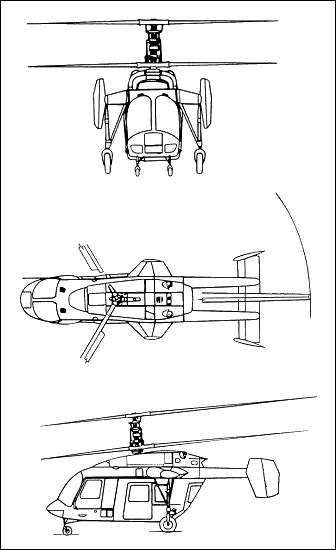
Kamov Ka-126 / Ka-128
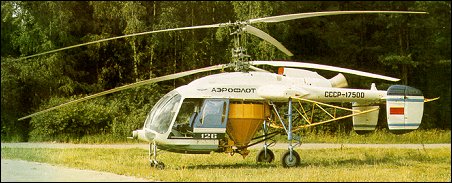
Development began 1984 with an early mockup with two small turboshafts above the cabin. A single TVO-100 turboshaft was subsequently adopted. In 1985 a Romanian-Russian agreement of co-operation for manufacturing a utility helicopter derived from the Ka-26 was signed. In 1986 the ICA Brasov factory started development and manufacturing preparation.
A ground test vehicle was completed early in 1986. The first flight of the prototype (SSSR-01963) was on 19 October 1988.
The first Romanian aircraft was flown on 22 December 1988 and, with a second, was delivered to the USSR for testing.Serial production was started with 15 completed.
The first of four Soviet-built preproduction Ka-126s first flew on 19 October 1988. A proposed Ka-128, differing only in a 722shp Turbomeca Arriel 1D1 turboshaft power plant and addition of an intermediate gearbox was abandoned.
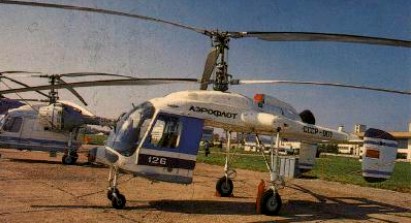
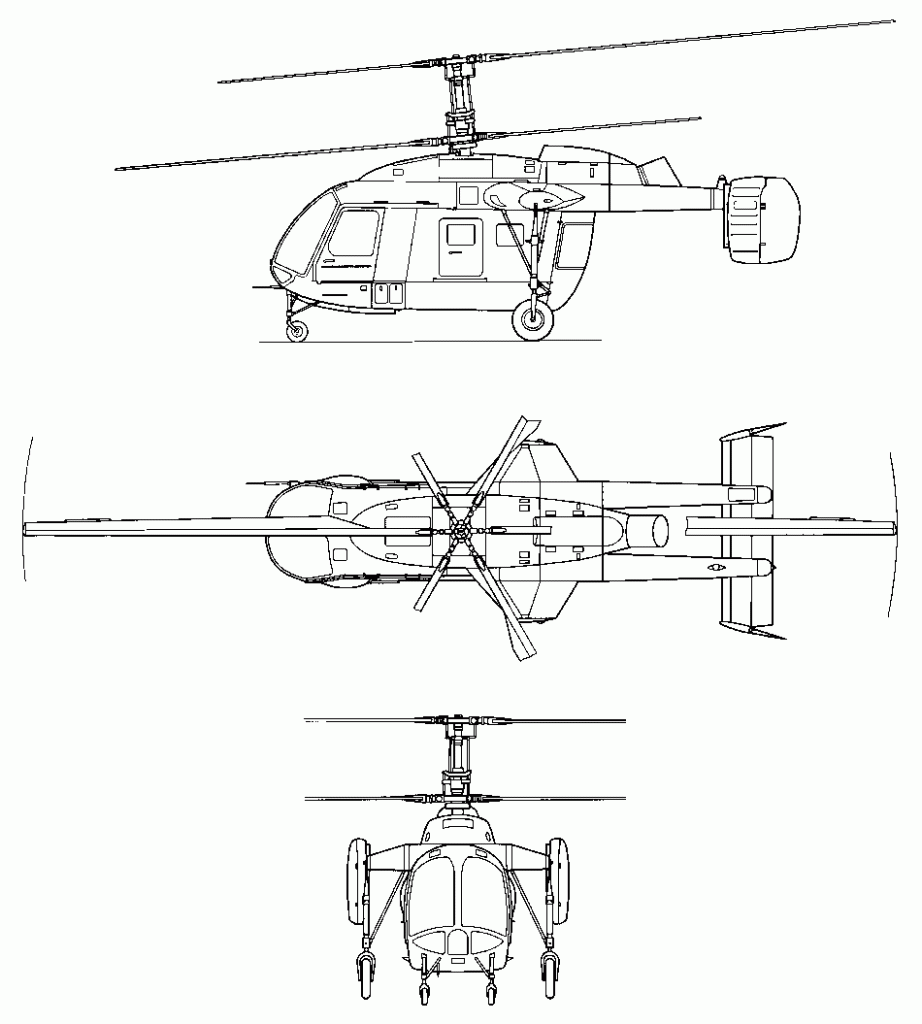
Featuring contrarotating coaxial three-blade rotors, a hinge rotor head with ‘rake’-type blade attachment, the Ka-26 blades of the initial series were to be succeeded by GFRP and CFRP blades with twin-contour spar, load-carrying rear section and electrothermal anti-icing. A rotor brake WAS standard, and non-folding blades.
There was a three-stage gearbox with planetary gear trains, of alloy steel and aluminium casting, flange mounted with four load-carrying bolts. Accessories included cooling fan, hydraulic pump and AC generator. The engine input was 6,000 rpm.
The flying controls were mechanical with irreversible hydraulic actuators. An automatic rotor constant-speed control, with a conventional four-channel control (longitudinal, lateral, cyclic and differential pitch). The two endplate fins and rudders are toed inward 15 degrees, with a non-controllable horizontal stabiliser.
Airframe materials are primarily aluminium alloys, steel alloys and composite sandwich panels of GFRP with honeycomb filler.
The landing gear is a non-retractable four-wheel type. Main units, at rear, are carried by stub-wings. All four units embody oleo-pneumatic shock-absorber, the forward wheels of castoring type, self-centring, with no brakes. The rear wheels have pneumatic brakes. Mainwheel tyres size 595 x 185 mm, pressure 2.45 bars; forward wheel tyres size 300 x 125 mm, pressure 3.43 bars. Skis optional. Provision for large inflatable pontoons, across front of aircraft forward of front wheels and under each mainwheel.
One 522kW Mars (Omsk) TV-O-100 turboshaft is installed centrally in a streamline fairing above the cabin. Electronic-hydraulic automatic two-channel control system, with manual control in case of electronic governor failure, is installed. A front driveshaft has a plate coupling to the gearbox. Fuel is in two forward and one aft tank, with a total capacity of 800 litres. There is provision for two external tanks, on sides of fuselage, total capacity 320 litres. A single-point main tank refuelling is on the port side of aft tank.
The fully enclosed cabin has a rearward-sliding door each side, and normal operation is by a single pilot. A second seat and dual controls are optional. The cabin is ventilated, and warmed and demisted by air from a combustion heater, which also heats the passenger cabin when fitted. An air filter is fitted on the nose of the agricultural version. Space aft of cabin, between main landing gear legs and under transmission, can accommodate a variety of interchangeable payloads. A cargo/passenger pod accommodates four or six persons on folding sidewall seats, with provision for a seventh passenger beside pilot. Two clamshell doors are at the rear of the pod, with emergency exit each side and a hatch in the floor. An ambulance pod accommodates two stretcher patients, two seated casualties and a medical attendant. For agricultural work, a chemical hopper (capacity 1,000 litres) and dust spreader or spraybars are fitted in this position, on the aircraft’s CG. The aircraft can also be operated with either an open platform for hauling freight or hook for slinging loads at the end of a cable or in a cargo net.
A single hydraulic system, with manual override, is for control actuators. The main electrical system is 27V 3kW DC, with a back-up 40Ah battery. A secondary system is 36/115V AC with two static inverters, and a 115/200V AC system with 16kVA generator (6kVA to power agricultural equipment and rotor anti-icing). Electrothermal rotor blade de-icing; hot air engine air intake anti-icing; alcohol windscreen anti-icing; electrically heated pitot. Pneumatic system for mainwheel brakes, tyre inflation, agricultural equipment control, pressure 39 to 49 bars.
After 1989 the project was cancelled.
Engine: 1 x Koptchencko TV-O-100.
nstant pwr: 537 kW.
Rotor dia: 13 m.
MTOW: 4250 kg.
Payload: 1000 kg.
Useful load: 1335 kg.
Max speed: 97 kts.
Max cruise: 86 kts.
Max range: 713 km.
HIGE: 3180 ft.
HOGE: 262 ft.
Service ceiling: 12,623 ft.
Crew: 1.
Pax: 7.
Kamov Ka-115
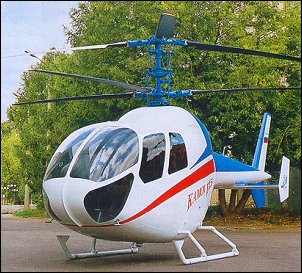
The Ka-115 is a light multi-purpose helicopter equipped with landing skids. It is powered by Pratt & Whitney/Klimov PW 206K/2 engine (Canada/Russia production), and features a large five-door cabin with large windows. In terms of payload-to-weight ratio the helicopter is comparable to its world counterparts.
The cabin is fitted with heating and ventilation systems.
High rotor system efficiency, absence of power losses for the tail rotor drive, combined with smooth aerodynamic shape of the airframe and economic engine give the helicopter fuel flow characteristic of less than 0.5kg per km at a cruise speed of 230km/h.
A de-icing system of the rotor blades, engine inlet particle separator and air conditioning system make the helicopter capable of operating in any climatic region within a 50 degree temperature range.
The helicopter complies with international standards on reliability, safety and comfortable conditions for pilot and passengers.
Ka-115
Engines: 1 x PW/K 206D turboshaft, 477kW
Rotor diameter: 9.5m
Fuselage length: 9.2m
Height: 3.6m
Width: 2.0m
Max take-off weight: 1850kg
Max speed: 250km/h
Cruising speed: 230km/h
Rate of climb: 11.5m/s
Service ceiling: 5200m
Range: 780km
Payload: 700-900kg
Crew: 1
Passengers: 5
Ka-115
Engine: 1 x P&W/Klimov PW206K/2.
Instant pwr: 410 kW.
Rotor dia: 9.5 m.
MTOW: 1850 kg.
Payload: 600 kg.
Useful load: 878 kg.
Max speed: 135 kts.
Max cruise: 124 kts.
Max range: 780 km.
HIGE: 10,164 ft.
HOGE: 7541 ft.
Service ceiling: 17,049 ft.
Crew: 1.
Pax: 4/5.
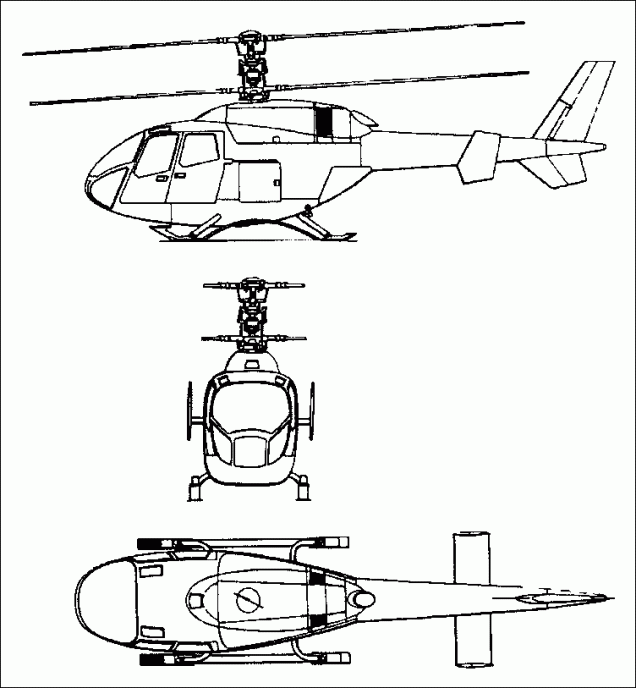
Kamov Ka-62
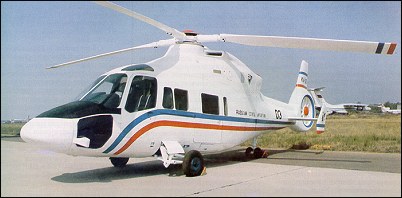
Funded under the Russian programme for development of civil aviation for 2000, construction of the prototype Ka-62 (then known as V-62) began early 1990, but apparently was abandoned. One Ka-60 military version and two Ka-62s were intended to undertake flight trials, although the second of the basic type was completed as a Ka-60U, delaying the debut of the civil version.
In April 2001, The Turkish Ministry of Public Health was discussing a contract for six Ka-62s, with a total value of US$31.5 million. The Russian government’s 2002-10 aviation plan included Rb62 million to develop the Ka-62 and Rb51 million to launch production at UUAP and, possibly, RSK “MiG” (LAPIK).
The Ka-62 was developed on the basis of the Ka-60 army helicopter and is intended for carrying passengers and cargo in the transport cabin, and transportation of bulky cargo on external sling. It has a single main rotor with a multi-blade tail rotor in the tail ring. The rotor blades and 60% of the airframe weight are made of polymeric composite materials. The airframe features perfect aerodynamic outlines, large transport-passenger cabin and retractable three-leg landing gear. The power plant is made of modular-design developed by Rybinsk Motor Design Bureau, headed by Mr. A. Novikov, Designer General. The civil derivative has large door openings on both fuselage sides of the cabin.
The helicopter is equipped with anti-icing and fire-fighting systems. The Ka-62 is equipped with standard avionics suite of a basic transport version for VFR conditions, or for IFR flying, using the satellite navigational equipment. The export version of the helicopter is supplied with western engines and avionics of the customer’s option.
Originated as a military transport, all main systems and components are duplicated, with main and secondaries routed on opposite sides of airframe. The transmission is resistant to 12.7mm bullets and main blades to 23mm shells. The gearboxes have a run-dry capacity. The main rotor blades have sweptback tips. Yaw control is by 11-blade fan-in-fin. Landing gear is retractable tricycle tailwheel.
Composites account for 60%, by weight, of the structure, including blades of main rotor, fuselage sides, doors, floor and roof, tailboom, fin, vertical stabilisers, and fan blades of carbon-reinforced Kevlar.
Retractable reverse tricycle type; Single KT-217 mainwheels retract inward and upward into the bottom of the fuselage and twin rear wheels retract forward into the tailboom. Shock absorbers are in each unit. An option is inflatable pontoons for emergency use on water.
The basic Ka-62 has two RKBM Rybinsk RD-600V turboshafts, each 956kW max continuous, 1,140kW emergency rating. Fuel tanks are under the floor, with a 1,450 litres capacity. General Electric T700/ CT7-2D1 engines are offered as an alternative to the RD-600V.
The crew of one or two, side by side, have an optional bulkhead divider between the flight deck and the cabin. The cabin holds up to 14 passengers in four rows. A forward-hinged door is on each side of the flight deck, and a large forward-sliding door and small rearward-hinged door are on each side of the cabin. There is a baggage hold to the rear of the cabin.
The interior is heated and air conditioned. A thermoelectric de-icing system is optional. An Ivchenko AI-9V APU was originally proposed, but a replacement Aerosila TA-14 was under development.
Ka-62
Passengers: 16
Engines: 2 x Rybinsk RD-600 turboshaft, 955kW
Main rotor diameter: 13.5m
Fuselage length: 13.25m
Height: 4.1m
Max take-off weight: 6250kg
Empty weight: 3730kg
Max speed: 162 kts
Cruising speed: 140 kts
Rate of climb: 11.7m/s
HIGE: 9508 ft.
HOGE: 6885 ft.
Service ceiling: 5000m / 16,885 ft.
Range: 720km
Payload: 2000-2500kg
Crew: 1-2
Pax: 14
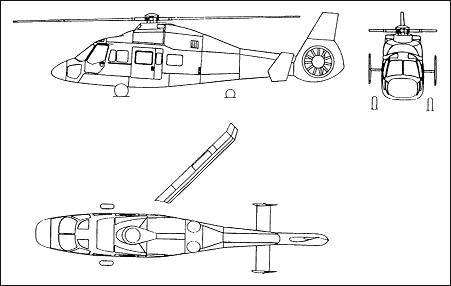
Kamov V-60 / Ka-60 Kasatka (Killer Whale)
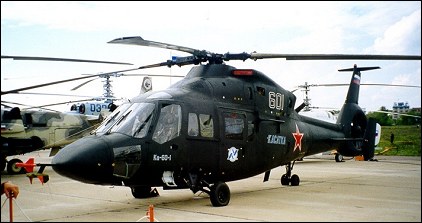
The original coaxial rotor, twin tail, single-engined V-60 won the Soviet Army lightweight helicopter and Mi-8 replacement competition against the twin-engined Mil Mi-36 in 1982.
Subsequently the design was considerably modified to achieve greater speed through adoption of a single five-blade main rotor of 13.5-m diameter and Fenestron-type tail rotor with eleven blades.
The polymeric composite blade is attached to the hub by a torsion bar. The airframe features large door openings on both fuselage sides, retractable three-leg energy-absorbing landing gear. The seats of the crew and the troopers are energy attenuating seats. The pilot-in-command is on the right-hand seat. The power plant of the helicopter is two modular-design engines developed by Rybinsk Motor Design Bureau, headed by Mr. A. Novikov, Designer General.
Particular attention is paid to the increased combat survivability means of the helicopter. All principal systems and units of Ka-60 are duplicated and separated. The composite polymeric materials that make about 60% of the helicopter structural weight add to the survivability of the helicopter being more resistant to the combat damages. The foam polyurethane that filled the tanks prevents the danger of the fuel explosion.
The basic avionics suite for all versions is the one for transport assault helicopter. This suite ensures operational missions in daytime and night, in VFR and IFR conditions.
All main systems and components are duplicated, with main and secondaries routed on opposite sides of airframe. The transmission is resistant to 12.7mm bullets, the main blades to 23mm shells. The gearboxes will run without oil. The main rotors are advanced technology with sweptback tips. Production versions were to have a slower-turning five-blade rotor. Undercarriage is a reverse tricycle. The Ka-60 has IR- and radar-absorbent coatings.
Accommodation is for up to 16 infantry troops or six stretchers and three attendants. The pilot (starboard) and co-pilot/gunner (port) sit side by side. There is provision for dual controls, with the control stick top common with the Ka-50/52. The cockpit has a three-screen EFIS. Avionics include a Pastel RWR and Otklik laser warning system, and an Arbalet MMW radar with an antenna in the nose.
The Ka-60 is fitted with a cargo hook.
Armament can be carried on a one-piece transverse boom through the cabin, to the rear of the doors, to provide suspension for total of two B-8V-7 seven-round 80mm rocket pods, two 7.62mm or 12.7mm gun pods, or similar armament.
The prototype has RKBM Rybinsk RD-600V Turboshafts, as the Ka-62, but the production engine was to be the 1,103kW Klimov VK-1500. RRTM RTM322 or GE CT7 were available in the export versions.
The first flight was originally due 1993, but the programme was slowed by funding shortages, and the priority changed to promotion of a civil variant (the Ka-62).
The Ka-60 was officially revealed at Lyubertsy on 29 July 1997, when the prototype was close to completion. The first (601) flew on 10 December 1998, made a second sortie on 21 December, and the first official flight on 24 December. All were hovering flights.
The international debut was at MAKS ’99, Moscow, in August 1999. The first ‘forward flight’ was on 24 December 1999. Further testing was intermittent, due to irregular Ministry of Defence funding, but production versions of the RD-600V turboshaft were installed in mid-2002. At this time, it was stated only that the prototype had completed “several” flights, although State Trials were not due to begin until early 2003.
Conflicting reports quote both Arsenyev and Ulan Ude as prospective production lines. However, LMZ (later LAPIK, part of RSK “MiG”) was reported in April 2000 to be preparing for production and in mid-2001 was building second prototype, which to be completed as a trainer in Ka-60U configuration. This entered final assembly in July 2002, although RD-600 engines became due to have been received late 2002. Displayed (marked as 602) at MAKS ‘03, Moscow, August 2003. Series production at LAPIK was due to begin in 2003.
The Ka-60U cost US$1.7 million in 2000. In August 2002, it was announced that power plant was to be changed to Klimov VK-1500 to increase participation by RSK “MiG” group.
A smaller variant of Ka-60 was reported in mid-2001 to have been offered to Russian Navy.
Versions:
Ka-60U – Pilot and aircrew training
Ka-60K – Utility, shipborne over-the-horizon targeting
Ka-60R – Reconnaissance
Ka-60
Crew: 1-2
Engine: 2 x Rybinsk RD-600 turboshaft, 975kW
Main rotor diameter: 13.5m
Max take-off weight: 6500kg
Max speed: 300km/h
Cruising speed: 265km/h
Hovering ceiling: 2100m
Service ceiling: 5150m
Range: 700km
Payload: 2000-2750kg
Kamov KA-56
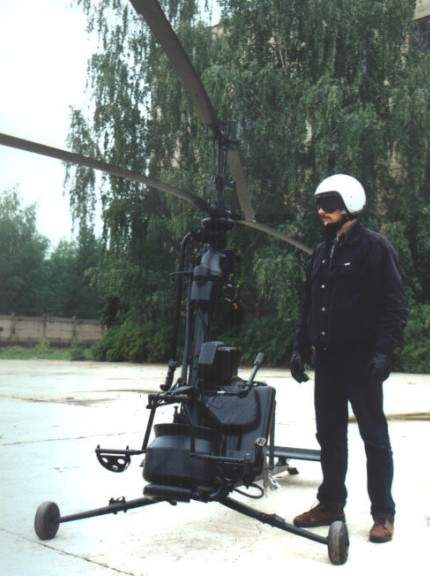
In 1971 Kamov Design Bureau was ordered to produce new ultralight helicopter for military service. Sergei Fomin, Deputy Chief Designer, was ordered to lead this project.
The special task for this helicopter was that it should be able to be transported in a cylinder container of 500 mm diameter. The reason was that Navy wanted to have an opportunity to pull the helicopter out of submarine’s torpedo tube.
Another point was that the helicopter should be able to be assembled for flying in only 15 minutes when unpacked from container.
Powerplant was 40 hp aircooled rotary engine which burned autofuel.
A full-scale mockup was built first, followed by a test plarform which included a real engine, rotor system, transmission and controls.
The only parts which were detachable from the helicopter for transportation were the four main rotor blades. All other parts were easily folded. The main rotor blades were attached by single shift each
No balancing was needed after assebling less rotor tracking. Time to assemble helicopter was only 10 min.
The Ka-56 wasn’t ever flown.
Empty weight: 110 kg
Take-off weight: 220 kg
Range (calculated): – 150 km
Cruise speed (calculated): 110 kmh
Ceiling (calculated): 1700 m
 All Aero