Kjeller Flyfabrikk / Kjeller Flyvernaskinsfabrik

Lillestrømmen Aeroplanværksted (Lillestrøm Airplane Workshop)
Hærens Flyvemaskinfabrik (Army Flying Machine Factory)

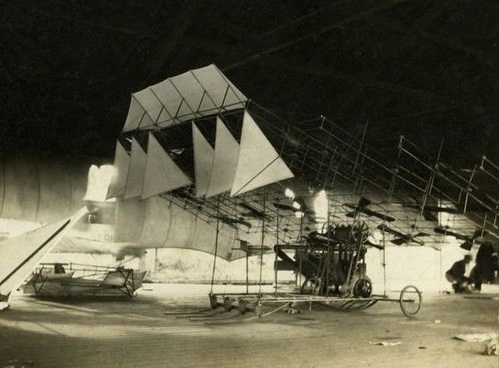
This state-owned factory was established in 1914 at Kjeller airfield at Lillestrøm north of Kristiania (Oslo). The original name was Lillestrømmen Aeroplanværksted (Lillestrøm Airplane Workshop), in 1915 it become the Hærens Flyvemaskinfabrik (Army Flying Machine Factory) which had relocated from Sagene in Kristiania.
The name Kjeller Flyfabrikk didn’t appear until Aug 1927.

The Norwegian Army Aircraft Factory, located at Kjeller. Built under license during the 1930s Fokker C.V as the F.F.7 Hauk (Hawk) and de Havilland Gipsy Moth and Tiger Moth. Also did repair and overhaul of military-aircraft equipment, and experimental work.

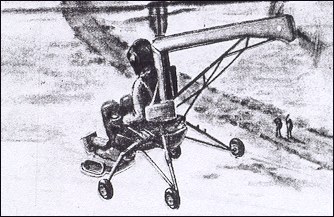
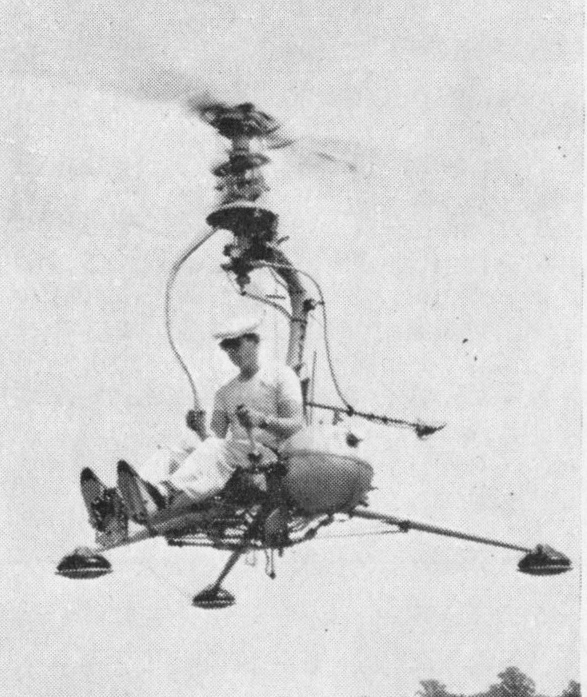
Kellett KH-15

In 1954 the first helicopters with rocket-driven rotors were flown; the Kellett KH-15 and Rotor-craft RH-1.

Nicknamed ‘Stable Mable’, the KH-15 has been built for the U.S. Navy to test a new system oft gyro-abilisng cotrols. It flew after only 8 minutes of tethered tests. Power units are tip-mounted hydrogen peroxide rocket motors.

Power: 2 Reaction Motors XLR32 rockets
Rotors: 2-blade tip-powered main rotor and tail rotor
Rotor diameter: 18 ft
Loaded weight: 644 lb
Seats: 1

Kellett

Under Pitcaim-Cierva license developed and built autogiros at Philadelphia from 1929. A K-3 was taken to the Antarctic by Admiral Byrd on his second expedition in 1933, piloted by William S. McCormick. K-4 had two side-byside seats with demountable enclosure but retained wings. KD-1 of 1934 had tandem seats but was wingless and had direct-control rotor. In 1938 U.S. Army Air Corps bought seven Kellett autogiros for experimental use. From 6 July 1939 a Kellett KD-1 B of Eastern Airlines operated the first scheduled mail service by a rotary-wing aircraft, from the roof of the Philadelphia Post Office and the Camden airport. In 1939 Kellett exported an autogiro to Japan (see Kayaba). YG-1 was developed into XR-2 and XR-3 for the U.S. Army. XR-8 and XR-8A of 1943/1945 had twin side – by- side rotors. As Kellett Aircraft Corporation the company later undertook research and development contracts and subcontracting. Built its own KH-15 single-seat research helicopter (1954), the world’s first rocket-driven helicopter. In late 1950s attempted unsuccessfully to resume production of pre-war KD-1 A direct-control autogiro.
Hughes owned Kellett designs.

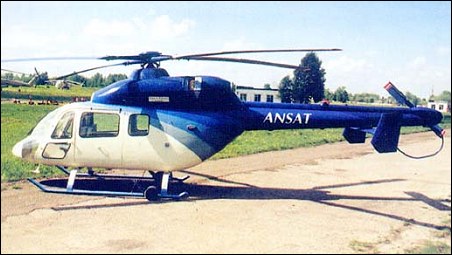
Kazan Ansat

Design began at Kazan in 1993, with design subcontracts to Kazan State Technical University for structural strength and aerodynamic calculations; Aviacon Scientific and Production Centre for rotor; and Aeromekhanica for transmission.

A fuselage mockup was exhibited at the 1995 Paris Air Show, followed by a considerably revised engineering mockup (001) at Paris ’97. By August 1998, now marked ’01’, this had accumulated 10 hours of ground running with engines and rotors, and totalled 800 hours by February 2003.

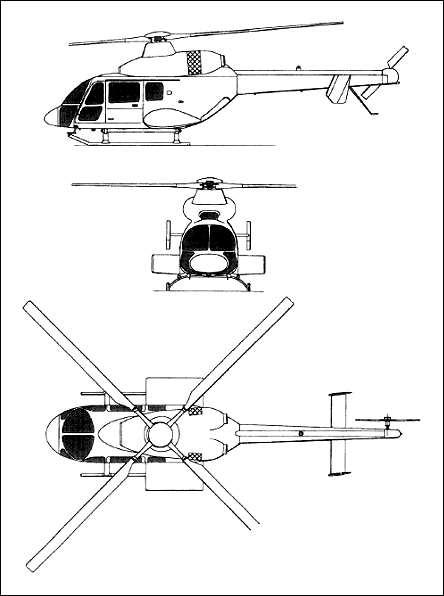
The design features a traditional metal structure and meets FAR Pt 29 Category A and Russian AP-29 requirements. A hingeless main rotor hub with glass fibre torsion bar, has four main blades; two-blade tail rotor. A two-stage, VR-23 main rotor reduction gear in magnesium case ahead of engines has ratio 16.4; rotation speed 365.4 rpm; blade tip speed 220m/s, and transmission rating 769kW. Tail rotor speed 2,000 rpm via single stage conical geabox. Rotor brake. Manual blade folding. Main rotor aerofoil section NACA 23012.

The aluminium alloy fuselage has sparing use of composites, layered glass fibre main rotor blades, window frames and nosecone. The landing gear has twin skids with Kazan transverse shock-absorbers, tail bumper to protect anti-torque rotor, and wheels optional in tricycle configuration, with Yaroslav tyres and Gidroagregat (Balashikha) brakes.
Power is from two P&W Rus XRK206S turboshafts, each rated at 477kW for T-O, 418kW max continuous, in prototypes. Production version with PW207Ks, rated at 470kW for T-O, 410kW max continuous, 529kW for 30 s, 470kW continuous OEI and 491kW 2 minutes OEI. FADEC standard. Fuel capacity 700 litres in either external panniers or underfloor. Optional internal ferry fuel. Alternatively, two Salyut TV-500A turboshafts, each 478kW.
Seating is for up to 11 persons, including one or two pilots, on energy-absorbing seats; or two stretcher patients and three attendants; or internal or externally slung freight. Two forward-hinged doors each side of flight deck; two horizontally split doors each side of cabin, forward; baggage bay behind cabin, with rear-facing door. Baggage door also used for loading stretchers of medical variant. Accommodation ventilated and heated; optional air conditioning.
Avionika FBW controls comprise quadruples electronic system and duplex hydraulic system. Automatic flight control is standard on all piloting functions and optional on navigation functions. Current FBW system to be replaced by KSU-A digital control system. Main transmission drives two alternators (each 200V, 400Hz), two generators (each 27V), two fans and two hydraulic fuel pumps for separate systems. Electrical system 27V, with battery; optional AC system, with second battery. Electric de-icing optional.
First flight was scheduled for late 1997, but initial designated flight trials aircraft (02) exhibited at Farnborough in September 1998, still unflown. First flight (02) was 12 minute hover on 17 August 1999, with an initial forward flight on 6 October 1999. Trials halted in November 1999, after 4 hours, due to gearbox problems, but resumed in the second quarter of 2000 with a strengthened and redesigned main transmission, scarfed engine exhausts and new identity ‘902’. Total 120 hours up to February 2003.

The third (second flying) prototype (03) was to have joined the programme in late 1999, but was not completed until August 2001. First flown 27 December 2001, this is to preproduction standard with small, detachable, pannier tanks, increased fin area, PW207 engines, additional side window and flatter windscreen combined with revised nose shape; will add 400 hours to trials programme. Certification flight resting began in October 2002, for completion before end of 2003; by early 2003 had been renumbered ‘904’.

On 14 September 2001, Ansat declared winner of competition to supply 100 training helicopters to Russian armed forces by 2015.

Aircraft No.5 was to Ansat-U standard, including dual controls and wheel landing gear. Optimised for training (uchebni).

Russian Federal Border Service (Federalnaya Pogranichnaya Sluzhba) requirement for 100 notified in 1997. Total 12 civil sales reported by late 2002, including one for export.
The price was US$2.0 million for utility version (2003). Kazan’s development expenditure had reached Rb200 million by mid-2000.

Ansat
Engine: 2 x Klimov / Pratt & Whitney Canada PW 206 C, 631 shp
Main rotor diameter: 11.5m
Fuselage Length: 37.861 ft / 11.54 m
Length with rotors turning: 13.77m
Height: 11.286 ft / 3.44 m
Rotor diameter: 37.73 ft / 11.5 m
Max take off weight: 7276.5 lb / 3300.0 kg
Cruising speed: 129 kts / 238 km/h
Max speed: 280km/h
Economic cruising speed: 140km/h
Service ceiling: 19685 ft / 6000 m
Hovering ceiling, OGE: 1800-2700m
Maximum range: 335 nm / 620 km
Range: 281 nm / 520 km
Endurance: 3 h
Crew: 1
Payload: 8 pax / 1300 kg int. max. / 1650 kg ext. max.
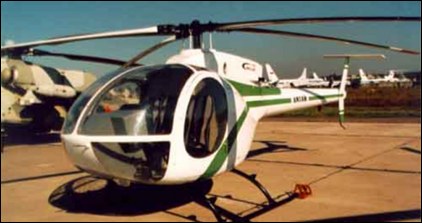
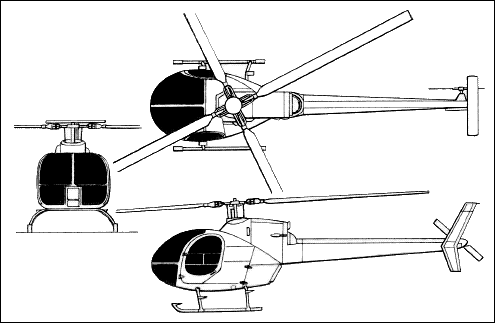
Kazan Aktay / White Colt

Work beginning in 1996, the project was revealed at the Moscow Air Show, on 19 August 1997, with display of a mockup. A second engineering mockup was built in 1998. Kazan decided in mid-2001 to begin building a prototype to fly in 2003.

Intended for light transport, patrol, medical evacuation and training, certification was to be to FAR Pt 27. A conventional pod and boom configuration with T tail, semi-articulated three-blade main rotor, tapered blades on production version. The max (emergency) rotation speed is 2,586 rpm. A rotor brake is standard but no provision for folding. A Krasnyy Oktyabr VR-10 main gearbox, rated for 216kW, receives an engine input of 6,000 rpm. A XP-10 gearbox is fitted for the two-blade tail rotor.
Extensive use of composites is made throughout, including main rotor blades.
The landing gear is a conventional, non-retractable skids on arched support tubes, with spring shock absorbtion.
Power is by one 201kW VAZ-4265 rotary engine mounted above the cabin and behind the gearbox and operating on 92/93 grade petrol. Rpm control is manual. Fuel capacity is 300 litres. A refuelling point is on the left side. Oil capacity 20 litres.

The pilot and two passengers, all side by side, in individual seats, have a forward-hinged door each side. Twin clamshell doors are at the rear of the pod, below the tailboom, provideding access to the flat freight floor. One casualty stretcher can be loaded through rear doors when a passenger seat is removed. Alternative access via door on starboard side. Optional, rear-facing seat in luggage bay. Optional heating and air conditioning.
The electrical system with accumulator and M-16 generator has a max rating of 16kW. Anti-icing is fitted for the main rotor blades.

Engine: 1 x 201kW VAZ-4265 rotary
Max take-off weight: 1050kg
Payload: 300kg
Empty weight: 2402kg
Max speed: 190km/h
Cruising speed: 155km/h
Hovering ceiling, OGE: 1300m
Service ceiling: 4700m
Range with 300kg payload: 100km
Range with 190kg payload: 600km
Max endurance: 6h
Crew: 1
Passengers: 2

Kazan Aviation Institute

Russia
Founded 1939, and since 1951 has manufactured Mil helicopters.
The Kazan Aviation Institute at Kazan on the River Volga, nearly 500 miles east of Moscow, has designed and produced some of Russia’s most notable sailplanes, especially the very advanced KAI-19 high performance all-metal single-seater which, in two-seater form, broke the world’s 300km closed circuit speed record on 1 August 1964, and the KAI-17 training glider.
Own designs are Ansat twin-turboshaft light multipurpose helicopter (first flown 1998) for up to 10 persons, and Aktay three-seat piston helicopter (to fly about year 2000).

Kayaba Heliplane

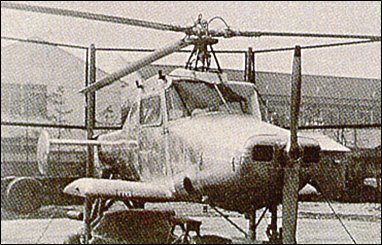
In 1952, Kayaba returned to rotary wing experimentation with the “Heliplane”. This was a compound helicopter fabricated from the fuselage and 180 hp Continental E-180 engine of a Cessna 170 light aircraft, with a rotor mounted above the cabin roof and low-set stub wings to which the undercarriage was attached. The three-blade rotor was fitted with small ramjets which were used for takeoff and landing and the rotor would rotate freely in horizontal flight when the “Heliplane” was being driven by the normal propeller. It first flew in 1954.

Engine: 185 hp Continental E-180
Rotor diameter: 24 ft 3.25 in
Fuselage length: 10 ft 6 in
Height: 9 ft 2.25 in
Seats: 4