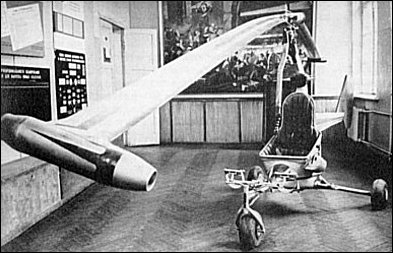
On public display in 1964 was a light helicopter developed by the Kuibyshev Aviation Institute. It was turbine powered with a 40 hp engine exhausting through tip jets on the rotor. The gross weight was 419 lb and height 5.9 ft. The pilot sits in the open.
An experimental helicopter, built in 1956 by students at the Kuibushevskij Aviatsionnyj Institut. Single-seat machine was powered by pulse-jets attached to the tips of the main rotor blade. Pod and boom fuselage was very basic, pilot was seated in the ‘bare seat’ with control stick hanging from above. The helicopter carried no tail rotor.
Aerospace division of the commercial airline, Korean Air Lines, founded 1976. Has built more than 300 McDonnell Douglas (now Boeing) MD 500 helicopters, and is now constructing Sikorsky UH-60Ps for the nation’s armed forces. In addition to developing its own four-seat lightplane as the Chang-Gong 91 (first flown 1991), it is currently working on its Multi-Purpose Helicopter (KMH) with Sikorsky assistance (to be flown in about the year 2000). Other activities include maintenance, upgrading, and production of components for U.S. and European airliners.
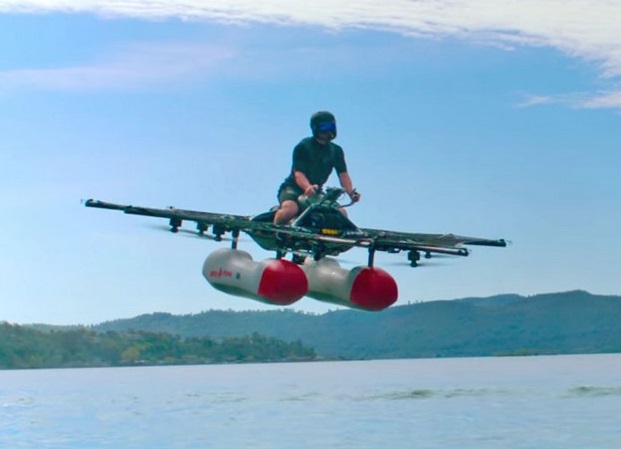
The Kitty Hawk Flyer flying car startup Google’s Larry Page is backing was first publicly demonstrated in April 2017. An aerospace engineer working for Silicon Valley company called Kitty Hawk piloted the Flyer above a lake about 100 miles north of San Francisco. It is an open-seated, 220-pound Flier with room for one person, powered by eight battery-powered propellers that howled as loudly as a speedboat.
The Flyer one-seat, propeller-driven vehicle is meant for a short flight across lake when you’re at the cottage, not commuting to work. During his test flight, Cameron Robertson, the aerospace engineer, used two joystick-like controls to swing the vehicle back and forth above Clear Lake. The flight, 15 feet above the water, circled over the lake about 20 or 30 yards from shore, and after about five minutes Mr. Robertson steered back to a floating landing pad at the end of a dock. The flyer is controlled by two handlebars and what looks like a giant touchscreen. It travels at up to 25 miles per hour at a max of 15 feet above water.
The vehicle is designed to fly above fresh water with two pontoons at its bottom. The prototype Kitty Hawk is showing off “looks and feels a lot like a flying motorcycle,” according to Cimeron Morrissey, who tested it.
They are flying under a special Federal Aviation Administration category for ultralight aircraft that does not require a pilot’s license and is intended for recreational flying in uncongested areas. To add an extra margin of safety, the Kitty Hawk engineers are sticking to flying over open water.
The Kitty Hawk Flyer is just one flying vehicle being worked on by the Larry Page-backed startup. Page has reportedly invested more than $US100 million into Kitty Hawk and its other division, Zee Aero. Both organisations have registered to test a number of different aircraft, from gliders to sailplanes.
The goal of Kitty Hawk and Zee Aero is to one day reinvent personal transportation. Both divisions have roughly 100 employees combined. The CEO of Kitty Hawk is Sebastian Thrun, cofounder of Udacity and the father of Google’s self-driving car project.
The Kitty Hawk focus on over-water flights is intentional – it’s meant to reassure Federal Aviation Administration officials worried that unlicensed pilots will be flying over populated areas. The company wants to work with the FAA to enable more ambitious vehicles, but it would rather play it safe in the early stages.
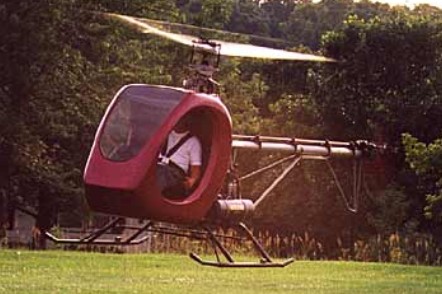
This helicopter was designed, completed, and flown in one year, one month, one week and one day. It’s named the Kinney HRH (Hot Rod Helicopter) because of the lack of doors and hood and an air cleaner from a dual quad setup. The helicopter is small enough to fit in a home garage, and the counter-clockwise rotation of the Waitman blades is the same as standard America helicopters. The HRH uses a 165 hp 4-cycle, 4 cylinder Subaru. It employs a computer-controlled fuel-air mixture, redundant fuel pumps, and multi-port fuel injection. It uses regular gasoline. The rotor head provides full cyclic and collective pitch, with an electronic system for maintaining rotor speed. The main blades are constructed of composite materials and the tail rotor is shaft driven. The fully enclosed composite cabin features a fully equipped panel with both digital and analog instrumentation; a vinyl-covered seat with a “crumple-zone” support; a 4-point aircraft seat belt; and a tinted polycarbonate windshield. Addition of doors and a catalytic heater provide year-round comfort. The powder-coated airframe is formed of aircraft-grade 4130 chromemoly steel, the primary structure both welded and bolted together with aircraft hardware. Most of the aluminum parts are black anodized.
Engine: Subaru EJ-25, 165 hp Cruise speed: 80-90 mph Empty weight: 1000 lbs Useful load: 350 lbs Gross weight: 1,350 lbs Main rotor diameter: 25 ft Main rotor chord: 8 in Tail rotor diameter: 46 in Length: 20 ft Height: 7.25 ft Width: 5.55 ft (175 cm) Fuel capacity: 18.5 USgal. Main rotor RPM: 520 Tail rotor RPM: 2,900 Endurance: 2 hours Top speed: 103 mph VNE: 115 mph Blade: Waitman composite Tail rotor chord: 4.5 in
Bob Kinney, designer/builder of the HRH, considers himself a practical “electro-mechanical applicationist.” Bob was born in a small town in Connecticut where, as a young boy, he and some friends would visit a nearby factory that was manufacturing curious rotary-wing machines. Looking back, Bob is convinced that the man with the distinctive Russian accent that continually chased him and his friends away from that factory was Igor Sikorsky—father of the modern helicopter—and only later understood that those curious machines were helicopters.
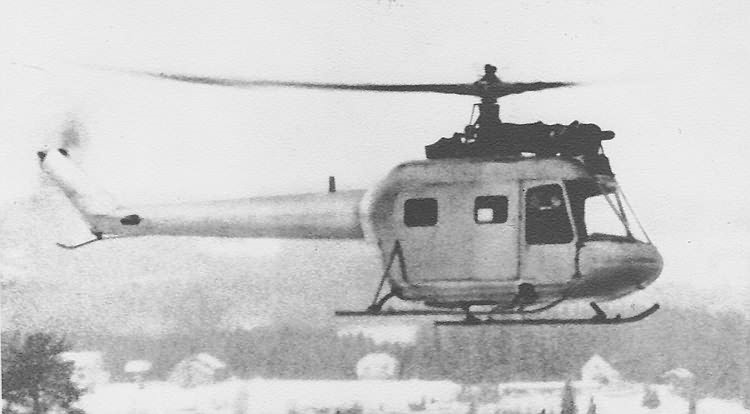
One prototype of the 1960 (some sources say 1962) four-seat Kjeller PK X-2 experimental helicopter was built, powered by a 800 shp GE YT-58 turbine engine and with a 13.00 m rotor diameter.
Built with some H-19 parts, it crashed in February 1965.
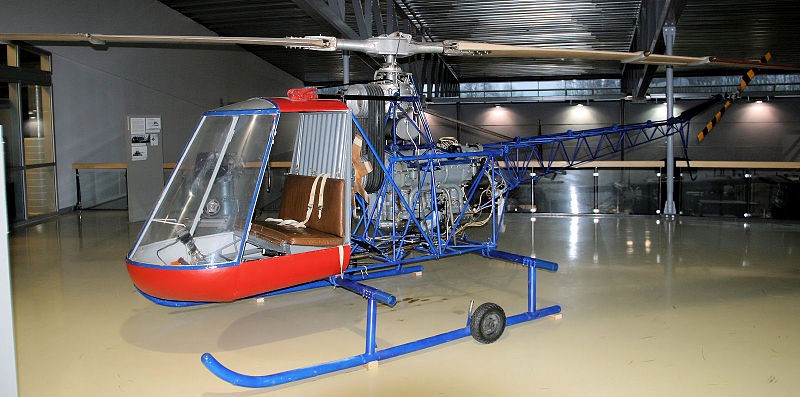
The Kjeller PK X-1 was a two-seater helicopter developed at Kjeller Flyfabrikk under the leadership of engineer Paul Kjølseth. The PK X-1 first flew in 1955, but was considered a purely experimental helicopter and never evaluated in terms of performance.
Further development of PK X-1 was cancelled in 1956 in favour of the development of PK X-2. Aeronautical calculations were made by Erik Tandberg and the powertrain was made by Torbjørn Syverstad.
The PK X-1 was equipped with a 180 hp Franklin 60440-C4 (Some sources say a 200 hp Ranger) and the rotor diameter was 9.26 m.




 All Aero