Formed 14 May 1969 as merger of Messerschmitt-Bölkow GmbH and Hamburger Flugzeugbau GmbH, headquarters at Ottobrun, Munich. Inherited its forebears’ production programs, including Bolkow’s 208C Junior, 209 Monsun and 223 Flamingo light aircraft and Bo.105 helicopter, also HFB’s Hansa executive jet.
Siebel ATG (SIAT) joined MBB in 1973.
Produced Bo.105 and Tornado, latter by virtue of its 42.5% holding in Panavia, and participated in Airbus, Transall, and Fokker F-28 programs; took over VFW January 1981. Became part of Deutsche Aerospace AG in 1989.
By 1995, Aerospatiale and MBB had merged to form Eurocopter.
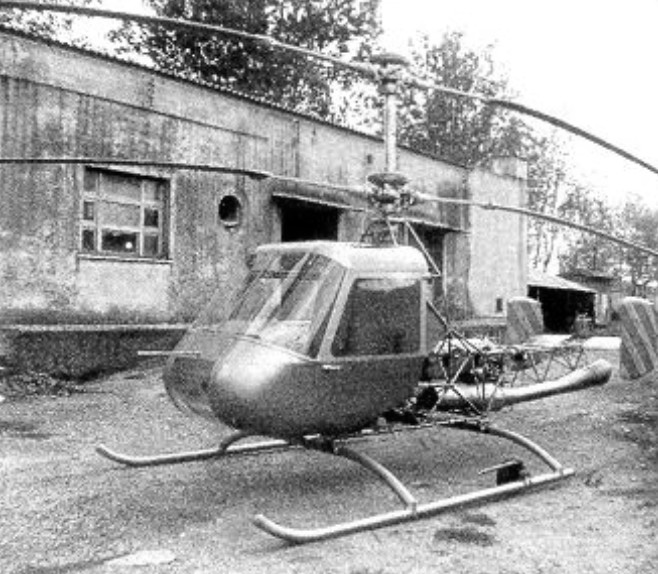
Following the collapse of Aerotecnica, Jean Cantinieau returned to France where he joined Matra. There, he designed and completed a single example of the “Bamby”. This single-seat machine closely resembled the Aerotecnica machines but embodied a triangular end to the tailboom which provided a better direction and control of exhaust gas. After brief testing in 1963 the “Bamby” suffered a power train failure and was abandoned.
Following the collapse of Aerotecnica, Jean Cantinieau returned to France where he joined Matra. There, he designed and completed a single example of the “Bamby”.
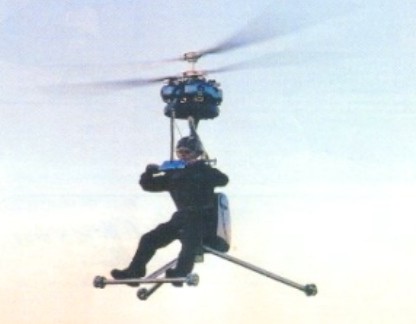
A single-seat strap-on helicopter. Complete helicopter fitted with one five-USG fuel tank and flown in the ultralight category. Gen H-4 should take 30-40 hours to assemble. Kit: $36,000 in 2009.
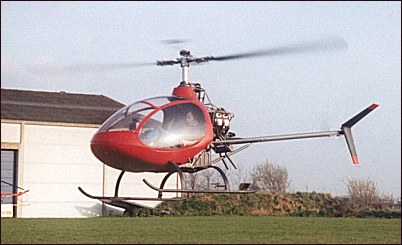
The Masquito Aircraft company was established in Belgium to produce the Masquito M80 ultralight helicopter and design started in November 1994.
Construction of the prototype began in December 1995, with the first flight (G-MASZ) in May 1996. 25 hours of test flying was completed by April 1997. P
The prototype was reconfigured as the M80 with a Jabiru engine and began ground trials in late 1997. The M80 was displayed unflown at the PFA International Air Rally at Cranfield in July 1999. By late 2002, over 120 hours of running time had been accumulated, including 20 within a limited hovering and slow flight envelope.
A CAA go-ahead for ground running of the fourth prototype (also marked G-MASZ) was given in mid-2001. This completed on 26 April 2002, confirming engine integrity.
The UK CAA requires Masquito aircraft to obtain a Design Organisation Approval before starting the flight-test programme for BCAR-VLII; this procedure started in 2003.
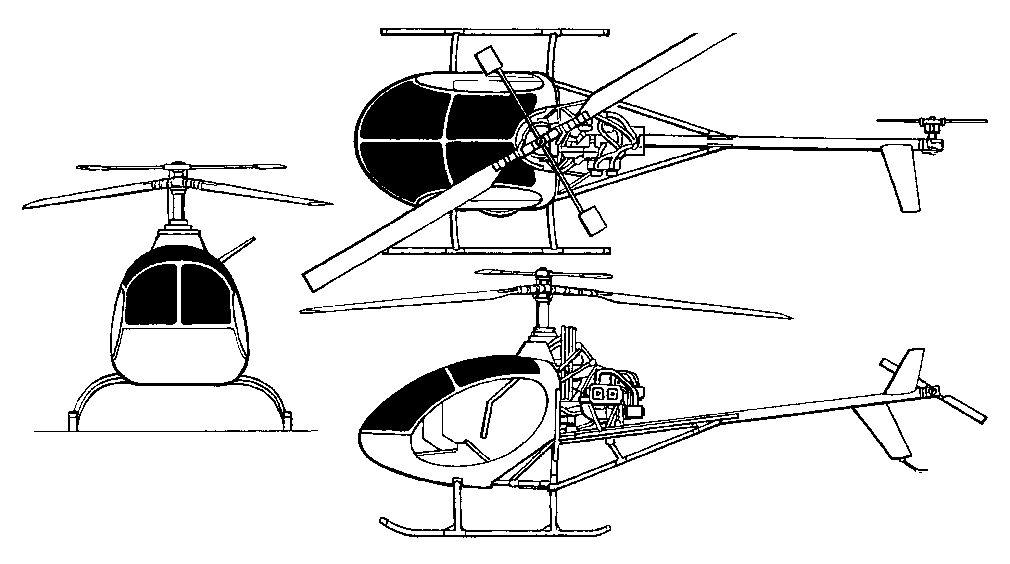
Conforms to FAR Pt 27 crashworthiness requirements. Two-blade, teetering main rotor and two-blade tail rotor; main rotor carbon composites blades with 9deg linear twist. Hiller servo rotor for increased stability in hover. Main rotor speed 690 rpm; 2kg lead weight in each tip to increase inertia and decrease rotor speed decay in event of engine failure. Tail rotor 3,200 rpm. Ventral fin offset 2degs. Composites “virtual hinge” main rotor head with elastomeric collective pitch thrust bearings. Prototype had Rotax gearbox for primary reduction and powerdrive toothed aramid fibre belts tor secondary reduction; production version employs toothed drivebelt, centrifugal clutch and flywheel as primary transmission, with flexible driveshaft for tail rotor.
Controls are conventional and manual, with Hiller servo rotor for cyclic pitch control. Primary structure of Ti3A12, 5V alloy; tailboom of 8.9cm carbon fibre tube. Main rotor blades have unidirectional composites spar with PVC foam trailing-edge core and bidirectional composites skin. Two fixed skids of 6061 alloy mounted on unidirectional carbon fibre supports.
Production aircraft to have an 89.5kW Masquito M2.6L four-cylinder, four-stroke air-cooled engine derated to 59.7kW at sea level, equipped with dual electronic ignition, electronic multipoint fuel injection, pressure and temperature compensation and dual variable timing ignition with max rpm limiter. Fuel capacity 67 litres of which 60 litres usable.
Production deliveries were due to begin in early 2004.
Masquito M 58
M58 Engine: 47.7kW Rotax 582
M58 Engine: Jabiru, 80 hp Rotor span: 4.60 m MAUW: 390 kg Empty weight: 170 kg Fuel capacity: 52 lt Max speed: 180 kph Cruise speed: 150 kph Minimum speed: 0 kph Climb rate: 9.6 m/s Seats: 2 Fuel consumption: 12 lt/hr Kit price (1998): £30,000
M80 Engine: Masquito M2.6L, 89.5kW Main rotor diameter: 5.52m Tail rotor diameter: 1.00m Overall length, rotors turning: 6.22m Fuselage length: 4.85m Height overall: 2.25m Max. take-off weight: 450kg Empty weight, equipped: 230kg Never-exceed speed: 180km/h Max cruising speed: 148km/h Max rate of climb at sea level: 335m/min Hovering ceiling IGE: 2,000m Range with max internal fuel: 600km Endurance: 4h
Engine: Jabiru, 80 hp Rotor span: 4.60 m MAUW: 390 kg Empty weight: 170 kg Fuel capacity: 52 lt Max speed: 180 kph Cruise speed: 150 kph Minimum speed: 0 kph Climb rate: 9.6 m/s Seats: 2 Fuel consumption: 12 lt/hr Kit price (1998): £30,000
The Masquito Aircraft company was established in Belgium to produce the Masquito M80 ultralight helicopter. Developed and first flew in May 1996 the M58 two-seat ultralight helicopter. Improved M80 version with more powerful 80 hp Jabiru 2200 piston engine followed, intended for sale in assembled and certificated form, and as a kit of parts.
Russia Voenno-Promyshlennyi Komplex Moscow Aviation Production Organization can trace its lineage to 1893 and the original factory in Moscow. Constructed French Nieuports and Farmans during First World War, and in 1918 was named State Aircraft Works No. 1. Retitled MAPO in 1991 and in 1996 became MIG “MAPO” (Military Industrial Group ‘MAPO’) as state-owned concern comprising MAPO “MiG” (see Mikoyan and Gurevich), Kamov and several other important Russian aviation-related companies and organizations. In 1997 Myasishchev Design Bureau was added, giving rise to MIG “MAPO-M” title. In addition to combat aircraft production and development of transports, also manufactures smaller civil aircraft such as Aviatika-890, T-101 Grach, I-1L, and IL-103 for others, plus maintenance and servicing.
The Libellula II used a higher powered 105hp Walter Minor 4-III engine and had an enclosed cockpit. This aircraft, I-MANZ, gained an RAI type certificate on October 15, 1962, but no manufacture was undertaken.
Libellula II Engine: Walter Minor III, 78kW Main rotor diameter: 9.0m Fuselage length: 4.75m Height: 3.30m Max take-off weight: 650kg Empty weight: 500kg Max speed: 109km/h Hovering ceiling: 1250m Range: 200km


 All Aero