Since 1949 the McDonnell Helicopter Engineering Division had attempted to develop a rotor system capable of high-speed operation. Such a system driven by tip-mounted pressure jets had been successfully tested on the XV-1 convertiplane and its use as a pure helicopter rotor was thought to offer many significant advantages, including (1) inherent angle of attack stability; (2) increased inherent pitch and roll damping; (3) greatly improved dynamic helicopter stability; (4) ability to start and stop in high winds; (5) no need for tracking and no dampers required; (6) no possibility of mechanical instability or ground resonance; (7) very low vibration; (8) low maintenance due to absence of highly loaded bearings, reduction gears, shafting, and anti-torque rotor; and (9) automatic rotor speed control. Accordingly, McDonnell decided in December 1956 to undertake as a private venture the design, development, and testing of a small single-seat crane helicopter using the XV-1 rotor.
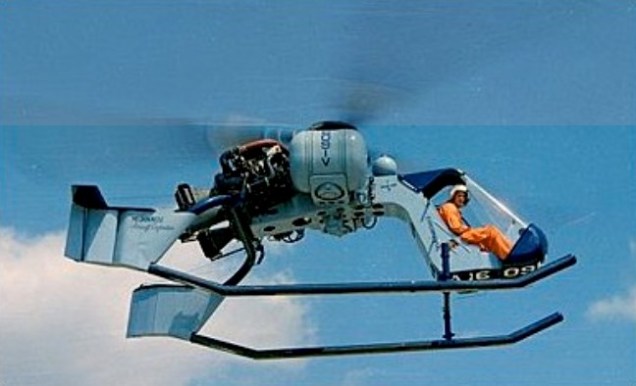
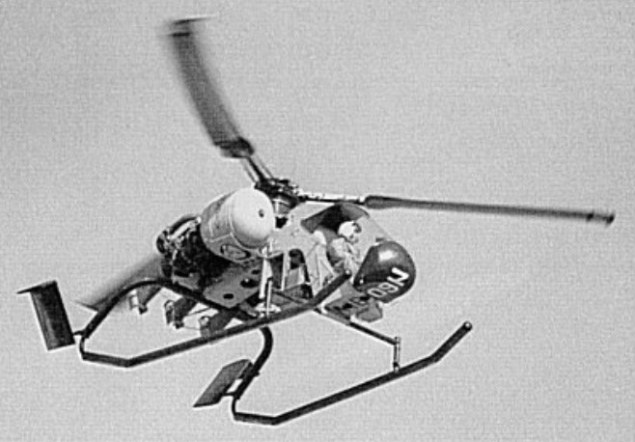
The mock-up of the Model 120, which was designed by a team led by Project Engineer Lloyd R. Novak, was completed in January 1957, and the first (N6081V) of two prototypes was flown on 13 November of that year by John R. Noll. This helicopter was of simple design, with the pilot seated centrally and the fuel tanks mounted on each side of the upper fuselage beneath the rotor head. Three AiResearch GTC-85-135 gas-turbine compressors, which fed pressure jets at the tips of the three-blade rotor, were located below and behind the rotor head. A wide-spaced skid undercarriage enabled large loads to be slung beneath the centre of gravity, or specialized pods to be fitted to carry up to 12 troops, firefighting equipment, or cargo containers.
In spite of some powerplant teething problems, the Model 120 demonstrated a maximum load-to-weight ratio of 1.5:1. Unfortunately, in spite of having been judged ‘one of the most outstanding helicopters evaluated to-date in its weight class’ when flown at the Naval Air Test Center, NAS Patuxent River, in September 1959, the Model 120 remained experimental as McDonnell failed to win either military or civil orders for this competent design. The termination of this programme in February 1960 marked the end of McDonnell’s independent efforts in this field as 13 months earlier the US Marine Corps had terminated the development of the XHCH-1 crane helicopter. McDonnell Douglas, however, came back to the helicopter field in 1984 with its acquisition of Hughes Helicopters, Inc.
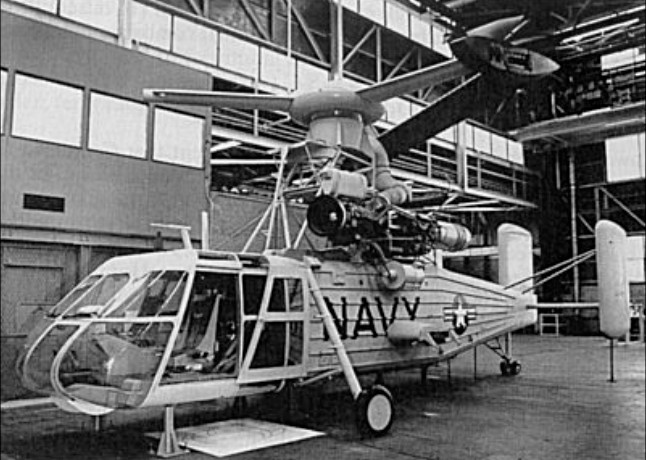
The McDonnell Model 86 was the first helicopter specially designed for the Navy vert-rep (vertical replenishment) mission – carrying supplies and ammunition between ships—and for the Marine logistic support mission—carrying heavy loads for short distances from ship-to-shore or from marshalling areas ashore to front-line units.
Emphasis was placed during its design on extreme simplicity, ease of maintenance, and good flying characteristics while carrying underslung loads of up to 6804kg when operating at normal gross weight, or 9979kg when operating at overload gross weight. The powerplant installation, derived from that developed for the XHRH-1, consisted of two 3750eshp Allison XT56-A-2 turbines mounted atop the fuselage and providing compressed-air to the 726kg thrust McDonnell 12JP20 pressure jet at the extremity of each rotor blade. The crew of two consisted of a pilot on the starboard side and an aft-facing winch operator to port. There was no provision for carrying loads internally. Loads were to be carried externally on a sling, in a net, or in a specially-developed pod. This pod was to be fitted with a detachable tail unit to stabilize the load in flight and with large wheels to enable it to be towed on uneven ground after it had been delivered to forward bases. Consideration was also given to using the Fairchild pod which had been designed for the XC-120 twin-engined cargo aircraft.
Three XHCH-1 prototypes (BuNos 138654/138656) were ordered on 11 April, 1952, under Contract NOa(s)52-947 and a mock-up was inspected on 22 and 23 May, 1953. However, the programme was later cut back due to lack of funds. No prototypes were completed but a much revised mock-up was inspected on 15 and 16 November, 1956, and a full-scale rotor was tested on a hot-whirling bench beginning in December 1957. Additional budget cuts forced the Navy to terminate the contract on 18 January, 1959, before completion of a prototype. Nevertheless, McDonnell kept working on the Model 86 sky crane until June 1961.
XHCH-1 Rotor diameter: 19.81m Length: 11.45m Height: 5.07m Empty weight: 6749kg Loaded weight: 16026kg Maximum weight: 19051kg Maximum speed at sea level: 185km/h Rate of climb: 16m/s Hover ceiling out of ground effect: 2285m Combat radius: 37km
In 1950, after trials with the XH-20 had been terminated, McDonnell engineers remained convinced that for certain specialized applications the intrinsic simplicity of this system would outweigh its uneconomical fuel consumption rate. Hence, after failing to attract the interest of the Army in a proposed light scout and observation vehicle using a ramjet-driven rotor, they turned their attention to the agricultural market in the belief that an easily maintained, low cost helicopter would find a ready market.
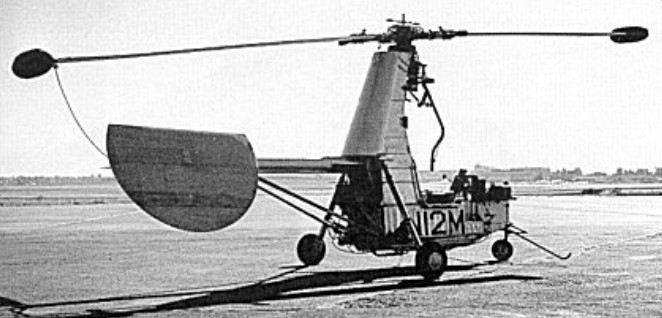
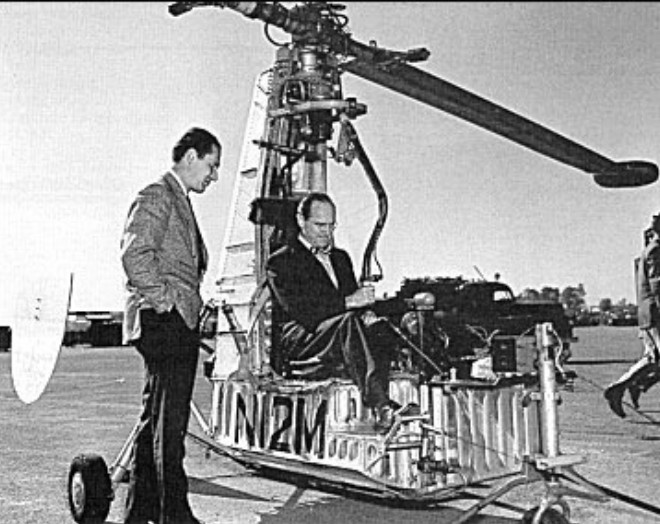
As described in a specification report dated 26 September, 1950, the Model 79 was essentially similar in concept and construction to the Model 38 (XH-20) but was somewhat larger with the diameter of the two-bladed rotor being increased from 5.49m to 8.23m. It differed further from the Model 38 in having tail surfaces consisting of a fixed ground adjustable tailplane and a universally mounted movable rudder. Open accommodation was provided for a pilot, and alternate alighting gears, consisting of either a tricycle gear or twin skids, were offered. Power was provided by a pair of McDonnell 8RJ4 ramjets, one at the tip of each rotor blade, and 379 litres of fuel was carried in two tanks. For ferry purposes auxiliary tanks could be fitted to increase fuel capacity to 681 litres.
Designed as a utility helicopter, the Model 79 was intended to be used for pest or weed control, defoliation, fertilizing, seeding, or many other varied uses such as carrying mail or cargo. To that end, it could be fitted with either (1) dual liquid chemical tanks with a total capacity of 439 litres and dual spray booms; (2) dual dust or seed bins with a total capacity of 0.44cu.m and a dust outlet pointing downward and aft of the rotor disc; or (3) dual mail or light cargo bins with a total volume of 1.13cu.m. As a further alternative, the design provided for the installation, either during construction or as rapid modification kits, of cockpit floor extensions and removable plastic panels to convert the single-seat Model 79 into the two-seat Model 79A with dual controls.
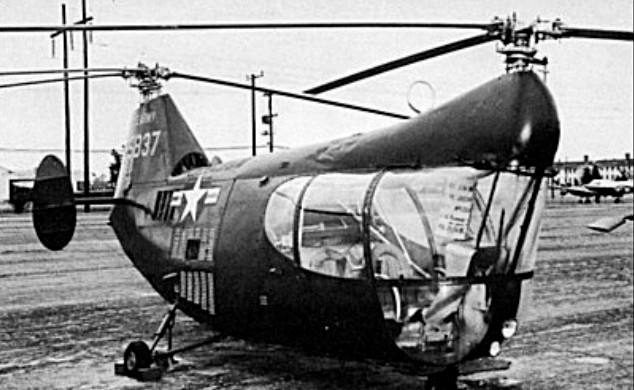
Charles R. Wood Jr. first flew the single seat Model 79 demonstrator, which was registered N12M, on 26 March, 1952. Although trials proved relatively uneventful and confirmed that the basic design was sound and easy to fly and maintain, development of the Model 79 had to be abandoned in mid-1953 as the type had failed to attract commercial interest due to high fuel consumption rate and noise level.
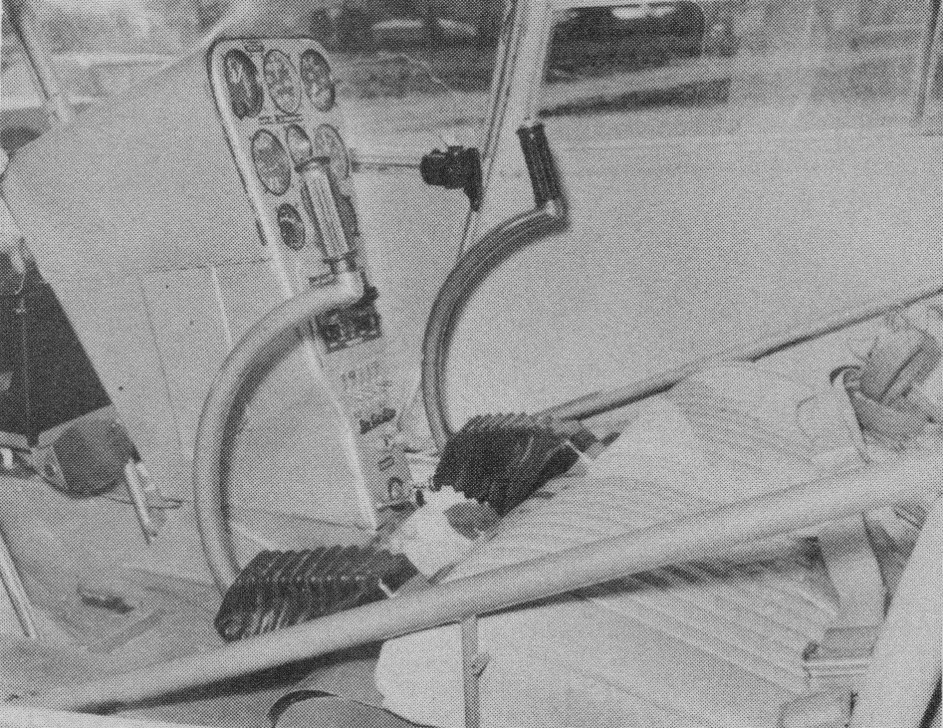
Steve Cole 15.03.2012 My Grandfather, Willis Cole Jr. worked for McDonnell. Somehow he acquired most of Big Henry when the project was cancelled. There are pictures of it sitting in the family driveway. Up until a few years ago, the landing gear, instrument panel and a piece of the fuselage (with the N12M number) were still floating around his garage. Willis Cole Jr. passed away 3-16-2012.
Model 79 Rotor diameter: 8.23m Fuselage length: 4.72m Height: 2.54m Empty weight: 293kg Loaded weight: 816kg Maximum weight: 907kg Maximum speed: 138km/h Rate of climb: 5m/s Hover ceiling in ground effect: 1160m Service ceiling: 3050m Endurance: 62 min
Design of the Model 78 was started in 1950 in answer to a request for proposals for an assault transport helicopter which had been issued by the Navy Department on behalf of the US Marine Corps. Intended to operate from CVE-105 class (USS Commencement Bay) carriers, the new helicopter was to fit on 13.41m by 12.80m deck elevators. Its primary mission was to carry 30 troops to objectives up to 100 naut miles away and return to the carrier without the need to refuel ashore.
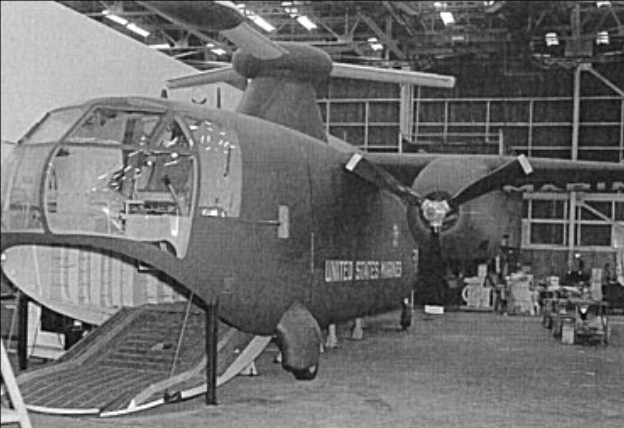
To fulfil what were then most demanding requirements, McDonnell designed a compound helicopter with a three-bladed rotor and short wings on which were mounted two 3507shp Allison XT56-A-4 turbines. For vertical flight, air from engine-driven auxiliary compressors was to be ducted to 726kg thrust McDonnell 12JP20 pressure jets, one at the extremity of each rotor. For forward flight, each engine was to drive a three-bladed propeller, with transition from helicopter flight mode to conventional flight being made by transferring power from the auxiliary compressors to the propellers as soon as the forward speed exceeded the stalled speed of the wing. Normal accommodation was to have been provided for a crew of two and 30 fully-equipped troops. Alternatively, accommodation could have been provided for 36 troops or 24 litter patients, or two Jeep-sized vehicles could have been carried internally. Larger loads (up to a maximum weight of 5224kg) could be carried externally. Another noteworthy design feature was the inclusion of a hydraulically-operated loading ramp in the forward fuselage, beneath the cockpit. Folding wings, rotor blades, and tail unit were to have enabled the Model 78 to fit on the deck elevators of CVE-105 carriers.
The Navy selected the McDonnell design on 15 March, 1951, and two and a half months later issued a Letter of Intent for three XHRH-1 prototypes (BuNos 133736/133738) to be built under Contract N0a(s)-51-1201. A full-scale mock-up of the XHRH-1 was inspected on 22 and 23 October, 1952, and construction of the prototypes was begun. However, after the Korean War had ended, budget cuts and concern over anticipated developmental problems led to the cancellation of the contract before completion of a single XHRH-1. All work on the project ended in April 1954.
XHRH-1 Rotor diameter: 19.81m Wingspan: 13.72m Length with rotor blades and tail folded: 16.33m Height: 5.09m Wing area: 30.84 sq.m Empty weight: 8695kg Loaded weight: 13795kg Maximum weight: 16329kg Maximum speed at sea level: 444km/h Climb rate: 12m/s Hover ceiling out of ground effect: 3050m Combat radius: 185km
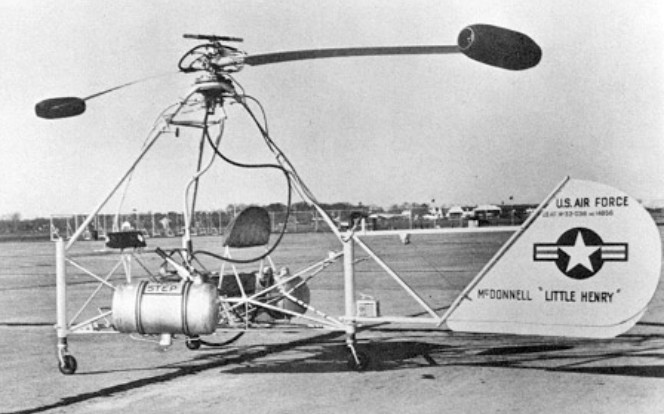
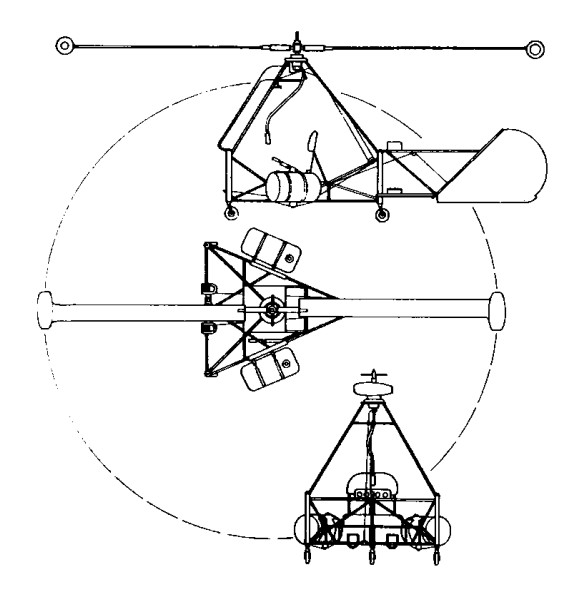
The XH-20 “Little Henry” was developed by a team led by Marvin Marks in close co-operation between the Helicopter and Propulsion Division of McDonnell and the AAF/USAF Rotor Wing Branch, Propeller Laboratory and Rotary Wing Unit, Aircraft Projects Section, Wright-Patterson AFB. At the time of its inception, the XH-20 was unique in being powered by two McDonnell-developed 18.42cm ramjet units weighing only 4.5kg each, mounted at the tips of the two-blade rotor and fed from tanks beside the pilot. The fuel, originally propane but later gasoline (motor car petrol), was boosted through a feed line to a delivery valve on the rotor head. From there centrifugal force took over to convey the fuel through the blades to the tip-mounted ramjets.
Having undertaken privately-funded studies of ramjets as powerplants for helicopters, McDonnell submitted an unsolicited proposal to the Air Materiel Command at Wright Field in the spring of 1946 and in July was awarded a contract for the development and testing of two experimental machines. It was then hoped that the powerplant would make it feasible to build small, lightweight helicopters by reducing or eliminating complex and heavy engine parts, gear systems, and transmissions. It was claimed that this powerplant installation would result in increased efficiency and would completely eliminate the need for a conventional anti-torque rotor. Accordingly, the two XH-20s were ordered as flying test-beds and were not intended as production prototypes. Their airframe was kept as simple as possible and consisted of welded tubes carried on three vertical legs ending with free-castoring wheels. Conventional helicopter controls were fitted, and the pitch lever incorporated a motorcycle-type throttle to regulate the fuel flow.
Fitted as a single-seater, the first of two prototypes (46-689 and 46-690) made both its first tethered flight on 5 May, 1947, and its first free flight on 29 August in St Louis with Charles R. Wood Jr. at the controls. With the project team then benefitting from the experience of Friedrich von Dobhloff, the Austrian engineer who had pioneered the application of jet principles to helicopters during the war, tests continued for four years. During that time, one of the two XH-20s was modified as a two-seater and, like the single-seater, proved generally satisfactory. However, the ramjet units had excessive fuel consumption, which drastically limited range and endurance when compared to conventionally-powered helicopters, and rate of descent in autorotation was excessive. Accordingly, the Air Force terminated the programme in 1951. The first XH-20 was preserved and is now part of the collection of the Air Force Museum at Wright-Patterson AFB, Ohio.
Main rotor diameter: 5.49m Length: 3.81m Height: 2.13m Max take-off weight: 254kg Empty weight: 129kg Cruising speed: 80km/h Endurance: 50min
The McDonnell Aircraft Corporation was formed on 6 July 1939 by James S. McDonnell. Built Fairchild AT-21 gunnery trainers at Memphis, Tennessee, plant and designed XP-67 experimental twin-engined fighter in 1942. Developed first U.S. Navy twin-jet fighter, FH-1 Phantom I, which was first flown January 26,1945. Enlarged version was F2H Banshee, flown January 11,1947. F3H Demon single-engined jet fighter, maiden flight August 7,1951. XF-88 jet fighter for USAF cancelled 1950 but developed later as F-101 Voodoo, flown September 29,1954. F-4 Phantom II twin-engined missile-armed attack fighter flown May 27,1958, subsequently standard USAF, USN and USMC fighter, built also for reconnaissance and antiradar roles and widely exported; 5,057 built in U.S.A. up to June 1979, and production by Mitsubishi in Japan continued until 1981.
Merged with Douglas Aircraft Corporation Inc April 28,1967 to form McDonnell Douglas. Douglas files bankruptcy and was forced to sell at a knocked down price to McDonnell of St. Louis, which had been making handsome profits out of its F-4 Phantom, supplied to the air force in Vietnam.
In 1949 Helicopter Division of McCulloch Motors Corporation appointed as chief designer D. K. Jovanovich, formerly of Helicopter Engineering and Research Corporation, who developed his JOV-3 as McCulloch MC-4 tandem rotor two-seat helicopter, first flown Los Angeles March 20, 1951.
This was the first tandem-rotor helicopter to be certificated by the U.S. Civil Aeronautics Administration for commercial use, and is also one of the smallest helicopters to be built with a tandem layout. Its development began in 1946 with the Helicopter Engineering and Research Corporation headed by D.K. Jovanovich and F. Kozloski, where a small 2-seat prototype (N9000H) was built with the designation JOV-3. This aircraft, powered by a 125hp Lycoming O-290, was flown successfully in 1948.
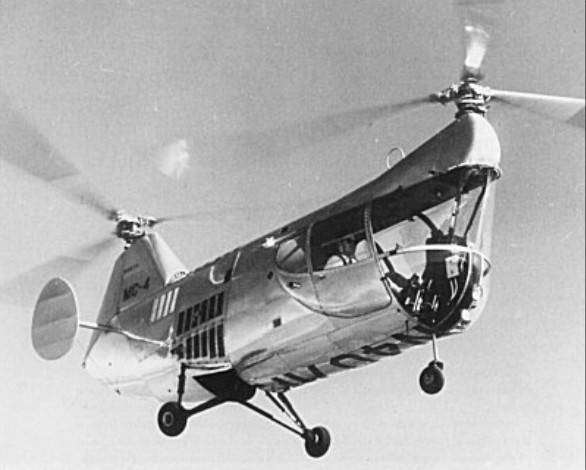
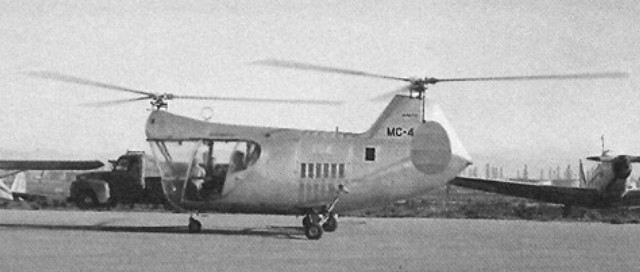
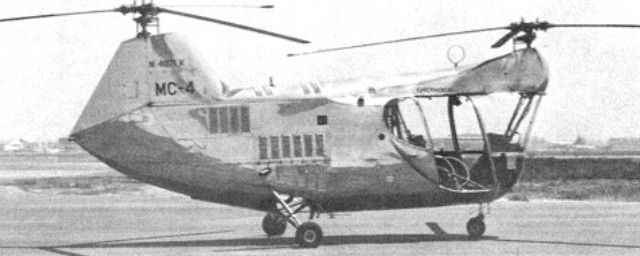
Jovanovich and Kozloski transferred in 1949 to the newly-formed helicopter division of the McCulloch Motors Corporation, where an enlarged development of the JOV-3 was built as the MC-4 with 6.71m rotors and a 165hp Franklin 6V4-165-832 engine. The main drive shaft is driven through a 12-unit vee-belt system. This prototype (N4070K) flew for the first time on March 20, 1951 at Los Angeles, and soon afterwards McCulloch began the construction of a prototype MC-4C (N4071K) and three generally similar YH-30’s (52-5837 to ’39) for evaluation by the U.S. Army. These were slightly larger than the MC-4, having 200hp Franklins and egg-shaped tail fins mounted on outriggers below the rear rotor head. The YH-30’s trials programme yielded no military orders, and no civilian customers were immediately forthcoming for the MC-4C, which was certificated by the CAA on 17 February 1953.
Jovanovich and Kozloski left McCulloch when the Airplane Division was closed, and formed Jovair Corp in 1957 to continue their work on helicopters. They resumed the design rights and purchased one of the MC-4A’s (N4071K) which had been produced for evaluation by the USN (as the HUM-1).
Four-seat 4E Sedan with the 1962-built Jovair 4A, a stripped-down two-seat agricultural and training aircraft
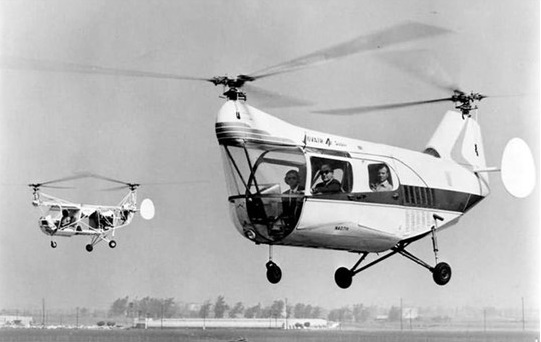
Jovair modified the MC-4C as a prototype for a four-seat private helicopter designated the Sedan 4E. The Sedan 4E was powered by 210 hp Franklin 6A-335 engine and received certification in March 1963. A version with a turbocharged engine was designed as the Sedan 4ES and a more basic Sedan 4A for agricultural use. By 1965 a small number of Sedan helicopters were built. In 1969 McCulloch regained the rights to the helicopter designs who continued development of the Jovair 4E Sedan as the McCulloch MC-4E.
The design was offered to the U.S. Army as the XH-30 (MC-4C, serials 52-5837 through -5839) and to the Navy as the XHUM-1 (MC-4A) by McCulloch Motors Corporation. Three were built for the Army and two for the Navy in 1953. Neither service had a use for them and they were returned to McCulloch.
The YH-30 was a craft of relatively simple construction, consisting of a steel tube framework to which was attached a light metal skin. The helicopter’s single 200hp Franklin engine was mounted horizontally amidships and drove the two inter-meshing tandem rotors through a single horizontal drive shaft and two right-angled reduction units. Two small endplate rudders were fixed to the rear fuselage to provide additional lateral stability, and the aircraft was equipped with wheeled tricycle landing gear. The craft’s two crew members enjoyed better than average visibility to the front and sides, though the view upward was blocked by the overhanging front rotor housing.
The Army’s evaluation of the YH-30 showed the helicopter to be somewhat underpowered and its drive system to be overly complex. The type was therefore not procured in quantity, and the three evaluation machines were declared surplus in mid-1953 and disposed of.
McCulloch MC-4
An MC-4C was used in the 1954 science fiction production Gog.
The civil version, the slightly larger MC-4, was unable to generate any sales and McCulloch lost interest in the project and turned it back over to the original designer D. K. Jovanovich.
Jovair Corporation produced N4071K in developed form as the prototype for a new 4-seat private or executive helicopter known as the Sedan 4E. The Franklin 6A-335 of 210hp was now installed and the fuselage offered comfortable accommodation and easy 4-door access to 3 passengers in addition to the pilot. A supercharged version, the Sedan 4ES, was offered with a 225hp Franklin 6AS-335. The Sedan 4E received type approval from the FAA in March 1963, and some two years later small-scale production of this version was begun; a version, with a 235hp 6A-350 engine, is slightly heavier. In mid-1963 Jovair offered the stripped-fuselage Sedan 4A as an agricultural, training or utility cargo version, with provision for some 450kg of cargo or crop spraying equipment in place of the rear passenger compartment.
Jovair Sedan
Jovair 4E
The Jovair E4 features independently removable components for ease of maintenance, including heavy-duty vibrationless control system, interchangeable rotor balades and ground resonanceless design. Landing gear is fixed type tri-gear. The Jovair Sedan has skinned, steel tube fuselage structure. Rotor blades are all metal using bonded, wrap-around skin construction, factory balanced. A hinged type rotor system is utilised. Vibrationless flexible Vee-belt drive transmits power to the shafts and gears (2 sets of bevel gears used) and one-size flex-spline type coupling replaces universal joints.
In 2008 two MC-4Cs were still registered in the United States. The Pima Air and Space Museum has a HUM-1, registration N4072K (Serial Number: 133817). The Yanks American Air Museum at Chino are restoring a MC-4C to flying condition although they have no plans to fly it. It may be N4071K or N4091K. One of the three YH-30 miitary prototypes is preserved by the US Army Aviation Museum at Fort Rucker, Alabama. It is c/n 001 and has the military serial 52-5837. As of April 2013 it remains in a storage building and is not on public display.
Variants: McCulloch MC-4 Prototype with a 165 hp Franklin engine, two built, one for evaluation by the United States Navy.
McCulloch MC-4A Variant for evaluation by the United States Navy as the XHUM-1, two built.
McCulloch MC-4C Prototype with a 200 hp Franklin engine, one built and an additional three for United States Army evaluation as the YH-30.
Jovair Sedan 4E Production civil four-seat version powered by a 210 hp Franklin 6A-335 engine.
Jovair Sedan 4ES Sedan with a turbocharged 225 hp Franklin engine.
Jovair Sedan 4A Simplified agricultural version.
YH-30 Military version of the MC-4C, three built.
XHUM-1 Two MC-4As for evaluation by the United States Navy, later redesignated HUM-1.
Jim Trego 02.09.2011 I was one of the engineers on the project. There were only 23 people on the project including engineers, welders, mechanics and a test pilot. A real fun project that didn’t go anywhere because the Korean war ended and so did the market for helicopters.
MC-4 Engine: 1 x Franklin 6A4-200-C6, 149kW / 200 hp Rotors: 2 x 3-blade tandem inter-meshing Rotor diameter: 7.01m / 23 ft Fuselage length: 9.88m Height: 2.77m Max take-off weight: 1043kg / 2,300 lb Empty weight: 726kg Max speed: 169km/h / 120 mph Cruising speed: 137km/h Ceiling: 3048m / 10,000 ft Range: 322km / 200 miles at 85 mph with full load Crew: 2
HUM-1 Engines: 1 Franklin 6A4-200-C6 200 hp Rotor diameter: 23 ft Length: 32 ft 5 in Height: 9 ft 3 in Weight: 2,300 lbs Max. Speed: 105 mph Service Ceiling: 8,000 ft Range: 200 miles Crew: 2
YH-30 Powerplant: 1 × Franklin O-335-6 (6A4-200-C6), 200 hp (147.1 kW) Crew: two Length: 32 ft 0 in Main rotor diameter: 2× 22 ft 0 in Height: 9 ft 2 in Empty weight: 1200 lb (544 kg) Gross weight: 2000 lb (907 kg) Maximum speed: 105 mph (168.98 km/h) Range: 200 miles (321.86 km)
Jovair 4E Rotor blade diameter: 23 ft Rotor blades chord: 6.76in Overall width: 18 ft Height: 9 ft Overall length: 33 ft 2 in Fuselage length: 18 ft Empty weight: 1463 lb Useful load: 837 lb Gross weight: 2300 lb Cruise speed: 90+ mph Endurance: 2 hr Service ceiling: 12,500 ft Hover ceiling IGE: 6000 ft Hover ceiling OGE: 3000 ft Undercarriage tread: 6 ft 6.75 in Undercarriage track: 7 ft Basic price: $48,500
In 1949 Helicopter Division of McCulloch Motors Corporation appointed as chief designer D. K. Jovanovich, formerly of Helicopter Engineering and Research Corporation, who developed his JOV-3 as the McCulloch MC-4 tandem rotor two-seat helicopter, first flown Los Angeles March 20,1951. Four-seat version developed as MC-4E. Later initiated quantity production of Jovanovich’s J-2 two-seat gyroplane, first flown in June 1962.
McCulloch Aircraft moved to California in 1946 and was renamed McCulloch Motors.
On 25 February 1977, MBB of West Germany and Kawasaki of Japan signed an agreement for the joint development of a twin-turbine utility helicop¬ter suitable for military as well as civil use, following more than two years’ negotiation. Joint development costs were to be divided equally, the financing being guaranteed by the respective governments. MBB was to be responsible for the main rotor and tail rotor, tail boom, empennage, hydraulic system and controls, while Kawasaki was to develop the landing gear, fuselage, transmission and other minor components. This emerged as the BK 117, which uses the BO 105’s rigid main rotor and a Japanese-developed transmission.
The original programme was based on four prototypes, two to be built by MBB in Munich and two by Kawasaki in Gifu, all to be completed by mid 1979. In each case, one of the prototypes was intended for flight testing and the other for static tests. However although the German company succeeded in completing its two models by the end of 1979, only one of the Japanese prototypes was ready on time.
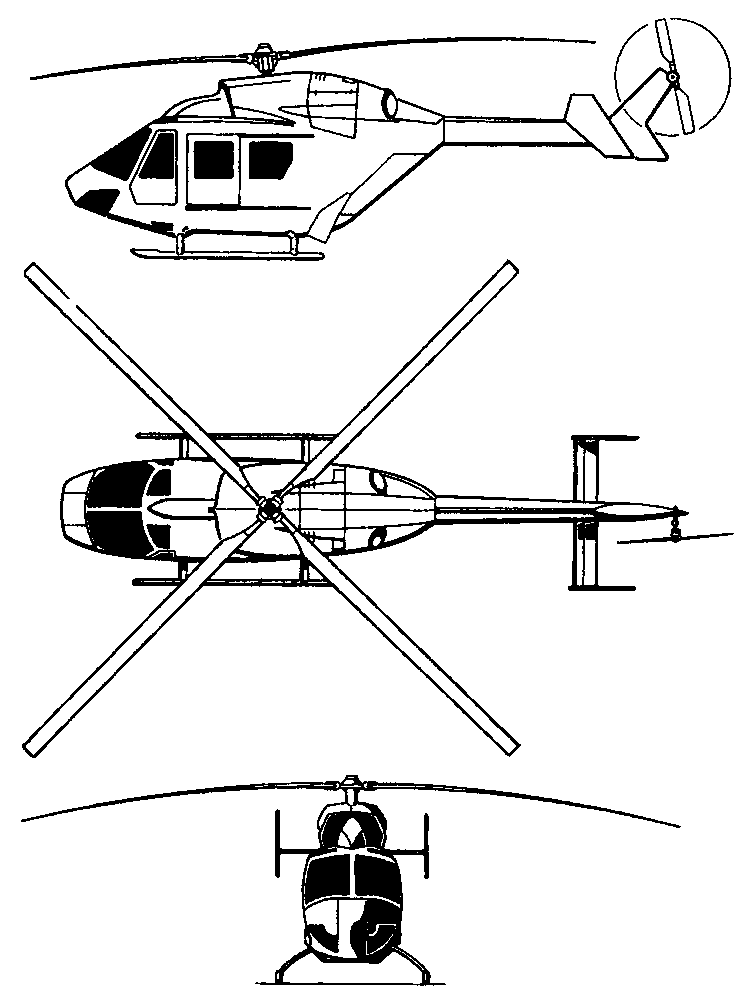
A fair percentage of parts and systems are identical to those of the German Bo.105 helicopter. The hydraulic system is based on the original Bo.105 version and even the rotor is taken from the Bo.105, suitably enlarged to match the demands of the bigger and heavier BK-117. The four-blade rotor is of the rigid type with a titanium hub and reinforced fiberglass blades. The transmission is derived from the Japanese KH-7 project: a seven-ten-seat helicopter which was to have been fitted with two 590shp Lycoming turbine engines. The BK-117 also has a pair of Avco-Lycoming LTS-101-650B-1 engines, delivering 600shp on take-off and 550shp maximum continuous power. The fuel tanks, with a total capacity of 605 liters, are housed in the lower part of the fuselage.
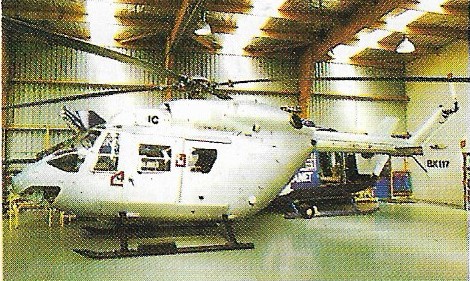
The executive version of the BK-117 carries a pilot and five passengers, but the volume of 3.22cu.m gives room for nine passengers in the high density version or in those used for commuter and offshore services to oil platforms. It can be loaded through two large sliding doors, one on either side of the fuselage. Behind the passenger cabin is a large baggage hold with a capacity of 1.34cu.m, which is reached through two hinged doors at the rear of the fuselage. A cargo hook can be fitted to the cabin floor for external lift work.
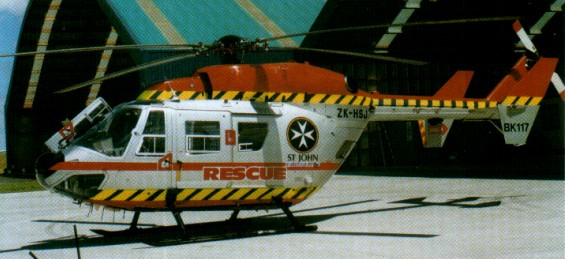
German and Japanese prototypes flew for the first time on 13 June 1979 (D-HBKA) and 10 August 1979 (JQ0003, the third BK.117) respectively. Kawasaki was first to fly a production aircraft (JQ1001) on 24 December 1981; MBB followed with D-HBKC on 23 April 1982, this machine being the first production aircraft to be delivered to a customer, in early 1983.
By the beginning of 1982, the BK-117 prototypes had logged more than 750 flying hours and type approval by the German Federal Authorities followed shortly afterwards. Half of the 130 aircraft ordered by February 1982 were for customers in the United States, where deliveries began in early 1983, from two production lines, in Germany and Japan.
Combining utility troop trans¬port and anti-tank capability, the BK.117A-3M was originally conceived as a contender for the Belgian Aeromobility 1 requirement. Based on the civilian BK.117A-3 airframe, the A-3M is offered in a multirole military configuration equipped with an under-nose Lucas 12.7mm or 0.5in gun turret with helmet sight, HOT anti-tank missiles with stabilised roof mounted sight, rocket pods, AAMs, and an ECM and Racal radar warning system, managed by a Racal 3000 Series avionics management system. Provision is also made for a mast mounted sight. Up to 11 troops can be carried in the utility role. Powered by twin Lycoming LTS1O1-650B-1 turboshafts, the BK.117 A-3M has a maximum take-off weight of 3,200kg and an operating range (minus auxiliary tanks) of 495km. MBB later abandoned its armed military BK 117A-3M.
The 1990 production version was the BK.117B-1. This was certificated in 1987 and is powered by two 592 shp (442 kW) Textron Lycoming LTS 101-750B-1 turboshafts.
BK 117 B1
The B-2 model has an increased MTOW and an extended C of G range.
Germany’s ministry of defence used one BK 117 as a composites testing aircraft.
More than 180 BK 117s had been delivered from the production lines in Germany and Japan by 1990. The BK 117M is a military version, six.of which were delivered for trials with the West German Army.
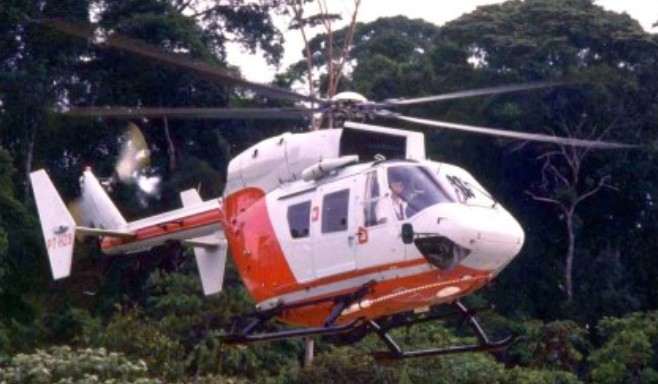
An agreement was concluded in 1982 for the type to be built in Indonesia under licence by IPT Nurtanio as the NBK-117.
By January 1990 more than 250 BK 117s had been delivered worldwide, including 36 by Kawasaki, the standard aircraft being the BK 117B-1.
Since April 1990 a BK 117 engine testbed has been flying equipped with Turbomeca Arriel turboshafts in an effort to offer customers an alternative engine, and certification was scheduled for 1992.
On 1 September 1991, MBB transferred its Helicopter Division to Eurocopter Hubschrauber GmbH. This was later integrated with Aerospatiale’s helicopter interests into the Paris-based Franco-German Eurocopter Holdings, along with the NH-90, BO 105, BO 108 and BK 117.
BK 117A-1 Initial production version with LTS 101-650B-1 engines
BK 117A-3 Certificated in March 1985 with larger tail rotor fitted with twisted blades and take-off weight increased to 3200kg
BK 117A-4 Certificated in July 1986 with increased transmission limits at take-off power, improved tail rotorhead, and extra internal fuel (on German aircraft), all giving enhanced performance
BK 117 B-1 Fitted with more-powerful LTS 101-750B-1 engines to provide further increased performance and 140kg more payload; certificated in 1987
BK 117M Military version of A-1 proposed by MBB in 1985, and flying since 1988; fitted with taller skids, a Lucas turret mounted under the fuselage houses a Browning 12.7mm automatic machine-gun and 450 rounds of ammunition, controlled by a helmet-mouted sight; outrigger pylons can carry up to eight HOT II or TOW antitank missiles, air-to-air missiles, rocket-pods, or forward-firing cannons; a doorway gunners position with a 12.7mm gun can also be installed, or 11 troops can be carried
Specifications:
MBB/Kawasaki BK 117 Engine: 2 x Lycoming LTS101-650B-1, 650 shp / 410kW TBO: 2400 hr Main rotor: 36.1 ft / 11m Seats: 8/10 Length: 32.7 ft / 9.91m Length rotors turning: 13m Height: 10.9 ft / 3.83m Max ramp weight: 6283 lb Max takeoff weight: 6283 lb / 2850kg Standard empty weight: 3505 lb / 1650kg Max useful load: 2778 lb Max landing weight: 6283 lb Max sling load: 2645 lbs Disc loading: 6.1 lbs/sq.ft Power loading: 7.4 lbs/hp Max usable fuel: 1058 lbs Max rate of climb: 1830 fpm Service ceiling: 17,000 ft / 4570m Hover in ground effect: 11,000 ft Hover out of ground effect: 8700 ft Max speed: 150 kts Normal cruise @ 3000 ft: 139 kt / 250km/h Fuel flow @ normal cruise: 463 pph Endurance @ normal cruise: 2.1 hr Range max payload: 500km
BK.117 Engine: 2 x Lycoming LTS 101-750A3, 986 shp Empty wt: 1849 kg Cruise: 130 kts Range: 540 km (340nm)
BK.117B-2 Engine: 2 x Lycoming LTS 101-750B-1 Instant pwr: 548 kW Rotor dia: 11 m MTOW: 3350 kg Useful load: 1595 kg Max speed: 150 kts Max cruise: 133 kts Max range: 540 km Crew: 2 Pax: 10 Seats: 8/11.
BK.117C-1 Engine: 2 x Turbomeca Arriel 1E2 Instant pwr: 574 kW Rotor dia: 11 m MTOW: 3350 kg Useful load: 1585 kg Max speed: 140 kts Max cruise: 133 kts Max range: 540 km Crew: 2 Pax: 10 Seats: 8/11
BK.117M Engines: two 592-shp (441-kW) Lycoming LTS 101-650B-1 turboshafts Maximum speed 155 mph (250 km/h) at sea level Initial climb rate 1,476 ft (450 m) per minute Service ceiling 15,000 ft (4,570 m) Range 308 miles (495 km) Empty weight 5,644 lb (2,560 kg) Maximum take-off weight 7,055 lb (3,200 kg) Main rotor diameter 36 ft 1 in (11.00 m) Length overall, rotors turning 42 ft 8 in (13.00 m) Height 11ft 0.3 in (3.38 m) to top of rotor head Main rotor disc area 1,022.96 sq ft (95.03 sq.m) Armament: one 0.5-in (12.7-mm) machine gun and disposable weapons Hardpoints: 2
Messerschmitt amalgamated with Bolkow as Messerschmitt Bolkow GmbH 1968 and then with Hamburger Flugzeugbau to form Messerschmitt-Bolkow-Blohm 14 May 1969.



 All Aero