Merckle SM-67

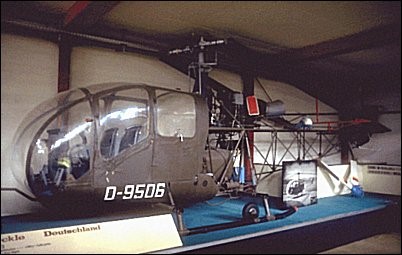
First turbine-powered helicopter built and flown in Germany, the five-seat Merckle SM 67 development began as a private venture in 1956, but the third prototype, which flew for the first time on April 12,1961, was bought by the Federal Government and spent much of last year undergoing an official flight test and evaluation programme.

More refined than its predecessors, it has a fully enclosed cabin and is powered by a 406shp Turbomeca Artouste IIC shaft turbine, driving a three-blade main rotor and two-blade tail rotor.

SM-67
Engine: 406shp Turbomeca Artouste IIC
Rotor diameter: 10.49m
Overall length: 12.75m
Height: 2.8m
Gross weight: 1700kg
Empty weight: 1037kg
Max speed: 220km/h
Cruising speed: 190km/h
Hovering ceiling OGE: 3500m
Range with full payload: 360km
Payload: 300kg

Meger Heli-Star

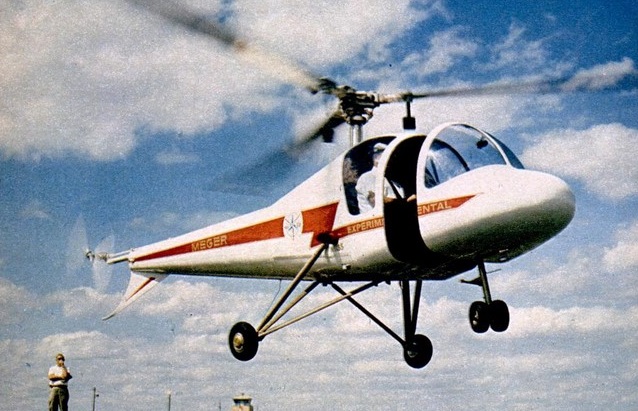
The Heli-star is a two place, homebuilt three rotor helicopter designed by Mike Meger, flight director of Enstrom.

It was equipped with tricycle landing gear, using modified Enstrom F-28 helicopter rotor blades, gearbox and tail boom. Developed in 1969, it was first flown on 25 March 1971.

The helicopter can be flown from either seat with dual controls. The fuselage splits open at the windshield line, sliding forward for access. The helicopter was demonstrated with the front section slid open in flight.

Only the one was built.

Engine: 1 × Lycoming HIO-360-C1A, 205 hp (153 kW)
Main rotor diameter: 3× 29 ft 6 in (8.99 m)
Length: 29 ft (8.8 m)
Height: 8 ft 2 in (2.49 m)
Empty weight: 1,450 lb (658 kg)
Max takeoff weight: 2,100 lb (953 kg)
Maximum speed: 100 kn (115 mph; 185 km/h)
Cruise speed: 78 kn (90 mph; 144 km/h)
Service ceiling: 13,000 ft (4,000 m)
Rate of climb: 1,000 ft/min (5.1 m/s)
Disk loading: 2.1 lb/sq ft (10 kg/m2)
Crew: 1
Capacity: 1 passenger

McDonnell-Douglas MD-900 / MD-902 Explorer

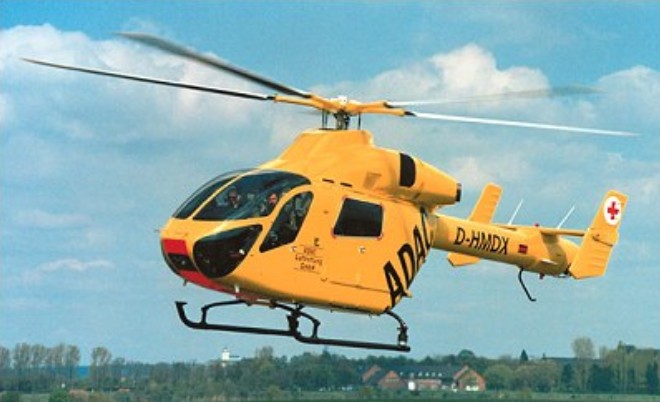
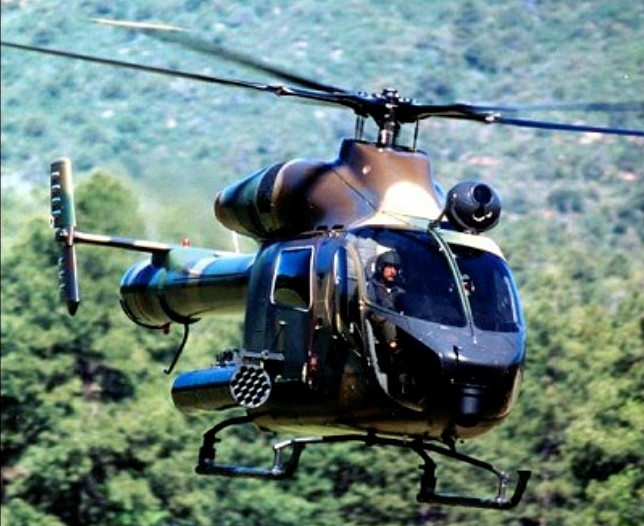
The genesis of the Explorer dates to 1986, when company engineers hit upon the idea of using the latest technology, such as an all-composite main rotor and MDHS’ own no-tail-rotor (NOTAR) anti-torque system, as a basis for a new eight-seater design which would give excellent performance at affordable cost. The MD Explorer is the first commercial helicopter totally designed using computer-aided design techniques and only after a detailed market survey of over 177 operators asking them what they wanted from a new utility helicopter in terms of flight performance and general layout in a 1800 to 3600kg helicopter.

McDonnell-Douglas MD-900 / MD-902 Explorer Article

MDHS decided to go ahead with design work in January 1989 with a senior advisory council formed from risk-sharing partners in the $200 million programme. The Explorer is created using computer-aided design (CAD) techniques. The Explorer is the first helicopter to have a major portion of its primary structure constructed from composites. This is most evident in the fuselage, which is manufactured by Hawker de Havilland in Australia. Skins, floors, mb/keel beam and aft-fuselage assemblies are made from a pre-impregnated carbon-fibre composite with a toughened epoxy resin system produced by Hexel. Hawker de Havilland refined manufacturing techniques after the first three fuselage units and standardised on a final design which is around 10% lighter than the development fuselages, weighing in at just 260kg. Metallic parts consist of the titanium roof which provides protection from fire in the engine area, the main frames, fittings and forward-cockpit structure. Two aluminium plough beams form the primary structural support for the nose and provide enhanced crash-protection. In the event of a forward impact with the ground, the beams are designed to keep the nose of the helicopter from tipping down. In the passenger configuration, the Explorer’s 1.44m-wide cabin provides enough space for two rows of three 480mm seats , with a seventh passenger seated in the co-pilots position. Without seats, the helicopter has a completely flat floor which is accessible via a rear-access door and large sliding doors on either side of the cabin. The tailboom and empennage are all-composite primary structures made by MDHS using the same carbon composite and toughened resin as the fuselage. Like the fuselage, the early tailboom design was altered slightly for the final-production configuration to give a 25% weight saving. As the tailboom is hollow to accommodate the NOTAR system, it has aerodynamic surfaces on the inside, as well as the outside. Slots run the length of the right-hand side of the boom to allow air to escape and create the Coanda effect at the heart of the NOTAR principle.

Initially known as MDX, then MD 900 (proposed MD 901 with Turbomeca engines was not pursued. Hawker de Havilland of Australia designed and manufactures airframe; Canadian Marconi tested initial version of integrated instrumentation display system (IIDS) early 1992; Kawasaki completed 50 hour test of transmission early 1992. Other partners include Aim Aviation (interior), IAI (cowling and seats) and Lucas Aerospace (actuators).

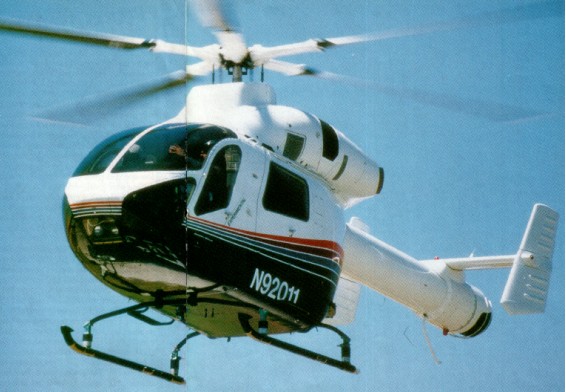
Ten prototypes and trials aircraft, of which seven (Nos. 1, 3-7 and 9) for static tests, were built. The first flight (No.2/N900MD) was on 18 December 1992 at Mesa, Arizona, followed by No.8/N900MH 17 September 1993 and No.10/N9208V 16 December 1993; first production/demonstrator Explorer (No.11/N92011) flown 3 August 1994.

FAA certification 2 December 1994; first delivery 16 December 1994; JAA certification July 1996; FAA certification for single-pilot IFR operation achieved January 1997. Type certificate transferred to MDHI on 18 February 1999.

This new technology helicopter received type certification on 21 December 1994 from the FAA which was only 23 months after first flight. This was one of the shortest certification periods ever recorded for a new helicopter and was also the first new design passenger and utility rotorcraft certified by the FAA in more than ten years.

FAA certification of uprated PW207E engine achieved in July 2000, providing 11% more power for take-off and 610m increase in hovering capability OEI in hot-and-high conditions; first delivery of PW207E-engined Explorer to Police Aviation Services, UK, 27 September 2000. “100th production” Explorer (actually 89th overall, including prototypes) delivered 1 March 2002 to Tomen Aerospace Corporation of Japan for ENG operations by Aero Asahi of Hiroshima. Total fleet time stood at more than 120,000 hours by December 2002.

MDHS begun delivery of the Explorer with a target direct-operating cost of $389/h and a base price of $3.16 million at 1995 exchange rates.

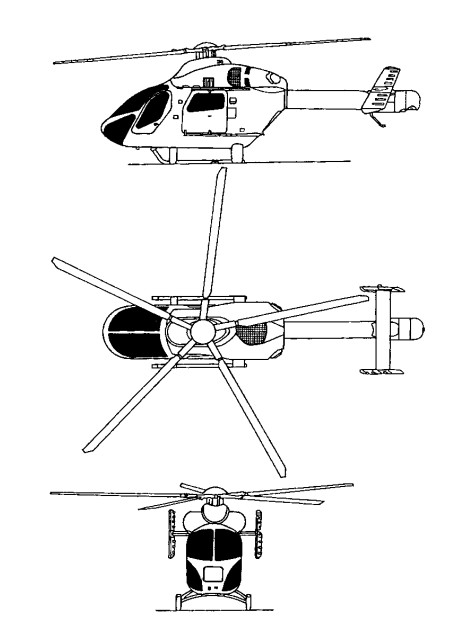
The Explorer has been built largely from composite materials and is powered by twin Pratt & Whitney Canada PW 206A turboshafts and has a maximum gross weight of 2950kg. It can lift 1150kg internally, or 1350kg externally and weighs only 1350kg empty. The helicopter incorporates a range of new technologies to improve safety and performance and reduce operating costs. These include the NOTAR yaw control system, composite, bearingless main rotor with five blades. Digital avionics including FADEC, diagnostics and an Integrated Instrument Display System. The liquid crystal Integrated Instrument Display System (IIDS) replaces traditional cockpit instruments by presenting aircraft operating information in a digital format and icon symbology on two six-inch screens. The system also records operating data for on-board health and usage monitoring, providing technicians with accurate information for performing maintenance functions.

The NOTAR anti-torque system features all-composites five-blade rotor of tapered thickness with parabolic swept outer tip with bearingless flexbeam retention and pitch case; tuned fixed rotor mast and mounting truss for vibration reduction; replaceable rotor tips; maximum rotor speed 392 rpm; modified A-frame construction from rotor mounting to landing skids protects passenger cabin; energy-absorbing seats absorb 20 g vertically and 16 g fore and aft; onboard health monitoring, exceedance recording and blade track/balance.

Mechanical engine control from collective pitch lever is back-up for electronic FADEC. Automatic stabilisation and autopilot available for IFR operation. The transmission overhaul life 5,000 hours; glass fibre blades have titanium leading-edge abrasion strip and are attached to bearingless hub by carbon fibre encased glass fibre flexbeams; rotor blades and hub on condition.

The baseline MD 900 is powered by two Pratt & Whitney Canada PW206E turboshafts with FADEC, each rated at 463kW for 5 minutes for T-O, 489kW for 2.5 minutes OEI and 410kW maximum continuous. Transmission rating 820kW for T-O, 746kW maximum continuous, 507kW for 2.5 minutes OEI and 462kW maximum continuous OEI.

Fuel contained in single tank under passenger cabin, capacity 564 litres, of which 553 litres are usable. Single-point refuelling; self-sealing fuel lines.

Accomodation is for two pilots or pilot/passenger in front on energy-absorbing adjustable crew seats with five-point shoulder harnesses/seat belts; six passengers in club-type energy-absorbing seating with three-point restraints; rear baggage compartment accessible through rear door; cabin can accept long loads reaching from flight deck to rear door; hinged, jettisonable door to cockpit on each side; sliding door to cabin on each side.

Hydraulic system, operating pressure 34.475 bar.

With 14 feet of flat floor space in the rear cabin, the Explorer is expected to undertake a multitude of civil missions from general utility to offshore transportation, corporate flight, tourist flights and air medical services. In the EMS configuration the Explorer can accommodate two patients, two attendants and life support equipment in addition to the flight crew.

The 100th Explorer registered in 2002 (to become seventh for Netherlands police); total of 108 manufactured by December 2002; first delivery 16 December 1994 to Petroleum Helicopters Inc (PHI) which ordered five; second delivery (N901CF) December 1994 to Rocky Mountain Helicopters for EMS duties with affiliate Care Flight unit of Regional Emergency Medical Services Authority (REMSA) in Reno, Nevada. Total of two delivered in 1994, 12 in 1995, 15 in 1996, one in 1997, four in 1998, 11 in 1999, 16 in 2000, 20 in 2001 and four in 2002; initial (MD 900) series comprised 40 aircraft including three flying prototypes; FW207E engine from 64th production (67th overall) aircraft.

MD Enhanced Explorer: Improved version, announced September 1996; originally MD 902, but now known as “902 Configuration”. Main features include Pratt & Whitney Canada PW206E engines with increased OEI ratings; transmission approved for dry running for 30 minutes at 50% power; improved engine air inlets, NOTAR inlet design and engine fire suppression system, and more powerful stabiliser control system, resulting in 7% increase in range. 4% increase in endurance and 113kg increase in payload over Explorer. First flight (N9224U; c/n 900-0051, 41st Explorer) 5 September 1997, FAA certification to Category A performance standards (including continued take-off with one failed engine) and single-pilot IFR operation achieved 11 February 1998; JAA certification for Category A performance achieved July 1998. Retrofit kits to convert Explorers to Category A standard. First Enhanced Explorer delivery in May 1998 to Tomen Aerospace of Japan. PW206E replaced by PW207E from late 2000, beginning at c/n 900-0077, allowing further MTOW increase to 2,948kg.

MH-90 Enforcer: Beginning March 1999, under a programme code-named Operation New Frontier, the US Coast Guard used two leased MD 900 Explorers for shipboard anti-drug smuggling operations. Armed with a pintle-mounted M240 7.62mm minigun at the door station. In September 1999 the MD900s were exchanged for two leased MD 902 Enhanced Explorers. These subsequently replaced by Agusta A 109s. Six delivered to Mexican Navy at Acapulco (two each respectively in May and December 1999 and April 2000) for anti-drug operations, equipped with 12.7mm General Dynamics GAU-19/A Gatling guns, and 70mm rocket pods; further four in process of delivery. Weapons qualification trials were completed at Fort Bliss, Texas in November 2000.

Combat Explorer: Displayed at Paris Air Show, June 1995; demonstrator N9015P (No.15), an MD 900 variant. Can be configured for utility, medevac or combat missions; armament and mission equipment may include seven- or 19-tube 70mm rocket pods, 12.7mm machine gun pods, chin-mounted FLIR night pilotage system and roof-mounted NightHawk surveillance and targeting systems. Combat weight 3,130kg; two P&WC PW206A engines. No customers announced by January 2000, but N9015P became one of initial two MH-90s (with third prototype, N9208V).

February 19, 1999: Boeing sold MD commercial line to RDM The dutch company bought the ex Mc Donnell Douglas models MD 500E and MD 530F single-engine helicopters with conventional tail rotors, the MD 520N and MD 600N single-engine NOTAR helicopters and the MD Explorer series of twin-engine, eight-place helicopters.

Costs: US$2.285 million (2002); direct operating cost US$408.11 (2002) per hour.

McDonnell Douglas MD 902 Explorer
Engine: 2 x Pratt & Whitney Canada PW206E, 630 shp
Length: 32.316 ft / 9.85 m
Height: 12.008 ft / 3.66 m
Rotor diameter: 33.825 ft / 10.31 m
Wing area: 3939.624 sqft / 366.0 sq.m
Max take off weight: 6504.8 lb / 2950.0 kg
Weight empty: 3214.9 lb / 1458.0 kg
Max. speed: 160 kts / 296 km/h
Cruising speed: 140 kts / 259 km/h
Initial climb rate: 2795.28 ft/min / 14.2 m/s
Service ceiling: 18497 ft / / 5638 m
Wing load: 1.64 lb/sq.ft / 8.0 kg/sq.m
Range: 313 nm / 580 km
Crew: 2
Payload: 8pax

MD Explorer
Engine: 2 x Turbomeca Arrius 2C
Instant pwr (Turbomeca engine): 480 kW.
Rotor dia: 10.3 m
MTOW: 2700 kg
Useful load: 1165 kg
Max cruise: 150 kts
Max range: 600 km
Seats: 8

MD Explorer
Engine: 2 x P&WC PW206A
Gross wt: 2,722kg
Empty operating wt: 1,481kg
Useful load: 1,163kg
Fuel capacity wt (600litres): 438/472kg
Main rotor dia: 10.34m
Length: 9.86m
Height: 3.66m
Skid width: 2.23m
Passengers: 7.
Crew: 1
Max cruise speed @ ISA 38oC: 135kt (@sea level ISA: 139kt)
Max range: 530km
Max endurance: 3.5hr
Hover Out of ground effect @ ISA: 3,353m (@lSA+20o: 2,073m)
Hover in ground effect @ ISA 3901m (@lSA+20o: 2,621m)
Climb rate: 14.2m/s
Ceiling: 20,000ft

MD 900 Explorer
Engines: 2 x Pratt & Whitney PW 206B turboshaft, 469kW
Rotor diameter: 10.31m
Length with rotors turning: 11.83m
Fuselage length: 9.85m
Height: 3.66m
Fuselage width: 1.63m
Max take-off weight: 3057kg
Empty weight: 1481kg
Max speed: 278km/h
Cruising speed: 250km/h
Rate of climb: 14.2m/s
Hovering ceiling: 3840m
Service ceiling: 6100m
Range: 530-600km
Payload: 1360kg
Crew: 1-2
Passengers: 6
McDonnell-Douglas MD-600 / MD-630

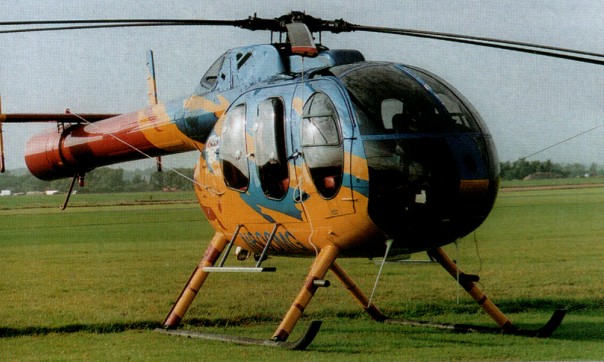
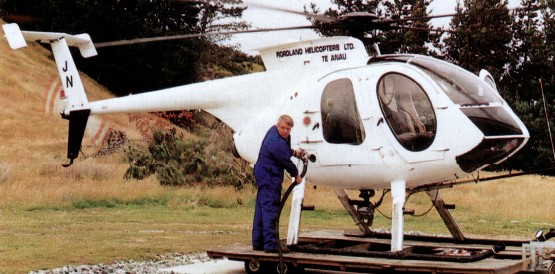
On 8 November 1994, McDonnell Douglas announced their plans to develop an eight-place version of their popular MD520N helicopter. They surprised the world’s press in January 1995 when they flew their new helicopter to Heli-Expo 95 in Las Vegas, Nevada. The prototype, then known as MD 630N (N630N, converted from MD 530F demonstrator), first flew 22 November 1994, 138 days after project approval. After their public debut at Heli-Expo the first year’s production was sold out on the first day.

McDonnell-Douglas MD-600 Article

Production go-head was given on 28 March 1995, at which time designation changed to MD 600N; and a prototype was first flown with production standard engine and rotor system on 6 November 1995.

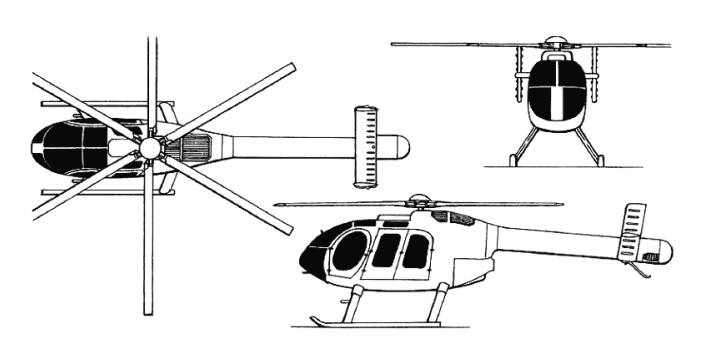
The 600N has a 33in lengthened fuselage centre section with double, centre opening doors, which gives access to a six-foot long flat floor with seating for five passengers in this rear cabin and three across the front seats. The complete fuselage of these helicopters are built under contract by helicopter manufacturer Kaman Aerospace. The six bladed fully articulated main rotor system shares many components with the MD500 series machines, and power comes from an 800-shp Rolls-Royce Allison 250-C47M turboshaft engine, which is derated to 600 shp for take-off and 530 shp for maximum continuous. The engine is equipped with FADEC as well as a manual backup hydro-pneumatic fuel system.

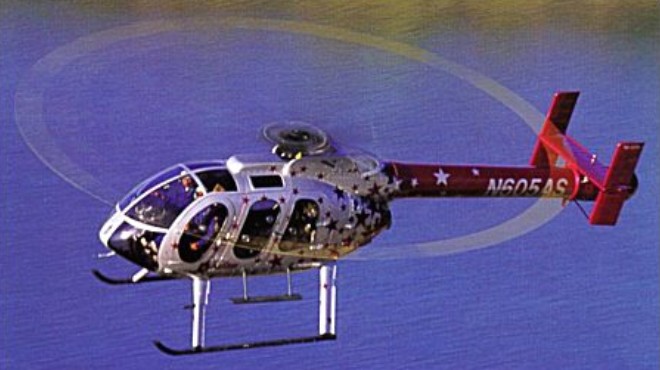
Production prototype (N600RN) first flown 15 December 1995, and became certification test vehicle leading to FAR Pt 27 certification, but was destroyed in ground fire 28 May 1996, following emergency landing after rotor/tailboom strike during abrupt control reversal tests. This resulted in changes to tailboom/rotor clearance; third prototype (N605AS) flown 9 August 1996; further accidents to N630N on 4 and 21 November 1996 and on 18 January 1997, all during autorotational descents, culminated in total loss and delayed certification and first delivery, originally scheduled for 18 December 1996, to 15 May and 6 June 1997, respectively. MD 600N certified on MD500 certificate.
The FAA Certification was received on 15 May 1997. The first delivery was on 6 June 1997, N605AS, to AirStar Helicopters.

The 630N features a stretched MD 520N airframe (less than 1% new parts) by means of 0.76m plug aft of cockpit/cabin bulkhead and 0.71m plug in tailboom, combined with more powerful engine, uprated transmission and six-blade main rotor. Cabin has flat floor to assist cargo handling, and will feature quick-change interior configurations to suit multiple-use operators. Intended for civil, utility, offshore, executive transport, medevac, aerial news gathering, touring, law enforcement and other noise-sensitive operations; also adaptable for armed scout, utility and other military missions.

Powered by one 603kW Rolls-Royce 250-C47M turboshaft, derated to 447kW for T-O (5 minutes) and 395kW maximum continuous, with FADEC. Transmission manufactured from WE43A magnesium alloy for lower weight, greater strength and enhanced corrosion resistance, rating 447kW. Fuel contained in two crashworthy bladder tanks in lower fuselage, total capacity 440 litres, of which 434 litres are usable.

The electrical system comprises 28V 200Ah starter-generator and 28V 17Ah Ni/Cd battery. 24V auxiliary power receptacle inside starboard cockpit door standard.

In July 1998, Boeing completed a year-long envelope expansion programme for the MD 600N leading to FAA approval for operation at a density altitude of 2,135m at a T-O weight of 1,746kg and at a density altitude of 1,220m at a T-O weight of 1,860kg. Other performance enhancements approved by the FAA included provision for doors-off operation at speeds up to 213km/h, operation at temperatures -40°C/52°C, lifting up to 968kg on the external cargo hook, making slope landings up to 10° in any direction, operation with emergency floats and for installation of a movable landing light and additional wire strike protection on the fuselage. The MD 600N also completed HIRF trials at NAS Patuxent River, Maryland. Yaw-stability augmentation system (Y-SAS) was under development during 2000, aimed at reducing pilot workload during extended flights and in turbulent conditions.

Total of 68 registered by May 2003. Launch customer AirStar Helicopter of Arizona (two, of which first delivered 6 June 1997); Saab Helikopter AB of Sweden and Rotair Limited of Hong Kong ordered one each in June 1995; other customers include Guangdong General Aviation Company (GGAC) of the People’s Republic of China, which took delivery of one MD 600N in November 2000, during Airshow China 2000 in Zhuhai, Los Angeles County Sheriff’s Department Aero Bureau (three), Orange County, California, Sheriff’s Department, Indianapolis, Indiana. Police Department (one), Presta Services of France (one), Turkish National Police, which ordered 10 in December 2000 for delivery during 2002 (subsequently postponed to 2003), UND (University of North Dakota) Aerospace (one), West Virginia State Police (one) and the US Border Patrol (45, of which 11 delivered by end of 1998. when procurement halted pending evaluation of UAVs for border patrol role). Deliveries totalled 15 in 1997, 21 in 1998, six in 1999, seven in 2000, two in 2001 and two in 2002.

Costs: US$1.315 million (2002).

February 19, 1999 : Boeing sold MD commercial line to RDM The dutch company bought the ex Mc Donnell Douglas models MD 500E and MD 530F single-engine helicopters with conventional tail rotors, the MD 520N and MD 600N single-engine NOTAR helicopters and the MD Explorer series of twin-engine, eight-place helicopters.

Gallery

MD600N
Engine: Allison 250-C47, 600 shp / 589kW
Main rotor diameter: 8.4m
Length with rotor turning: 11.2m
Height: 2.9m
Max take-off weight: 1860-2123kg
Empty weight: 875kg
Max internal payload: 984kg
Max external payload: 1247kg
Max speed: 282km/h
Cruising speed: 248km/h
Service ceiling: 6100m
Hovering ceiling, IGE: 3200m
Hovering ceiling, OGE: 2875m
Range: 335km
Endurance: 3.7hr
Seats: 8

MD-630N
Engine: Allison 250-C30, 600 shp
Seats: 7/8
MTOW: 4100 lbs
Max cruise: 134 kts
Range: 335nm
ROC: 1700 fpm
Max op alt: 20,000 ft
Max external load: 2750 lb
Max internal load: 2170 lb

McDonnell-Douglas MD 530 / AH-6

MD530F

Military variants known as Defenders (AH-6E, MH-6F) carry TOW missiles, FLIR, mast-mounted sight, etc.
The Model 530 Defender (has refined aerody¬namics and more power the OH-6), and AH-6 (Model 530 version for US Special Forces).

February 19, 1999: Boeing sold MD commercial line to RDM The dutch company bought the ex Mc Donnell Douglas models MD 500E and MD 530F single-engine helicopters with conventional tail rotors, the MD 520N and MD 600N single-engine NOTAR helicopters and the MD Explorer series of twin-engine, eight-place helicopters.

MD 530N

Commercial MD 520N and uprated (485 kW Rolls Royce 250-C30) MD 530N NOTAR helicopters announced February 1988 and officially launched January 1989. The first production prototype MD 530N (N530NT) flew on 29 December 1989, but this variant not pursued.

Flight testing of the MD 530N indicated capabilities greater than expected. With only 25.2 hours logged, a series of aerobatic manoeuvres were performed during June 1990, including loops, rolls, hammerheads and Split ‘S’ manoeuvres. In other tests the envelope was expanded to a maximum internal gross weight of 33500 lb / 1520 kg.

Gallery

MD530
Engine: 1 x Allison 250- C20B turboshaft, 420 shp (313 kW)

MD530F
Engine: 1 x Allison 250-C30, 650 shp
Instant pwr: 313 kW
Rotor dia: 8.35 m
MTOW: 1405 kg
Useful load: 685 kg
Max cruise: 135 kts
Max range: 381 km
HIGE: 14,300 ft
HOGE: 12,000 ft
Crew: 1
Pax: 3
Seats: 5

530MG Defender
Engine: 1 x Allison 250-C30
Installed pwr: 317 kW
Rotor dia: 8.4 m
Fuselage length: 9.8 m
No. Blades: 5
Empty wt: 664 kg
MTOW: 1610 kg
Payload: 901 kg
Max speed: 240 kph
ROC: 505 m/min
Ceiling: 4200 m
HIGE: 2315 m
HOGE: 1770 m
Fuel cap (+aux): 240 lt ( 80 lt )
Range: 443 km
Crew: 1
Pax: 5

McDonnell-Douglas MD 520

MD520N

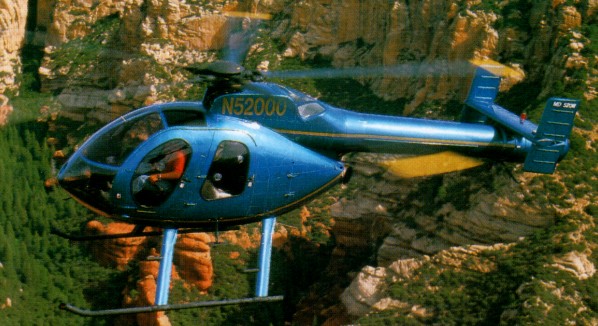
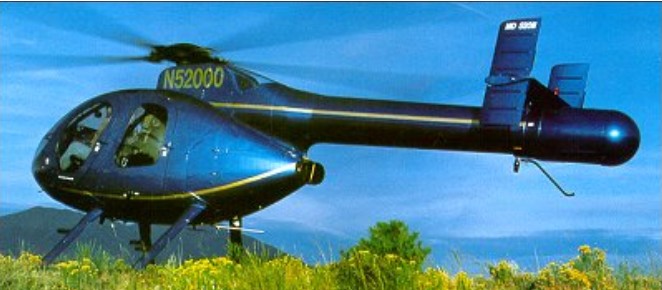
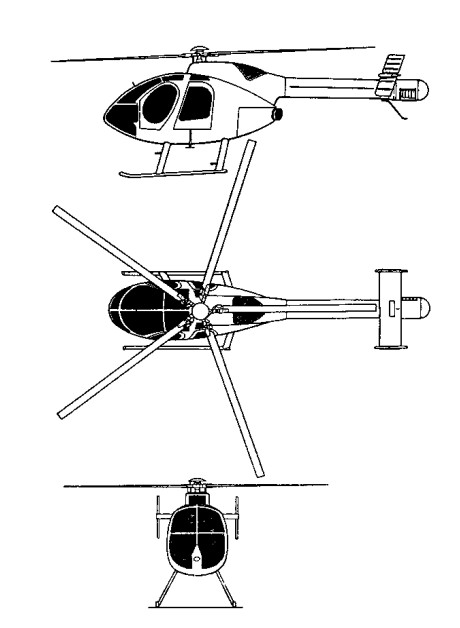
In 1976 engineers at McDonnell Douglas Helicopter Company (then Hughes) decided to explore the theories of Henri Marie Coanda (1885-1972), a Romanian-born aeronautical engineer and inventor, who put forward the concept that air flowing over a curved surface tends to follow the curve of that surface. The “Coanda Effect” is seen working when air flows over the surface of an airfoil. Under this effect, the aerody¬namics of the tailboom itself could be tapped to provide the bulk of the anti-torque force required. It is this principle which is at the heart of the NOTAR system embodied in the MD520N. The front half of the helicop¬ter is virtually identical to the MD 500E, but in place of a conventional tailboom and tail rotor mechanism, the MD 520N has a variable pitch fan totally enclosed within the tailboom, circulation control slots on the side of the boom, and vertical stabilizers and direct jet thruster. The variable pitch fan is driven off the back of the Allison 250-C20R turboshaft engine and, with help from the main rotor system down-wash, draws air via a grill into the enclosed tailboom, and provides low-pressure, high-mass airflow. Air is forced out through the circulation slots on the right side of the boom. Air exits the slots at about four times the velocity of the rotor downwash, which keeps the downwash attached to the curvature of the boom, resulting in the horizontal equivalent of lift, just like a vertical wing, and the Coanda Effect generates anti-torque force.

The direct jet thruster is located at the end of tailboom on the left side, and provides directional control plus assists with anti-torque. Even the engine exhaust stack helps out here, as it is canted to the left. However the bulk of the anti-torque required (eg 60-70 percent in hover) is provided by the Coanda Effect. Directional control above in forward flight above about 20 knots comes largely from the left vertical stabilizer, which is linked to pilot’s pedals. The effectiveness of this system is such that the MD 520N is approved for hovering in 30 knot crosswinds, and has been flown sideways at speeds signifi-cantly higher.

The first flight of an OH-6A NOTAR concept-demonstrator was made on 17 December 1981. The commitment to full-scale development and production was made in 1987. An extensive modifications during 1985 with second blowing slot, new fan, 250-C20B engine and MD 500E nose, led to flight testing resuming on 12 March 1986 and completed in June. The demonstrator was retired to US Army Aviation Museum, Fort Rucker, Alabama, October 1990.

Commercial MD 520N and uprated (485 kW Rolls Royce 250-C30) MD 530N NOTAR helicopters announced February 1988 and officially launched January 1989. The first production prototype MD 530N (N530NT) flew on 29 December 1989, but this variant not pursued.

First flight 520N (N520NT) on 1 May 1990 and first production 520N 28 June 1991. The 520N was certified on 12 September 1991 on the MD500 type certificate and the first production aircraft 520N (N521FB) delivered to Phoenix Police Department 31 October 1991. MD 520N set new Paris to London speed record in September 1992, at 1 hour 22 minutes 29 seconds.

The structure is the same as the MD 500E/530F, except graphite composites tailboom; metal tailplane and fins; new high-efficiency fan with composites blades fitted in production aircraft. NOTAR system components now have twice the lifespan of conventional tail rotor system assemblies. During 1993, NOTAR system components’ warranty increased from two to three years. Thicker fuselage skins, to reduce surface rippling, was to be introduced during 2001.

The single Rolls-Royce 250-C20R turboshaft, derated to 317kW for T-O (5 minutes) and 280kW maximum continuous. Improved, heavy-duty transmission, rating 447kW, derated to 317kW for T-O, 280kW maximum continuous, on production aircraft from June 1995. Fuel capacity 235 litres.

Believed to be the quietest turbine helicopter, based on FAA certification test noise figures, the main rotor rpm 477; main rotor tip speed 208m/s; NOTAR system fan rpm 5,388. A redesigned diffuser in NOTAR tailboom and revised fan rigging was introduced from early 2000 and available for retrofit; combined with uprated Rolls-Royce 250-C20R+ engine; these improvements increase the aircraft’s payload capability,

Customers had a total of 99 registered by mid-2002. Four delivered in 2000, two in 2001 and four in 2002. Law enforcement agencies flying MD 520Ns include Phoenix, Arizona (first operator; two more delivered in early 2002); Burbank, Glendale, Huntington Beach, Los Angeles, Ontario and San Jose, California; Hernando County, Florida; Orange County, Florida; Jefferson County, Kentucky, which took delivery of one in March 2002; Prince George County, Clinton, Maryland, which took delivery of two on 4 October 2000; Hamilton County, Ohio, which has seven 520Ns; El Salvador, whose Policia Nacional Civil took delivery of two in 1996; San Juan, Puerto Rico; Honolulu, Hawaii; and Calgary, Alberta, Canada. Other operators include the Tata Group of Mumbai, India, Weetabix Ltd, UK, and Belgian Gendarmerie (two). The unit cost was US$980,000 (2002).

Héli-Max Ltée from Trois-rivières, Québec, Canada was the first Canadian operator of MD520N model. They bought 6 of them.

Gallery

MD 520N
Engine: 1 x Allison 250-C20R, 450 shp / 336kW
Instant pwr: 317 kW
Rotor dia: 8.35 m
Length with a rotor turning: 9.8m
Height: 2.9m
Empty wt: 1826 lb / 719kg
MTOW internal: 3350 lb, external: 3850 lb
Useful load: 800 kg
Vne: 150 kt
Max speed: 135 kts
Max cruise: 125 kts
Max range: 403 km
Rate of climb: 9.7m/s
Service ceiling: 6100m
HIGE: 9034 ft
HOGE: 5043 ft
Crew: 1
Pax: 4
Seats: 5
Fuel cap: 242 lt
Endurance @ 75%: 2 hr

McDonnell-Douglas

Douglas files bankruptcy and was forced to sell at a knocked down price to McDonnell of St. Louis, which had been making handsome profits out of its F-4 Phantom, supplied to the air force in Vietnam. McDonnell-Douglas was created 28 April 1967 by merger of Douglas and McDonnell. Continued development and production of F-4 at St Louis (until 1979). On December 23,1969 received contract for F-15 Eagle air-superiority fighter, first flown July 27,1972, (first production F- 15E flown December 1986) suited to both air superiority and long-range interdiction. Evolved F/A-18 Hornet multi-mission carrier bome and land-based combat aircraft suited to fighter and attack missions (first flown November 1978, with the F/A-18E and F Super Hornet variants, first flown November 1995, placed into production by Boeing), STOVL AV-8B Harrier II and II Plus with British Aerospace for U.S. Marine Corps (first flights November 1981 and September 1992 respectively; and T-45 Goshawk naval jet trainer (first flown April 1988) from British Hawk.

Long Beach and Palmdale factories continued production of A-4 Skyhawk attack aircraft until 1979, DC-8 fourjet airliner (until the early 1970s, and in the 1980s instituted a re-engine program) and DC-9 twin-jet airliner (first tlown February 1965 and produced until the end of the 1970s, when the new designation MD-80 was adopted for developed models), and developed wide-body triple-engined DC-10 (first flown August 29,1970 and the last delivered in 1989, when replaced by the MD-11).

Purchased Hughes Helicopters January 1984, taking over that company’s range that included small helicopters and the AH-64 Apache, plus the NOTAR (no tail rotor) anti-torque system. Hughes Helicopters became McDonnell Douglas Helicopters.

Merger of McDonnell Douglas with Boeing announced in December 1996, and from August 1997 the combined company began operating as a single unit under the collective name The Boeing Company.

Boeing has sold its civil helicopter production line, formerly manufactured by McDonnell Douglas, to Dutch company MD Helicopters. The sale, coming only two years after Boeing themselves purchased the range through a merger. The sale includes the MD500, 520N, 530F and 600N models, as well as the twin-engined MD Explorer and the licence to incorporate the no tail rotor (NOTAR) system on future aircraft. Boeing does, keep the ownership of the NOTAR technology. Boeing was to continue to produce the machines, under contract to the new Dutch owners, until early 2000.

McDonnell XV-1

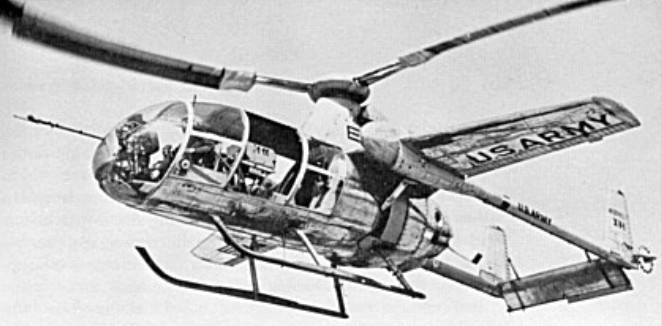
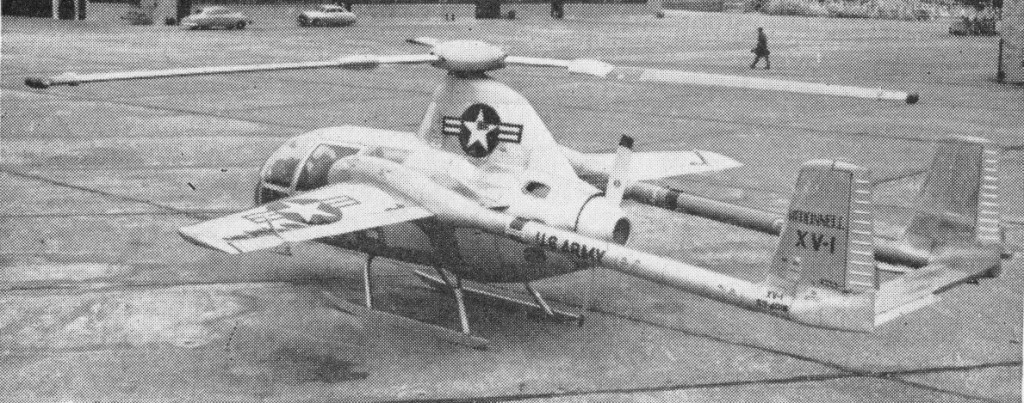
Initially designated XL-25 in the liaison aircraft category, then XH-35 in the helicopter class, and finally XV-1 as the first type in the new vertical lift category of aircraft designations, this machine worked on the unloaded rotor principle. Designed by Friedrich von Doblhoff, the Austrian helicopter pioneer responsible for the wartime WNF 342, the XV-1 was the result of an experimental programme undertaken jointly by McDonnell, the US Army Transportation Corps, and the USAF Air Research and Development Command.

Initiated by a Letter of Intent dated 20 June, 1951, the XV-1 project proceeded through mock-up inspection in November 1951, and the first aircraft (53-4016) was completed some 22 months later.

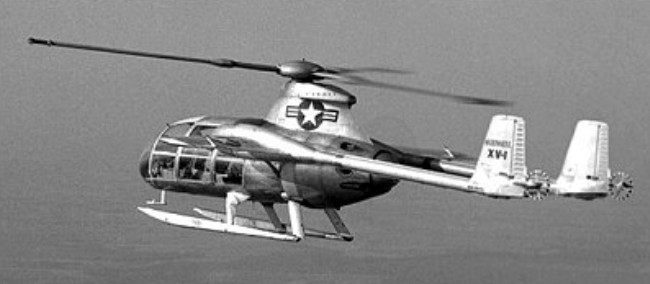
Combining the features of a twin-boom, twin-tail, fixed-wing aircraft with those of a single-rotor helicopter, the XV-1 was powered by a 525hp / 391kW Continental R-975-19 seven-cylinder radial. For vertical flight this engine drove two compressors which fed air through tubes to small pressure jets at the tips of the three-blade rotor, with the pressure jets operating on the principle of ignition and expansion of the fuel gases. For forward flight, the engine drove a two-blade pusher propeller mounted aft of the fuselage between the tail booms while the rotor autorotated. The XV-1 was intended to take-off and land as a helicopter, with transition from helicopter flight mode to conventional flight being made by transferring power from rotor to propeller as soon as the forward speed exceeded the stalled speed of the wing. Side-by-side accommodation was provided for a pilot and a co-pilot with room behind them for test instrumentation. Alternatively, accommodation could have been provided for a pilot and three passengers or a pilot and two stretchers.

The 9m long fuselage, mounted on skid landing gear, and mid/high-set wings mounted twin tailbooms with twin vertical surfaces (about 3m in height), inter-connected by tailplane and elevator.

The 7.9m span fixed wing featured a slight sweep on both the leading and trailing edges, although the angle of sweep was greater on the leading edge. It was also designed with a high aspect ratio and joined the fuselage at the same level as the top of the cockpit, directly below the mounting for the upper rotor. The wing terminated in the fuselage into a large bulbous housing on either side of the fuselage.

Project test pilot John R. Noll began tethered hover flights on 11 February, 1954, but difficulties with the pressure jet system delayed initial free flight until 14 July, 1954. The first successful transition from helicopter flight to conventional flight was made on 29 April, 1955. The flight test programme revealed several design deficiencies which were progressively corrected through the introduction of such modifications as a cut-down rotor pylon, small anti-torque rotors fixed to the end of each taitboom, redesigned landing skids, and other minor detail changes. During the preceding months, the second XV-1 (53-4017) had joined the flight trials programme. This machine differed from the first prototype in having a bulkier but streamlined undercarriage and cut-down rotor pylon to reduce interference drag. Numerous detail improvements, including the addition of a small steering rotor behind each boom, were progressively incorporated.

In evaluating the program, the consensus was that the basic concept was sound, but the piston engine powerplant could not provide the needed performance to optimize the design. It was felt that use of a gas turbine engine in this application would solve the problem.

Although on 10 October, 1956, the second prototype XV-1 had become the world’s first rotary wing vehicle to reach a speed of 322km/h, the gain in performance over conventional helicopters did not warrant the added complexity of the convertiplane configuration. Furthermore, the potential of the McDonnell XV-1 was seriously limited by its use of a piston engine instead of gas turbines as adopted to power European convertiplanes which preceded or followed it.

The programme was terminated in 1957 after the two prototypes had been flown for a total exceeding 600 hours. The first XV-1, 53-4016, then went to the Army Aviation Center Museum at Fort Rucker, Alabama, and the second, 53-4017, was donated to the Smithsonian Institution’s National Air and Space Museum, in Washington, DC.

Gallery

XV-1
Engine: 1 x Continental R-975-19 radial, 410kW
Wingspan: 7.92m
Length: 15.37m
Height: 3.28m
Rotor diameter: 9.45m
Empty weight: 1940kg
Loaded weight: 2497kg
Gross weight: 2160kg
Fuel capacity: 315 litres / 225kg
Payload: 185kg
Rotor loading: 35.6kg/ sq.m
Power loading: 4.8kg/hp
Maximum speed: 327km/h
Cruising speed: 190 km/h
Ceiling: 3600m
Maximum rate of climb: 6.6m/s in 3.2 minutes
Vertical rate of climb: 1.6m/s

McDonnell XHJD-1 Whirlaway / Platt-LePage Aircraft PL-9

McDonnell Aircraft Co had invested in Platt-LePage Aircraft in mid-1942, in exchange for having McDonnell personnel learn helicopter design. In 1943 McDonnell authorized Constantine M. Zakhartchenko and a small group of engineers to undertake research on design and construction of rotors. He was appraised of Platt-LePage’s preliminary work on a twin-engined, twin-rotor helicopter to meet Army requirements. Although that PL-9 design eventually proved unsuccessful in the Army competition (the AAF selected the Kellet XR-10), it fared better in a different guise as McDonnell, in return for an increase in his investment as finalized in June 1944, obtained Platt-LePage’s agreement allowing the McDonnell Aircraft Corporation to initiate the parallel development of the twin-engined, twin-rotor concept.

On the strength of both this agreement and the work accomplished by Zakhartchenko’s team, McDonnell proposed a helicopter of this design to the Navy to serve either as a testbed or as an anti-submarine warfare platform. As a testbed, the proposed Model 65 was intended to be used for the study of the effects of rotor diameter, disk loading, variations in rotor blade flap and lag angles, and other variables. In the ASW role, it was to be able to carry an adequate load of detection gear and weapons.

Considering the side-by-side rotor arrangement proposed by McDonnell to be a most suitable configuration for large helicopters capable of operating in the ASW role, the Bureau of Aeronautics issued a Letter of Intent on 15 May, 1944, covering the design, construction, and testing of one XHJD-1. This Letter of Intent was confirmed on 23 March, 1945, when Contract NOa(s)-3703 was awarded.

At the time of contract award, design of the Whirlaway, entrusted to a team led by Constantine Zakhartchenko, was well underway and ground testing was begun early in 1946. Piloted by Charles R. Wood Jr, the XHJD-1 made its first hover flight at Lambert Field, St Louis, on 27 April, 1946.

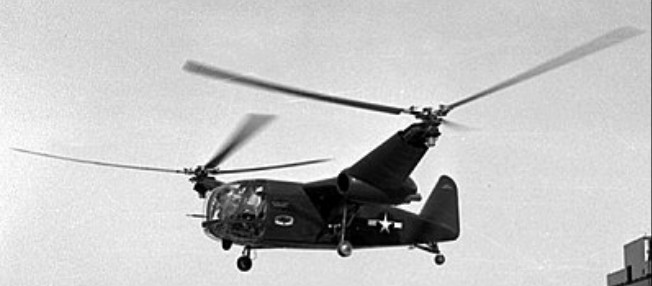
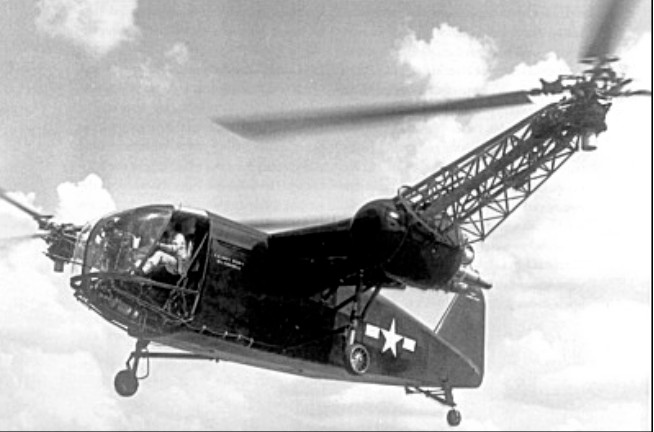
Designed to carry up to ten occupants but normally flown as a two-seater with up to 816kg of test instrumentation, the Whirlaway was fitted with twin side-by-side rotors mounted on pylons extending outboard of the engine nacelles. The nacelles, each housing a 450hp Pratt & Whitney R-985-AN-14B seven-cylinder radial engine, were attached to short wings which supported approximately 10 per cent of the gross weight during cruise and as much as 30 per cent of the weight in power-off autorotation, with consequent substantial improvement in overall performance efficiency. This feature, combined with the ability to transmit power from either engine to both rotors by transmissions and gear boxes, enabled the XHJH-1 to maintain level flight at full gross weight on the power of only one engine.

From April 1946 until June 1951, the XHJD-1 was used for numerous flying research tests including the evaluation of performance, stability balance and vibration characteristics peculiar to its twin-rotor configuration. In the process, the Whirlaway had its original 15.24-m diameter rotors replaced by rotors of varying diameters and had a braced tailplane with externally balanced control surfaces added before translation flights began. Once vibration and resonance problems with its unsynchromzed three-blade rotors were alleviated through the use of shock-absorbing rotor mounts, the XHJD-1 was considered to handle well and was flown some 250 hours without serious mishap. It was flown not only by McDonnell and Navy pilots but after being fitted with a rescue winch, was also evaluated in November 1949 by USAF pilots from the Arctic Rescue Helicopter Board.

As helicopter technology had made significant progress since development of the Whirlaway had been initiated, neither the XHJD-1 nor its proposed Model 65C development was put into production. Upon completion of its trials programme, the XHJD-1 – the first helicopter to bear the McDonnell name and the world’s first successful twin-engined, twin-rotor helicopter was donated to the National Air and Space Museum.

XHJD-1
Engine: 2 x Pratt & Whitney R-985-AN-14B Wasp Junior, 336kW / 450 hp
Rotor diameter: 14.02-15.24m depending on configuration
Overall span: 26.52m
Fuselage length: 9.8m
Height: 3.73m
Empty weight: 3629kg
Loaded weight: 4990kg
Rotor loading: 13.7-16.2kg/sq.m
Power loading: 5.5kg/hp
Maximum speed at 1525m: 193 kph
Cruising speed: 145km/h
Rate of climb: 6.6m/s
Absolute ceiling: 3930m
Range: 485km