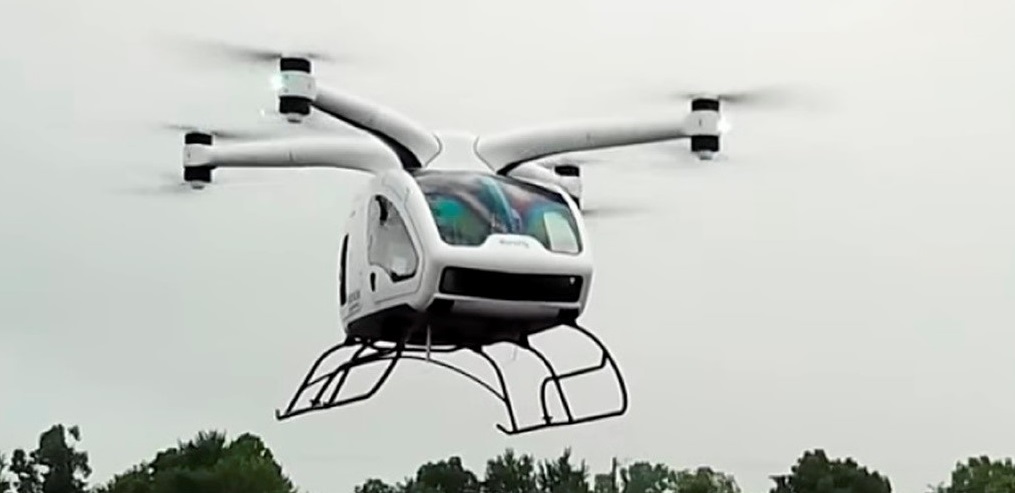
On 30 April 2018 the Moog Surefly flew its first flight. The configuration of the Surefly is four arms with the counterrotating propellers are mounted above the aircraft instead of close to the ground.
On 30 April 2018 the Moog Surefly flew its first flight. The configuration of the Surefly is four arms with the counterrotating propellers are mounted above the aircraft instead of close to the ground.
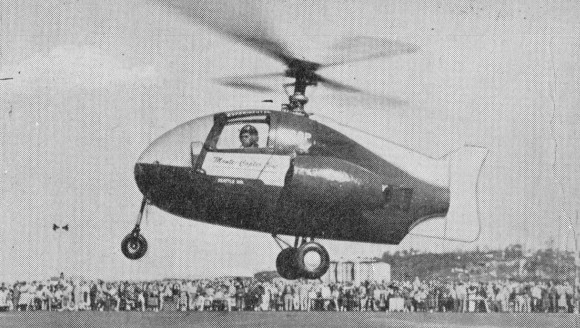
Under development, with two small turbine engines, in 1958.

Under development, with a Lycoming piston engine driving a centrifugal compressor, in 1958.
MK Helicopter produced the Mk.II two-seat helicopter in ultralight form, first flown 1996, and offered it ready assembled. Ultralight since withdrawn, giving way to new and improved certificated version.
Produced the Mk.II two-seat helicopter in ultralight form, first flown 1996 and offered ready assembled. Ultralight since withdrawn, giving way to new and improved certificated version.
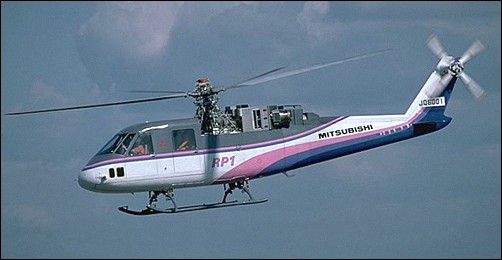
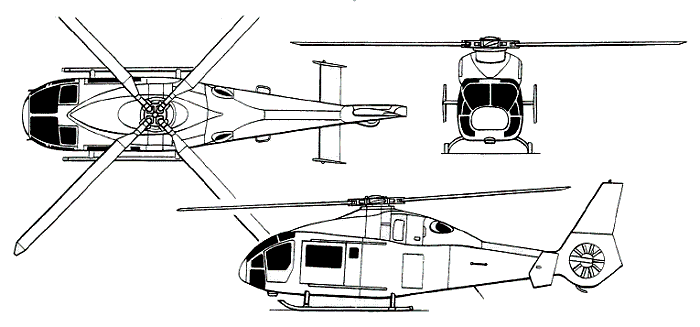
The 1994 Mitsubishi-originated helicopter programme is the MH.2000. Launched in second half of 1995, this 7/12 seat commercial helicopter was first known as the Mitsubishi RP-1. Four development MH.2000 aircraft (two flying, two for ground test), the first flew on 29 July 1996(JQ6003), followed by a second machine (JQ6004, later JA001M) in late 1996.
Of single main rotor configuration (four blades with tapered tips) and Fenestron-type tail rotor, the main gearbox and other drive mechanisms are in an overhead fairing located aft of the passenger cabin. There is a mid-mounted tailplane with angular endplate fins. The landing gear is a cnventional twin-skid type, and all-composites main and tail rotor blades.
Power is from two 800shp / 653kW Mitsubishi MG5-110 turboshafts, with digital electronic control permitting one-touch changeovers between high-speed and low-noise modes. Crash-resistant fuel tanks are aft of the passenger cabin, wit a maximum usable capacity of 1,132 litres.
The main cabin has forward-facing, impact-absorbing seats for eight (standard) or six persons, and a crew of two. A crew door is on each side at the front, and a; large sliding door to the main cabin on each side. A baggage compartment is aft of the fuel tanks, with external access. An avionics bay is in the rear fuselage aft of the baggage compartment.
JCAB limited certification was awarded in June 1997 and full VFR certification on 24 September 1999.
First and second prototypes had flown approximately 800 hours (500 + 300) by April 1998 and the initial production rate then planned for three per year.
The first production MH2000A (JQ 6005) was handed over to customer (Excel Air Service of Japan) on 1 October 1999. Two others were sold by October 1999, to the National Aerospace Laboratory (delivered March 1999 as JA21ME) and a Japanese private customer.
By July 2000, only three production aircraft had been registered in Japan. In 2003, Mitsubishi anticipated sales of 10 per year. The fifth production aircraft was registered in April 2003.
Four of first five (three customer aircraft and one demonstrator) was recalled in August 2000 when flaws were discovered in the metal engine covers. The sixth MH2000 was on the production line at that time. Loss of one prototype due to tail rotor blade separation led to suspension of the type certificate and redesign of the tail rotor. The aircraft was re-certified with new rotor and resumed flight testing in 2002.
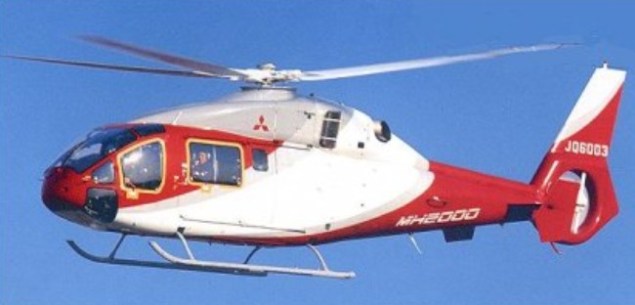
Mitsubishi MH2000
Crew: 1
Passengers: 6-12
Engine: 2 x Mitsubishi MG5-100 turboshaft, 597kW
Main rotor diameter: 12.2m
Length with rotors turning: 14.0m
Fuselage length: 12.2m
Height: 4.1m
Fuselage width: 3.1m
Max take-off weight: 4500kg
Empty weight: 2500kg
Max speed: 280km/h
Economic cruising speed: 250km/h
Range: 700km
Mitsubishi Jukogyo Kabushiki Kaisha
Mitsubishi Heavy Industries Ltd
After World War 1 several members of the former Sopwith Aviation Company’s technical staff had joined Mitsubishi and produced designs to meet the specifications of the Air Supply Section of the I.J.N. In this way, Herbert Smith became chief designer for Mitsubishi. W. L. Jordan, D.S.C., D.F.C., an ex RNAS and RAF fighter pilot, was appointed their chief test pilot.
Mitsubishi Heavy Industries Ltd. formed April 11,1934, through the merger of Mitsubishi Shipbuilding and Engineering Co Ltd. and Mitsubishi Aircraft Co Ltd. Long association with Japanese Navy, commencing with Type 10, operational 1922. Most notable aircraft were 1937 A5M4 “Claude”; 1942 J2M3 ‘Jack’; 1939 A6M3 ‘Zeke’ (Zero), which were all fighters; 1941 Ki-46 ‘Dinah’ reconnaissance aircraft; 1940 G3M1 “Nell” and 1941 G4M1 “Betty” medium bombers; 1940 Ki-21 “Sally” heavy bomber; and its replacement, 1944 Ki-67″Peggy.”
Mitsubishi built 80,000 aircraft between 1920 and 1945. After the pre¬dominant role Mitsubishi played in Japa¬nese aviation during the 25 years that preceded the termination of World War II, MHI was prohibited from engaging in aircraft manufacture until 1955.
Post-war built North American F-86F Sabres, Sikorsky S-55s, S-62As, and S-61s, and 177 Lockheed F-104J and 19 two-seat F-104D-Js Starfighters with Kawasaki, with which company it also manufactured McDonnell Douglas F-4EJ Phantoms. They will be fitted with arrester gear
Mitsubishi completed the assembly of 300 F-86F Sabres for the JASDF, but modifed 18 of these aircraft into RF-86F reconnaissance-fighters, each carrying two K-22 cameras in the forward fuselage and one K-17 camera under the centre fuselage.
Licence production of Sikorsky S-55 helicopters began in 1958, and was to be followed by manufacture of the HSS-2 Seadragon anti-submarine helicopter, of which Mitsubishi were to build 10 for the JMSDF by November 1966.
Shin Mitsubishi Jukogyo Kabushiki Kaisha
1962:
Shin Mitsubishi Building,
No 10,
2-Chome,
Marunouchi,
Chiyoda-ku,
Tokyo
Produced 90 T-2 supersonic jet trainers, the first Japanesedeveloped supersonic aircraft (first flown 1971 and all delivered by 1988) and 77 F-1 single-seat close-air-support derivatives (all delivered by 1987). Developed MU-2 turboprop executive aircraft (first flown 1963), built in Japan and assembled and marketed in U.S.A. by subsidiary Mitsubishi Aircraft International, followed by the MU-300 Diamond (first flown 1978), which later became the Beech Model 400 Beechjet.
Produced 213 McDonnell Douglas F- 15J/DJ fighters for JASDF by 1998, and in October 1995 first flew new Japanese-developed F-2 fighter support aircraft, intended to replace F-1 and based on F-16 but incorporating new technologies. Currently modernizing F-4EJ fleet, is a partner in the Bombardier Global Express program, has a 20% share in the Kawasaki OH-1 helicopter program, constructs Sikorsky S-70B-3 helicopters for the JMSDF as SH-60JS (the first flew 1991) plus UH-60Js for SAR with JMSDF and JASDF and UH-60JAS for JGSDF, has developed the new MH2000 twin-turbine multipurpose helicopter (first flown July 1996), and constructs components forthe Dash 8, various Boeing airliners and Sikorsky S-92. Also has engine and space activities.
Its overhaul and repair organization handles all types of aircraft and aero-engines. In particular, it is responsible for component manufacture and repair of Pratt & Whitney engines in Japan.
Engine: 2 x turboshaft
Rotor dia: 13.5 m
MTOW: 4200 kg
Useful load: 1800 kg
Max cruise: 150 kts
Max range: 800 km
Seats: 10/12
Engine: 1 x VAZ-430 rotary
Instant pwr: 165 kW
MTOW: 1150 kg
Useful load: 320 kg
Seats: 3
Uses M+28 dynamic C system.
Engine: 2 x Klimov TV3-117VM
Instant pwr: 1545 kW
MTOW: 11,9000 kg
Max range: 460 km
HOGE: 10,825 ft
Service ceiling: 18,200 ft
Crew: 2
Pax: 10
 All Aero