The Yakolev design bureau designed an experimental helicopter with coaxial rotors, the Yak-100, in 1949. It did not progress beyond the experimental stage.
Helicopters
Yakolev
While working as a mechanic at Khodynka airfield, Yakolev had access to an aircraft graveyard in a ravine next to the flight area. In the course of a dozen years it was filled with wrecked airframes from all over the world, and Alexandre Sergeevich fully used his chance to study variety of construction methods, examine the nature of breakdowns and to discover the weak points in damaged parts.
Aieksandr Sergievich Yakolev won a design competition for lightplanes even before entering an engineering academy in 1927. His design bureau was established 1935, and first military design was the Yak-4 twin-engined fighter, completed 1939. The Yak-1/3/9 series of single-seat fighters served the Soviet Union well in combat during Second World War and were built in larger numbers than any other Soviet wartime fighter. A Yak-3 airframe was modified to produce the Yak-15 jet fighter in 1945, developed subsequently as the Yak-17. The Yak-23 of 1947 was a complete redesign, resembling the earlier fighters only in fuselage configuration.
Other post-war Yakolev designs included the Yak-12 high-wing utility aircraft, produced also in Poland and China, Yak-11 and Yak-18 trainers, Yak-28 twin-jet bomber and reconnaissance aircraft (production began 1960) and related Yak-28P radar-equipped all-weather interceptor (first flown 1960), and Yak-40 (first flown October 1966) and Yak-42 (first flown March 1975 and still in production) short-range transports. The important Yak-38 operational VTOL combat aircraft (first flown January 1971 for Russian naval use) was followed by a new VTOL prototype known as the Yak-41 (first flown March 1987) which was subsequently abandoned, as was the projected next-generation STOVLYak-43 and the Yak- 44 shipborne AEW&C aircraft. The Yak-142 transport is a new variant of Yak-42D, featuring mostly US digital avionics and other improvements. Projected airliners include the short-range twin-turbofan Yak-46-1 for 126 passengers, short-range Yak-46-2 with propfan engines, and Yak- 242138-180 passenger short-range airliner.
In the field of general aviation, Yakolev developed the Yak-18T 4-seat multipurpose lightplane development of Yak-18 (first flown 1967 and still available), Yak-50 aerobatic sporting aircraft (first flown 1972), Yak-52 tandem two-seat piston trainer (first flown 1974 and still built in Romania), Yak-54 two-seat aerobatic trainer (first flown December 1993), Yak-55M single-seat aerobatic aircraft (first flown 1989), Yak-58 six-seat business transport with a pusher piston engine (first flown April 1994), and Yak- 112 four-seat light aircraft (first flown October 1992). General aviation projects include Yak-48, thought to be derived from the Israeli-designed Galaxy, Yak-56 piston-engined primary trainer and Yak-57 single-seat aerobatic competition aircraft. Yakolev is also a partner with Aermacchi of Italy in the Yak/Aem-130 and Yak-131 jet trainer and light combat aircraft program. In total, Yakolev has produced over 70,000 aircraft of more than 100 types since 1927, and the present Design Bureau is joined by the Saratov and Smolensk manufacturing facilities under Yak Aircraft Corporation.
On 22 August 1989, Alexander Yakovlev died at age 83.
Windspire Aeros
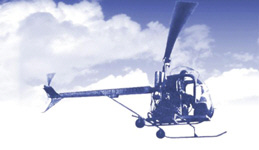
The Aeros is a Single Seat homebuilt helicopter. The plans manual offers pages of highly detailed construction prints, photos and assembly instructions to guide the builder.
This single-seat helicopter can be built in a well-equipped home shop. It features a bolt-together main frame and a standard helicopter control system: full collective with a twist-grip throttle, full cyclic and foot-operated tailrotor pedals. For low-cost and reliability, the drive train utiliizes a converted VW car engine and a primary belt drive that leads to a geared transmission with VW gears. The belt-driven tailrotor is high-mounted to minimize the rolling moment caused by tailrotor thrust. A number of weight-saving features have gone into the design Aeros, including a simple, but attractive monocoque tailboom. The Aeros is licensed as an Experimental Aircraft.
The Guidebook covers, with clear, illustrated explanations, how helicopters work, the various considerations that go into their design, main and tailrotor aerodynamics, control-system operation, and a glossary of terms. Then, fully illustrated with photos and detailed specifications, is a presentation of what is currently available to the helicopter hobbyist in the form of kits and plans. A comprehensive list includes sources of engines, metals, AN hardware, cables, controls, rotorblades, instruments, and the regulations you need to know.
The Aeros is capable of vertical take-offs and landings; hovering; forward, backward and sideward flight. In the event of engine failure, the Aeros can autorotate to a safe landing.
Length: 18 ft.
Height: 7 ft.
Width: 5 ft.
Main rotor dia: 22 ft.
Main rotor chord: 8 in.
Main rotor rpm: 450
Disc loading: 2.5 lb/sq ft
Tail rotor dia.: 40 in.
Tail rotor chord: 3.5 in.
Tail rotor rpm: 3200
Empty weight: 544 lbs.
Useful load: 356 lbs.
Speed (max): 85 mph
Range (max): 65 miles
Engine: Volkswagen
Horsepower: 95+
Power loading: 9 lbs/hp
Fuel capacity: 12 gal.
Fuel consumption: 4 gph
Altitude (max): 12000 ft
Williams Helicopter 1908

A 1908 helicopter designed by Williams and shown here assembled at Hammondsport NY with what appears to be a 40hp Curtiss B8 motor, the same as used on the AEA Red Wing. Possibly achieved brief tethered flight.
A single place helicopter project, believed to have involved Williams, was underway in Connecticut circa 1924 — the only information comes from two photos showing a prototype or a test stand. The engine looks like a LeRhône rotary. Coaxial, contrarotaing rotor system. The two-blade rotor wings were attached rigidly to an elongated hub using two offset spars.
Williams Helicopter 1907
J Newton Williams first design of a single-rotor helicopter, based on the French Vuitten- Huber, failed to fly with its 8hp Curtiss motor, but further experiments in league with Emile Berliner produced a two-engine, two-bladed (rotor: 18’8″) machine weighing 460 lb that lifted the 150-lb Willams off the ground in a tethered flight on 26 June 1909.
Engine: 63hp Adams-Farwell
Williams, J Newton
Ansonia CT
USA
Helicopter experimenter circa 1907-08.
Wiener-Neustadter / WNF
Wiener-Neustadter Flughafen Betriebs GmbH
Wiener-Neustadter Flugzeugwerk GmbH
Germany
Originally Wiener-Neustadter Flughafen Betriebs GmbH, after the Anschluss of 1938 was amalgamated with Hirtenberg, whose manufacturing department it absorbed under the name Wiener-Neustadter Flugzeugwerk GmbH. Light two-seat biplane in production 1937, later undertook subcontracts on Bf 109. In 1943-1944 built the world’s first tip-jet helicopter, designed by team under Friedrich von Doblhoff. Four built and tested. Conventional piston-engine provided compressed air which, mixed with fuel, was fed to tip-mounted combustion chambers through rotor blades. System adopted by other designers.
Westland Westminster
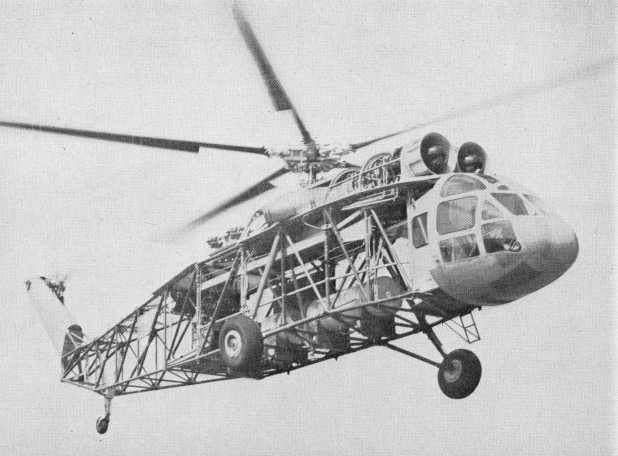
A private venture by Westland, based on the single main 5-blade rotor, gearbox, and hydraulic controls from the Sikorsky S-56 Mojave, Westland redesigned the fuselage using steel tube construction to create a medium sized troop and passenger carrying helicopter, witth tailwheel u/c. Up to 40 passengers were to be carried, with metal cladding for passenger role or open frame for utility/crane role.

First flown at Yeovil on 15 June 1958 (G-APLE), the prototype Westland Westminster was powered by two 2920shp Napier Eland E220 turboshafts. Two prototyprs were built.
After the type’s appearance at the 1960 Farnborough Air show, it was cancelled in September of that year.

The Westminster appeared in June 1960 with its fuselage framework faired in. Late a six-blade rotor was fitted.
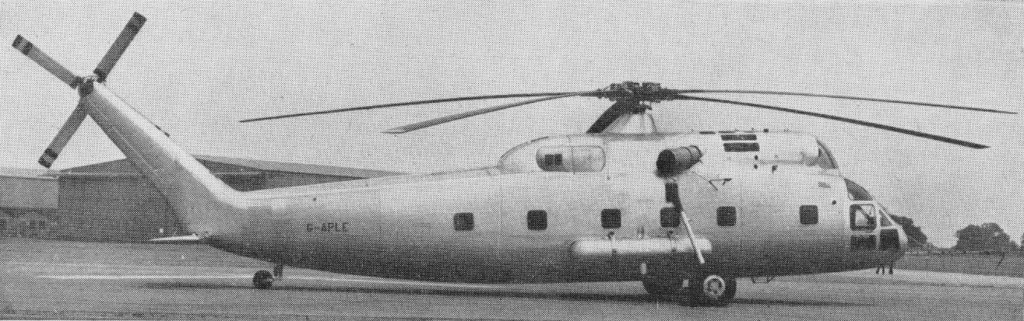
Westminster
Engines: 2 x Napier Eland E.229A turboshaft, 2090kW
Rotor diameter: 21.95m
Length: 27.4m
Max take-off weight: 14965kg
Empty weight: 10125kg
Max speed: 241km/h
Cruising speed: 184km/h
Hovering ceiling, IGE: 2750m
Range: 330km
Crew: 2
Passengers: 40
Westland WG.33

Following on from experience gained during the development of remotely piloted helicopters Westland started investigations in 1977 into a light two seat helicopter that could be used for aerial reconnaissance without the need for a skilled pilot.
Built in 1977 at Yeovil, Somerset and intend to be a 2-seat light reconnaissance helicopter powered by either a Plessey Meon turboshaft engine or one/two piston engines. The two crew sat side-by-side in a circular fuselage giving all round visibility. Having built a mock-up in 1977 to show prospective customers, the project soon faltered due to a lack of interest or funding by the UK Ministry of Defence and in early 1979 the project was formally abandoned. The mock-up was placed in storage before eventually being presented to the Museum for preservation in 1980. It is currently under restoration and reasssembly.
WG.33
Rotor diameter: 5.0m
Fuselage length: 2.0m
Max take-off weight: 500kg
Max speed: 157km/h
Cruising speed: 130km/h
Seats: 2
Westland WS-30 / WG.30 / T30 / TT300

Under the designation Westland 30 (initially WG 30 Super Lynx), the company developed an enlarged, twin-engined transport version of the Lynx, beginning in 1976, when Westland was studying the possibility of a replacement for the Wessex and Whirlwind which were then in service with various civil and military operators.
After considering a civil version of the Lynx, the British company favoured a larger machine using many of the components of the military helicopter. Accordingly, the Westland 30 has the transmission, rotor blade structure, some systems and many instruments and accessories of the Lynx, but the fuselage is entirely new and is bigger, even if it resembles the Lynx aerodynamically. It is made wholly of aluminum with a traditional type of structure and skin, while composite materials are used in the tail boom. The landing gear is fixed and the main units are housed in two fairings at the sides of the aft fuselage. The fuel system comprises two 630 liter tanks in the fuselage. The hydraulic system is similar to that of the Lynx as is the instrument panel with a few additions. The larger rotor should have a much longer service life than that of the Lynx on account of its slower rotational speed. Care has been taken to reduce vibrations in the fuselage.
The Westland 30 was originally intended for military use in the tactical transport and air ambulance roles, but the design has proved equally suitable for the civil market. In this role, the helicopter is approved for instrument flight, has optional airstair or sliding doors, and can take up to 22 passengers in the high density version in a comfortable, soundproofed cabin. Behind the cabin, which can be furnished to customers’ requirements to carry VIPs, executives or freight, there is an ample baggage compartment reached from the rear of the fuselage. The capabilities of the Westland 30 for offshore work are particularly interesting: with a 250km radius of action and 227kg fuel, the initial W30-100 variant can carry nine passengers on the outward journey and 13 on the homeward one. This type has been ordered by British Airways. In the military version, the same aircraft can carry 14 equipped troops or 17 without equipment, or six stretchers plus medical attendants.
The prototype of the Westland 30 (G-BGHF) made its first flight on 10 April 1979 in time for a successful appearance at the Paris Air Show that year. Production and delivery of W30-100 aircraft began in 1981. This version was superseded by the W30-160 with uprated Gem 60 engines. CAA and FA A type certification of the basic production version, the Series 100, powered by a pair of 846kW Rolls-Royce Gem Mk 41-1 turboshafts, was granted in 1982. In January 1984 the Series 100-60 appeared, powered by two 940kW Gem 60-3 engines. Westland was test-flying the W30-200 prototype, powered by 1277kW / 1700shp General Electric CT-7-2B engines. This version first flew in 1983. The Series 300 of 1986 offered a General Electric CT7 or Rolls-Royce Turbomeca RTM 322 powerplant, and also had an increased maximum take-off weight, composite BERP rotor blades, considerably reduced noise and vibration levels and an optional EFIS cockpit.
Two military tactical transport versions were also developed, the TT30 and the TT300, but these met with even less success than the civilian versions.
The TT300, which first flew in February 1986, is powered by twin 1,277kW General Electric CT7 turboshafts, and has a maximum all-up weight of 7,257kg.

British Airways ordered two helicopters, for delivery in 1982, and obtained a third the following year. Sixteen further aircraft were spread among several operators in the United States, such as PanAm/Omniflight (for services between John F. Kennedy, Newark and downtown New York) and Airspur. These aircraft were largely Series 100s and 100-60s, operated on lease. By early 1984 only 19 orders had been received. In 1986 the Westland 30 received its last, and largest, order for 21 Series 100-60s from the Helicopter Corporation of India, financed largely by UK government assistance. Production ended in January 1988 with the completion of the 38th airframe. The Helicopter Corporation of India became Pawan Hans and its 19 surviving Westland 30-160s are stored at Delhi and Bombay, the company having failed to sell them on several recent occasions.
Westland 30-100
846kW Rolls-Royce Gem Mk 41-1 turboshafts
WS.30 100-60
Engine: 2 x R-R Gem 60-3, 940kW / 1006kW
Installed pwr: 1880 kW
Rotor dia: 13.31 m
No. Blades: 4
Length with rotors turning: 15.91m
Height: 4.74m
Width: 3.1m
Empty wt: 3165 kg
MTOW: 5600 kg
Max speed: 245 kph
Cruising speed: 222km/h
ROC: 660 m/min
Ceiling: 3030 m
HIGE: 1160 m
HOGE: 790 m
Fuel cap: 1310 lt
Range: 750 km
Crew: 2
Pax: 22
WS.30 200
1277kW / 1700shp General Electric CT-7-2B
WS.30 300
General Electric CT7 or Rolls-Royce Turbomeca RTM 322

 All Aero