Navickas Load Ranger 2000

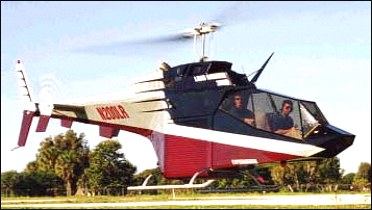
Designed and built by Tom Navickas, the Load Ranger is primarily targeted at the aerial spraying market, but applications for medium freight hauling, law enforcement and special missions also being considered.

Development started July 1996; first flight in April 1997 and certificated in the Experimental category; 30 flight hours logged by February 1998. Restricted use certification was aimed for third quarter of 1998, but no further information.

The structure was a chrome-alloy tubing skeleton with semi-monocoque skin and a slab-sided fuselage with large centre cargo compartment accessed via a roller shutter. The landing gear was tubular welded steel skids.
Power was from one Allison 250-C18 turboshaft, rated at 236kW for take-off, and a max continuous rating of 201kW driving a two-blade metal main rotor with blade folding. Fuel capacity in standard tank was 190 litres, and with auxiliary or ferry tank, 758 litres.

A pilot and operator were in tandem seats. A freight compartment had a typical load capacity of 907kg. Alternatively, six passengers can be seated side saddle in the cargo compartment with roller doors stowed.
It was priced at US$500,000 (with Army surplus Allison T63 engine and drive train) or US$1.5 million (with civil Allison 250-C18 engine and Bell 206 drive train) in 1999.

Tom Navickas was killed in the Load Ranger in Jersey fathers day 2005 and killed his nephew with him. Apparently they ran out of fuel.

Load Ranger 2000
Main rotor diameter: 10.15m
Tail rotor diameter: 1.58m
Fuselage length: 10.44m
Overall length, rotors turning: 11.79m
Overall width: 0.70m
Height to top of rotor head: 3.35m
Height over tail fin: 3.20m
Weight empty: 438kg
Max gross weight: 1520kg
Useful internal load: 1081kg
External slung load: 1045kg
Never-exceed speed: 278km/h
Hover ceiling, IGE: 2745m
Hover ceiling, OGE: 1065m
Service ceiling: 4725m
Range, with max fuel: 547km
National Aero Manufacturing Corporation

Phillipines
Until 1982 a subsidiary of the Philippines Aerospace Development Corporation, which began assembly and license-manufacture of MBB BO 105 helicopters in 1974. Later that year a contract was signed with Britten- Norman for the assembly and eventual manufacture of the BN-2A Islander, and for the development and marketing of an amphibious version. Assembly of Islanders began in 1976 from sets of parts from the UK. In 1978 a four-seat utility aircraft was developed in conjunction with the Philippine Government’s National Sciences Development Board.
1982 closure.

Nagler-Rolz NR 54

Nagler-Rolz NR 54

Development of the NR 55 concept continued in 1941 with the generally similar NR 54 V1, in which reductions were made in size and weight. The engine power was reduced to 24hp and the rotor diameter to 7.8m with the engines mounted 1.2m from the centerline driving the propellers, which were 1.8m further out along rotor blade. The carburetor was never perfected to work satisfactorily and due to this no test flights were ever made. Performance with empty and loaded weights of 80 and 175kg respectively, was estimated to have a 55 mph cruising speed.

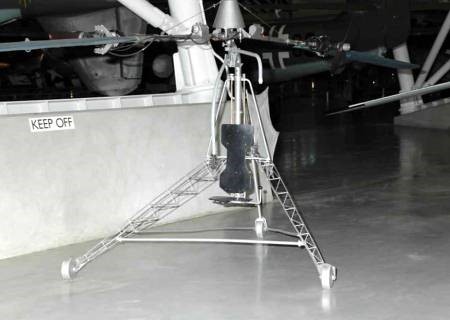
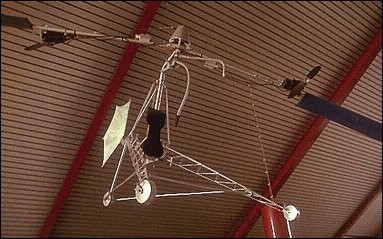
The NR 54 V2 was produced in 1941. The single-seat helicopter flew on remarkably little power. The 6.9m rotor consisted of two single blades, each of which had an 8hp motor driving a small airscrew at 6000rpm to give a torqueless drive, and the pilot’s controls consisted of two levers, one to alter rotor blade pitch and the other to control the engines. The entire airframe broke down for transporting and could carried by a single man. The little ship was said to cruise at 80km/h and climb at 140m/min.

Four of the NR 54V2 machines were built before the war ended, but it is not known how close the NR 54 was to being ready for production at that point. At least one of them was brought to the USA for evaluation and is now in the collection of the National Air and Space Museum.

NR 54 V2
Engine: 2 x 8hp
Main rotor diameter: 7.92m
Max take-off weight: 140kg
Empty weight: 36.5kg
Cruising speed: 80km/h
Ceiling: 457m
Range: 48kg
Crew: 1

Nagler-Rolz NR 55

The Nagler-Rolz Flugzeugbau built a helicopter similar in configuration to the RI and RII. This ship had an empty weight of 700 pounds and though it was flown in hover, it could not be lifted out of ground effect. With the coming of World War II, the company received contacts from the German Government for the development of small single-seat helicopters.

In 1940 the first machine from the new company appeared as the NR 55, which had a single-blade rotor. This rotor blade was counterbalanced by a 40hp engine which applied to it a torqueless drive by means of two small airscrews which pulled it round at about 135rpm. Because of gyroscopic forces at the engine location, the carburetor was mounted on the centerline of the rotor hub and fuel-air mixture was piped out to the engine cylinders. The rotor diameter was 10.5m, and the machine weighed about 338kg loaded, but, although a cruising speed of 97km/h was thought feasible, only hovering and lift test were undertaken because the machine was built purely for testing the rotor system.

Development of the NR 55 concept continued in 1941 with the generally similar NR 54 V1.

Nagler-Rolz Flugzeugbau

With the outbreak of war, Nagler joined with Franz Rolz to form the Nagler-Rolz Flugzeugbau.

The new company built a helicopter similar in configuration to the RI and RII. This ship had an empty weight of 700 pounds and though it was flown in hover, it could not be lifted out of ground effect. With the coming of World War II, the company received contacts from the German Government for the development of small single-seat helicopters.

Nagler Honcho

The 1972 single-place Honcho 100 (N1750Z) was powered by an AiResearch 85-90 gas turbine feeding compressed air to the rotor.

The 1973 two-place Honcho 200 and Honcho 202 were was powered by a Solar-T-62-Titan gas turbine.

Honcho 100
Engine: AiResearch 85-90 gas turbine
Rotor: 28’7″
Length: 10’9″
Useful load: 275 lb

Honcho 200
Engine: Solar-T-62-Titan gas turbine

Honcho 202
Engine: Solar-T-62-Titan gas turbine

Nagler VG-1 Vertigyro

The 1963 VG-1 Vertigyro (N5395Z) comprised a Piper Colt aircraft fuselage, complete with engine and prop. Its Sud Djinn rotor system was driven by a turbine engine, enabling the craft to be flown as a gyroplane, a helicopter, or a combination of both. Only the one was built.

The vehicle could take off and fly as a helicopter at 75mph, powered by a Garret-AiResearch GTC-85-90 gas turbine to feed compressed air to nozzles in the two-blade rotor, then convert into an autogyro to do 85mph powered by the one 108hp Lycoming O-235.

Engines: 1 x Garret-AiResearch GTC-85-90 gas turbine / 1 x Lycoming O-235, 108hp
Rotor diameter: 36 ft 0 in
Minimum gyro speed: 45 mph
Seats: 2

Nagler NH 160

This version incorporates the lessons learnt from the NH 120, and while the general principle remains the same, i.e. the main rotor in the same alignment as the anti-torque rotor, their positions have been changed.

The two-bladed main rotor remains in its usual position, but the anti-torque rotor with three articulated blades is on the helicopter’s underside between the two skis acting as landing gear, and 1.83m away from the main rotor. The latter has cyclic and collective control and is mounted on an oscillating hub. In horizontal flight it turns at 400 r.p.m. and the lower rotor at 1.500 rpm, the latter consuming 55hp, the former 15hp of the engine’s total power.

Nagler has designed an unusual steering system: two disc brakes of the kind used in motor vehicles, one acting on the main rotor, the other on the shaft of the engine to which the anti-torque rotor is fixed. These brakes are pedal operated.

A fixed vertical surface at the end of the rudimentary fuselage ensures directional stability. The production model is planned to have an enclosed cockpit and fuselage.

Nagler’s Model NH-160 single-seat helicopter first flew in 1955.

NH 160
Crew: 1
Engine: McCulloch 4 318, 70hp
Upper rotor diameter: 6.1m
Lower rotor diameter: 2.13m
Length: 3.66m
Weight empty: 190kg
Weight fully loaded: 399kg
Cruising speed: 192km/h

Nagler NH-120

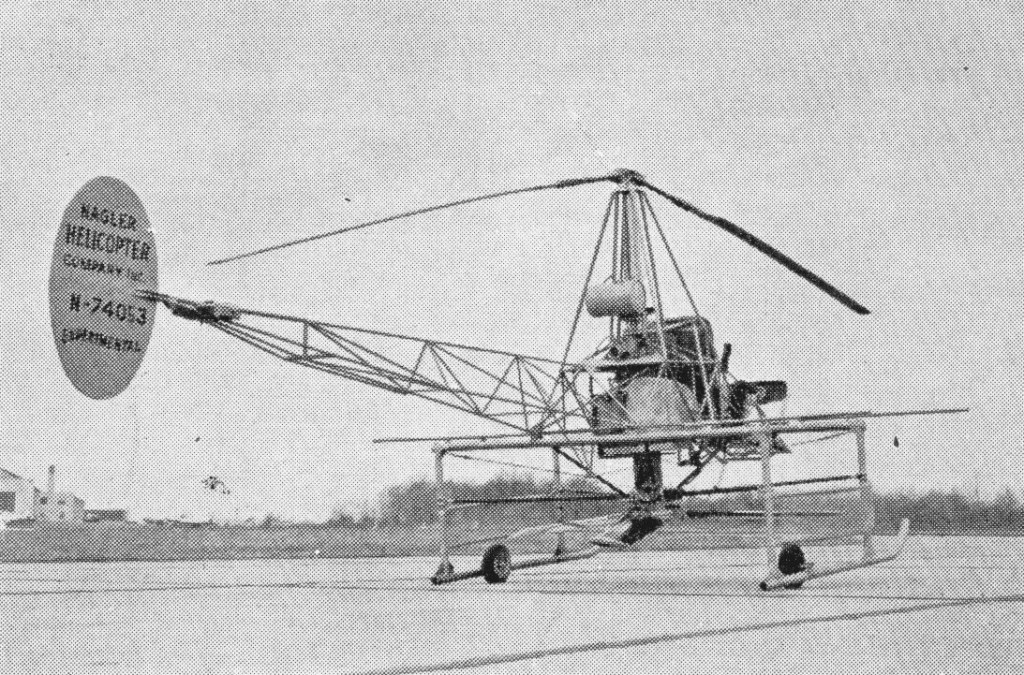
This 1954 ultra-light single-seater has two rotors: one main rotor with collective and cyclic pitch control, the latter by a hanging stick, and one smaller anti-torque rotor. Nagler’s ingenuity in this design consists in placing the latter above the main rotor, which is thus surmounted by the driving engine directly above it and a two-bladed, much smaller diameter fixed-pitch rotor. This compact unit, two rotors with the engine between them, is supported by the helicopter frame made of tubes and containing the pilot’s seat with fuel tanks behind it. The 45hp engine originally planned for proved insufficiently powerful and has been replaced. The tricycle landing gear has three wheels held at the end of legs fitted with shock absorbers.
When folded this rotorcraft will go into a container measuring 0.77 by 2.13m.

NH 120
Engine: Nelson, 40hp
Upper rotor diameter: 2.13m
Lower rotor diameter: 6.1m
Length: 8 ft 2 in
Height: 2.74m
Weight empty: 127kg
Weight fully loaded: 340kg
Max speed: 80 mph
Cruising speed: 112km/h
Range: 210 mi
Endurance: 3h
Crew: 1