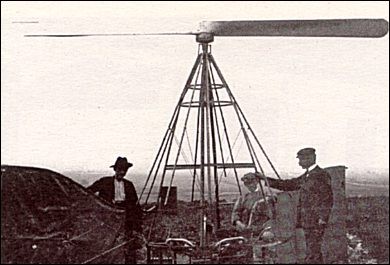
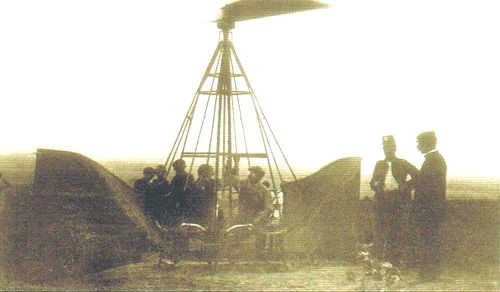
Novák started his pioneering work on helicopters already in 1909 with a model helicopter and in June 1910 he started building his first full size helicopter which used a motorcycle engine for power. In this first version it turned out that the 3 meter diameter rotor was too heavy and that the motorcycle engine was too weak. Later Novák was able to obtain a more powerful engine, a 3-cylinder Trojan and Nagl of 25 hp; and developed a lighter rotor of the same 3 meter diameter. This helicopter did lift into the air unloaded – however, as there was no compensation for the reaction movement, the machine counter-rotated in the air and even the fitting of large vertical panels did not stop the helicopter from spinning. Coinciding with the start of his more advanced second helicopter, development of Novák’s first ended in the fall of 1911.
The N.1700 was a two-place aircraft; the rotor had two blades with a stabilizer bar. The engineer Andre Bruel wanted to get rid of the cyclic control, considered too complex. The rotor head was installed on an articulated parallelogram, allowing lateral motions. The lateral control was obtained by relative displacement of the rotor head in relation to the center of gravity.
The 160hp Mathis GR7 engine directly powered a rear axial helix which blew on two flap shutter systems, some horizontal, some vertical, to control pitch and yaw. The aircraft was damaged at first, due to violent vibrations of transmission, induced by brutal clutching. Alter repairing it, they resumed power checks but, in the hands of an inexperienced pilot, it hit an obstacle.
Management decided then to abandon the N.1700 and to turn to a smaller aircraft, the 1950 single seat N.1710, built in accordance with the same principle. SNCAN asked SNCASE to send Jean Boulet to test this machine:
“The first free flight took place on July 1, 1950. After several difficult hovers (all controls had very larges forces that we tried to compensate somehow by elastic cords), I performed the first forward flight on July 22. The longitudinal control appeared to be very insufficient. Modifications were then made, above all we increased the deflection of the horizontal flap shutters. On September 20, 1950, I took off again to make a forward flight under these new circumstances, but the effect of the modifications appeared to be just the contrary of what we expected: the longitudinal control was even less efficient and moreover the yaw control had lost its efficiency (the horizontal flaps were over deflected and it is probably they stalled and banked the vertical flap shutters). I very quickly found myself flying forward more and more rapidly and banking to the left, with the controls in an extreme position. I had to end this terrible merry-go-round. I reduced the pitch to touch the ground, but the aircraft overturned immediately. I was thrown to the ground and was very lucky not to be killed by a blade. The aircraft was repaired, and we lengthened the tail to improve the efficiency of the control surfaces. In the spring of 1951, I made several more flights, then as my company sent me to Marignane.”
The Societe Nationale de Constructions Aeronautiques du Nord (Nord-Aviation) built its first helicopter prototype in 1947. The N.1700 was a two-place aircraft; the rotor had two blades with a stabilizer bar. The engineer Andre Bruel wanted to get rid of the cyclic control, considered too complex. The rotor head was installed on an articulated parallelogram, allowing lateral motions. The lateral control was obtained by relative displacement of the rotor head in relation to the center of gravity.
Collective pitch and also cyclic pitch were respectively controlled by the radial and the flapping movements of small auxiliary blades set at 90° to the main blades. In this helicopter, the anti-torque device consisted of a fixed-pitch airscrew placed at the end of the tail and blowing backwards on to an assembly of suitably adjusted vanes.
The 160hp Mathis GR7 engine directly powered a rear axial helix which blew on two flap shutter systems, some horizontal, some vertical, to control pitch and yaw. The aircraft was damaged at first, due to violent vibrations of transmission, induced by brutal clutching. Alter repairing it, they resumed power checks but, in the hands of an inexperienced pilot, it hit an obstacle.
Management decided then to abandon the N.1700 and to turn to a smaller aircraft, the single seat N.1710.
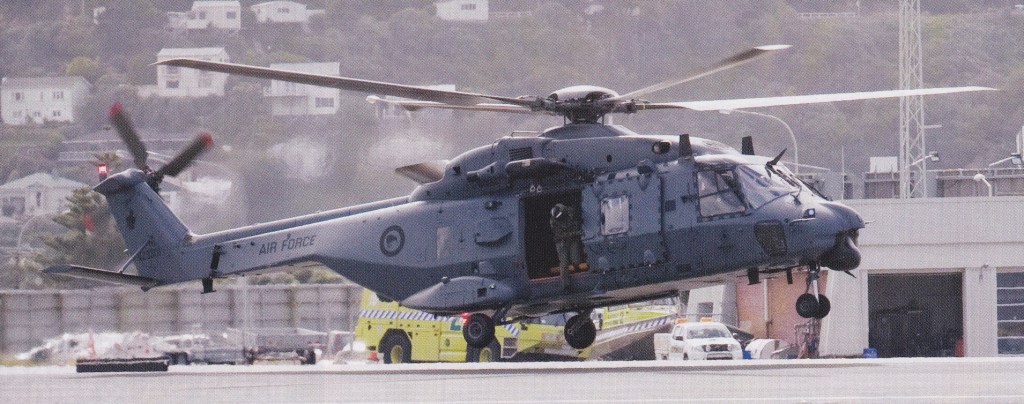
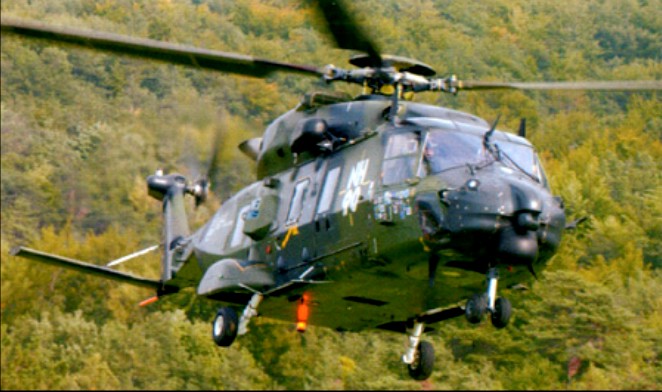
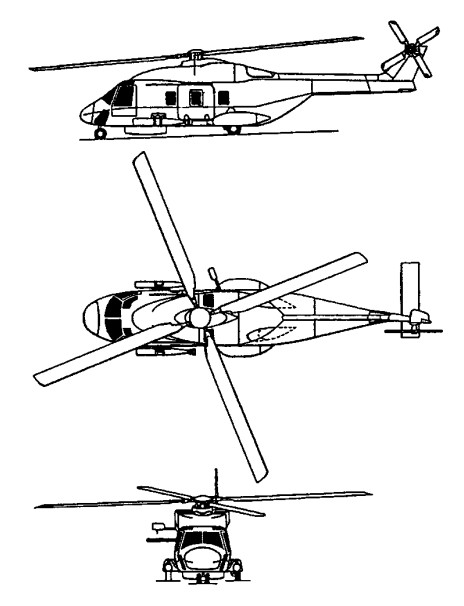
In the 8000/9000kg class, the NH90 was developed and qualified in both a Naval and Army variant and powered by RTM322 engines. A rear ramp option is available for the Army variant. Designated as the TTH (Tactical Transport Helicopter) and NHF for the NATO Frigate Helicopter, the NH90 has fly-by-wire controls and is capable of all-weather operations either on land or at sea. In the tactical version it carries 20 fully-equipped troops or 2500kg of cargo. In the NHF version can undertake multimaritime roles including the ASW or anti-surface vessel role and can carry up to 700kg of missiles.
Five European nations signed the memorandum in 1985 allowing the development of the NH 90. The work is being shared by Eurocopter France (43%), Agusta (26%), Eurocopter Germany (24%) and Fokker (7%).
Largely built of composite materials, the NH90 was in service with France, Italy, Germany, the Netherlands, and New Zealand.
NH-90 Engine: 2 x RTM 322-01/9 turboshaft, 1484kW at take-off Main rotor diameter: 16.3m Length with rotors turning: 16.3m Height with tail rotor turning: 5.44m Max take-off weight: 10000kg Empty weight: 5400kg Max speed: 290km/h Cruising speed: 259km/h Service ceiling: 4250m Range: 1204km Payload: 2000kg
NH90 TTH Engine: 2 x R-RTM 332 or 2 x GE CT7-6E Instant pwr: 1367 or 1360 kW MTOW: 10,000 kg Payload: 4460 kg Max speed: 155 kts Max range: 930 km HIGE: 9,600 ft HOGE: 7878 ft Crew: 2 Pax: 20
NH Industries WAS founded IN 1992 by Agusta of Italy, Eurocopter Deutschland of Germany, Eurocopter and Fokker to develop and produce the twin-turboshaft NH90 tactical transport (TTH) and multirole NATO frigate helicopter (NFH). First flown December 1995, production deliveries Were expected to begin in 2003, first to the Netherlands (navy). Planned orders were for France to receive between 68 and 133 TTHs and 27 NFHs, Germany 205 TTHs and 38 NFHs, Italy 160 TTHs and 64 NFHs, and the Netherlands 20 NFHs.
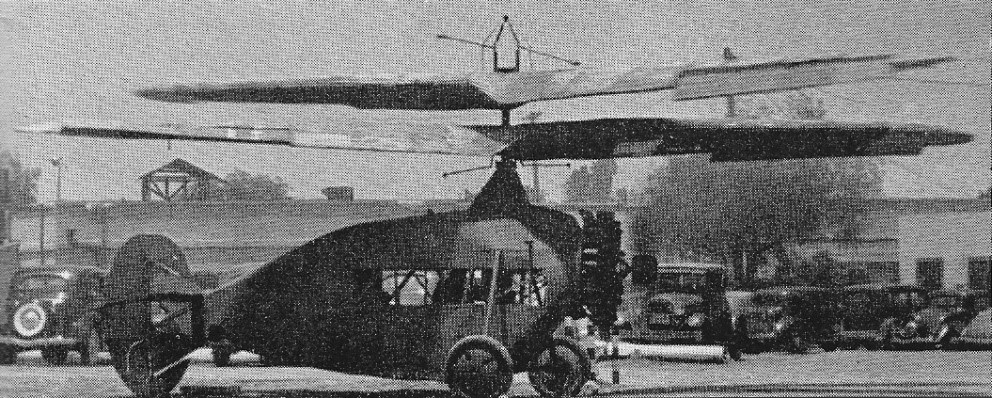
Built in 1928 in Hollywood, California, by Newbauer Vertical Airplane Co, the Hummingbird was an ornithopter-type craft with two revolving disks on top, and wings made from lateral vanes, all powered by a four-cylinder motorcycle engine.
The Hummingbird weighed 3496 lb and carried 44 Imp.Gal of fuel.
There is no record found of flight and US patent #1,743,327 was issued in 1930.
(Valentine) Newbauer Vertical Airplane Co Monterey Park CA. USA
In 1927 Valentine Newbauer built a single-place open helicopter with two propeller-type (coaxial?) rotors and a tractor prop. A model was built, powered by a 1.5hp engine. Newbauer claimed it lifted 60 pounds, which is judged by experts to be highly improbable.
He was engaged in helicopter experiments from 1917-27 and held several patents. One project was entered in the 1924 British helicopter competition.
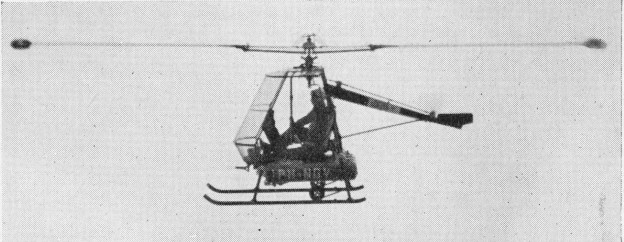
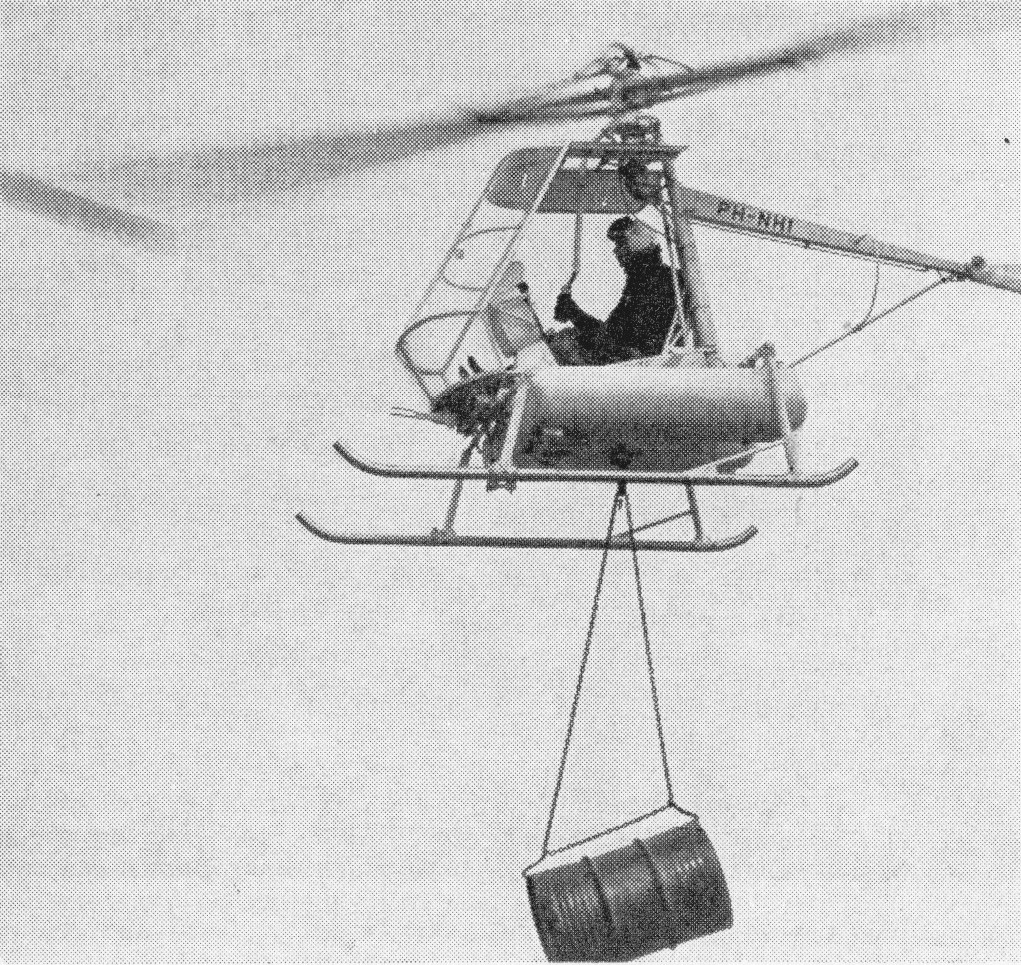
A light helicopter which first flew in May 1956. For propulsion the Kolibrie employed ramjets mounted at the tips of its rotor blades. Ten helicopters were built before production rights were handed over to Aviolanda Maatschappij voor Vliegtuigbouw, which subsequently abandoned it.
The Kolibrie could lift more than is own empty weight.
Netherlands This company designed and built the N-3 Kolibrie light helicopter which first flew in May 1956. For propulsion the Kolibrie employed ramjets mounted at the tips of its rotor blades. Ten helicopters were built before production rights were handed over to Aviolanda Maatschappij voor Vliegtuigbouw, which subsequently abandoned it.




 All Aero