Founded 1964 and undertook remanufacture of Sikorsky S-55 and S-58 helicopters into range of new models for civil/military uses.
Guangzhou Orlando Helicopters Ltd was a joint Chinese/U.S. company formed 1985 to assemble Panda, as Chinese version of Orlando OHA-S-55 Bearcat.
Helicopters
Omega BS-12
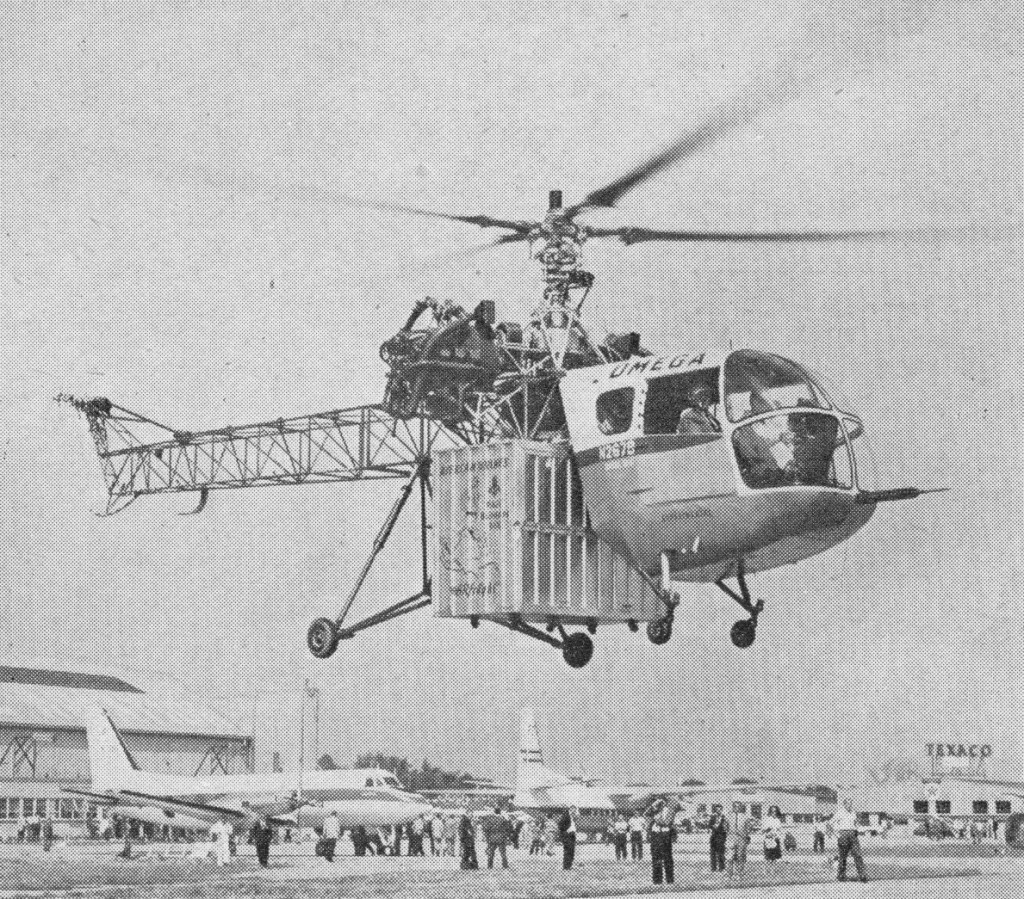
The Omega BS-12 four-seat, twin-engined helicopter flew in 1956, and was succeeded by the BS-12D with more powerful engines and the 1963 BS-12D3S supercharged version.
Developed from an original Canadian design with two Franklin engines, the BS-12 could carry a 1500 lb load.
Production was to have started in 1964, when all development was suspended after completion of four prototypes.
Omega Aircraft Corp
USA
Omega Aircraft Corp was founded 1953 as a subsidiary of Allied Aero Industries for further development of the Sznycer-Gottlieb SG VI helicopter. The Omega BS-12 four-seat, twin-engined helicopter flew in 1956, and was succeeded by the BS-12D with more powerful engines and the 1963 BS-12D3S supercharged version. Production was to have started in 1964, when all development was suspended after completion of four prototypes.
Oelimichen No.6
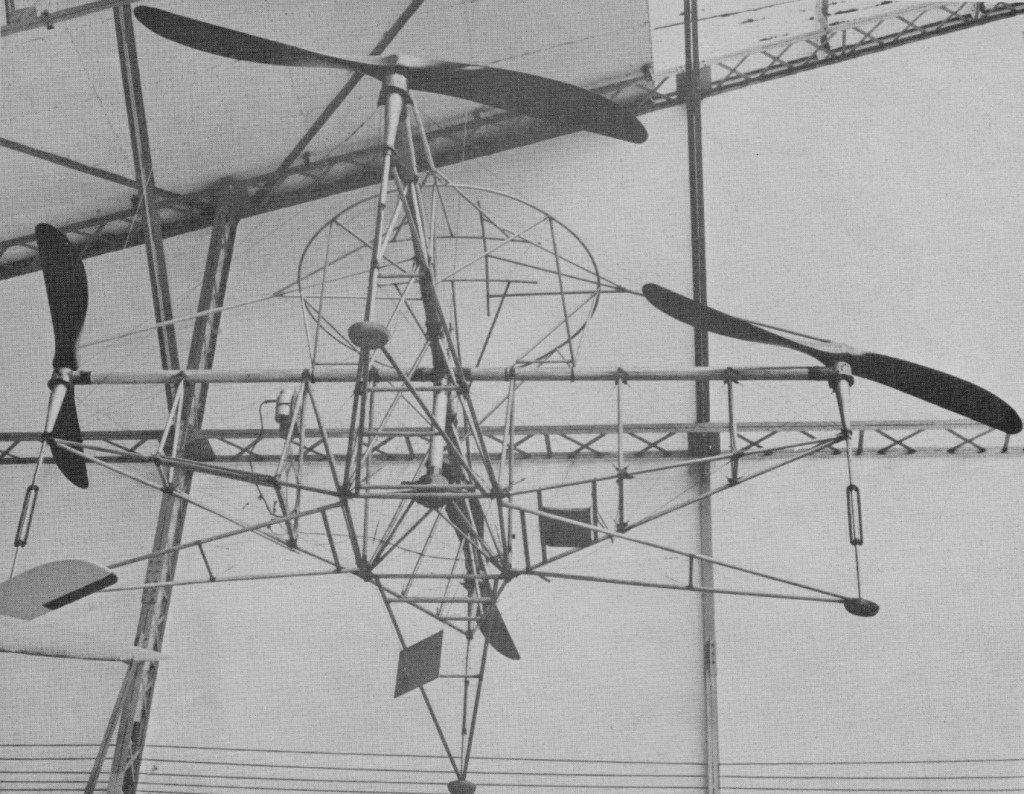
The Etienne Oelimichen No.6 of 1935 was a helicopter with a 353 cu.ft balloon mounted above to assure stability. It also had a quad rotor and quad gear.
On 2 March 1935 Oelimichen flew the craft for 5 minutes in the large dirigible hanger at Orly, demonstrating its stability.
The French Musee de l’Air possesses five of Etienne Oelimichen’s experimental helicopters developed from 1920 through 1938. In 1965 only his sixth project of 1935 was on display.
Width: 16.73 ft
Length: 16.73 ft
Rotor diameter: 9.18 ft
Oelimichen No.3
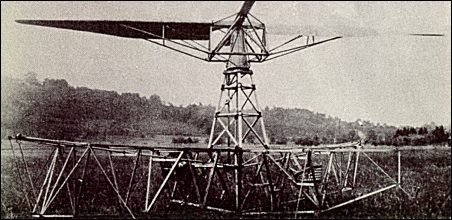
Oemichen was dissatisfied with the modest heights to which No.2 was able to fly, and from the third machine onward he adopted a single main rotor layout, accompanied by two smaller anti-torque rotors. His last design, in 1938, reverted to the balloon-assisted principle of his first aircraft.
Oemichen’s third helicopter which appeared in 1924 had a single large rotor with two blades.
Oelimichen No.2
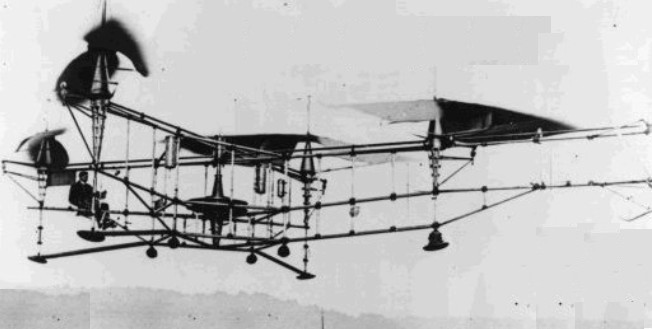
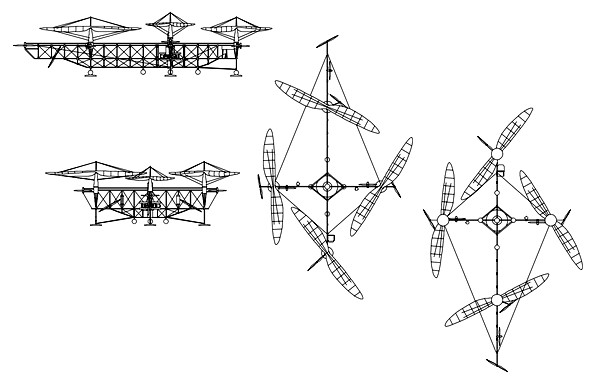
In 1922 Oemichen was able to dispense with the gasbag of the first machine and fly free. Etienne Oelimichen’s No. 2 machine was powered by a 120 hp Gnome rotary engine. It had four large rotors and eight stabilizing and steering propellers about an open lattice work frame and it flew for the first time on 11 November 1922.
Etienne Oelimichen’s first helicopter flew in 1922 for a distance of 60 m (197 ft). In 1923 he made the first hovering flight of more than five minutes.
The Oemichen No.2 was basically a steel-tube framework of cruciform layout, with 2-blade paddle-shaped rotors at the extremities of the four arms. The angle of these blades could be varied by warping. Five of the propellers, turning in a horizontal plane, served to stabilise the machine laterally; another propeller mounted at the nose was for steering the helicopter; and the remaining pair acted as pusher propellers for forward propulsion. The opposing pairs of rotors were of slightly different diameters. The Oemichen No.2 exhibited, for its time, a considerable degree of stability and controllability, and in all made more than a thousand test flights during the middle 1920s. By 1923 it was able to remain airborne for several minutes at a time, and on 14 April 1924 it established the first-ever FAI distance record for helicopters of 360m. Three days later it increased this to 525m. On 4 May 1924 this contraption made a closed¬ circuit flight of 1 km (0.62 mile) at Arlonans to set a distance record for helicopters, It was airborne for 14 min with the kilometer taking 7 minutes and 40 seconds, to win a 90,000 franc prize.
A 180hp Gnome engine was substituted later.
Despite the fact that it was able to demonstrate sufficient controllability and power in ground effect for this historic flight, it was not a practical flying machine. In recognition of the impracticality of the machine, Oemichen began pursuing a series of aircraft with a single-main rotor and two anti-torque rotors, but had little success.
Oemichen No.2
Engine: 1 x Gnome Rhone, 135kW
Rotor diameter: 2 x 7.60m + 2 x 6.40m
Empty weight: 800kg
Oelimichen No.1
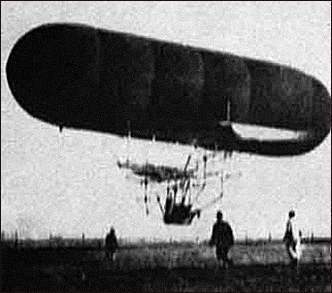
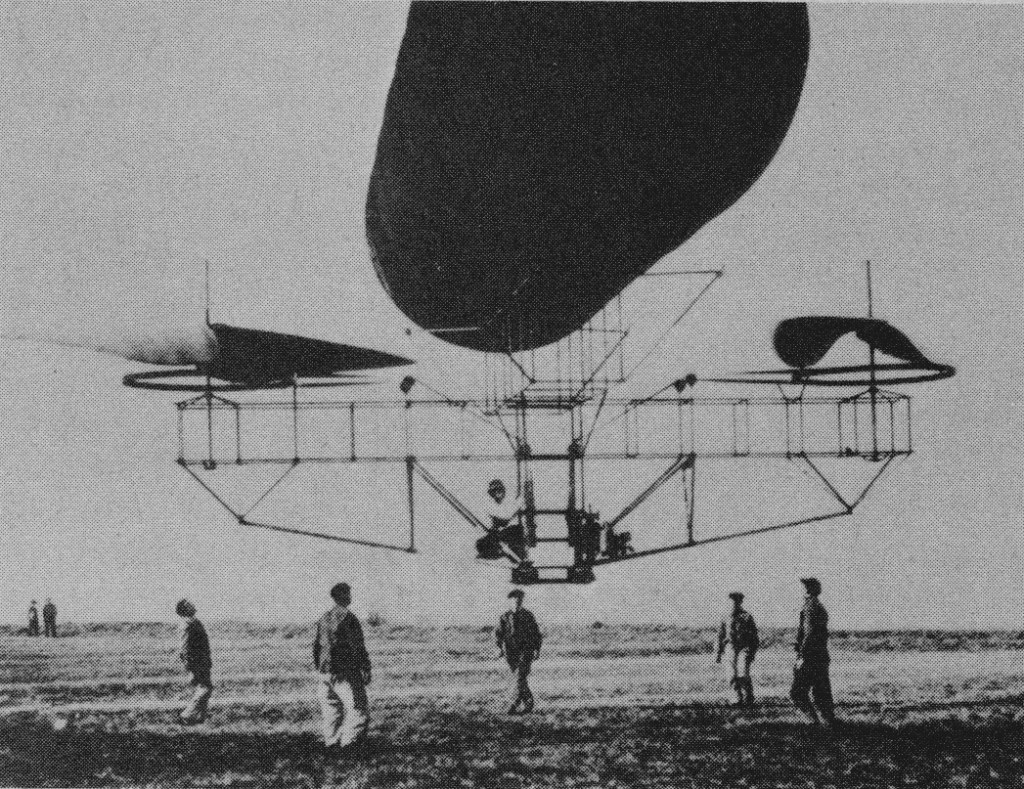
Etienne Oemichen, a young engineer with the Peugeot motor car company, began to experiment with rotating-wing designs in 1920, and in all designed and built six different vertical take-off machines. When the first of these failed to develop enough lift from its twin rotors and 25hp engine to rise off the ground, he added a hydrogen-filled balloon on top of it to give it added stability and lift.
With two rotors of 20.99 ft and weighing 814 lb, it flew for 1 min 40 seconds, and later 5 minutes.
Oelimichen, Etienne
The French Musee de l’Air possesses five of Etienne Oelimichen’s experimental helicopters developed from 1920 through 1938. In 1965 only his sixth project of 1935 was on display.
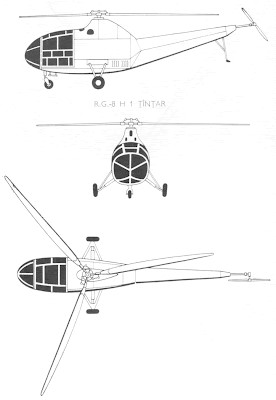
Novitchi RG-8 H1 Tintar

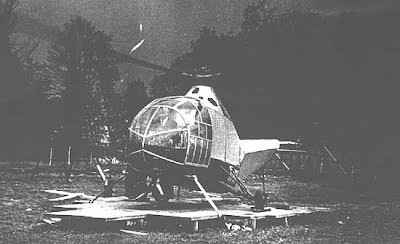
The RG-8 H1 Tintar, designed by Romanian engineers Vladimir Novitchi and Gheorghe Rado, was the first Romanian helicopter.
The only example was built at the CIL factory in 1960.
IFIL-Reghin RG-8 H1
Engine: 1 x Walter Minor 4 III
Rotor diameter: 10.50m
Length: 8.99m
Height: 2.50m
Max. takeoff weight: 660 kg
Tail rotor diameter: 1.80m
Crew: 2
Novak No.2
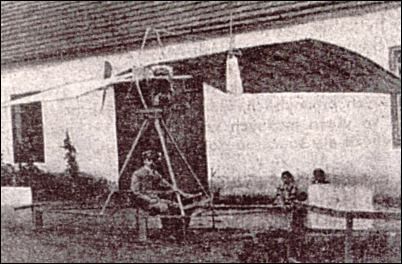
The second helicopter made by Frantisek Novak in 1914.

 All Aero