Model 101, 1946 A second version of the Strap-on with a motor-cycle saddle acting as a seat and a tubular tripod assembly with three wheels as landing gear, and also a hanging stick to control the aircraft was tested later.
Model 102, 1947 Tests of the Model 101 revealed the need for several improvements, so that the 102, while somewhat resembling its predecessor, had a more powerful engine. Besides a directly engaging clutch, there was also a freewheeling device for auto-rotation in case of engine failure.
The two rotors, set at a distance of 2 feet (61 centimetres) from each other, consisted of a 4-foot (1.32-metre) tubular metal section centred at the hub; to these tubular sections the two spruce blades were attached.
The controls included collective, cyclic and differential pitch, the latter being obtained by rotating the stick handle which made the helicopter turn on its vertical axis.
Model 103, 1947 This model was similar to the previous ones, except that the rotor diameter was slightly increased and the distance between the two rotors somewhat greater.
Model 104, 1948 Once again this was an ultra-light single-seater helicopter with two co-axial contra-rotating two-bladed rotors of the same lineage as the firm’s previous products. Model 104 was sent to the United Kingdom, where it remained, to be tested for the British Ministry of Supply under the aegis of a British company, Hoppicopter Ltd.
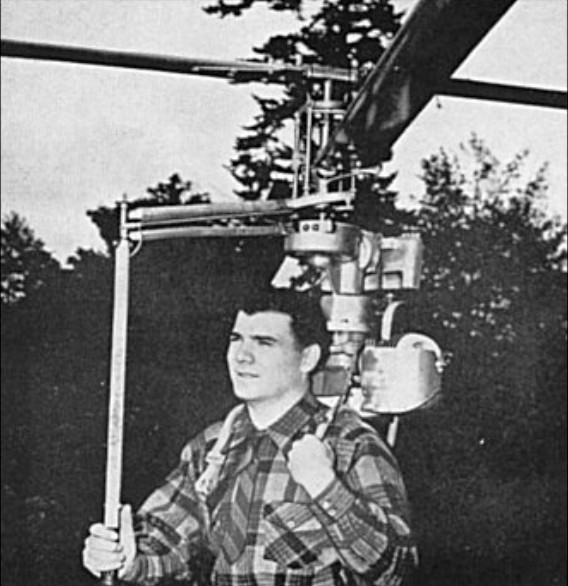
The Pentecost Hoppi-Copter was a 41kg personal helicopter pack designed to be strapped to an infantryman’s back to make it possible for him to surmount terrain obstacles, but had no landing gear. Conceived by Horace Pentecost, it first flew in 1945, but landing shock problems proved insurmountable.
This ultra-light individual helicopter had two co-axial contra-rotating two-bladed rotors powered by a small two-stroke horizon-tally opposed engine developing about 20 h.p.
The body consisted of a tubular aluminum frame curved to fit over the pilot’s shoulders and attached to the body by harness of the type employed in parachutes; the pilot’s legs were used for landing.
Some twenty hops were made with the use of safety cables attached to the pilot, but this strap-on helicopter ended its career at the Smithsonian Institution in Washington.
Capital Helicopter Corp was established January 1954 for continued development of C-1 Hoppi-Copter, took over the patents in 1954, and flew a Hoppi-Copter with rotor blademounted pulse jets.
Horace Pentecost became President of the Capital Helicopter Corporation, founded in 1954, on leaving the Hoppicopter concern and retaining his rights in his inventions.
A new type of helicopter, powered by small pulse-jet engines at the blade tips, was also developed by Horace Pentecost.
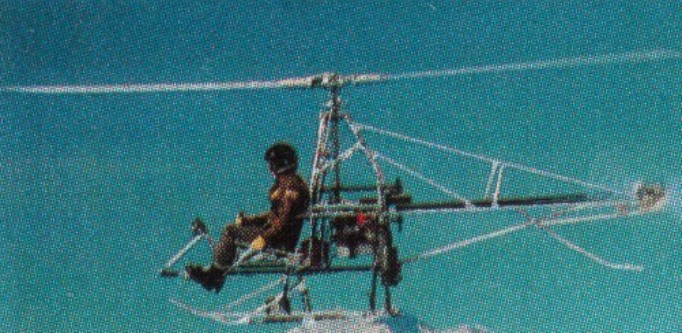
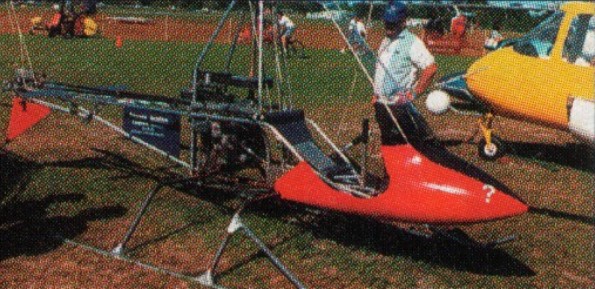
A kit helicopter, first flown in 1992, the kits had all major parts assembled, and all blades and parts balanced. Kit price in 1997 was US$15,500.
Engine: Hirth, 65 hp hp range: 65-110 Height: 7 ft Length: 15 ft Disk span: 21 ft Empty weight: 435 lb Gross weight: 825 lb Fuel capacity: 14 USG Max speed: 100 mph Cruise: 80 mph Range: 175 sm Rate of climb: 1000 fpm Service ceiling: 10,000 ft Seats: 1
Max speed: 95 mph Cruise: 80 mph Range: 175 sm Rate of climb: 1000 fpm Service ceiling: 10,000 ft Engine: Hirth, 65 hp hp range: 65-110 Fuel capacity: 10 USG Empty weight: 350 lb Gross weight: 700 lb Height: 7 ft Length: 20 ft Disk span: 21 ft Seats: 1
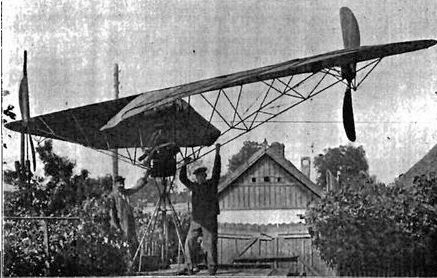
Built by W Luther Paul, the 1907 helicopter had four 3hp motorcycle engines. Two rotors in tandem and a tractor propeller with an empty weight of 500 lb.
The helicopter was tested in a large barn, where it was reported to have reached a height of about 4 feet.
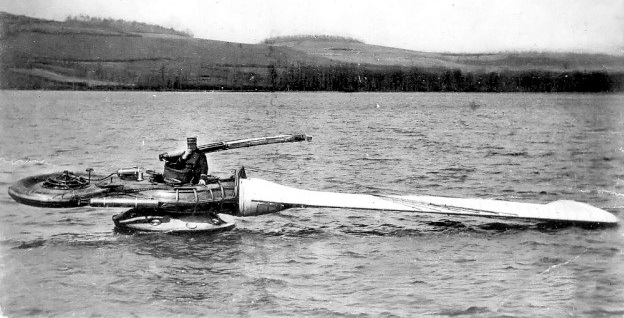
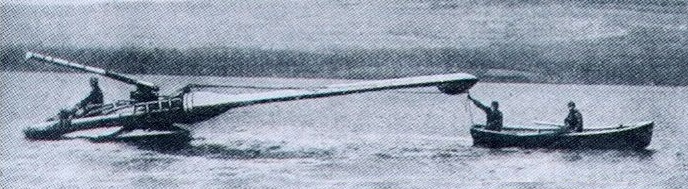
The completed Gyroptere awaiting tests on Lake Cercey on 31 March 1915
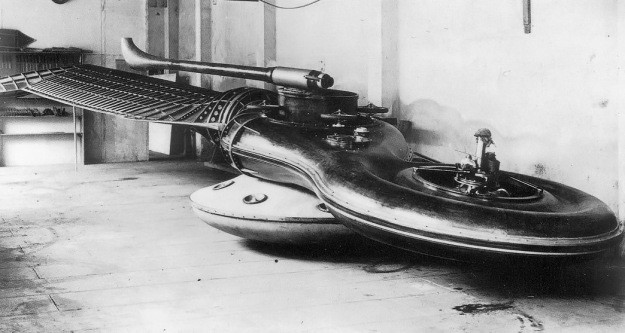
The Gyroptere was designed in France from 1911-1914 by Alphonse Papin and Didier Rouilly. Their monocopter was based on the sycamore seed; a single blade extends from the seed to spin the seed and slow its descent as it falls. Though unsuccessful, the machine was the first air-jet helicopter. Papin and Rouilly obtained French patents 440,593 and 440,594 for their invention and later obtained U.S. patent 1,133,660 in 1915 (filed in 1912).
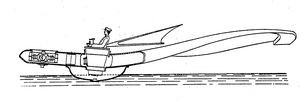
Construction of Papin and Rouilly’s Gyroptere began in February 1914 and was completed in June of the same year. The prototype was named Chrysalis (Chrysalide). Constructed of molded wood, the Gyroptere was well built with compound curves and a smooth sweep of its single, long, airfoil-shaped blade. The fabric-covered blade was hollow and approximately 19.5 ft (5.9 m) long and 4.4 ft (1.33 m) wide, giving it an area of 130 sq ft (12 sq m). The blade was counterbalanced by an 80 hp (60 kW), nine-cylinder Le Rhone rotary engine. The pilot occupied a nacelle between the blade and engine. The bottom of the nacelle included a structure to support the machine while it was on the ground or act as a float when on water.
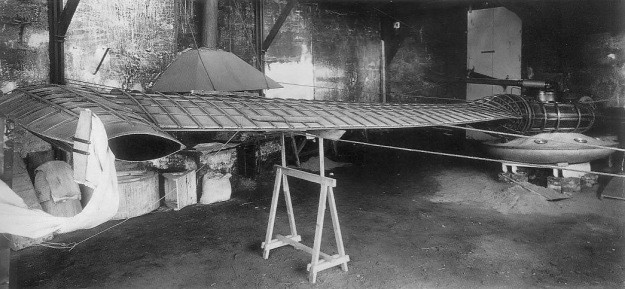
This image offers a good view of the Gyroptere. The blade does not have its covering, the float and directional control tube can clearly be seen in the center nacelle, and the Le Rhone engine in its fan housing is on the right.
The Le Rhone engine was started with a pulley system. The engine, turning at 1,200 rpm, drove a fan that produced an output of just over 250 cu ft (7 cu m) of air per second. The air, along with the engine’s hot exhaust for thermal expansion, was directed through the length of the blade and exited the blade’s tip through a nozzle on the trailing edge at 330 ft/s (100 m/s). This jet of air would turn the blade, and the gyroscopic force of the motor would lift the blade into a positive angle of attack. The nacelle that carried the pilot was centered on the axis of rotation. The nacelle was mounted on ball-bearings and was centered against four horizontal rollers. The entire machine weighed 1,100 lb (500 kg), which was 220 lb (100 kg) more than originally planned.
The pilot controlled the Gyroptere through the use of two foot pedals: one pedal opened a valve to admit air to the blade; and the second pedal allowed air into an L-shaped tube above the craft that served as a rudder for directional control. The L-shaped tube was directed by the pilot; its discharge provided forward thrust, steering, and stabilized the center drum to prevent it from spinning with the blade. A switch in the nacelle allowed the pilot to engage or disengage the engine.
The outbreak of World War I delayed testing until 31 March 1915. During tests on Lake Cercey (Reservoir de Cercey), near Pouilly-en-Auxois, France, the craft achieved a rotor speed of only 47 rpm, well below the 60 rpm calculated as necessary for liftoff. Even so, the machine was wildly out of balance, and the blade repeatedly contacted the water, damaging itself and shaking up the pilot. In addition, the Le Rhone engine used was not powerful enough; the Gyroptere had been designed to use a 100 hp (75 kW) engine which could not be obtained.
A military commission observing the test determined that such a machine could not aid the war effort and halted further evaluation. The Gyroptere remained at Lake Cercey until it was sold for scrap in 1919.
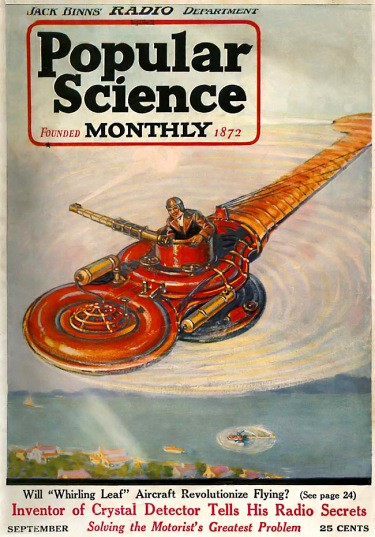
The Papin-Rouilly Gyroptere as depicted on the cover of the September 1922 edition of Popular Science
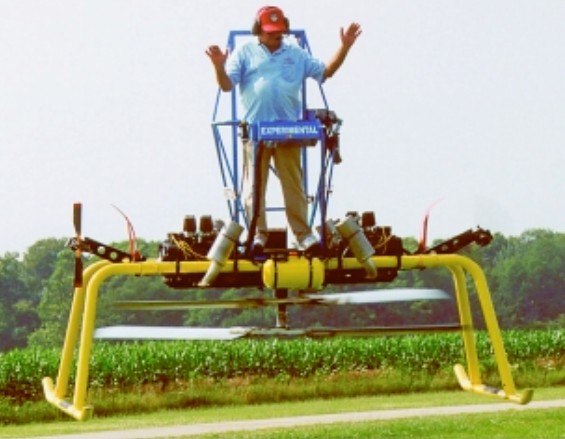
PAM 100B Single place, stand-on Individual Lifting Vehicle (ILV) with two composite 24″ diameter props for directional control. Simple tubular helicopter-type high strength airframe made of aircraft grade aluminum. Controls consist of a throttle and a fly-by-wire joy stick for directional control. There is no collective control. Kit price of $50,500 includes everything but shipping in 2009. Plans were also available.
Engines: (2) Hirth F-30 100 hp Rotor Blades: Four extruded aluminum Blade diameter: 9.17 ft Chord: 8″ chord
Min Speed Hover Cruise 45 mph Top Speed 60 mph Empty Weight 640 lbs Useful Load 360 lbs Gross Weight 1,000 lbs Skid Width 10 ft Height 9 ft Length 8 ft

 All Aero