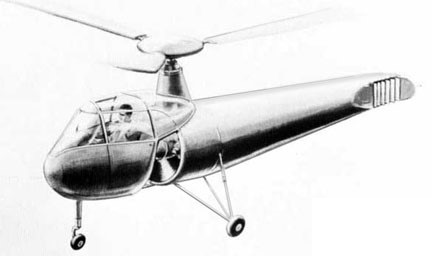
PV-1 1940 – Frank Piasecki and his P-V Forum’s first design was to be a single-rotor helicopter with a fan-forced, anti-torque system blowing air through the tail cone, and turned by control vanes in the exit, predating the NOTAR* by several decades. PV-1 was not developed beyond the design stage due to high development risk at the early stage of helicopter design. *Acronym for “No Tail Rotor” technology whereby the tail rotor was replaced as anti-torque control by a swiveling exhaust duct at the end of a hollow tail boom.
Towards the end of 1943, Frank Nicholas Piasecki also appeared on the scene. Piasecki had worked for the Kellett Autogyro Company and Budd Aircraft. He had previously been involved in development of the Platt-LePage XR-1 and had undertaken a small-scale project of his own. Frank N. Piasecki, President of the PV-Engineering Forum, an organization he formed with F.M.Vinsie and Elliott Daland for the purpose of building his helicopter. Records show he is the first American to be granted a license to fly a helicopter before first qualifying to fly a conventional airplane. He did, however, previous to flying his own helicopter design, get in some flying time in a light plane. This helped him, too, in building the PV.
P-V Engineering Forum had completed several rotary-wing contracts for NACA and the U.S. Navy. The latter ordered an XHRP-1 helicopter which flew in 1945; following successful tests it was placed in production. Further orders followed for XHJP-1 tandemrotor helicopters for USN shipboard operations and the large XH-16, which had a fuselage of DC-4 size.
P-V Engineering became Piasecki Helicopter Corp in 1946, formed by Frank Piasecki, who was concerned in development of vertical-lift aircraft and flew the Model 59K Sky-Car flying jeep with an Artouste turboshaft engine in 1958 under a US Army contract.
Technical interchange agreements signed with Breguet Aviation in 1957 included sales rights for that company’s STOL transports in the U.S.A. and Canada, but these were dropped in 1962. Also provided engineering assistance to Agusta from 1960 for the AZ-101G and AZ-105 helicopters.
Built prototype of PiAC 16H-1C Pathfinder compound helicopter in 1962, continuing development under a U.S. Navy contract, but no production. Work included developing vectorod-thrust ducted propeller system for attack helicopters under U.S Army contract, definition of a possible U.S. Marine Corps medium-lift replacement type, and marketing the PZL Swidnik W-3A in the Americas and Pacific Rim regions.
After F N Piasecki was forced out of his company in 1955, he founded Piasecki Aircraft Corp, and his original company became Vertol Aircraft Corp, which in turn became a division of Boeing Co in 1960.
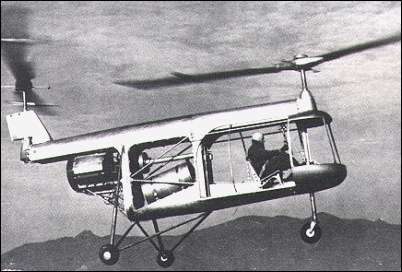
The P.D.4 was a four-seat helicopter with two rotors placed in tandem. Initially it had to be equipped with 450hp Alpha Romeo engine but then a 215hp Franklin was adopted.
The helicopter flew in the first half of 1952, demonstrating good handling characteristics although being seriously underpowered. In a wrong maneuver during a landing with lateral wind it was seriously damaged and wasn’t repaired.
SA Piaggio & Co, an engineering and shipbuilding company, produced some Caproni aircraft and parts during the First World War at a Finale Ligure factory, but subsequently abandoned aircraft manufacture until it took over Pegna & Bonmartini in 1923. First product was the Piaggio-Pegna pursuit monoplane with Hispano-Suiza engine. Later was associated with Societa di Costruzioni Meccaniche Aeronautiche in license-construction of Domier Wal flying-boats. Built P.32 twin-engined heavy bomber at end of 1930s and several four-engined P.108 heavy bombers during Second World War.
Resumed aeronautical work in late 1946 with conversion of Dakotas for airline service. Built P.136 five-seat twin-engined amphibian, prototype flying in 1948, followed by a series of trainers for the Italian Air Force; the P.149 was also license-built by Focke-Wulf in Germany. Produced the P.166 executive transport in 1957, with two Lycoming engines and pusher propellers, as with the P.136; P.166-DL3 turboprop variant later developed and produced, with final P.166-DL3-SEM Maritime variant for search and surveillance, coastal patrol and other roles still available in 1998, but only to special order. Signed agreement with U.S. Douglas company in 1961 for joint development of light utility aircraft, first flown in 1964. Designated PD.808 and powered by two Bristol Siddeley Viper turbojets, only a small number was built.
The present Rinaldo Piaggio company was formed in February 1964 as a separate concern, but in 1994 was put under insolvency protection; 51 percent shareholding in the company was purchased by Tushav, a Turkish holding company, in mid-1998, and protection was thereafter lifted. P.180 Avanti twin-pusher turboprop business aircraft flown September 1986, but only 43 production aircraft ordered; turbofan derivative may be developed. Has manufactured components for Aeritalia/Alenia, AMX International, Dassault and Panavia. In 1998 three Italian industrial families bought the debt-free assets from the Government and formed Piaggio Aero Industries SpA.
In 2024 Italy approved the sale of Piaggio Aerospace to the Turkish unmanned combat aerial vehicle (UCAV) producer Baykar. In 2023, Baykar ranked among the top 10 exporters in Türkiye across all sectors, racking up $1.8 billion in exports. Türkiye dominates 65% of the global unmanned aerial vehicle (UAV) export market, with Baykar alone holding nearly 60% of the market – three times the size of its closest US competitor. In recent years, Baykar has generated more than 90% of its revenues from exports, delivering Bayraktar TB2 UCAVs and Bayraktar AKINCI UCAVs to 35 countries.
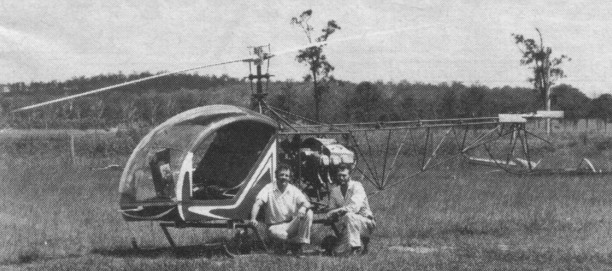
Ten years’ of design and four years’ construction by Mr P. Gerakiteys and Mr D. Phillips went into the Australian two seat ‘Phillicopter” prototype beginning certification trials in 1972. The aircraft is expected to have a cruise speed of 70kt and a range of 200 miles. Powered by a 145 h.p. Continental A 300, it has a 5001b useful load. Eight firm orders had been received by 1972.
After the PKZ 2 was modified in May 1918 and the 120 hp (89 kW) La Rhône engines installed
In 1916, Major Stephan Petróczy von Petrócz of the Austro-Hungarian Army envisioned replacing hydrogen-filled observation balloons with tethered helicopters. These helicopters would have been used as static observation platforms. Compared to hydrogen balloons, the helicopters’ were much less likely to catch fire, presented a smaller target for the enemy, increased operational readiness, required fewer ground and support crew, and eliminated the need for hydrogen generating equipment.
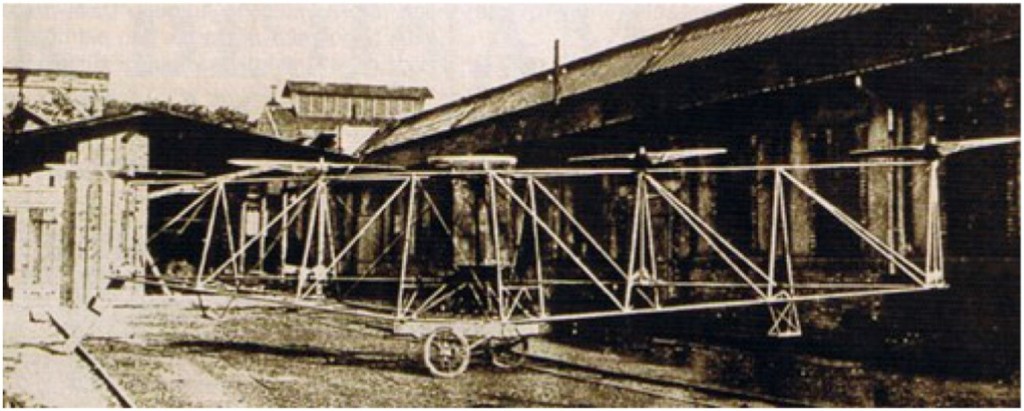
To achieve his goal, Petróczy, along with Oberleutnant Dr. Theodor von Kármán and Ingenieurleutnant Wilhelm Žurovec, conceived the Schraubenfesselflieger (S.F.F) mit Elektromotor (captive helicopter with electric motor). This machine is now commonly referred to as the Petróczy-Kármán-Žurovec 1 (PKZ 1) helicopter. Built in 1917 and primarily designed by von Kármán and Žurovec, the PKZ 1 consisted of a rectangular frame with an observation basket in the middle. On each side of the basket were two lift rotors. All four rotors were powered by a single 190 hp (142 kW) Austro-Daimler electric motor.
PKZ-1
The PKZ 1 was flight tested and was able to lift three men to a tethered height of 20 in (50 cm). However, the electric motor generated 50 hp (37 kW) less than anticipated, and on the fourth flight, the straining motor gave out. Because of the scarcity of high-grade electrical copper and quality insulation, Daimler was not able to repair the motor. In addition, the PKZ 2, which was originally known as the S.F.F. mit Benzinmotor (captive helicopter with petrol engine), was nearing completion. No further work was done on the PKZ 1.
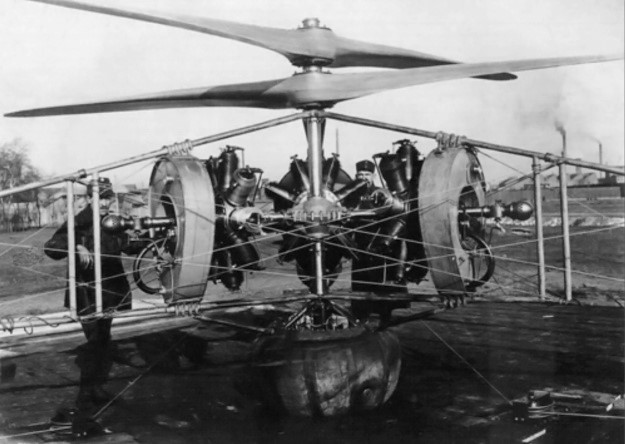
PKZ 2 rotary engine arrangement with the 100 hp (75 kW) Gnomes installed
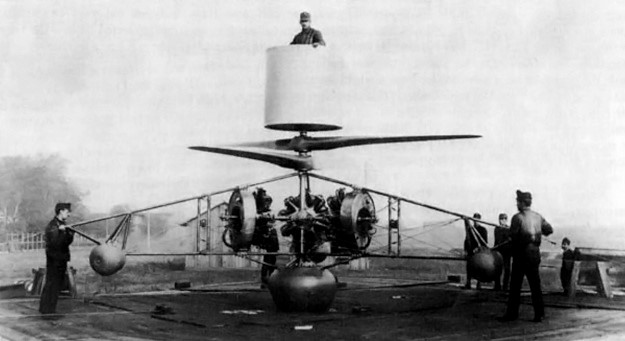
The PKZ 2 helicopter (for which he received German patent 347,578) was designed solely by Wilhelm Žurovec. The PKZ 2 was privately funded by the Hungarian Bank and the iron foundry / steel fabrication firm of Dr. Lipták & Co AG, who built the machine. The PKZ 2 utilized two two-blade contra-rotating rotors to cancel out torque and provide lift. The rotors, made of high-quality mahogany, were 19 ft 8 in (6.0 m) in diameter and were rotated at 600 rpm by three 100 hp (75 kW) Gnome rotary engines. A removable observation basket sat atop the rotors.
120 hp Oberusel powered
The craft had three outrigger legs; each supported one engine. All engines were connected to the rotors via a common gearbox. The PKZ 2 was supported by a central air cushion and three additional air cushions; one on each outrigger leg. These air cushions were filled by an air pump driven from the rotor drive. Attached to each outrigger was a tethering cable that was connected to the ground and controlled by an electric winch. With one hour of fuel, The PKZ 2 weighed 2,645 lb (1,200 kg).
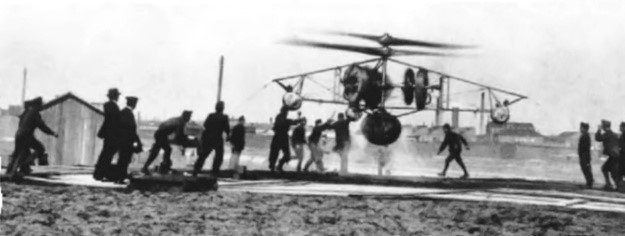
PKZ 2 shown just off the ground and without the observation basket on 5 April 1918, powered by the 100 hp (75 kW) Gnome engines.
Tethered and unmanned, the PKZ 2 was test flown on 2 April 1918. After several flights, including one that lasted about an hour, tests were suspended on 5 April because of insufficient power from the Gnome engines. The engines were replaced by 120 hp (89 kW) La Rhône engine (that were captured and rebuilt) and, with a few additional modifications, tethered and unmanned flight tests resumed on May 17th. With the new engines and calm winds, an altitude of 165 ft (50 m) was achieved, and the PKZ 2 could lift 330–440 lb (150–200 kg). The craft would lose lift at higher altitudes, but the PKZ 2 was kept under control as long as tension remained on the tethering cables.
PKZ 2 in a tethered high hover with power provided by the 120 hp (89 kW) La Rhône engines on 10 June 1918
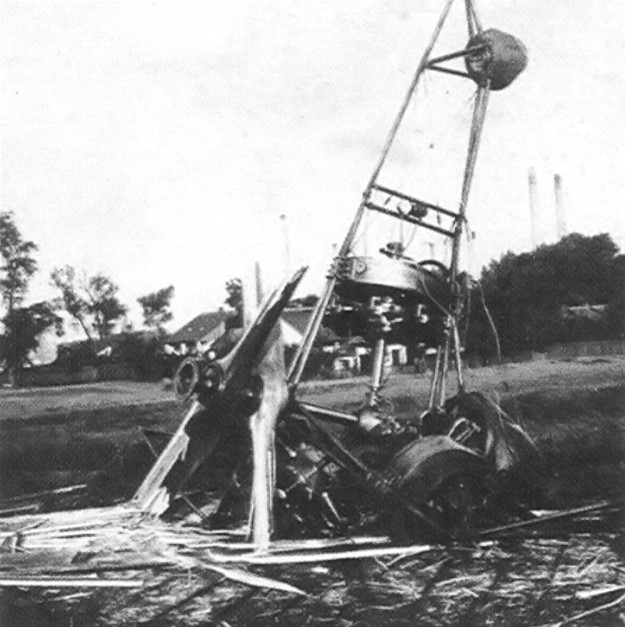
On 10 June 1918 the PKZ 2 was demonstrated for high ranking members of the military. A flight was made with the observation basket in place, but the engines were not running well and the craft became unstable. The basket was removed and another flight attempted. The wind had picked up, and as the PKZ 2 hovered at 40 ft (12 m) tethered to the ground, the craft began to rock. The overheating engines lost power, and the tether winch crew could no longer maintain control. The PKZ 2 crashed from a height of 6.5 ft (2.0 m), severely damaging the airframe and completely destroying the rotors.
Realizing the technical problems could not be overcome quickly, the government cancelled the project on 21 June 1918. However, Žurovec pressed on and began to design an individual cylinder water jacket to water-cool the rotary engines. The craft was being rebuilt to resume flight tests in November 1918 when the end of the war and revolution caused all development to cease. The PKZ 2 made over 15 tests flights, but it is doubtful any were manned.
Remains of the PKZ 2 after it crashed on 10 June 1918.
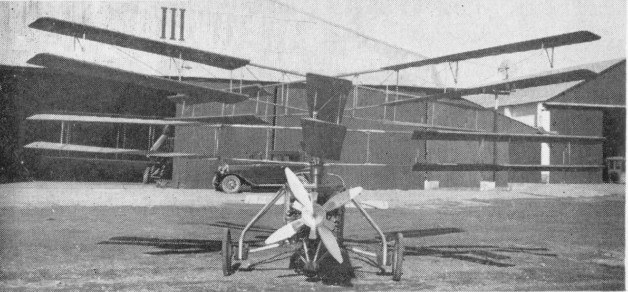
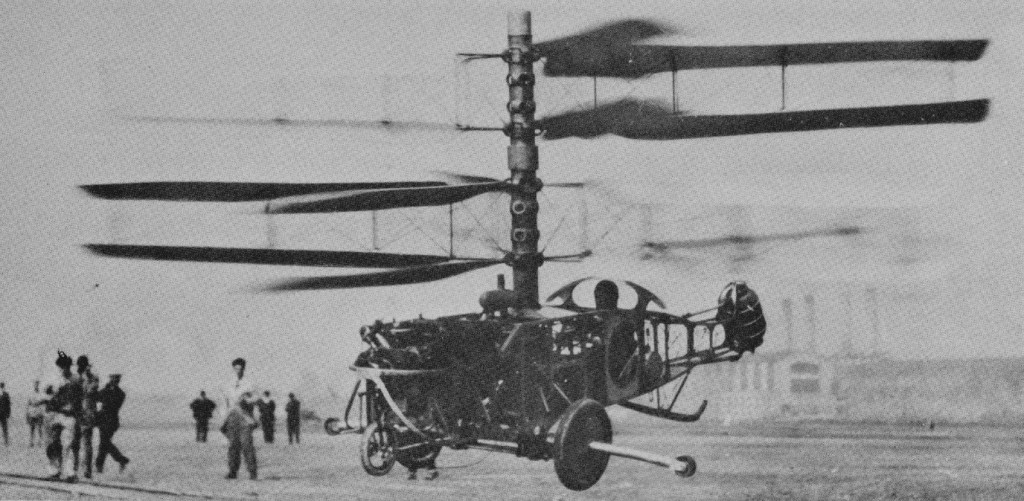
In 1919 the Marquis Raul Pateras de Pescara began trials with a series of helicopters leading to his 1924 biplane helicopter which had 16 rotorblades mounted co axially with both cyclic and collective pitch control. He flew it in France rather than his native Argentina, succeeding in directing its flight at a speed around 8 kph (13 mph) and 700 yards, making autorotative descents with the blades free¬wheeling.
2nd flight
The Pescara No.3 was flown backwards in 1924 on second flight. It later flew for 670 seconds.
By 1965 it was in reserve storage at the Musee de L’Air.
In 1923 Thomas O Perry / Chicago Helicopters Ltd built a two-place helicopter with coaxial counter-rotating rotors, collective pitch control. A novel approach to power-off descent was used—with a hand crank, the rotors could be moved to a position perpendicular to the direction of flight, transforming the helicopter into a sort-of biplane. A horizontal tail surface mounted on a boom was then used as elevator. A prototype was built by Plamondon Mfg Co of Chicago and flight-tested at Lombard IL. Results were not publicized but apparently were unsatisfactory.
In 1951, a Helicopter Division was formed by Hunting Percival and design work commenced on a medium-sized helicopter designated P.74.
The P.74 was intended as a demonstrator for a new type of helicopter. It worked on the tip-jet principle, but the P.74 had a gas generator under the cabin floor which fed compressed air through triple ducts to the three-bladed rotor, each blade of which had triple ejector ducts. The hot and noisy gas pipes running up the cabin walls between rows of seats. The rotor blades were not adjusted by actuators at the hubs as on most helicopters but by ailerons on the trailing edges. Pitch was controlled with a screw jack.
This machine had a teardrop-shaped fuselage with the two-seat cockpit in the nose and a large cabin running the full length of the fuselage. The P.74’s undercarriage consisted of four wheels, the forward two of which were castoring. There was no entrance door or escape hatch near the cockpit. The only way in or out was the door at the rear of the port side of the fuselage.
The prototype was completed in the spring of 1956, carrying the military serial number XK889. Months of testing in a static rig showed up many problems with the power system, which refused to develop full power and maximum gas flow. Finally these problems were fixed and a first flight attempted. Despite the efforts of two pilots on the very stiff controls, the P.74 resolutely refused to fly. One engineer associated with the project says that a consultant designer used the wrong formula for calculating lift. All the figures added up but the P.74 went nowhere. It was ordered to be towed across the airfield out of sight, and that is about the last anyone heard of it.
Plans to fit a more powerful Rolls-Royce RB.108 turbine engine (which should have got the P.74 into the air) were abandoned when the helicopter industry was rationalized. A proposed 10-passenger model called P.105 using the Oryx system was never built.
Hunting Percival P.74 Engines: 2 x Napier Oryx Rotor diameter: 16.77 m Max take-off weight: 3518 kh Cruising speed: 178 kph Ceiling: 8530 m Range: 530 km




 All Aero