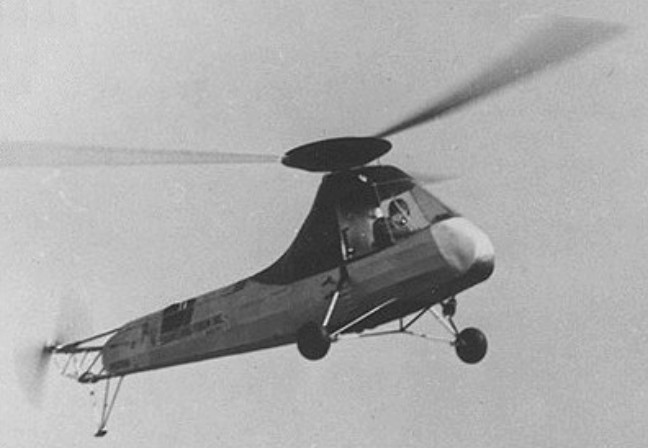
Built by the H B Picken Co in 1953, the Helicon was a two-place cabin helicopter. It featured a framework fuselage aft of the fabric-covered cabin.
Helicopters
Picken
H B Picken Co,
Hamilton OH.
USA
Built the Helicon helicopter in 1953.
Piasecki X-49A

The Piasecki X-49A conversion of a Sikorsky YSH-60F with a lifting wing and a ring tail rotor to test Vectored Thrust Ducted Propeller (VTDP) technology. Only one conversion was made.
Piasecki PA-97 Heli-Stat
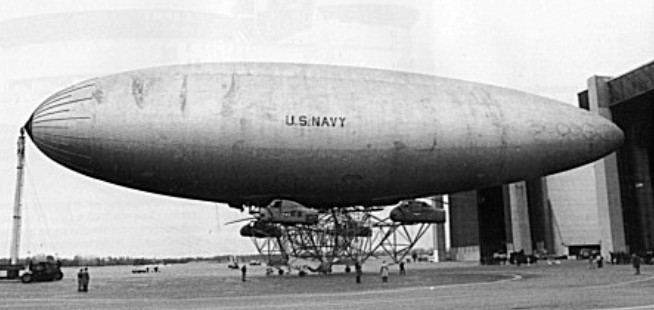
The Piasecki PA-97 Heli-Stat project began in the mid 1970s with a view to combining the lift capability of a lighter-than-air vehicle with the precise manoeuvrability of the helicopter, and following support from the US Forestry Service and the US Navy, construction of a prototype Heli-Stat began at Lakehurst, New Jersey, in 1979. The hybrid aircraft uses an airship-based envelope, attached via a skeletal structure to the front fuselage portions of four Sikorsky SH-34J helicopters, each powered by a standard Wright radial engine driving the conventional main rotor system and mounted at the four corners of the aircraft. The tail rotors are replaced by large diameter propellers to provide propulsion and full controllability.
At the beginning of 1984 it was expected that the Heli-Stat would fly in 1985, following a redesign of the structure which had failed under load tests. The following data is provisional
Richard Burke, 29.07.2008
I spent 7 years on this project starting first at the MAIN engineering facility drafting this monster along with 15 other people on Island Avenue in Philadelphia and later moved to Lakehurast during the structural pluck tests. I was there up until the ground manuvering tests where being performed. If you have any questions I can answer them I was over every single part of the airframe / Sh34J’s (Modified) and the aerostat (ZPG2 envelope). [The photo] was a roll out for a photo op dog and pony show note the lack of inverted v fins on the aerostat and the lack of pusher props on the helos also US Forrest Service was not painetd on the envelope yet . I am actually in this photo aft center stern of ship next to the guy with the bike, Joe O’Halleren
It was truly a combination of four SH-34 helicopters and a ZP-3 patrol blimp. It had B-52 landing gear and P-51 reduction gear boxes driving H-3 tail rotors as pusher props.
Piasecki Heli-Stat
Engines: 4 x Wright R-1820-84A, 1525shp
Overall width: 60.05m
Overall length: 74.07m
Empty weight: 24895kg
Gross weight: 50469kg
Maximum speed: 132km/h
Service ceiling: 3810m
Range: 3307km
Range with maximum payload: 80km
Piasecki 16H Pathfinder
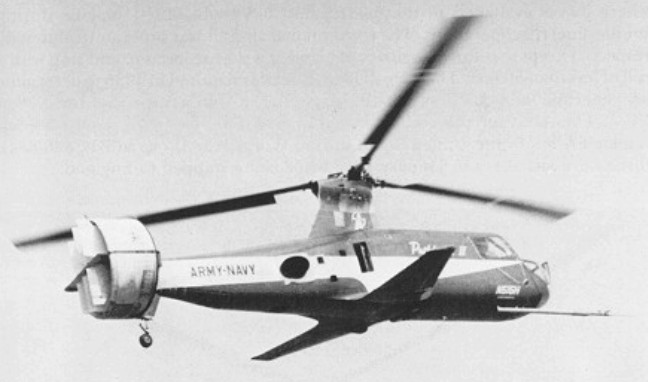
The Piasecki Aircraft Corporation has been engaged since the early 1960s on a series of compound helicopter research designs known by the name Pathfinder. The concept first took material form at the Model 16H-1 Pathfinder prototype (registration N616H). This aircraft was developed as a private venture and flew for the first time on 21 February 1962, undertaking this flight as a ‘pure’ helicopter without using the 3-blade ducted tail fan. No wings were fitted at that stage, the cabin was unfaired, and the retractable landing gear was fixed in the extended position. Small stub-wings, which could be folded, and a fully-enclosed cabin to accommodate a pilot and 4 passengers, were added later in the year. The Pathfinder also mounted a retractable landing gear.

Powered by a 550shp UACL PT6B-2 turboshaft engine, the Pathfinder had a l2.50m diameter 3-blade rotor, a fuselage length of 7.62m and a gross weight of 2,565kg. In all, it amassed a total of 185 flying hours, during which speeds of up to 273km/h were attained. Piasecki subsequently received a joint US Army/US Navy contract to develop a compound helicopter capable of providing data on flight by such aircraft at speeds of up to 370km/h. As part of this programme the original aircraft was redesigned to become the Model 16H-1A Pathfinder II, in which form it made its second ‘first’ flight on 15 November 1965. Modification work had begun in 1964, ground tests and tethered test ascents were carried out in in October 1965, and initial hovering trials were completed by the end of the year.
The principal design changes in the Pathfinder II were the enlargement of the fuselage, lengthened to accommodate 8 persons; the installation of a 1,250shp General Electric T58-GE-5 engine; and the adoption of a three-foot larger-diameter rotor at 13.4m, a new drive system and a new tail fan. The gross weight of the 1A model was 1037kg heavier than the first model. By May 1966 the Pathfinder II had flown some 40 hours, during which it had achieved level speeds of up to 361km/h (compared to 287 with the first version), had flown sideways at up to 55km/h and backwards at 52km/h, and had made 20 autorotative flights. For the final phase of the Army/Navy programme, in the summer of 1966, it was refitted with a 1,500shp T58-GE-5 engine, having new-design air intakes ahead of the wing leading edges, and received the new Model designation 16H-1C.
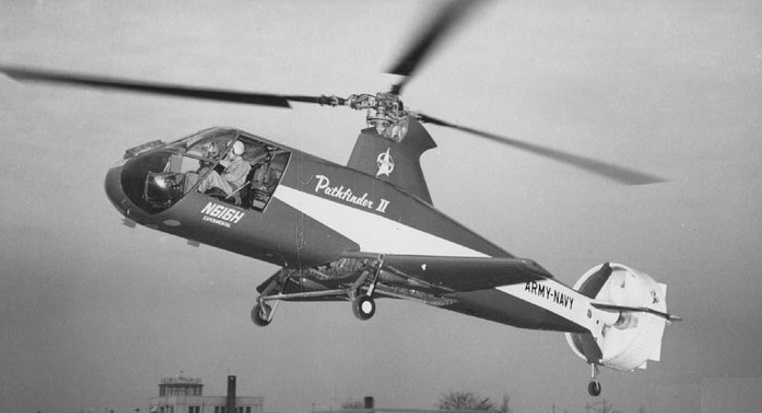
Joint Army-Navy sponsorship of the 16H-1A ended in late 1966, at which time the craft was returned to Piasecki for further company-funded research.
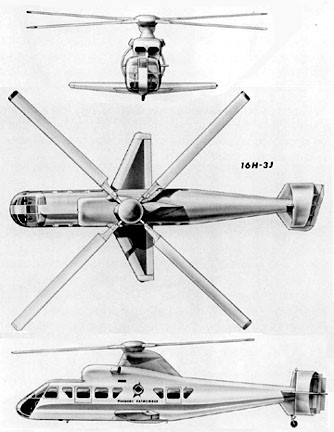
Piasecki announced several designs based upon the Pathfinder configuration, although up to 1972 none of these had been built. In 1968 it announced the Model 16H-3F Pathfinder III, a twin-turbine design using the 16H-1A fuselage with two T58-GE-10’S and 4-blade rotor and tail fan, for search and rescue, ASW and military utility applications.
The 16H-3H Heli-Plane project, for an 8-passenger executive transport with twin PT6 or TPE 331 engines, was superseded in 1969 by the 9/15-seat 16H-3J commercial transport project; this in turn was redesignated 16H-3K in 1971, following the proposal to install more powerful PT6B engines.
In 1972 Piasecki was reported to be working on a high-performance development of the original Pathfinder, designated 16H-1HT, to seat a pilot and 4 passengers. Intended to be powered by a 986shp Turbomeca Astazou XVI engine, it was planned to have a maximum speed of 325km/h and a range of 708km.
16H-1
Engine: 550hp P&W-Canada PT6B-2
Rotor diameter: 41’0″
Length: 25’0″
Useful load: 3089 lb
Max speed: 178 mph
Cruise: 172 mph
Range: 610 mi
Ceiling: 11,500′
Hover ceiling: 6,200′
Piasecki 16H-1A Pathfinfer II
Engine: 1 x General Electric T-58-GE-8 turboshaft, 1250 shp / 930kW
Main rotor diameter: 13.41m
Wingspan: 10.0m
Fuselage length: 11.35m
Max take-off weight: 4870kg
Empty weight: 2165kg
Max speed: 370km/h
Cruising speed: 280km/h
Service ceiling: 5700m
Range: 725-1530km
Crew+passengers: 2+6
Piasecki PD-22 / H-21 Shawnee / Workhorse / Vertol 42 / H-21 Shawnee

Developed from the US Navy’s HRP-2 Rescuer, the Piasecki PD-22 tandem-rotor helicopter prototype (US Air Force designation XH-21) was first flown on 11 April 1952 with Len LaVassar and Marty Johnson at the controls.
Piasecki PD-22 / H-21 Shawnee Article
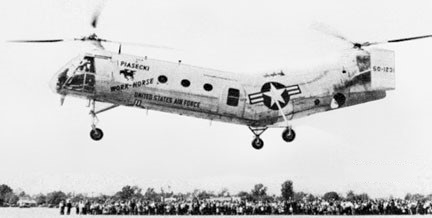
Winner of a USAF competition for an arctic transport helicopter, the new craft looked almost like the HRP-2, but weighed 6630kg fully loaded, more than twice the earlier machine. A 1425hp Wright R-1820 engine (derated in early models to 1150hp) and a 0.9m increase in rotor diameter to 13.4m gave it much better performance than the HRP-2. The H-21 used the single engine with tandem three-blade rotors. Structurally, it was a new aircraft. (TC 1H12, 1H16, H1AL, H3EA, H8WE, H9EA, HR35).
The Work Horse could carry fourteen fully equipped troops or an equivalent weight of cargo. Features included a rescue hoist and inflatable donut-shaped floats around its wheels for landings even on marshy tundra. Winterized to support Distant Early Warning (DEW) Line radar stations far to the north, extensive cold-weather testing was performed atop Mount Washington, the highest peak in New Hampshire’s White Mountains, as well as in the climate hangar at Eglin Air Force Base.
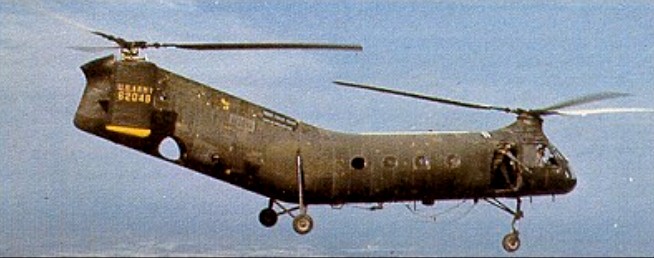
Eighteen Model PD-22 / YH-21 helicopters had been ordered in 1949 for USAF evaluation, these being followed by an initial production batch of 32 H-21A helicopters, named Workhorse in USAF service. For use by the Military Air Transport Service Air Rescue Service, the H-21As were each powered by a derated 932kW Wright R-1820-103 engine; the first flew in October 1953. Six more were built to USAF contract but supplied to Canada under the Military Assistance Program. Vertol produced in 1957 a small number of Vertol Model 42A, exclusively Canadian civil conversion of RCAF H-21B helicopters used to supply stations of the mid-Canada radar chain.
The second production variant was the H-21B, which used the full power of the 1063kW R-1820-103 to cover an increase in maximum take-off weight from 5216kg to 6804kg. The Air Force eventually purchased 163, mainly for Troop Carrier Command, and these had autopilots, could carry external auxiliary fuel tanks, and were provided with some protective armour. They could carry 20 troops in the assault role.
The Army became aware of the H-21’s potential as a medium utility helicopter soon after the type’s maiden flight, and in 1952 awarded Piasecki a contract for the production of the H-21C variant. This aircraft retained the H-21B’s extensive armor plating and ability to carry two external fuel tanks, but had such additional features as increased troop capacity and a 4000-pound capacity belly sling hook. The Army procured 334 H-21C Shawnees, with deliveries beginning in August 1954. In addition, the Army obtained at least sixteen H-21B aircraft from the USAF; the majority of these machines were ultimately brought up to H-21C standard, and all were known as Shawnees despite their origins as Work Horses. The B and C variants of the H-21 were used in Vietnam, equipped with 12.7 or 7.62mm light machine guns which were fired through the cabin doors.
While the Navy’s helicopters had a 600hp Pratt & Whitney R-1340 engine, those for the Army had a Wright R-1820. Thirty-three of the H-21A were assigned to SAR units in the Arctic and another five were sent to Canada. Foreign operators of the H-21 included the German Army (26), French Army (98), French Navy (10), Japanese armed forces (10) and Swedish Navy (11).
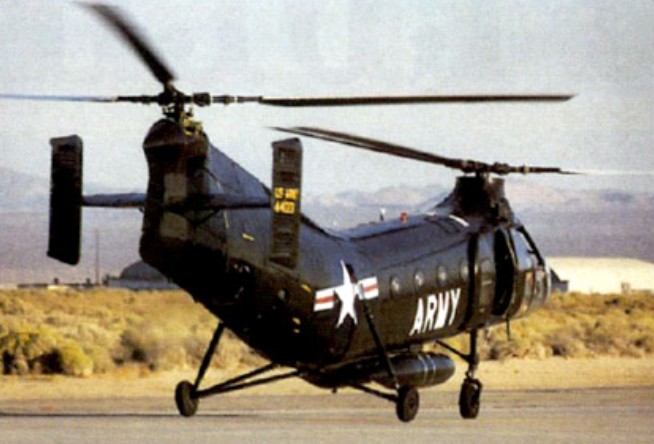
The US Army’s equivalent was the H-21C Shawnee, of which 334 were built. This total included 98 for the French army, 10 for the French navy and six for Canada; 32 Shawnees were supplied to West Germany, serving with the army’s Heeresfliegerbataillon 300. The first deliveries to the Army were in September 1954 with production continuing until March 1959. The H-21C, redesignated CH-21C in July 1962, had an underfuselage sling hook for loads of up to 1814kg. Production deliveries were made between September 1954 and March 1959, later helicopters acquiring the company designation Model 43 when the Piasecki Helicopter Corporation became the Vertol Aircraft Corporation in 1956. The H-21 A and H-21B retrospectively became the Model 42. In 1962 the H-21B and H-21C were redesignated as, respectively, the CH-21B and CH-21C.
Two turboshaft conversions of H-21C airframes were the Model 71 (H-21D), with two General Electric T58 engines first flown in September 1957, and the Model 105 which had two Avco Lycoming T53s in 1958. The variant was not adopted for production. From the latter was designed the Vertol 107 (Boeing Vertol H-46 series).
Most Shawnees were withdrawn from the active inventory by 1965.

It set a closed-course distance record of 1,199 miles in Aug 1957 with extra fuel tank. It was a Shawnee dubbed ‘Amblin’ Annie that made the first non-stop helicopter flight from one coast of the United States to the other, being refuelled in flight from a U-1A Otter in Aug 1957. More significantly, the H-21 was the first American military helicopter type to be deployed in appreciable numbers to South Vietnam: the first four Shawnee units arrived in that country between December 1961 and September 1962. The H-21 also gained the dubious distinction of being the aircraft in which America’s first Vietnam casualties were killed; four Army aviators died in July 1962 when their Shawnee was shot down near the Laotian-Vietnamese border.
“I was working as a helicopter mechanic with the U.S. Army Aviation Service Test Board in 1954 and 1955 and we received some of the first production H-21Cs for operational testing; I was assigned to serial number 51-15888, tail number 115888, the eighth built, and I recall us having 115881 also which I believe was the one we picked up at Edwards AFB in 1955. The Air Force did all engineering flight testing for the Army and when they completed tests on the H-21C version (in preparation for their USAF H-21B version ordered after the “C”), a small group of us from the Fort Rucker Test Board went to Edwards to take over the ship and perform some high altitude and desert tests before flying back to Rucker. Arriving at Edwards, complete with papers and “secret” clearances, we promptly discovered that the USAF’s Army H-21C was in terrible condition and unairworthy. Much to their dislike and consternation, we hung around the air base for several days while we performed an inspection and changed the Wright 1820 engine – the desert flying had eaten up the cylinders and bearings to the point that the 19-gallon oil tank wouldn’t sustain a single flight! Needless to say, there was some exciting experimental jet activity going on at Edwards at that time and we GIs were in no hurry to leave as we had a front line seat on the test ramp. We spent a few weeks at an Apple Valley dude ranch, parking the helicopter in the desert, and refueling at George AFB. Each day we flew several sorties into the White Bear region and did a few exciting running takeoffs at White Bear Lake. We made an uneventful (mostly), but rather warm and humid, flight back to Rucker, taking a pretty straight course from San Antonio across Texas, Louisiana, Mississippi and into Alabama. A late evening thunderstorm threw us off course during a night flight leg and we made an “off-airport” landing in a drenched high school football stadium in Mississippi (still lit up following a game); the locals fed us and I wound up spending the night RON in a friendly funeral parlor. One of the Board’s test H-21s made the first non-stop flight across the U.S. in August, 1956; it took 37 hours and refueling by a fixed wing”.

1955 commercial developments of the H-21 included models 42, 43, 44, 63, and 71.
YH-21 / PD-22
Engine: 1150hp Wright R-1820-103
Rotors: 44’6″
Length: 86’4″
Max speed: 131 mph
Cruise: 110 mph
Ceiling: 15,000′
Capacity: 14 fully-equipped troops
H-21 Shawnee / CH-21/UH-21
Engine: Wright R-1820-103, 1425hp
Rotor diameter: 44’0″
Length: 52’7″
Useful load: 4500 lb
Max speed: 130 mph
Cruise speed: 98 mph
Range: 265-400 mi
Ceiling: 9,4500 ft
Passenger capacity: 20
H-21A
Engine: 1150hp Wright R-1820-103
Medevac capacity: 12 litter patients
H-21B Work Horse
1957
Engine: 1425hp Wright R-1820-107
Capacity: 20 troops or 12 litters
H-21C
1957
US Army version
H-21D
1957
Engines: 2 x GE T58 gas turbines
First flight: September 1957
Vertol 42A
1954
Length : 52.165 ft / 15.9 m
Height : 15.354 ft / 4.68 m
Rotor diameter : 44.029 ft / 13.42 m
Max. speed : 110 kt / 204 km/h
Service ceiling : 10335 ft / 3150 m

Piasecki PV-14 / PV-18 / HUP Retriever / UH-25
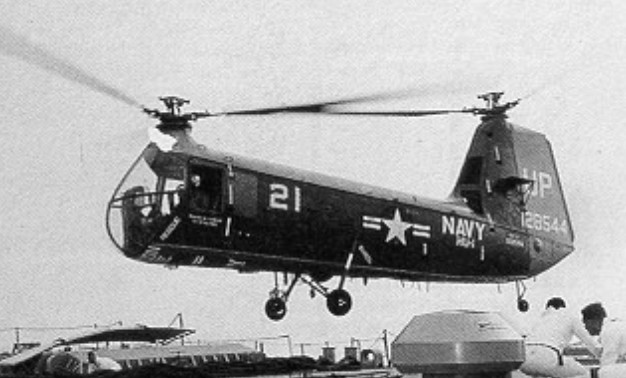
Piasecki set to work on a specification, issued by the US Navy Bureau of Aeronautics in 1945, for a shipboard helicopter to be used on aircraft carriers and larger vessels for SAR, liaison, replenishment and plane guard duties.
Designated PV-14 (XHJP-1 by the US Navy), two XHJP-1 prototypes (37976 and ’77) were completed for US navy evaluation and three pre-production aircraft, the HUP-1, were ordered in 1948. From 1950-52 a further twenty-two HUP-1 Retrievers (PV-18) were delivered to the U.S. Navy. They differed little from the original XHJP-1, the major apparent change being the addition of inward-sloping endplate fins to the horizontal stabilisers below the rear rotor head. Both sets of 3-blade rotors could be folded for shipboard stowage and the HUP-1, powered by a single 391kW / 525hp Continental R-975-34 piston engine, could accommodate 4-5 passengers or 3 casualty litters in addition to the 2-man crew. The power-plant was installed at the center of the fuselage, which had a steel tube framework with particularly strong, fixed tricycle landing gear. The fin of the HUP-1 was subsequently eliminated, as further improved versions were fitted with an autopilot. The US Navy versions had all-weather instrumentation and some were equipped with sonar for antisubmarine warfare.
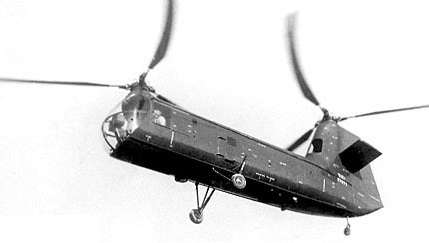
The HUP-1 had a smaller, more compact fuselage than its predecessors. This enabled the helicopter to be stowed without having to fold back the rotor blades. Once acceptance trials were over, the US Navy ordered 32 aircraft including 124588/124594, 124915/124929, 126706/126715, followed by another 165 of the HUP-2, which was fitted with a more powerful engine. The first squadron, HU-2, took delivery of its initial aircraft in February 1951.
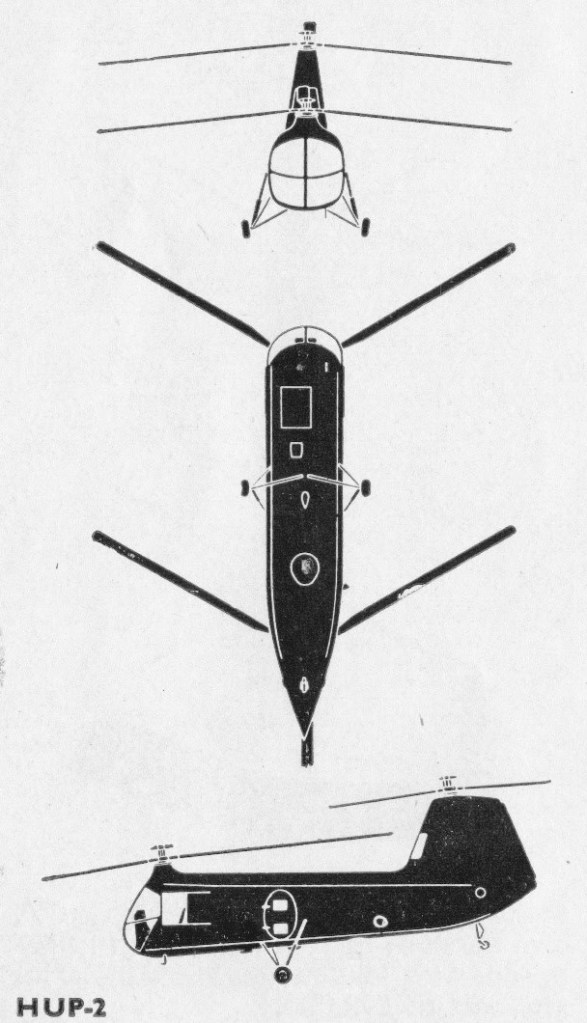
Successful tests with a Sperry autopilot in the XHJP-1 enabled the HUP-2, to be built without tail surfaces and the more powerful 410kW Continental R-975-46 was installed in this and all subsequent production models. Another feature of the Retriever was a large rectangular rescue hatch offset to starboard in the floor of the front fuselage, through which a winch inside the cabin could lift weights of up to 181kg / 400 lb at a time. The U.S. Navy machines included some completed as HUP-2S submarine-hunting aircraft with dunking sonar equipment. Another HUP-2 was given a sealed, watertight hull and outrigged twin floats for waterborne tests, presumably as part of the development programme for the Boeing-Vertol 107 / CH-46 helicopter.

The Marines also used 13 HUP-2, while the Army acquired 70, designated H-25A (serials 51-16572 to -16641) powered by the R-975-46A engine, 50 of which were later transferred to the Navy as HUP-3s, three serving with the Royal Canadian Navy’s Squadron VH-21. One H-25A went to the USN as the HUP-3 prototype; 51-16641=149088.
339 HUP-2 were built (128479/128600, 129418/129522, 129978/130085, 134434/134437), of which some with radar as HUP-2S for anti-sub warfare. Redesignated as UH-25B in 1962.
The first H-25A entering regular Army service in early 1953. Those Army Mules that remained in Army service were used mainly as training or medical evacuation aircraft, and the type was totally withdrawn from Army service by 1958.
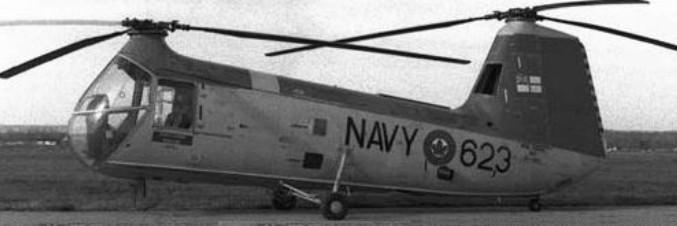
The Army H-25 Mule was basically similar in general layout to the HUP-2, sharing that aircraft’s all-metal fuselage, fixed three-point landing gear, and 550hp Continental R-975-42 engine. The H-25A differed from the Navy variant primarily in having hydraulically-boosted controls, a strengthened floor with cargo tie-down fittings, and modified doors intended to ease the loading and unloading of stretchers.
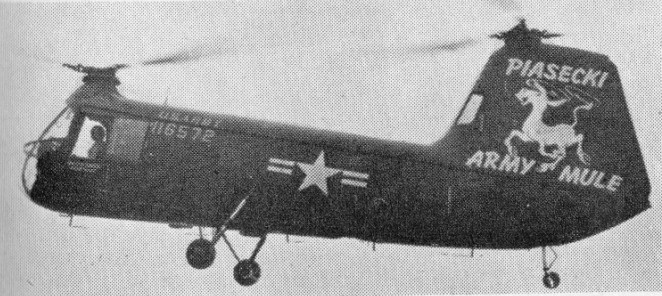
In 1951 the U.S. Army ordered a version of the HUP-2 with a reinforced cabin floor and hydraulically boosted controls, for general support and evacuation work. Seventy of these were delivered as H-25A Army Mule from 1953, as were fifty similar Naval HUP-3’s (including three for the Royal Canadian Navy) for ambulance and light cargo duties. Production of the three hundred and thirty-ninth and last aircraft was completed in July 1954. Shortly after this a proposal was made to boost the speed, range and payload of all H-25/HUP aircraft still in service by refitting them with 700hp Wright R-1300-3 engines. However, this did not take place and by the time the new tri-service designation system was introduced in July 1962 only the HUP-2 and HUP-3 remained in service; these became the UH-25B and UH-25C respectively. Neither type is now in U.S. front-line service, and the French and Canadian HUP types were withdrawn from service in 1966.
The 50 HUP-3 built were 147582/147630 and 149088], redesignated as UH-25C in 1962. The last one was former Army H-25A 51-16641.
The HUP-4 has the 800-h:p. Wright R-1300-3 engine, and earlier versions could be modified to that standard.
An amphibious conversion of the HUP-2 was used for research by the Edo corporation in New York. It had a reinforced hull-type lower fuselage, all-metal outrigger floats and a new engine cooling system.

H-25A Army Mule
Engine: 550 hp Continental R975-42
Rotor dia: 35 ft
Length: 56’11”
Weight: 5,750 lb
Max. Speed: over 103 mph
Range: 340 mi
Seats: 6
HUP-1
Engine: 525 h.p. Continental R-975-34
Rotor diameter: 35 ft.
Rotors: 2 x 3-blade main rotors in tandem
Fuselage length: 32 ft
Loaded weight: 5,750 lb
Max speed: Over 103 mph
Ceiling: Over 10,000 ft
Typical range: 395 miles at 80 mph
Seats: 6.
HUP-2
Engine: 550 h.p. Continental R-975-46
Rotor diameter: 35 ft.
Rotors: 2 x 3-blade main rotors in tandem
Fuselage length: 32 ft
Loaded weight: 5,750 lb
Max speed: Over 103 mph
Ceiling: Over 10,000 ft
Typical range: 395 miles at 80 mph
Seats: 6.
HUP-3
Engines: 1 x 550 hp Continental R-975-42, 410kW
Speed: Max: 170 km/h
Range: Max 550 km
Weight: Empty: 1780 kg
Max weight: 2770 kg
Rotor diameter: 10.67 m
Length rotors turning: 17.35 m
Height: 3.80 m
Disc Area: 179 sq.m
Service ceiling: 3050m
Height: 3.80 m
Disc Area: 179 sq.m
Service ceiling: 3050m
HUP-4
Engine: 800h.p.Wright R-1300-3
Rotor diameter: 35 ft.
Rotors: 2 x 3-blade main rotors in tandem
Fuselage length: 32 ft
Loaded weight: 5,750 lb
Max speed: Over 103 mph
Ceiling: Over 10,000 ft
Typical range: 395 miles at 80 mph
Seats: 6.
Piasecki PV-15 / H-16 / H-27 / Vertol H-16
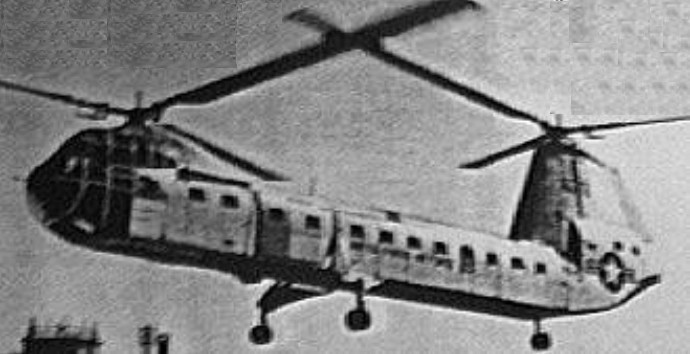
A USAF requirement for a wide-ranging helicopter capable of rescuing downed strategic bomber crews had given rise to the new helicopter. The hefty fuel capacity required to meet its specified 2250km range in part dictated its size. Without the extra fuel, the capacious aircraft also had possible military application as a large troop and cargo transport. In 1946 the Army Air Forces awarded Piasecki Aircraft a contract for the development of a tandem rotor helicopter intended for use in the long-range search and rescue (SAR) role. The resultant Piasecki Model PV-15 was originally given the military designation XR-16 (R denoting rotorcraft under the World War II system), though this was changed to XH-16 in June 1948. The Air Force placed an order for two service test and evaluation aircraft in June 1949, and subsequently allocated the serial numbers 50-1269 and -1270 for these machines.
Piasecki PV-15 Transporter Article
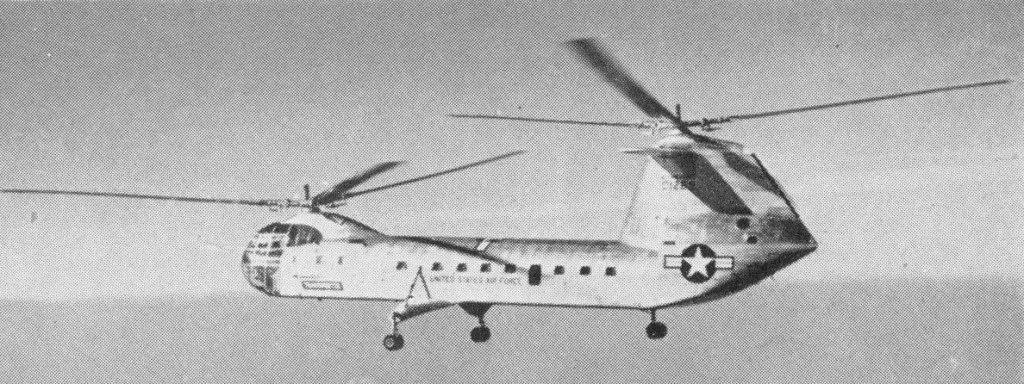
At the time of its inception the H-16 was the largest helicopter in the world. Though originally intended for the SAR role the Transporter, as the H-16 was ultimately named, evolved during the design process into a heavy-lift craft equipped with a tail loading ramp and optimized for troop and cargo transport. In this role the aircraft could carry up to forty troops or three light trucks within its fuselage, the interior of which was kept clear of obstructions by mounting the engines and all dynamic components in the upper fuselage. The H-16 was also capable of transporting large exterior cargo pods, and was equipped with variable-height landing gear legs in order to accommodate pods of varying sizes.

It had tandem three-blade rotors, and two engines, one at the front and the other in the rear of the fuselage. The rear engine drove the rotor at the top of a tail pylon nearly 4m high. The helicopter had a horizontal stabilizer, to which vertical control surfaces were later added in order to overcome problems of directional stability during fast flight. It weighed 14 tonnes on take-off with two pilots and 40 equipped infantry on board.
It was 23.8m long and topped by two overlapping rotors each 25m in diameter. In-flight vibration was low and of a loping nature. Bonded and tapered all-metal rotor blades (built using a new company process) combined milled-aluminum skins, aluminum honeycomb filler, and a leading-edge balance weight that also served as a mechanical fastener for the skins.
These capabilities appealed to the U.S. Army, which saw in the H-16 an answer to several helicopter mission requirements of its own. It therefore joined the USAF in sponsoring further development of the YH-16.
The first Transporter (serial 50-1269) was powered by two 1650hp Pratt & Whitney piston engines and made its first flight on 23 October 1953 at Philadelphia International Airport, designated YH-16. Company personnel and military officials watched the helicopter take off, hover, and fly forward and sideways during a successful twelve-minute maiden hop flown by Harold Peterson and Phil Camerano.
The Air Force ultimately decided against procuring the H-16 for operational use, and in 1955 the YH-16 was turned over to the Army for evaluation. The Army found the piston-driven Transporter to be underpowered and therefore awarded the reorganized Vertol company a contract for the machine’s conversion to turbine power.
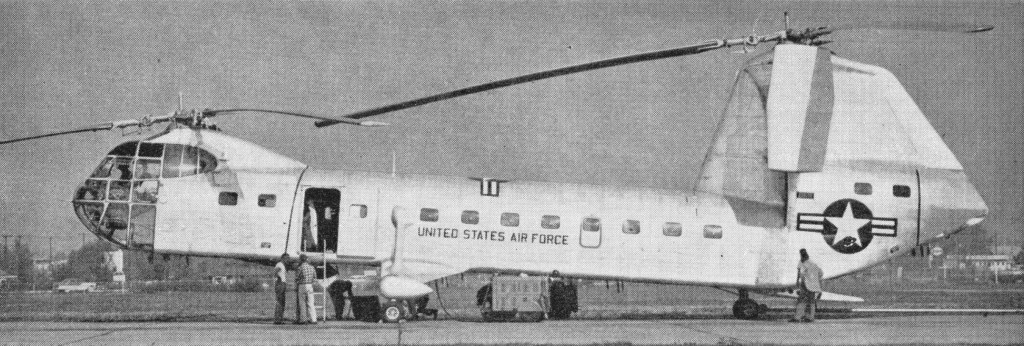
During construction the second prototype (50-1270) was modified to Model PV-45 (first designated H-27 and then H-16A) standard through the replacement of its piston engines with two 1800shp Allison T38-A-6 turboshafts, and modified to carry up to fifty troops, and redesignated YH-16B. The change in powerplants and inclusion of various structural modifications prompted a redesignation to XH-27 in October 1952, though this was changed to YH-16A prior to the aircraft’s first flight in July 1955 with Harold Peterson and George Callaghan at the controls. This aircraft set an unofficial world record of 270km/h in 1956. Both H-16 variants were at times fitted with varying types of experimental horizontal tail surfaces, one of which incorporated large end-plate rudders, but none of these designs were adopted for permanent use.
Despite improvements the type was ultimately judged to be unsuited to sustained operations under field conditions, and the Army terminated the H-16 test programme in mid-1956.

In December, the YH-16A broke apart in the air and crashed near the Delaware River, killing Peterson and Callaghan as they returned from a test flight in New Jersey. Investigators determined that the rear rotor shaft had failed, allowing the blades to desynchronize and wobble into the plane of those of the forward rotor. In fact, a frozen bearing in the test instrumentation had precipitated this failure by allowing a steel-tube standpipe, placed within the aluminum rotor shaft to guide wires from the instrumented blades, to undetectably inscribe a deepening groove within the shaft.
This accident caused the H-16 program to be scrapped, preempting the sixty-nine-passenger YH-16B Turbotransporter (a conversion of the YH-16 then in progress), which would have flown with two 3700shp Allison T56 engines. It also preempted Frank Piasecki’s vision of interchangeable under-body pods for the rapid transport of differing loads such as field operating rooms, communications centers, and mobile repair centers. A tall stilt landing gear had already been designed to let the YH-16B accommodate such pods.

XR-16 / YH-16
Engines: two 1,650 h.p. Pratt & Whitney R2180-11
Rotors: 2 x 3-blade main rotors in tandem.
Rotor diameter: 25m / 85 ft
Fuselage length: 23.8m / 78 ft
Loaded weight: Over 30,000 lb
Useful load: 15,615 lb
Max speed: Over 130 mph
Range: 210 mi
Ceiling: 18,000′
Capacity: 32 stretchers, 3 jeeps or 40 troops.
No built: 1, 50-1269
YH-16A
Engine: 2 x Allison YT-38A-10 turboshaft, 1800 / 1340kW
Rotor diameter: 24.99m
Length: 23.65m
Height: 7.62m
Max take-off weight: 15244kg
Empty weight: 10218kg
Max speed: 235km/h
Hovering ceiling, IGE: 4800m
Service ceiling: 6980m
Range: 2300km
XH-27
Engines: 2 x 1800hp Allison YT38-A-10 turboshafts
Useful load: 20,250 lb
Range: 216 mi
Ceiling: 15,600 ft
Capacity: 49
No built: 1, 50-1270
YH-16B
Engines: 2 x 2100hp Allison T56-A-5
No converted: 1, 50-1270

Piasecki PV-3 / HRP / PV-17

On 1 February 1944 Piasecki received a contract to develop a tandem-rotor utility transport and rescue aircraft for the U.S. Navy.
Given the factory designation PV-3, this machine was a development aircraft for the US Navy’s HRP Rescuer transport and rescue helicopter. Powered by a Wright R-975 piston engine, the tandem-rotor PV-3 first flew at Morton, Pennsylvania on 7 March 1945. The first of its kind, initially flew as a bare metal frame and was covered later. It was followed by two XHRP-1airframes, 37968 and 37969, one of which was used for static tests while the other undertook the U.S. Navy flight development programme, during the course of which the company changed its name to Piasecki Helicopter Corporation.
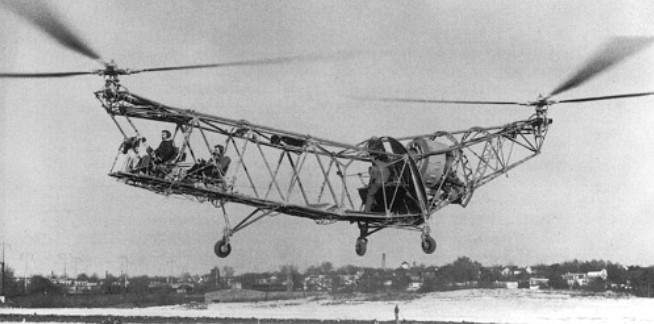
In June 1946 Piasecki received an initial order for 10 production HRP-1 helicopters. The test programme was completed in the spring of 1947, by which time work had already begun on an initial batch of ten HRP-1 Rescuers, 111809 to 111828. The first of these flew on 15 August 1947, powered by a 447kW / 600hp Pratt & Whitney R-1340-AN-1 engine
A second batch of ten was built later, 111834 to 111848, the final machine being delivered in 1949, with a metal-skinned rear fuselage and fabric covering over the main cabin section, although they were often flown with the fabric removed.
Service evaluation was undertaken by US Navy Squadron VX-3 and US Marine Corps Squadron HMX-1. Twelve of the HRP-1’s were eventually assigned to the U.S. Marine Corps for assault training, while three others, as HRP-1G’s, were used as rescue craft by the U.S. Coast Guard. After withdrawal of the Rescuer from military service in the early 1950s, about six appeared on the U.S. civil register.
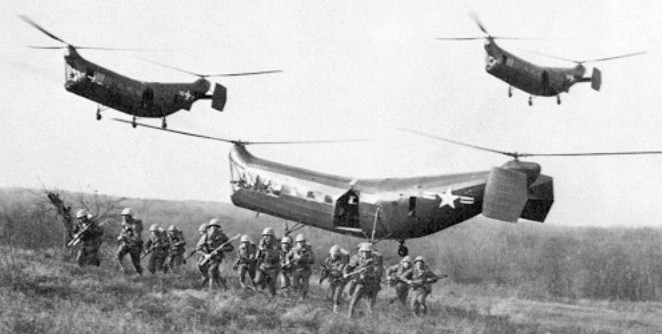
The HRP-1 (redesignated as PV-3) carried a crew of 2 sitting in tandem, and its 11.33cu.m cabin could accommodate 8 passengers, 907kg of cargo or 6 stretchers. The single engine was mounted in the rear part of the fuselage, with a clutch and gearbox amidships from which drive shafts ran to reduction gearboxes below each of the rotor hubs.
In June 1948 the U.S. Navy ordered five examples, 111829 to 111833, of the much-developed PV-17 with the designation HRP-2. The much-improved HRP-2 (PD-17) featured a streamlined metal fuselage offering better visibility for two pilots, who now sat side by side ahead of the front rotor. The most significant improvement was the HRP-2’s all-metal stressed-skin construction, and modified rotor heads. The length was 54’9″.
It used the same engine and rotors as the HRP-1, but was slightly shorter and lighter. The Piasecki team used a thinner skin and had the longitudinal members shaved down, as well as other extruded parts that could not be manufactured thinly enough. Produced by Boeing-Vertol in 1948.
Jim Ryan lifted the new Navy helicopter into the air for the first time October 29, 1949. While it was indeed better than the HRP-1, the fast pace of helicopter technology had already passed it by, and better helicopters could now be built. With a gross weight of 3260kg, the HRP-2 was simply too light to offer much utility and only five were built.
The HRP-2 formed the basis of the later PD-22 model which became the military Vertol H-21 series.
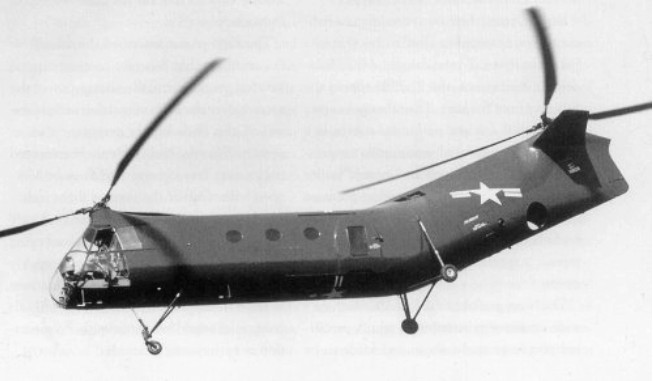
Robert Cummings, 23.02.2009
As a U.S.Navy pilot I was stationed in VX-1 at Key West. We had 12 of the HRP-1s and developed the dunking sonar for helicopters. Lt. Lockwood and I were later assigned to a project at Mine Counter-Measures station at Panama City, Florida where we developed towing mine sweeping gear with an HRP-1. George Spratt from Piasecki was the head engineer on that project. The time period for these projects was 1951 to 1953.
HRP / PV-3
Engine: 600hp P&W R-1340
Rotors: 41’0″
Length: 48’0″;
Capacity: 12 passenger
HRP-1 / PV-14
Engine: 1 x Pratt & Whitney R-1340-AN-1, 600 hp / 445kW
Rotors: 2 x 3-blade main rotors in tandem
Rotor diameter: 12.50m / 41 ft
Fuselage length: 14.63m / 47 ft 2 in
Height: 3.81m
Take-off weight: 3629kg / 6,900 lb
Max speed: 193km/h
Service ceiling: 3658m / 12,000 ft
Normal range: 483km
Typical range: 264 miles at 85 mph with 100 USgals fuel
Seats: 10
HRP-2 / PV-17
Engine: 1 x Pratt & Whitney R-1340, 600 hp
Seats: 10
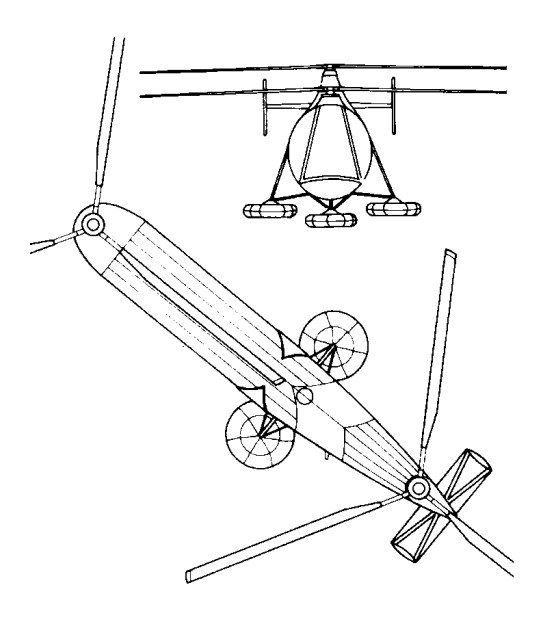
Piasecki PV-2
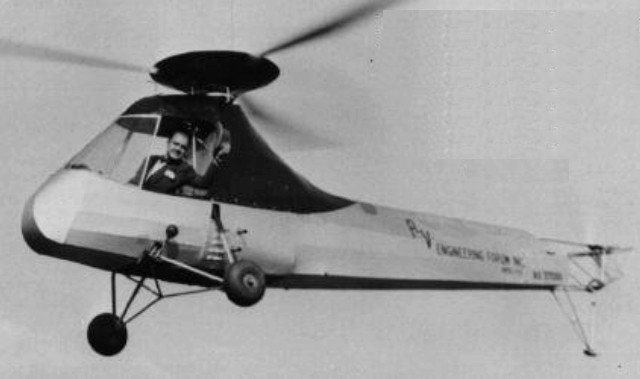
The PV.1 was an advanced design for its day with a tube and fabric fuselage and a tail-mounted anti-torque system involving an enclosed fan in the rear fuselage. This design did not fly but the single-seat PV.2 which took to the air in April 1943 was very similar – but with a conventional tail-mounted anti torque propeller. It was probably the first truly rigid rotor helicopter ever to fly.
There is room for one person (pilot), who sits in a conventional seat behind a rounded, glassed-in nose, similar to the front end of an early Aeronca light plane. The fuselage is fabric-covered. There are three blades. Two blades fold back like the wings on a fly to permit storage. Control of the PV-model has cyclic pitch control of its rotor blades. There is the conventional rudder-stick combination, rudder action manipulating a five-foot tail rotor similar to the vertical rotor on the XR-4. The PV-2 helicopter is powered with a four-cylinder, air-cooled Franklin engine, mounted with its crankshaft upright.
Piasecki himself was the pilot for the first flight, made on 11 April 1943. He flew the aircraft several times in public. Once he took off from the driveway of a private home in Falls Church, Virginia, and flew a short distance to a filling station, where he landed and spent an a ration stamp for three gallons of gasoline. The surprised attendant put in the gas, wiped off the helicopter’s windshield, and Piasecki took off again, heading for the golf course. A few minutes later he landed right beside the first tee, took his golf clubs out of the small baggage compartment, and proceeded to tee off for a game of golf.
It was then dropped because Piasecki turned his attention to the more ambitious field of large military helicopters; with the PV-3, he returned to the twin-rotor formula which had given rise to his earlier experiment.
Engine: 1 x 4-cylinder Franklin, 67kW / 90 hp
Main rotor diameter: 7.62m
Length blades folded: 6.7m
Height: 2.3 m
Width: 2.4 m
Take-off weight: 450kg
Empty weight: 340kg
Max speed: 160km/h
Cruising speed: 135km/h
Range: 240km
Endurance: 2hr
Crew: 1
 All Aero