William J Purvis, Charles A Wilson
Goodland KS.
USA
Circa 1910 built a helicopter
William J Purvis, Charles A Wilson
Goodland KS.
USA
Circa 1910 built a helicopter
A 1929 single-place experimental plane with a Flettner Rotor Wing. A 300hp Wright J-6 Whirlwind driving a propeller in front, and 85hp American Cirrus (ACE) to spin the rotors.
Registered N921V.
NY.
USA
Built the Plymouth A-A-2004 rotorwing in 1929.
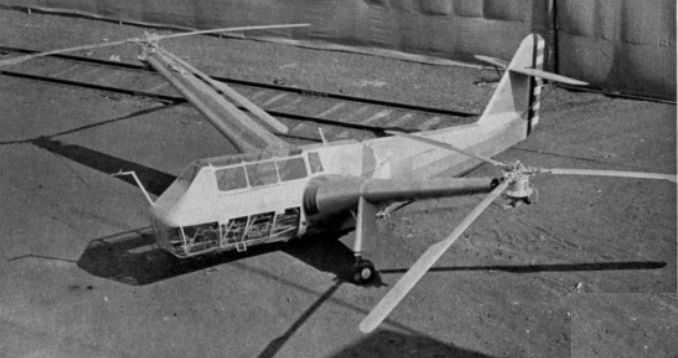
In July 1940 the Platt-LePage Aircraft Co. won the competition to build a helicopter designated XR-1.
The first flight of the XR-1 took place in May 12 1941, a number of teething problems developed with the control system, causing delays in progress, along with test pilot Lou Leavitt refusing to fly the XR-1 in forward flight.
In June of 1943 Col. H.F. Gregory took the XR-1 up and proceeded to fly the XR-1 at speeds of up to 100 miles per hour, and completed the first close course flight of the XR-1. By the summer of 1943 the XR-1 was flying with much better control, when on July 4, 1943 the XR-1 was damaged in a crack up due to the loss of a rotor blade, further slowing testing.
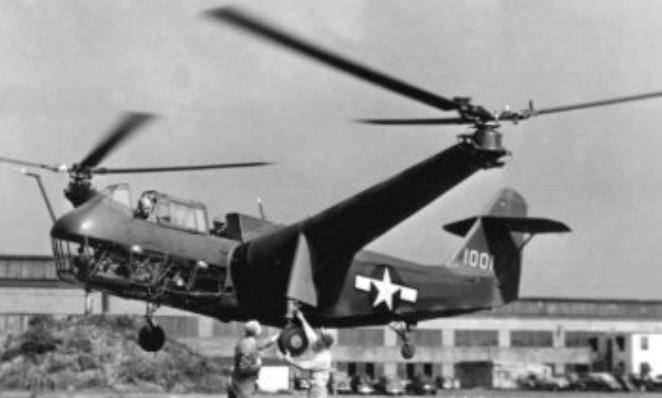
In October 1943 the second model XR-1A made its first flight, and was found to have better flying characteristics than the XR-1. Numerous flight tests were carried out and by June of 1944 the XR-1A was flown from Eddystone Pennsylvania, to Wright field in Dayton Ohio, passing through a dangerous mountain pass and flying through a long stretch of bad weather, during which the XR-1A encountered a grounded Sikorsky SR-4 along the way.
By August of 1944 rebuilt XR-1 was back in the air and slowly progress was made in solving the control problems, In March of 1945 just a few days after a new control system was installed that solved some the problems with longitudinal stability, the Air Corps cancelled all contracts with Platt-LePage, including seven additional YR-1A helicopters that were to be built.
Design and construction was started on an experimental helicopter PL-1, with Laurence LePage keeping the U.S. Air Corps informed of their progress during the early construction of their machine. At this time there were no funds for the U.S. Air Corps to purchase a helicopter, so the Platt-LePage design went forward as a private venture, later with the passage of the Dorsey Bill H.R.8143, the U.S. Air Corps held a competition for Rotary Winged Aircraft, and Platt-LePage redesigned the PL-1 to meet military needs and the design became known as the PL-3.
In 1935, due to the effects of the economic depression in the 1930’s, Dr .Wynn Laurence LePage left Kellett to become an independent engineer, by 1935, LePage met and became partners with Haviland H. Platt, a mechanical engineer and patent expert with a number of rotary wing patents. In 1938 W. Laurence LePage traveled to Germany to view the Focke Fw-61 helicopter, and after much negotiation obtained an option to build Focke helicopters in the USA, but the worsening conditions between the two governments prevented a deal going through.
In November of 1938, Platt and LePage formed The Platt-LePage Aircraft Company, and abandoned talks with the German government to import a Focke helicopter. They proceeded on their own to design a helicopter based on their patents and ideas.
Small size and lack of capital of Platt-LePage Aircraft, along with lack of orders for military aircraft caused the Platt-LePage Aircraft Co. to shut down in August of 1946. The McDonnell Aircraft Co. obtained most of the helicopter patents from Platt-LePage during the liquidation of the company, along with the personnel responsible for the twin engine project.
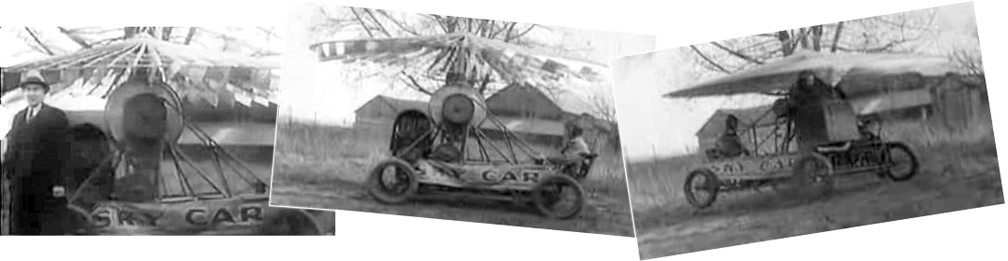
The 1928 Pitt Sky Car appears to be a helicopter with vibration designed into it (US patent #1,602,778). Each blade of the 60-blade rotor had a full-radius vane attached to it that was free to flap about its radial hinge. Rotation caused the drooping vanes to swing out, closing the space between blades and forming a solid rotor disk, the point being that the rotor was forced by the engine to reciprocate up and down. When the rotor went up the vanes were flung open, allowing the air to pass between the blades; when it then moved downwards, the vanes closed and a good portion of air was thrown downwards, thus supposedly creating a lifting force.
Motion pictures recorded a flight attempt in which it is seen jumping up and down but it is dubious if this was caused by downwash.
Engine: Curtiss OX-5, 90hp
Seats: 1
John W Pitts and W P Kindree
Detroit MI.
USA
Circa 1928 built the Sky Car
Former Polish Air Force pilot Joseph Pidek designed and built J.P.2B two-seat ultralight helicopter at Vancouver in 1962. The aircraft was not developed beyond prototype stage.
Canada
Former Polish Air Force pilot Joseph Pidek designed and built J.P.2B two-seat ultralight helicopter at Vancouver in 1962. The aircraft was not developed beyond prototype stage.
 All Aero