Siemetzki Asro 4

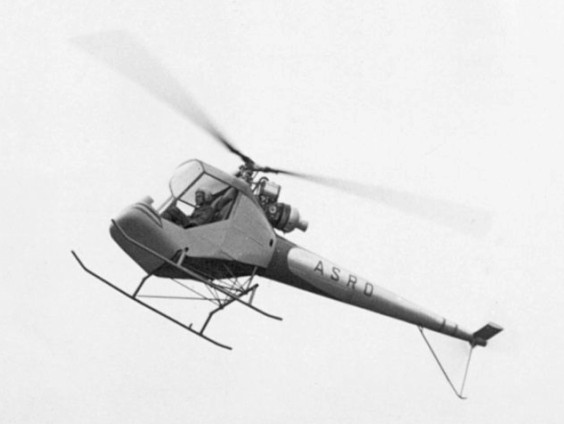
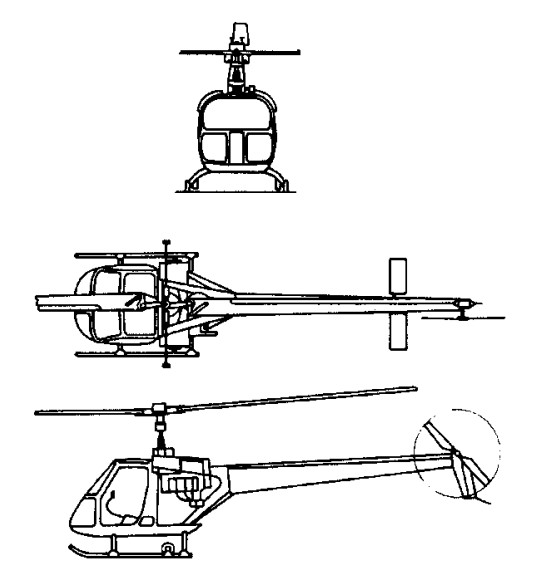
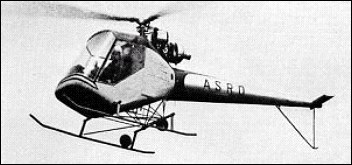
The ASRO-3 was used to develop the ultra-light side-by-side two-seater ASRO-4. Of welded steel tube construction covered with light-alloy, it had a fully enclosed fuselage pod and tapered tubular tailboom. It was fitted with an 130 shp BMW 6012 turboshaft mounted behind the rotor gearbox driving three-blade main and two-bladed tail rotors of composite construction.

The ASRO 4 was first displayed at the 1964 Hanover Air Show.

This machine flew in May 1964, and was tested for some while before being abandoned without achieving certification.

ASRO 4
Engine: BMW 6012, 100/130hp
Rotor diameter: 7.22m
Rotor disk area: 403.45 sq.ft (37.48 sq.m)
Fuselage length: 5.78m
Height: 7 ft 11 in (2.41 m)
Empty weight: 840 lb
Max takeoff weight: 1,360 lb
Max speed: 99 mph / 160km/h
Cruise speed: 90 mph (144 kmh)
Climb: 985 ft (300 m)/min
Service ceiling: 12,467 ft (3,800 m)
Endurance: 1 hr 20 min

Siemetzki Asro 3

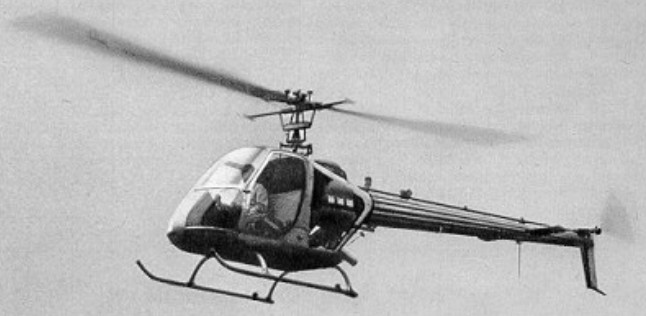
Alfons Siemetzki of Kirchdorf am Iller, privately-built the ASRO 3T ultra-light single-seater. This experimental helicopter was an open-frame steel-tube machine of conventional layout, with a rudimentary windshield to protect the pilot, a skid undercarriage and a 65 shp BMW 6002 turboshaft engine mounted amidships. A conventional rotor system, with two-blade main and tail rotors.

The single-seat ASRO 3-T was built by Alfons Siemetzki and made its first flight on 29 December 1961, piloted by USAF Captain Stanley Frick.

The ASRO-3 was used to develop the ASRO-4

SIAI-Marchetti SV-20

As a result of the seeming success of the SH-4, SIAI-Marchetti’s Sezione Volo Verticale (Vertical Flight Division) was formed in 1968 under the leadership of Dr. Emilio Bianchi.

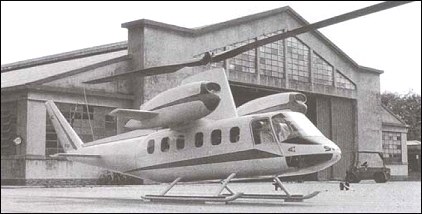
In July of that year, development began of the SV-20A (A = Alato or “winged”) – a 14-seat twin-engine, winged, high-speed helicopter – as well as the SV-20C (C = “compound”) – an improved performance version with a pusher propeller. The SV-20 was a project to design a helicopter that weighed 4,000kg when carrying a load greater than its empty weight and cruised at 390km/h.

In December 1968, fabrication of dynamic components and major dynamic assemblies, as well as a number of airframes, was begun (first flight was originally expected in 1970). A full-scale mock-up of the SV-20A was also completed and was shown at the Paris Air Show. By the end of 1972, about 200,000 manhours had been spent on the SV-20 design, including wind tunnel testing at the Universities of Turin, Milan, and Pisa, but a prototype was not completed.

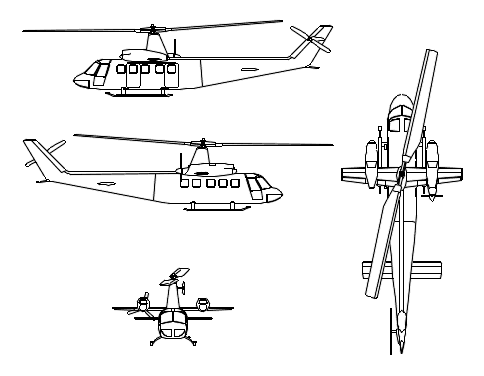
The SIAI-Marchetti SV-20 had a two-blade teetering-hub main rotor, anti-torque rotor and a high mounted cantilever wing. The SV-20C compound added a three-blade variable pitch pusher propeller driven by the right engine. The two United Aircraft of Canada PT6C engines would have been built under license by Motoren-und-Turbinen-Union (the successor to MAN) in Germany. Each engine had a maximum rating of 900hp, and were located in two nacelles on the wing; the Turbomeca Astazou XIVA or Rolls-Royce RS.360 were considered as alternates based on customer preferences. The cabin was designed to transport 12 passengers or 1250kg of cargo in addition to the two pilots. The SV-20C was projected to be about 80kg heavier than the SV- 20A, but about 110km/h faster.

The wings of the SV-20 had movable surfaces acting as flaps or ailerons, allowing the pilot to vary the load between the rotor and the wing. During high speed flight, the rotor was to be partially unloaded by the wing and the surfaces were used to augment roll control. A version with a “Fenestron” type tail rotor was planned in 1970.
Production jigs reportedly had produced numerous examples of many components by the end of 1972. A market of 500 units was expected, producing 40-60 SV-20s per year. Three prototypes were planned, but, despite initial talks with the FAA and the Registro Aeronautico Italiano (RAI) in January 1972, none of the prototypes were ever completed and the project was abandoned the following year. Agusta, which had acquired 30% of SIAI-Marchetti in 1970, had increased its stake to about 60% by 1973 and reached complete ownership in 1983.

CV-20C
Engines: 2 x PT6C-30, 671kW
Main rotor diameter: 12.86m
Tail rotor diameter: 2.50m
Length overall: 15.63m
Height overall: 3.55m
Wing span: 6.0m
Max take-off weight: 4000kg
Empty weight: 1950kg
Max speed: 390km/h
Cruising speed: 352km/h
Hover ceiling, OGE: 4400m
Hover ceiling, IGE: 6000m
Rate of climb: 9.65m/s
Range: 815km
Endurance: 3.7h
SIAI-Marchetti XY / SH-4 / Silvercraft SH-4

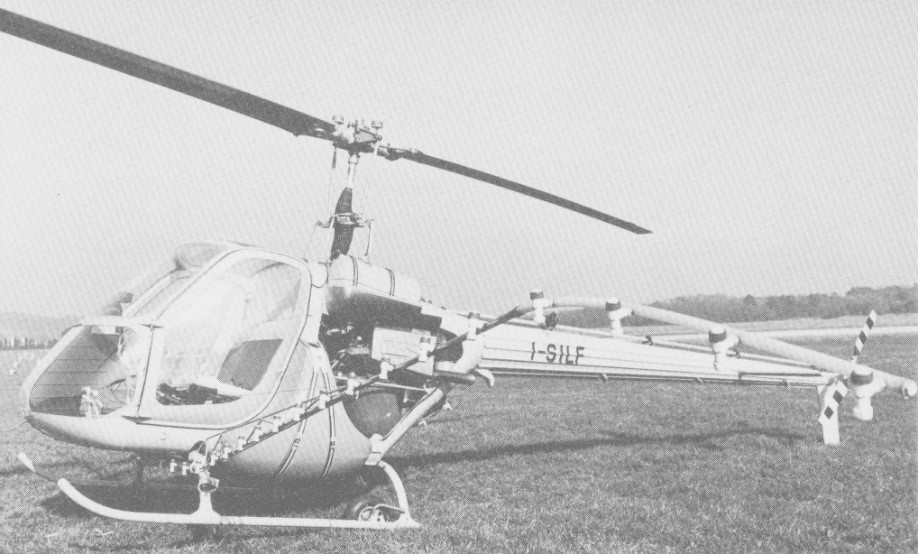
n October 1963 Silvercraft SpA flew the XY prototype light helicopter further developed with financial and technical assistance of shareholder SIAI-Marchetti as the all-metal three-seat SH-4, the prototype of which (I-SILX) made its first flight in March 1965.

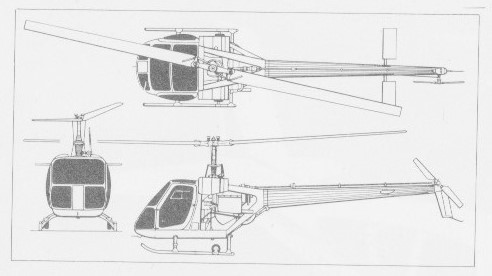
The SH-4 had a skid undercarriage and a high-set tubular corrugated tailboom with a small fin and tailplane and a two-blade tail rotor and powered by a 235hp (derated to 170hp) Franklin 6A-350-D1B piston engine. The main rotor had two blades and a transverse mass-balanced stabiliser bar.

A pre-production model was displayed at the 1967 Paris Air Show, certification was achieved in September 1968. The first helicopter of all-Italian design and construction to receive both Italian and U.S. certification. The SH-4 went into production at Silvercraft’s works at Sesto Calende in basic form. Variations were the SH-4/A for agricultural use and as the SH-4/C with a supercharged Franklin 6AS-350-D1 engine.

SH-4A

Serious production had begun as SIAI-Marchetti/Silvercraft SH-4, but under name Silvercraft alone deliveries began 1970. Production ceased 1977. Production of a batch of about 50 SH-4s was started at the Sesto Calende works with the aid of Fiat Aviazione (Motori), who manufactured mechanical parts for the rotor transmission, but the firm ran into difficulties over the Franklin engine, which had gone out of production.

A total of 21 SH-4s were completed with individual examples being exported to Brazil, South Africa, France and Holland. One aircraft was delivered to the Italian Air Force.

The company ceased operations in the late 1970s.

SH-4 / SH-4A
Engine: Franklin 6AS-350-S1, 235 hp de-rated to 170 hp
Main rotor diameter: 29 ft 7.5 in / 9.03 m
Fuselage length: 25 ft 1.25 in / 7.65 m
Empty weight: 1142 lb / 518 kg
MTOW norm: 1900 lb / 862 kg
Max cruise: 70 kt / 81 mph / 130 kph
ROC: 1180 fpm / 360 m/min
Service ceiling: 15,100 ft / 4600 m
Range max fuel: 173 nm / 200 mi / 320 km
Seats: 3
SH-4A ag capacity: 54 USG / 200 lt / 441 lb / 200 kg
External cargo hook: 441 lb / 200 kg
Cabin length: 4 ft 9.75 in / 1.47 m
Cabin height: 4 ft 0.25 in / 1.24 m

SH-4

SIAI-Marchetti / Savoia-Marchetti

Societa Idrovolanti Alta Italia
Siai-Marchetti Societa Per Azioni

The original company was founded in 1915 as SIAI (Società Idrovolanti Alta Italia – Seaplane company of Northern Italy). After World War I gained the name Savoia, when it acquired the Società Anonima Costruzioni Aeronautiche Savoia, an Italian aircraft company founded by Umberto Savoia in 1915.

The name Marchetti was added when chief designer Alessandro Marchetti joined the company in 1922. Savoia-Marchetti gained prominence with the successful S.55 flying boat. Savoia-Marchetti became famous for its flying boats and seaplanes, which set numerous endurance and speed records. Favoured by Air Marshal Italo Balbo, the company began rapidly prototyping and developing a number of other aircraft, increasingly focusing on warplanes in the lead-up to World War II. However, most of S.M.’s manufacturing capabilities were destroyed in World War Two. It was renamed SIAI-Marchetti in 1943.

Since 1946 engaged in overhaul and repair work and developed new aircraft. SIAI-Marchetti only survived in postwar Italy by building trucks and railway equipment. However it still struggled with insolvency for 6 years after the war before declaring bankruptcy in 1951.

In 1953, the company reopened. Types have included SA.202 Bravo trainer produced jointly with FFA in Switzerland; S.205 four-seater and S.208 development. First flew SF.250 aerobatic trainer in July 1964; became highly successful SF.260 production aircraft for civil and military use (initials in SF.260 denoted design by Stelio Frati). In 1968 company formed a Vertical Flight Division, but increasing helicopter work became associated with Agusta and Elicotteri Meridionale. SM.1019 light multipurpose high-wing monoplane followed 1969, SF.600 Canguro transport 1979 (recently taken over by VulcanAir), and S211 jet trainer and light attack aircraft 1981.

Agusta, which had acquired 30% of SIAI-Marchetti in 1970, had increased its stake to about 60% by 1973 and reached complete ownership in 1983.

Company taken over by Aermacchi January 1997.

Sellmer Quadruplane

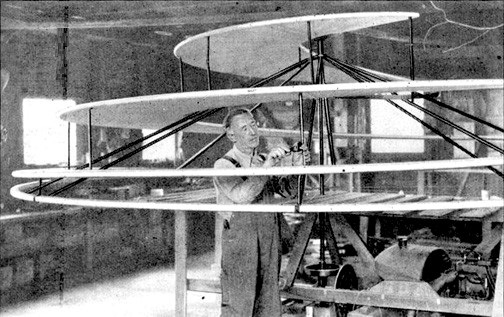
Sellmer working on Quadruplane

According to the 1932 photo and its press release, this was to be some form of an autogyro with a “large clutch-operated disc” (the spiral “lift”) arrangement. The caption explains: “Runways and landing fields will not be necessary if this creation of J P Sellmer works out. When the motor is started, the lift is started whirling to raise the ship straight up. When the right elevation is reached, the spiral folds up and the engine drives the plane as does any other. In large ships, two spirals are to be provided to eliminate torque, and in small ones, a propeller at the back of the plane will prevent spinning.” How far this grand idea progressed is unknown.