hang glider
Hang-glider
Aeros Ltd
At the Antonov Construction Bureau there was an Ultralight Aircraft Department well-known for its creations: hang gliders Slavutich-UT, Sport-5 and trike T-2. These were created according to aircraft requirements, by people able both to compute endurance of anything and to test a hang glider in CAGI wind-tunnel. In the late 80s there started a co-operative trend and ITACO-CENTER co-operative was organised at the Ultralight Aircraft Department. This co-operative started to produce sports hang gliders C-14 and C-15, and about 150 of them were manufactured. Almost all members of USSR hang gliding national team used these hang gliders and after there appeared cracks in the “iron curtain”, it was attempted to sell these machines to the Western states and they even almost completed their certification in Germany.
32-B Obolonskiy pr
Kyiv 254205
Ukraine
In 1991 specialists of the Ultralight Aircraft Department organised Limited Liability Association Aeros and starting from November began to manufacture new wings: sports hang glider Stalker-14 and wings for trike Stranger which became Aeros’ “business cards” for the few next years.
In the very first year of the company’s existence its specialists launched hang glider’s safety parachute Down, a prototype of which was German canopy PSR. It was also decided to explore other spheres of ultralight aircraft. Fathers of paragliding theme were originally redesigned copy of a hang glider Airwave Black Magic (called “the Parasol”), which was popular in the West, and the first independent creative work – paraglider Zig-Zag. At that time Aeros’ staff consisted of not more than a dozen enthusiasts.
In 1993 the first representatives of the company Aeros appeared abroad – in the UK and in Spain.
In 1994, with little experience in paragliders’ manufacture, a decision was taken to start production of designs of АРСО: Starlite, Astra, Supra. These models were not the newest ones, but they fit in excellently for the CIS market. Over 80 paragliders were made, experience was acquired and production was organised. At this stage a framework decision was taken – to manufacture all aircraft only of high quality materials and parts. In most cases these were imported goods: fabric of a German company POLYANT, ropes and wire products LINDEMANN, plastic and special parts FINSTERWALDER, paraglider fabric CARRINGTON and GELVENOR. Full-scale production of harnesses for hang gliders and paragliders began.
In 1996, a new, kingpostless design had already completed flight trials – Stealth 14 KPL. By the end of the year the wing was ready for certification in England and there appeared a small model Stealth 12 KPL. While designers and pilots were busy resolving a complex of “kinpostless” problems, motor wings gave stable income to the enlarged staff. In the course of a year 220 wings of Stranger type has been manufactured and the Aeros’ staff expanded to 30 employees. Aeros was noticed not only in the Western Europe – within a year two distributors appeared in the USA, U.S.AEROS, dealing with hang gliders and Sabre Trikes dealing with trikes.
1998: ad32-B Obolonsky Pr., UKR-254205 Kiev, Ukraine
By 2001 the team consisted of over 70 specialists.
Aeronautic 2000
The Aeronautic 2000 company was founded in 1981 by Henri de Beaufort and Roland Magallon, to distribute the Baroudeur. One of the first participants in hang gliding in France and a man who became one of the most important manufacturers of hang gliders in Europe, Roland was the first to produce trikes units to fit under an unmodified hang glider wing. With the marketing of the Baroudeur single-seater in the summer of 1982, he became the first European manufacturer to offer a complete range of machines from weight shift machines (which are marketed separately under the name Veliplane) to three axis conventional control types.
1983: Aeronautic 2000, 14 16 rue du Ratrait, 92150 Suresnes, France.
Aerial Experiment Association 1907 Glider
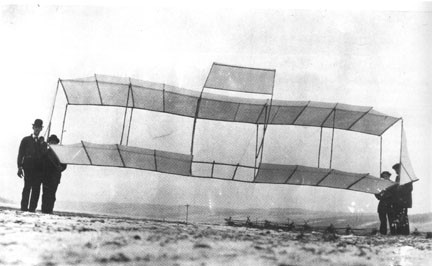
Alexander Graham Bell, inventor of the telephone, had a passionate interest in aviation and had experimented with scientific kites since 1891. He was also a good friend of the Dr. Samuel P. Langley, the builder of the unsuccessful Aerodrome. Bell was Langley’s successor determined to develop a practical airplane with the apparent blessing of the U.S. Army.
In September of 1907, he organized the Aerial Experiment Association to build a practical airplane.
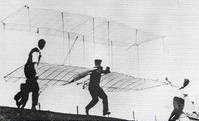
Initial plans were to build four flying machines, and for each member to personally oversee at least one project. The first of these was to be Bell’s kite, equipped with one of Curtiss’ motors. It took shape by December of 1908, but Bell wanted to test it as a glider before engine installation, so Selfridge, somewhat experienced in flight, was towed by a motorboat across a lake near Baddeck. The kitelike machine rose to an estimated height of about 170 feet, but then settled in the water still on tow, ruining many of its silk cells. While it was tediously undergoing repair, the group’s thoughts shifted to more conventional aircraft, such as those being flown in Europe at the time.
Aerial Arts Tyro
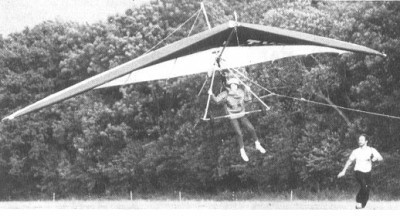
The 1986 Tyro was designed as a school trainer. It was a CFX machine with a simple airframe.
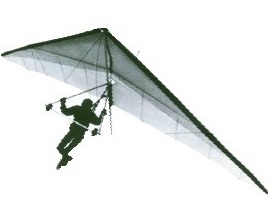
Aerial Arts Laser
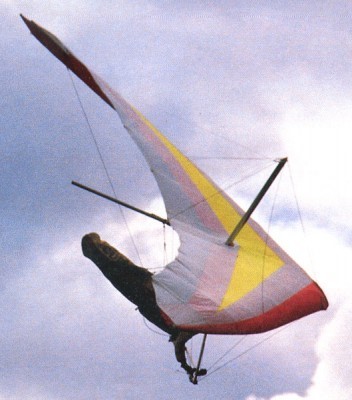
The 1987 Laser was a lightweight high performance machine which incorporated some unusual features. Additional support for the outboard leading edges was provided by a continuous wire running through the control frame to the outer leading edges. This allowed more twist transfer to occur for a given sail and crossboom tension than with conventional single side-wire designs.
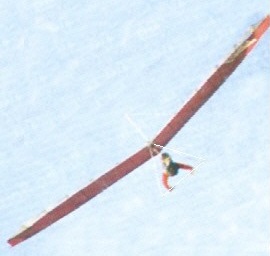
The keel was placed within the double surface in a horizontal keel pocket. Another feature of this glider was a bellcrank arrangement separating the twin tensioner wires running back from the crosstube which separate as the VB is pulled tighter. This was designed to alleviate the handling problems normally brought on when the kingpost is trapped between the wires and thus prevents sideways movement of the keel.
Equipped with Variable Billow and internally sprung battens instead of bungies, the price was £1375.00 inc VAT.
Wing area: 14 m² / 150 sq ft
Wing span: 10 m / 33 ft
Aspect ratio: 7.25
Hang glider weight: 28 kg / 60 lb
Nose angle: 124°
L/D: 13:1
Aerial Arts Clubman
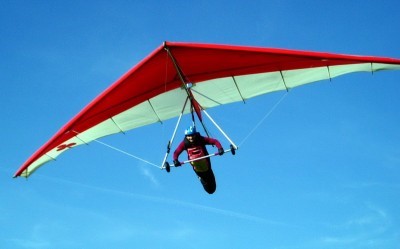
The Clubman 1 is a lightweight intermediate of which only a few were built in 1984, priced at £675.00.
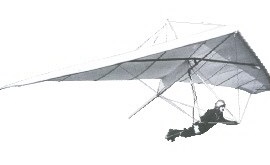
The 1984 Clubman CFX was a fifth generation lightweight intermediate glider built in three sizes.140/160/180. The Clubman CFX was price from £765.00.
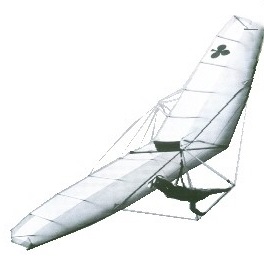
Clubman 1
Wing area: 14.5 m²
Wing span: 9 m
Aspect ratio: 5.6
Hang glider weight: 21 kg / 46.5 lb
Max glide ratio (L/H): 9.5
Min Sink: 180/ft min
Number of battens: 14
Nose angle: 120°
Aériane Swift / Brightstar Swift
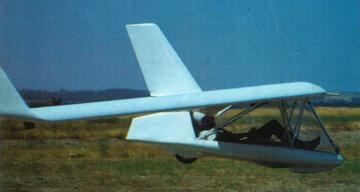
The original Swift (Swept Wing with Inboard Flap Trim) was made by Bright Star Gliders in California. When they were looking for a manufacturer for the European market, they found Aériane in Belgium.
The pilot lies flat in this 24-1 glide ratio motor glider. For Advanced pilots, it can switch from powered to unpowered in 30 minutes. The Swift PAS is equipped with an auxiliary motor.
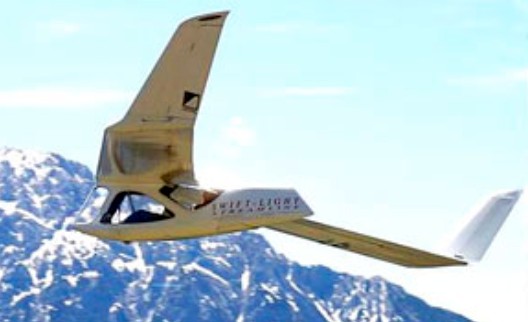
The Swift was marketed by Bright Star Gliders Inc in California. From 1997 Aériane was the only manufacturer building and marketing all versions of the carbon fibre / kevlar construction Swift light sailplane.
When Bright Star closed Aériane continued building the Swift.
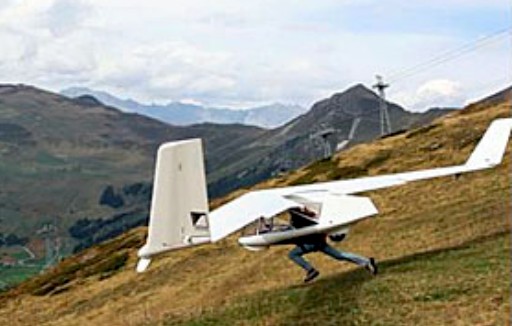
Wing Span: 11.898 m
Empty weight: 63 kg
Wing area: 12.54 sq.m
Vne: 120 km/h
Stall: 35 km/h
Vzmin: 0.65 km/h
Glide Ratio: 25 @ 60 km/h
Price (1998): £ 11,750
Aériane Swift Light
Wing area: 12.54 m²
Wing span: 12.7 m
Aspect ratio: 12.86
Hang glider weight: 46 kg
Minimum pilot weight: 55 kg
Maximum pilot weight: 105 kg
Minimum speed: 35 km/h
Maximum speed: 120 km/h
Max glide ratio (L/H): 27
Max glide ratio speed: 75 km/h
Minimum sink rate: 0.6 m/s
Nose angle: 140 deg
Aériane Swift Standard
Wing area: 12.54 m²
Wing span: 11.89 m
Aspect ratio: 11.27
Hang glider weight: 60 kg
Minimum pilot weight: 55 kg
Maximum pilot weight: 105 kg
Minimum speed: 35 km/h
Maximum speed: 120 km/h
Max glide ratio (L/H): 25
Max glide ratio speed: 75 km/h
Minimum sink rate: 0.6 m/s
Nose angle: 140 deg
Advanced Dynamics Chotia-916
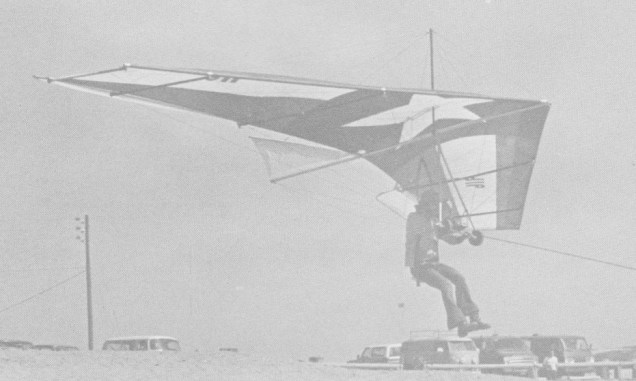
The Chotia-916 airframe is made from 6061-T6 anodised aluminium tubing. The rigging cable 3/32in 7 x 7 galvanised, and all hardware is aircraft quality. The sail is double stitched stabilised dacron.
The Chotia-916 wing combination of sweep, taper, twist, and wingtip design pretents spins. Stalls are indicated by a slight oscillation and heavy mush, with no tendency to drop a wing.
The Chotia-916 features stick operated aerodynamic controls. Glidemaster safety wheels were included. Optional seated or prone harness was provided.
Wing span: 28 ft
Wing area: 153 sq,ft
Aspect ratio: 5.13
Weight: 50 lb
Pilot weight: 100-200 lb
Takeoff speed: 15 mph
Stall speed: 12 mph
Max speed: 45 mph
Best glide ratio (L/D): 9-1
Best L/D speed: 19 mph
Min sink: 180 fpm
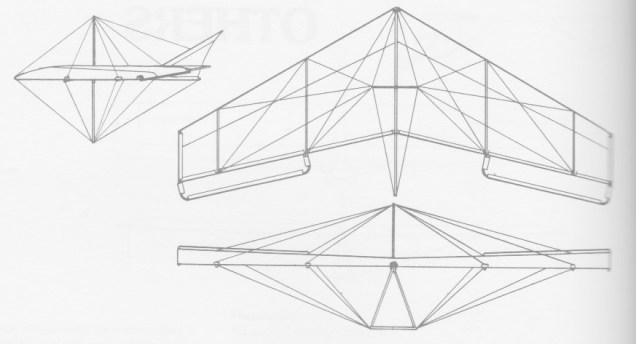
AAR Zetka
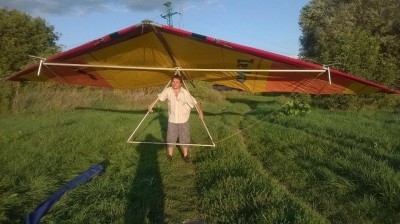
Minimum pilot weight: 73 kg
Maximum pilot weight: 86 kg
Minimum speed: 18 km/h
Maximum speed: 65 km/h
 All Aero