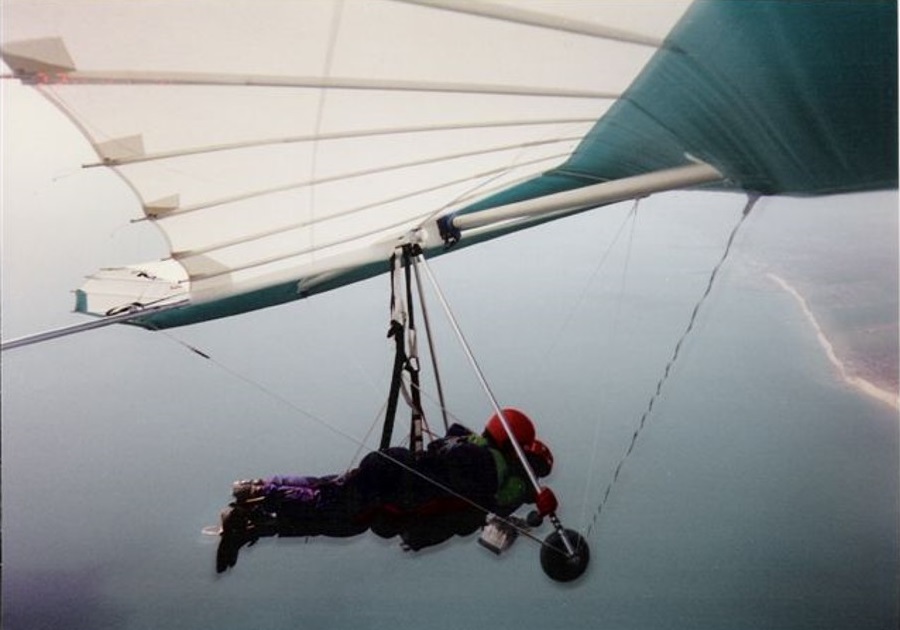
Fly 2
Hang glider circa 1998.
Wing area: 19.97 sq.m
Certification: BHPA / USHGA
Pilot weight: 91/190 kg
Wing span: 10.63 m
Nose Angle: 132 deg
Aspect ratio: 5.65
Price (1998) £ 2,495
Fly 2
Hang glider circa 1998.
Wing area: 19.97 sq.m
Certification: BHPA / USHGA
Pilot weight: 91/190 kg
Wing span: 10.63 m
Nose Angle: 132 deg
Aspect ratio: 5.65
Price (1998) £ 2,495
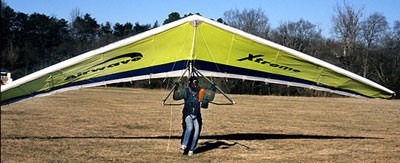
Hang glider new in 1998, the Extreme was designed in the USA by Mark Gibson. The production of the Xtrem started 1.5 year before Airwave UK shut down. Only about 40 were produced mostly shipped to the US, Brazil, Japan and some in France.
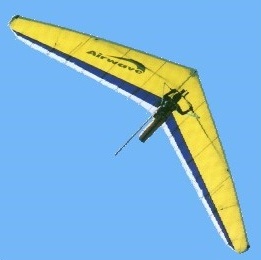
The Xtreme has battens 27 (6 under), the airframe material is 7075-T6 / carbon fibre, and the price was £3999 inc VAT.
This glider lacks in sink rate at low speed except in tight turn. It has a tendency to yaw and has a wide flare window. Its newer version, called the Xbow, was certified 4 months before the factury shutdown.
Extreme 138
Wing area: 12.82 sq.m
Certification: BHPA / DHV
Pilot weight: 64-95 kg
Wing span: 9.77 m
Nose Angle: 130 deg
Aspect ratio: 7.43
Extreme 150
Wing area: 13.83 sq.m
Certification: BHPA / DHV
Pilot weight: 68/114 kg
Wing span: 10.26 m
Nose Angle: 132 deg
Aspect ratio: 7.53
Flying weight: 34 kg
Packed length: 5.85 m
Double surface: 92 %
Price (1998) £ 3,999
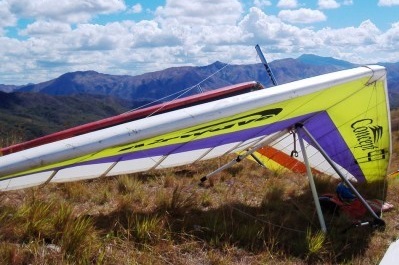
Mark Gibbson did much of the development of this and Tim Buckley owned the prototype Concept for many years after Mark had finished with it.
The 1997 Airwave Concept wing has no return cable but two ballestrons foam / carbon profiles embedded in the double surface of each half-wing. The concept has a mast. Released on the market at the same time as the Laminar without mast, it generally has the same performance in transition and very good handling. Neutral spiral, it presents no difficulty in landing. It has two carbon winglets at the end of the pen which slightly increase the elongation.
The Concept FR was available with a kingpost, or as a topless model. The kingpost model costing around £500 less. The FR utilises carbonfibre fin wingtips.
The 1997 Concept FR new kingpostless design was released in ’39’ and ’49’ sizes. Carbon-fibre spars take the place of the top rigging and cross-tubes, yet the weight is similar to that of the standard kingposted Concept. The new wing was claimed to be light in pitch and to have a wide trim speed adjustment and VB range.
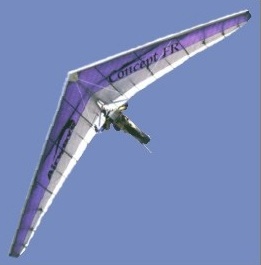
The Concept FR Spare Rib system of the original Concept, said to confer handling, drag reduction and climb advantages was retained. This was Airwave’s first kingpostless glider.
The 1997 Concept 49 incorporated the ‘Spare Ribs’ technology as an alternative to the kingpostless route. The design dispenses with luff-lines and provides essential pitch stability through a system of ‘floating ribs’ attached to the outboard leading edge and restrained to give adequate washout at low angles of attack. Winglets, which on the Klassic were an optional extra, became on the Concept an integral part of the design. The Concept 49 airframe material is 6080-T6 and 7075-T6, priced inc VAT at £3700.
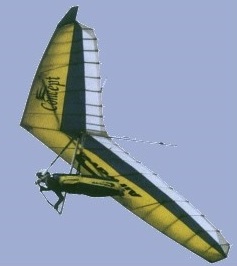
Concept 46
Wing area: 13 m²
Wing span: 10.29 m
Hang glider weight: 34 kg
Minimum speed: 31 km/h
Number of battens: 27
Concept 49
Sail area: 13.8 sq m
Span: 10.3 m
Nose angle: 131 deg
Aspect ratio: 7.6:1
Packed length: 5.8 m
Battens: 29 (inc 6 under)
Flying weight: 35 kg
Pilot weight: 58-91 kg
Concept 59
Wing area: 14.77 m²
Wing span: 10.54 m
Hang glider weight: 36 kg
Minimum speed: 31 km/h
Number of battens: 29
Pilot weight: 160 – 280 lb (72 – 127 Kg)
Stall speed max pilot weight: 7m/s (25 km/h)
Max speed min pilot weight: 28m/s (100 km/h)
Packed length: 5,7 m
Concept FR 39
Hang glider circa 1998.
Wing area: 12.64 sq.m
Certification: BHPA
Pilot weight: 47-79 kg
Wing span: 10 m
Nose Angle: 132 deg
Aspect ratio: 7.92
Price (1998) £ 3999
Concept FR 49
Hang glider circa 1998.
Wing area: 13.85 sq.m
Pilot weight: 58-91 kg
Wing span: 10.29 m
Nose Angle: 132 deg
Aspect ratio: 7.64
Price (1998) £ 3999
Concept FR 59
Hang glider circa 1998.
Wing area: 14.77 sq.m
Certification: BHPA
Pilot weight: 76-101 kg
Wing span: 10.54 m
Nose Angle: 132 deg
Aspect ratio: 7.52
Price (1998) £ 3999
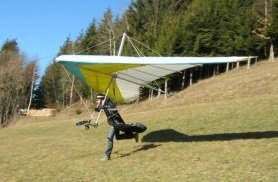
The Airwave Calypso hang glider.first appeared in 1987 as a totally new intermediate double surface glider which was been designed for pilots who want an excellent sink rate plus handling attributes like easy roll, slow landings and a forgiving nature.. Sink rate goes up fast with speed, so it’s easy to burn off height in the landing field. A bit lazy to turn, but stable for it. A great 1st glider even for heavy pilots, very forgiving, easy to fly and land.
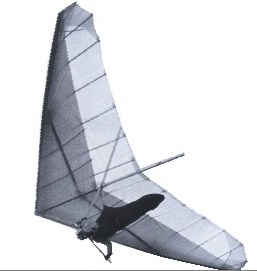
Short pack by simply pulling the plastic ball off and forwards quite hard off the end of the wing spar. Then slide out the 2m length of spar. Reassemble by locating the dive strut in its hole and then the peg/ notch for the spar.
The 1991 Calypso 2 was for intermediate pilots. A good glider, quite forgiving in bumpy air and for landings.
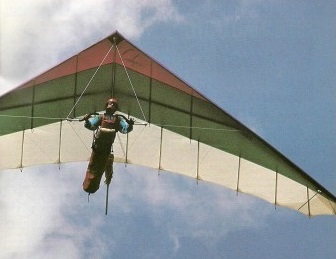
Calypso
Wing area: 15.8 sq.m
Certification: BHPA / USHGA
Pilot weight: 55-105 kg
Wing span: 9.3 m
Nose Angle: 122 deg
Aspect ratio: 5.5
Price (1998) £ 2343
Calypso 2
Wing area: 15.8 m²
Wing span: 9.3 m
Aspect ratio: 5.5
Hang glider weight: 25 kg
Minimum pilot weight: 57 kg
Maximum pilot weight: 95 kg
Minimum speed: 25 km/h
Max glide ratio (L/H): 8
Max glide ratio speed: 29 km/h
Minimum sink rate: 1 m/s
Packed length: 5.4 m
Packed length short: 3.7 m
Number of battens: 18
Nose angle: 122°
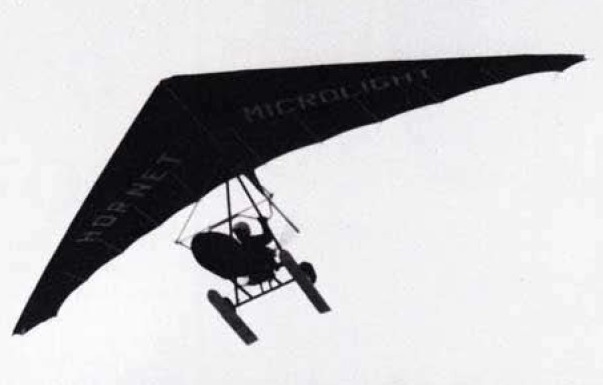
The Nimrod wing (beefed up Comet) were fitted to Hornet Microlights trike unit.
In 2002 Airwave Gliders broke another performance barrier with the Ten, the first paraglider to achieve a glide angle of 10:1. The FR (Full Race) series soon followed.
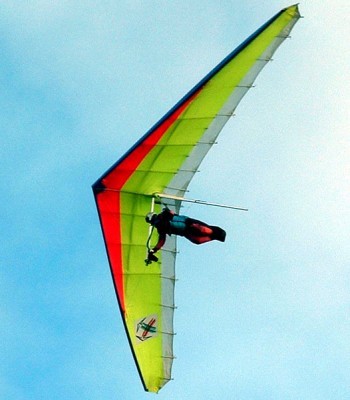
The 1988 Magic Kiss replaced the Full Race Magic IV. It was reported that the machines glide and speed are comparable to the Full Race but the handling and sink rate are noticeably better. The wider nose angle and higher aspect ratio makes the glider feel a bit more wingy but this is supposed not to be a problem. Landing is reported to be easier than the Full Race and the ground handling is also better. Mainly due to the use of thin wall lightweight 7075 tubing the machine is 10 lbs lighter than the Magic IV.
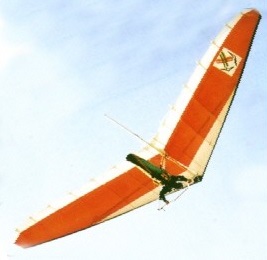
The 1989 Kiss and the Magic Kiss are the same hang glider. A very light handling glider, very easy to land but good performance, though definitely ‘advanced’. For pilots with 50hrs+.
It is a very “yawy” wing requiring a light touch and “active flying” to keep it under control. Pilots transitioning from stiffer wings may have a tendency to PIO or even dutch-roll especially at higher speeds.
Some can tend to yaw but you get used to it after a while. It does tend to have roll control problems if not set properly. Other wise very light on the control.
Glide was good up until you reached high speed. The Kiss then tended to yaw from side to side. Not disconcertainly so, but enough to require constant corrections, though you did automatically begin correcting for the yaw. Wing-wires are not too slack, so she handles well on take-off. Not very good at high speed but there is no problem for aerotowing.
Never fly without the nose cone – the glider will become divergent at speed.
Kiss
Sail area: 154 sq/ft
Nose angle: 130 deg
No keel pocket
85 percent double surface
Kiss 144
Wing area: 13.38 m²
Hang glider weight: 30 kg
Minimum pilot weight: 50 kg
Maximum pilot weight: 80 kg
Kiss 154
Wing area: 14.2 m²
Wing span: 10.4 m
Aspect ratio: 7.4
Hang glider weight: 30 kg
Minimum pilot weight: 60 kg
Maximum pilot weight: 90 kg
Minimum speed: 26 km/h
Maximum speed: 83 km/h
Number of battens: 29
Nose angle: 127°
Airwave was created in 1979, originally as a Hang Glider manufacturer on the Isle of Wight. Graham Deegan was a sail designer and Rory Carter specialised in the hardware design.
Airwave’s early successes were on the Magic series of Hang Gliders, with a team of British pilots who dominated the World Hang Gliding Competition circuit for over ten years.
Pacific Windcraft (USA) became part of Airwave circa 1983, from Pacific Airwave to PacAir. In 1986 PacAir closed the doors.
Airwave Gliders’ production moved to China in the middle of 1997 but the company’s headquarters remains on the Isle of Wight.
1998: Elm Lane, Shalfleet, Newport, UK PO30 4JY Isle of Wight, UK
Even though sales of Airwave gliders were strong, the company was in a deep financial crisis. As a result of this Bruce left and the old Airwave collapsed and folded.
The production of the Xtrem started 1.5 year before Airwave UK shut down. Only about 40 were produced mostly shipped to the US, Brazil, Japan and some in France. Its newer version is called the Xbow, was certified in the 138 (140 Sq ft) version 4 months before the factury shutdown (35 sold in 3 months).
After running Wills Wing Europe in the early 1990´s, in November 1999, Markus Villinger took over Airwave and the company moved to his home town of Stubai, in the Austrian Alps.
Industriegebeit zone A2
A-6166 Fulpmes
Austria
Hang Gliders are made in the Airwave factory, while paragliders are manufactured by subcontractors.
Bruce Goldsmith, an engineer, joined Airwave in May 2000, set up Airwave Paragliders and started designing Airwave’s paragliders from his home in Greolieres, France.
Starting in spring 2005 Airwave have been doing wind tunnel testing as well as Computational Fluid Dynamics (CFD) analysis to study the gliders as well as the traditional full scale test flying procedures.
John C. Massey of Texas began hang gliding in the early days but after being transferred to Kansas City by IBM began thinking powered machines. He began building his own design hang gliders in his garage and eventually became a dealer, building and maintaining hang gliders and ultralight lines.
The business eventually grew and moved it to an old schoolhouse in DeSota Kansas.
1982: Airmass Inc, 16845 Kenneth Road, Hillside Airport, Stilwell, Kansas 66085, USA.
By 1983 Airmass had ceased trading.
Air Creation was founded about 1982 by Gilles Bru and Yves le Bihan and established at Aubenas in the south-east of France.
1995: 8710 W. Carefree Hwy, Peoria, AZ 85382, USA.
1995-8: Aerodrome de Lanas 7200, Aubenas, France.
By 2002 the factory had produced nearly 3,000 trike units and about 4,700 wings. Many of the 25 staff employed are actively involved in the development and testing and most were pioneers in weight-shift flying. The company offers a range of Trikes with an even larger range of wings for different flying conditions, range and personal preference, with most of them being interchangeable with the various Trike bases. Air Creation Trikes hold several world records, including the highest flight of 31,000 feet.
 All Aero