Altiss Véga         

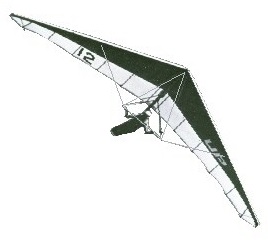
The 1985 Altiss Véga was for novice pilots.

Véga 150
Wing area: 15 m²
Wing span: 9.70 m
Aspect ratio: 6.2
Hang glider weight: 22 kg

Véga 160
Wing area: 16 m²
Wing span: 10 m
Aspect ratio: 6.2
Hang glider weight: 23 kg

Véga 170
Wing area: 17 m²
Wing span: 10.3 m
Aspect ratio: 6.2
Hang glider weight: 25 kg

Véga 180
Wing area: 18 m²
Wing span: 10.6 m
Aspect ratio: 6.2
Hang glider weight: 26 kg

Altair Saturn / UP Saturn

A hang glider built in 1998 for intermediate pilots. It has excellent aerotow manners, and practically lands itself. It sets up quickly as well. Light, easy to setup, ground handle, takeoff & landing, a great sink rate and respectable speed when you need it.. Very solid, stable, no stupid tip wands or sprogs to mess with.

The Saturn 167 is responsive, yet forgiving, providing an excellent glide ratio and sink rate for an intermediate/beginner glider. It trims right at 18/19mph but can give ample speed when called for. It has a large flare window. It sets up easily and quicker than most gliders due to the fact that two inboard battens can be left in the sail after breakdown & the luff lines are permanently attached to the kingpost.

The Saturn was still in production along with the Predator by John Heiney & Joe Spinney at UP Gliders.

Saturn 147
Wing area: 13.2 m²
Wing span: 10.1 m
Aspect ratio: 6.32
Hang glider weight: 24 kg
Minimum pilot weight: 55 kg
Maximum pilot weight: 100 kg
Minimum speed: 37 km/h
Maximum speed: 86 km/h
Packed length: 5.48 m
Packed length short: 3.68 m
Number of battens: 17
Nose angle: 122°

Saturn 167
Wing area: 15.6 m²
Wing span: 10.05 m
Aspect ratio: 6.6
Hang glider weight: 28 kg
Minimum pilot weight: 72 kg
Maximum pilot weight: 117 kg

Saturn 170
Wing area: 15.6 sq.m
Certification: USHGA
Pilot weight: 80-130 kg
Wing span: 10.05 m
Aspect ratio: 6.6
Price (1998) US$3595

Altair Predator

The Predator evolved from UP USA’s TRX model in 1995.

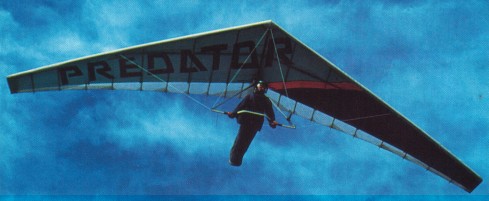
The leading edge, spar and keel are all in carbon fibre. The Predator is a fast hang glider, but hard to soar in light conditions. Also fast on take-off, I has a hard time to start in no wind conditions.

They were building them in California again in 2012.

Predator 142
Wing area: 13.1 sq.m
Wing span: 10.2 m
Nose angle: 127°
Aspect ratio: 8
Hang glider weight: 30 kg
Pilot weight: 64-100 kg
Certification: USHGA
Price (1998) US$4975

Predator 158
Wing area: 14.5 sq.m
Wing span: 10.6 m
Nose angle: 127°
Aspect ratio: 8
Hang glider weight: 31 kg
Pilot weight: 82-127 kg
Certification: USHGA
Price (1998) US$4995

Albatross Sails ASG 23

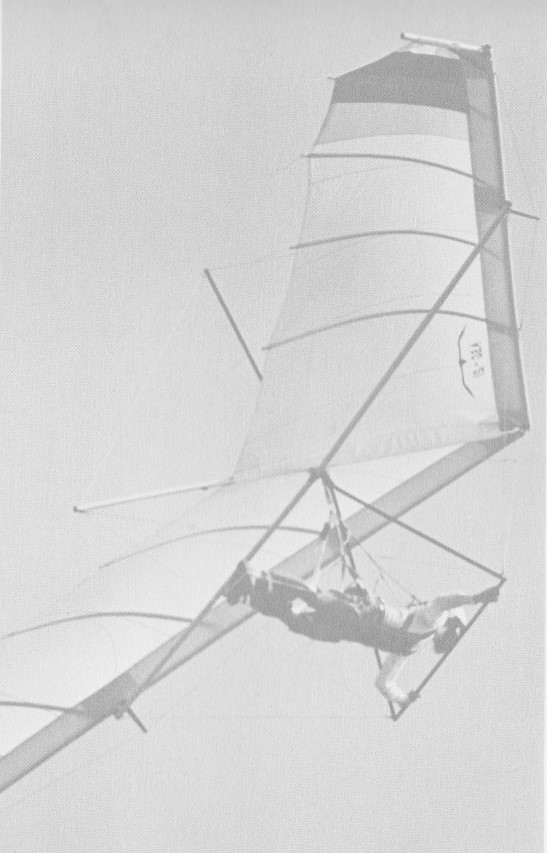
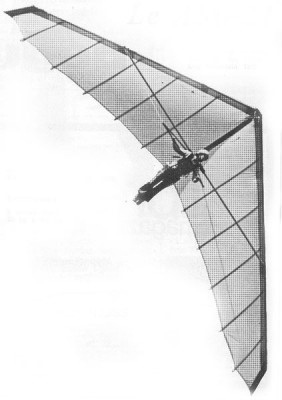
The ASG-23 was a conventional glider with crossbar, preformed ribs, and fiberglass leading edge tips to tension the trailing edge at the tips.

It went out of production in the winter of 1977-1978, when Tom Price closed his own sail loft and went to work for Electra Flyer.

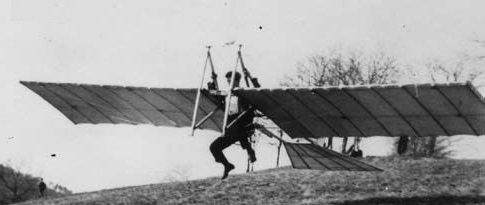
The photo was taken at the American Cup in 1980. Randy Rauck and Larry Croome were flying the only two production topless models ever in existance, with the Canadian Team. Tom Price brought the ASG 23 up to Canada with its preliminary build done -it needed some shape refinements as well as new spars. The ASG 23 design needed more mods and tests to be competative with the just released and well finished, Comet 1 by UP. Tom got rid of crossbar drag by eliminating it and UP (Roy Hagard) covered it up to achieve similar results and a lot less cost.

The ASG 23 version 1 was small and very efficient at speed. They built a whole new sail for the rocket on the old spars with the dubious extra 1/2″ holes in them that Tom assured us were in the nuetral axis. Larry Croome flew the new prototype in the 1980 Canadian Nationals Gaspe, Quebec. The wind virtually stopped on the last day and it turned into a sink rate contest. He went from 1st to 7th.

After the nationals they built two new ASG23’s with two new sets of spars and nose units starting in the second week of September. Only four weeks later they had two new gliders very much redesigned. The new ASG’s had more span and better wing tip.

Albatross Sails ASG-21

The 1976 ASG-21 was a high performance, truncated tip glider. It uses a 1 deg cambered, fully battened sail to lower the stall speed. The battens let it fly faster without fluttering, thus reducing high-speed drag. This glider requires an experienced pilot.

The ASG21 used a curved, cantilevered tip that is fully enveloped within the sail sleeve, reducing tip inertia and drag. A reinforced kingpost and an extra winpost for turbulent thermal flying were optional. The sail is cambered throughout the body to assume a specific airfoil shape in flight and a cambered keel pocket is applied to match the camber of the sail, rather thn the bend of the keel tube. Leading edge sleeves are applied to minimise any diagonal wrinkles.

All spars and sleeving are 2024-T3 aluminium and all holes are internally sleeved and use compression bushings. The sleeves are stress releved at both ends. 1.75in tubing is used for the leading edge and crossbar and 1 5/8in for the keel. The 5ft x 5ft control bar and the kingpost are both 6062-T6 1in x .083.

All cable is 3/32in 7×7 vinyl coated stainless steel aircraft quality and all wire ends are double nico pressed around stainless steel thimbles. The tangs and shackles are stainless steel, nose plates 7075-T6 aluminium, and all bolts, nuts and turnbuckles are aircraft quality.

The sail is made from Howe & Bainbridge 3.8oz stabilised dacron, all white for constant stretch characteristics. All seams are double zig-zag stitched with reinforced stress points. Applied leading edge sleeves and keel pockets eliminate wrinkles. The sail is fully cambered. Battens by Roy Searman are of fibreglass, polyurethane foam sandwich constructin. They have a constant taper ratio to allow them to curve to the airfoil shape of the sail.

Options were for any type or make of harness.

ASG-21AA
Leading edge: 16 ft
Keel length: 7.2 ft
Wing span: 28.8 ft / 9.4 m
Wing area: 130 sq,ft / 12.1 m²
Aspect ratio: 6.4
Nose angle: 116˚
Sail billow: 1˚
Weight: 44 lb / 20 kg
Pilot weight: 110-135 lb / 50-61 kg
Packed length: 4.88 m

ASG-21A
Leading edge: 17 ft
Keel length: 7.6 ft
Wing span: 30.5 ft / 8.8 m
Wing area: 145 sq,ft / 13.5 m²
Aspect ratio: 6.4
Nose angle: 116˚
Sail billow: 1˚
Weight: 45 lb / 20 kg
Pilot weight: 130-155 lb / 59-70 kg
Packed length: 5.18 m

ASG-21B
Leading edge: 18 ft
Keel length: 8 ft
Wing span: 32 ft / 9.76 m
Wing area: 160 sq,ft / 14.9 m²
Aspect ratio: 6.4
Nose angle: 116˚
Sail billow: 1˚
Weight: 46 lb / 21 kg
Pilot weight: 150-175 lb / 68-79 kg
Packed length: 5.41 m

ASG-21C
Leading edge: 18.8 ft
Keel length: 8.5 ft
Wing span: 33.9 ft / 10.35 m
Wing area: 180 sq,ft / 16.7 m²
Aspect ratio: 6.4
Nose angle: 116˚
Sail billow: 1˚
Weight: 47 lb / 21 kg
Pilot weight: 170-195 lb / 77-88 kg
Packed length: 5.74 m

ASG-21D
Leading edge: 18.7 ft
Keel length: 9 ft
Wing span: 33.2 ft / 10.12 m
Wing area: 195 sq,ft / 18.1 m²
Aspect ratio: 5.7
Nose angle: 116˚
Sail billow: 1˚
Weight: 48 lb / 22 kg
Pilot weight: 190-215 lb / 86-97 kg
Packed length: 5.72 m
Albatross Sails ASG-20

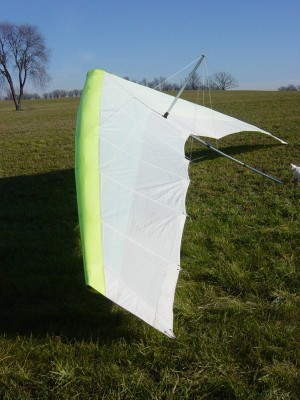
The ASG-20 was originally designed in 1975 to fill the need for a safer, more docile, beginner/intermediate glider. The final design meeting the criteria. The ASG-20 was available with an optional modification kit, which essentially soups up the -20, noticeably increasing the L/D while not adversely affecting the slow speed or stall characteristics. The modification kit includes a triple wing strut assembly to provide the negative load strength of the ASG-21.

With or without the mod kit, the -20 fits the Standard Class for competition.

Because the sail is not cambered like the ASG-21, a wide choice of colours was available, although Albatros recommends white cloth. Standard with the sail were applied leading edge sleeves and an applied keel pocket in the pilot’s choice of colour.

Options such as colour, split panels, and insert work were also available, as well as the modification kit.

It was an (at the time) intermediate glider with remarkably high performance. David Dilworth gained a 2nd place in Bodo Midnight Sol Cup in 1977 – and set a Scandanavian distance record with the ASG 20 (15+ km along the front of Kaiservarden).

ASG-20 AA
Span: 24.00 ft
Leading edge: 15.43 ft
Area: 130 sq.ft
Aspect ratio: 4.47
Sweep: 31.7 deg
Nose angle: 102 deg
Sail billow: 2.25 deg
Keel: 10.41 ft
Pilot weight: 90-125 lb
Optimum wing loading: 1.1 lb/sq.ft

ASG-20 A
Span: 26.32 ft
Leading edge: 17.00 ft
Area: 155 sq.ft
Aspect ratio: 4.47
Sweep: 31.7 deg
Nose angle: 102 deg
Sail billow: 2.25 deg
Keel: 11.46 ft
Pilot weight: 120-150 lb
Optimum wing loading: 1.1 lb/sq.ft

ASG-20 B
Span: 27.57 ft
Leading edge: 17.79 ft
Area: 170 sq.ft
Aspect ratio: 4.47
Sweep: 31.7 deg
Nose angle: 102 deg
Sail billow: 2.25 deg
Keel: 12.00 ft
Pilot weight: 145-175 lb
Optimum wing loading: 1.1 lb/sq.ft

ASG-20 C
Span: 28.75 ft
Leading edge: 18.50 ft
Area: 185 sq.ft
Aspect ratio: 4.47
Sweep: 31.7 deg
Nose angle: 102 deg
Sail billow: 2.25 deg
Keel: 12.50 ft
Pilot weight: 170-190 lb
Optimum wing loading: 1.1 lb/sq.ft

ASG-20 D
Span: 29.90 ft
Leading edge: 19.29 ft
Area: 200 sq.ft
Aspect ratio: 4.47
Sweep: 31.7 deg
Nose angle: 102 deg
Sail billow: 2.25 deg
Keel: 13.00 ft
Pilot weight: 185-205 lb
Optimum wing loading: 1.1 lb/sq.ft

ASG-20 E
Span: 31.00 ft
Leading edge: 20.00 ft
Area: 215 sq.ft
Aspect ratio: 4.47
Sweep: 31.7 deg
Nose angle: 102 deg
Sail billow: 2.25 deg
Keel: 13.65 ft
Pilot weight: 200-225 lb
Optimum wing loading: 1.1 lb/sq.ft

Airwave Gliders Comet

1980 Comet

The 1980 Magic Comet was made entirely in Britain by Airwave under the US UP license. It was therefore the first Airwave wing, which stood out from other productions by the quality of manufacture. At the time, the pilots who flew under ATLAS re-christened their wings MAGIC-ATLAS so they spoke only about MAGIC.

The Comet has a perfected floating cross boom system totally enclosed in a highly developed 60 % double surface airfoil section and mylar leading edge. The Comet was produced in three sizes, 135, 165 and 185.

Comet 165
Weight 69 lb

Comet 185
Weight 83 lb