Matt Bailet
624 Mawyer Dr.
Columbus
OH 43085
USA
Hang glider builder circa 1997
Matt Bailet
624 Mawyer Dr.
Columbus
OH 43085
USA
Hang glider builder circa 1997

Made in 1976, the Swift was been designed by John Glover and features a folding cross boom to facilitate quick rigging, also a separate back-up wing wire system. The Swift glider was offered in two sizes to suit pilot weights of 9 – 12 st. and 11 – 15 st. and can be quickly converted for seated or prone.
Swift (Medium)
Sail area of 236 sq ft
Boom 19 ft 4in
Keel 14 ft 9 in
Nose angle 102 deg
Billow 2.5 deg
Aspect ratio 3.9

Made in 1977, the Hustler was regarded as a delight to fly because of the immediate feeling of smoothness and stability. Its response to control inputs was positive and excessive movement was not required even for extreme manoeuvres.
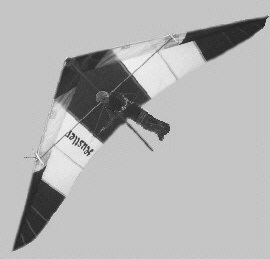
Radial tips stabilize the machine throughout its entire flight envelope. Hands-off stall and dive flight tests have shown quick and positive recovery. The 1977 Hustler was priced at £450.00 inc VAT and bag.
Hustler (small)
Leading edge: 19 ft 4in
Keel: 10ft 2.5in
Sail area: 172 sq ft
Nose angle: 107 deg
Billow: 0.3 deg
Aspect ratio: 5.65
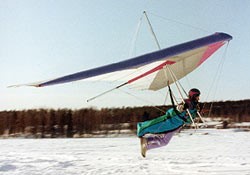
The Avian Elan is a 1989 hang glider and successor to the successful Clubman. Avian took over manufacture of the Clubman but after building a number of them with up-to-date fittings a complete re-design of both sail and airframe was been undertaken.
The new keelpocketless sail gave a cleaner, tighter appearance. The leading edge was made from a mylar laminate fabric, usually only seen on high performance machines. The airframe, constructed from HT30 TF tubing was optimised to produce a glider that is light to carry and both quick and easy to rig.
The Elan has Speed bar, aerofoil king-post, 13 top surface battens, no undersurface or intermediate battens, HT30TF tubing, no keel pocket, mylar leading edge ,4.2 ounce sail cloth, VB, and a surface area of 150 sq ft.
Elan 14
Wing area: 14 m²
Wing span: 8.85 m
Aspect ratio: 5.6
Minimum pilot weight: 51 kg
Maximum pilot weight: 85 kg
Nose angle: 120°
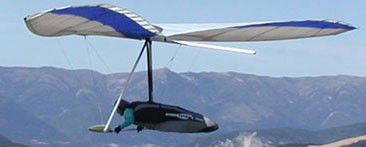
A 1999 hang glider for advanced pilots.
Cheetah 140
Wing area: 13 m²
Wing span: 9.7 m
Aspect ratio: 7
Hang glider weight: 31 kg
Minimum speed: 24 km/h
Maximum speed: 113 km/h
Max glide ratio (L/H): 14.3
Minimum sink rate: 0.86 m/s
Packed length: 5.6 m
Nose angle: 127°
Cheetah 150
Wing area: 14 m²
Wing span: 10.4 m
Aspect ratio: 7.5
Minimum pilot weight: 70 kg
Maximum pilot weight: 100 kg
Nose angle: 127°
160 Cheetah
Wing area: 15 m²
Wing span: 10 m
Aspect ratio: 7
Hang glider weight: 33 kg
Minimum pilot weight: 75 kg
Maximum pilot weight: 110 kg
Minimum speed: 24 km/h
Maximum speed: 113 km/h
Max glide ratio (L/H): 14.3
Minimum sink rate: 0.86 m/s
Packed length: 5.9 m
Nose angle: 127°
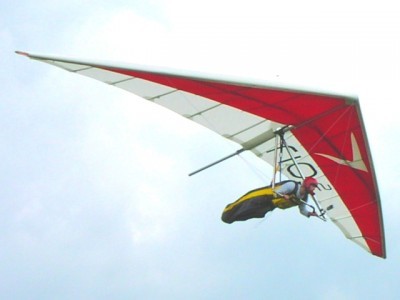
The Rio is a sports glider (formerly referred to as intermediate) which is faster than a Skyfloater, lighter and easier to fly than a typical kingposted CFX glider. The price inc VAT was £2399 in 1999.
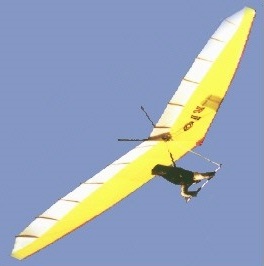
The United Kingdom’s Avian built the Rio novice-intermediate glider from 1999 to 2011. Replaced with the Rio2 which has a VG.
Rio 15
Wing area: 15 m²
Wing span: 9.4 m
Aspect ratio: 6
Hang glider weight: 25.3 kg
Pilot Weight: 61-95 kg
Minimum speed: 24 km/h
Maximum speed: 88 km/h
Max glide ratio (L/H): 10
Minimum sink rate: 0.96 m/s
Packed length: 5.6 m
Packed length short: 3.68 m
Number of battens: 20
Nose angle: 120°
Double surface: 55%
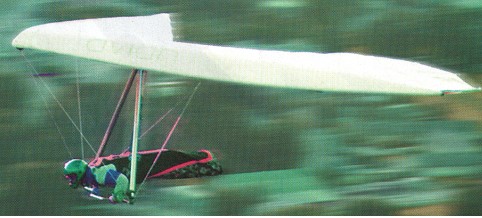
The 1995 Avian Java was the new competition wing from Avian. Features of the glider included a sealed ball bearing VB system giving a large cross-tube travel, 80 % double surface, a new airfoil section, automatic tension release on the leading edges when de-rigged, a ball-joint cross-tube centre junction, new-design tip compression struts and a kingpost mounted hang point.
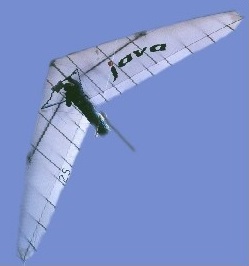
The airframe material was 6080-T6, and battens 7075-T6. The price inc VAT (1997) was £3238.
One pilot claimed that he was able to log a top speed of 80 mph. It is claimed also to fly very slowly. The Java was to be available also in sizes 140 and 150 sq ft.
The Java Comp is a 1997 topless competition glider. The Java Comp incorporated the latest computer-aided design, hybrid composite cross-tubes and an aluminium centre box.
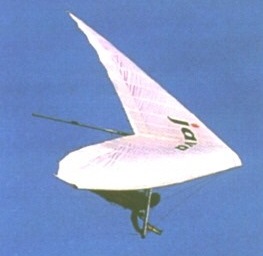
The Java Comp had a carbon speed bar, thin lower rigging wires, low drag uprights, and was priced at £3994.00, and the mylar version for £4299.00. They were available with sail area of 140, 150 and 160 sq ft.
Java
Sail area: 14.4 sq m
Span 10 m
Nose angle: 123 degs
Aspect ratio: 7:1
Packed length: 4.6 m
Battens: 25 (inc 6 under)
Weight: 29.5 kg
Pilot weight: 70-108 kg
Java 140
Wing area: 13 sq.m
Wing span: 9.2 m
Nose Angle: 125 degs
Aspect ratio: 6.5
Hang glider weight: 28 kg
Pilot weight: 50-80 kg
Minimum speed: 24 km/h
Maximum speed: 113 km/h
Max glide ratio (L/H): 13
Minimum sink rate: 0.86 m/s
Packed length: 5.6 m
Packed length short: 4.3 m
Certification: BHPA
Price (1998) £ 3238
Java 150
Wing area: 13.9 sq.m
Certification: BHPA
Pilot weight: 70-108 kg
Wing span: 10 m
Nose Angle: 125 degs
Aspect ratio: 7.3
Weight: 30 kg
Minimum speed: 24 km/h
Maximum speed: 113 km/h
Max glide ratio (L/H): 13
Minimum sink rate: 0.86 m/s
Packed length: 5.9 m
Packed length short: 4.6 m
Price (1998) £ 3238
Java 155
Wing area: 14.4 sq.m
Wing span: 10 m
Nose Angle: 125 degs
Aspect ratio: 7
Pilot weight: 70-110 kg
Certification: BHPA
Price (1998) £ 3238
Java Comp 140
Wing area: 13 sq.m
Certification: BHPA
Pilot weight: 50-80 kg
Wing span: 9.5 m
Nose Angle: 125 degs
Aspect ratio: 7
Price (1998) £ 4299
Java Comp 150
Wing area: 13.9 sq.m
Certification: BHPA
Pilot weight: 60-95 kg
Wing span: 10 m
Nose Angle: 125 degs
Aspect ratio: 7.3
Price (1998) £ 4299
Java Comp 155
Wing area: 14.4 sq.m
Wing span: 10 m
Nose Angle: 125 degs
Aspect ratio: 7
Hang glider weight: 30 kg
Pilot weight: 70-100 kg
Minimum speed: 24 km/h
Maximum speed: 113 km/h
Max glide ratio (L/H): 14
Minimum sink rate: 0.86 m/s
Packed length: 5.9 m
Packed length short: 4.6 m
Certification: BHPA
Price (1998) £ 4299
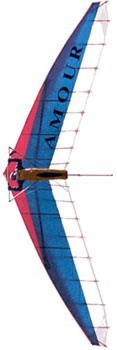
First made in 1991, the Amour was designed for the recreational pilot. It was claimed to be an exceptionally agile performance wing.
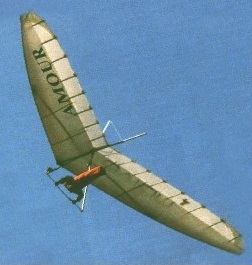
The Amour has an aerofoil king post, 17 top surface battens, and 4 undersurface battens, trim tips, HT 30 TF tubing, no keel pocket, mylar leading edge, 4.2 ounce sail cloth, VB, and a weight of 56 lbs in the bag was claimed. Price including VAT was £1938.75.
Later models, the Amour 159, were upgraded to include 19 top surface battens and 6 under surface battens.
The 1991 Avian Amour is described as a lovely glider – respectable performance – easy handling easy landing. A good 2nd glider for those looking for more perfomance – or more experienced pilots looking for a ‘Fun’ wing.
Some 159 had tendency to drop a wing on landing. Some land well, others don’t. On light wind landings, it seems to resist the flare, followed by a tip stall, with the stalled wing catching. Apparently ‘de-tuning’ the tips helps, as does ‘landing’ 2m above the ground (out of ground effect?). Otherwise, very nice glider.
Handling is a little stiff, heard rather heavy pilots reporting it too. However with a bit of push out while weightshifting you can turn it reasonably quick or keep that wing down. The Amour159 reportedly handles easier. The glider a bit stiff in turn (especially if turn with bank angle more than 45 degrees).
Landing – didn’t notice much resistance to flare, but heard of that on 159 size. Quite easy on 139.
Rather short control frame, good for short pilots. All construction is definitely aimed to satisfy small pilots.
Amour 139
Wing area: 12.5 m²
Wing span: 8.85 m
Aspect ratio: 6.3
Minimum pilot weight: 48 kg
Maximum pilot weight: 80 kg
Nose angle: 121°
Amour 159
Wing area: 14.6 sq.m / 157 sq ft
Wing span: 9.85 m / 32.3 ft
Nose Angle: 123 degs
Aspect ratio: 6.7
Double surface: 75%
Hang glider weight: 29 kg
Pilot weight: 64-93 kg / 10-14 st
Minimum speed: 24 km/h / 15 mph
Maximum speed: 90 km/h / 55 mph
Max glide ratio (L/H): 11.5
Minimum sink rate: 0.86 m/s
Packed length: 5.9 m
Certification: BHPA
Price (1991) £ 2350
Price (1998) £ 2827
1998: Stretfield Bradwell, S33 92JT Sheffield, Hope Valley, United Kingdom.
Run by Steve Elkins and Neil Hammerton.
Hang glider builder
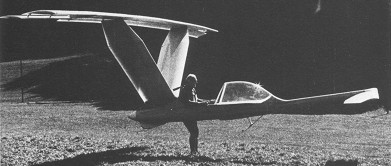
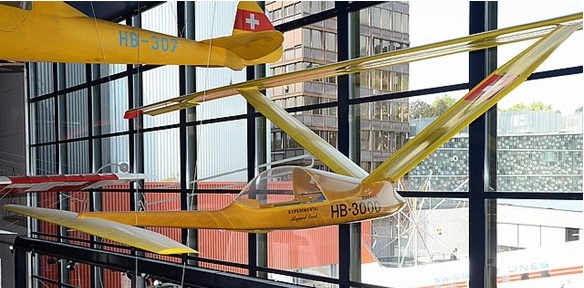
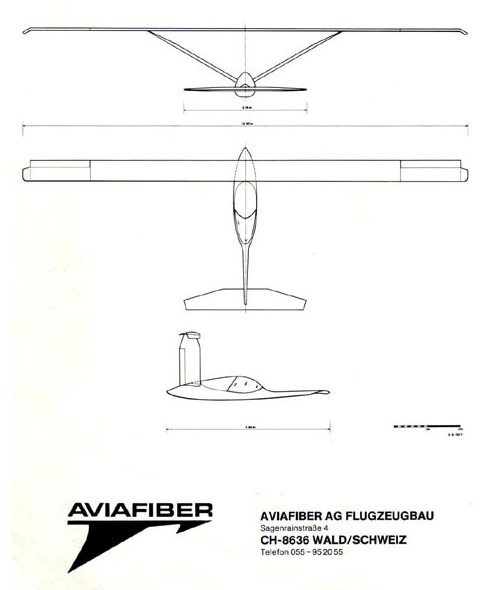
Variously described as a rigid-wing hang-glider or as a foot-launched sailplane, the Canard 2FL was designed by Swiss aero-dynamicist Hans Farner. Of fibreglass construction, it consisted of a small fuselage, big enough to accommodate the pilot in a prone position, provided with doors in the bottom through which the pilot’s legs could protrude for take-off and landing. A large canard was fitted at the nose, and the main lifting surfaces were supported atop tall, V-shaped pylons which both generated lift and acted as vertical fins. Wings, pylons and canard have Wortmann FX-67-170 airfoil section.
Construction is fiberglass to form in the matrix of the skin and spar fiberglass laminate, with extensive use of foam filler Styrofoam. To transport the wing unit disassembled into three sections of 4.8 meters (15.8 ft), to lay on the roof of a car or trailer.
Pylons (two “V” wings) attach a high wing at the mid-point of the span on both sides – positioning the main wing out of the flow of the canard. The vee-tail pylons have a core of solid hard foam unlike the styrofoam of the wings, while the ailerons have cores of hard foam cells. The wing has a Wortmann FX-63-137 section and is a single-spar structure with a vacuum-formed shell of laminated resin and glassfibre and a core of styrofoam plate. The canard did not hinge in the horizontal axis to produce pitching moments as convention dictates, but rather twisted about the glider’s longitudinal axis to control adverse yaw, thus stall was impossible (unacellerated), and Vne could not be exceeded even by deliberate pilot action. The canard was positioned out front of a fully canopied pilot pod via a slender extension. The one piece canopy/windscreen is open at the rear and for landing there is a retractable front skid and a nonretractable tailskid. A monowheel is optional for downhill rolling take-offs.
The control system is mixed. The longitudinal control, pitch, is changed by the pilot the shifting center of gravity. The pilot rotates prone on a stomach board that slides fore and aft 80 cm (32 inches). Pilot weight at launch is supported on shoulder straps. Ailerons and all-moving canards (each console can rotate (or warp) on 5 degrees relative to the longitudinal axis of the machine). On the vertical tail is mounted brakes, to control the rate of descent giving a sink rate of 0.6 m/s (120 fpm).
At first the claim of 35:1 seemed excessive but consider this, Farner had Lockhead as his client. The joined wing concept allowed an effective span of the main wing plus the pylons of around 65 feet, without the tip drag induced by the vortices of biwings.
At the start of the pilot runs on his feet, after the lift-off, pulls his legs inside the fuselage, rotated horizontally, the bottom hatch (and lantern above) is closed for the streamlining of the fuselage. Landing can take place either on the ski under the fuselage, or the pilot’s legs. After launch, doors under the pilot were closed, the pilot rotated prone and the rear canopy half was closed.
The construction and development of Canark 2FL began in August 1976 in a workshop in Hinwil, Switzerland, on the basis of a previous project by Hans Farner and Ernst Ruppert, the Colibri, dating back to 1972. The Canard-2 FL made its first flight on 7 September 1977.
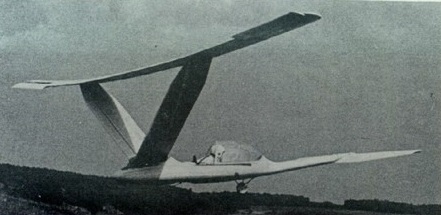
Results of flight testing with the engine running encouraged Farner and Bucher to designa dedicated motor-glider version as the Canard Aviation Canard SCM, powered by a 15–18 kW (20–24 hp) engine. Farner had previously designed a motor-glider using the FL concept as the Farner HF Colibri 1 SL, which first flew in 1979.
Test flights of the Canard took place in Vaduz. Hans Farner was killed test flying the Canard after a small number were sold. The 1980 accident that claimed the designer’s life was due to over-control of pitch. The pilot strapped into a dolly that pivoted flat after takeoff. The dolly slid forward and aft on rollers and changed the CG to control pitch. The designer slid off the dolly and ended up over-controlling and fell out of the final pull-up upside down.
The business promoter (H. Bucher) decided to withdraw the Canard 2FL, Canard SC and Canard SCM from sale, buying back all the remaining four gliders after the accident and then redesign and re-release the Canard as a sailplane. The moulds were in the small town of Wald not too far from Zurich. Another incident finally ruined the reputation of the Canard 2FL design.
Airframes constructed by Ruppert Composites of Wald, Switzerland, were HB-3000 (Sept 1978), HB-3001 (Apr 1979, HB-3002 (Aug 1979), and HB-3003 (Aug 1981).
One of the glider remains in the Swiss Lucerne Transport Museum.
Variation:
Rochelt Solair I
Canard-2 FL
Length: 4.5 m (14 ft 9 in)
Wingspan: 13.5 m (44 ft 3 in)
Wing area: 13 sq.m (140 sq ft)
Airfoil: Wortmann FX-67-170
Height: 5 ft 11 in
Empty weight: 50 kg (110 lb)
Max weight: 372 lb
Aspect ratio: 20.0
Never exceed speed: 100 km/h (62 mph; 54 kn)
Stalling speed: 24 mph
Maximum glide ratio: 31 at 37.5 mph
Minimum sink: 0.6 m/s / 120 ft/min / 1.64 ft/sec at 31 mph
Crew: 1
Packed size: 4.8 m (15.8 ft.)
 All Aero