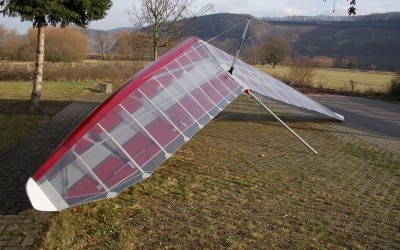
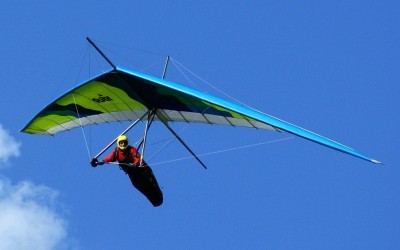
A hang glider circa 2006 with a double surface of 85%. Described as incredible performance and easy handling.
Wing area: 13.8 m² Wing span: 10.15 m Aspect ratio: 7.5 Hang glider weight: 30 kg Minimum pilot weight: 60 kg Maximum pilot weight: 120 kg Minimum speed: 25 km/h Maximum speed: 90 km/h Max glide ratio speed: 43 km/h Packed length: 5.7 m Packed length short: 3.8 m Number of battens: 29 Nose angle: 128°
Although Fizz is classified and confirmed DHV 3, it is easier to drive than the Kite which is an intermediate wing DHV2. Incredible performance for a kingposted glider. Very low sink rate, fantastic glide. The wing gives you a precise feeling of the surrounding air. Not hard to land, but requires a good approach because of the flat glide.
Fizz 14 2012 Wing area: 14.1 m² Wing span: 10.41 m Aspect ratio: 7.7 Hang glider weight: 31 kg Minimum pilot weight: 60 kg Maximum pilot weight: 120 kg Minimum speed: 25 km/h Maximum speed: 90 km/h Max glide ratio speed: 45 km/h Packed length: 5.7 m Packed length short: 4.1 m Number of battens: 30 Nose angle: 130°
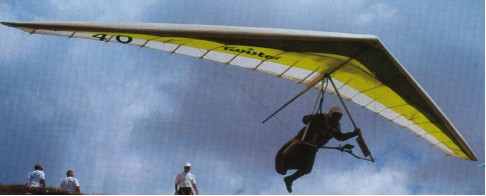
For 1998 the Zimmer brothers improved the topless Twister SPS with a revised system for controlling washout.
Twister SPS
Regarded as a great glider, very solid and stable. Hard on hard conditions, but smooth on soft ones. Out of all topless gliders, this is one with the best /easiest handling. At takeoff, there is no slack in the side wires, a big advantage on a windy day without assistance. Control is effortless, without any delay, and well co-ordinated. There were some problems with batten tensioner.
There is a 13m version with less sail (unofficial and unapproved by Bautek), that were made to meet the demand for light pilots.
Twister SPS Wing area: 14 sq.m Certification: DHV 2-3 Pilot weight: 65-110 kg Wing span: 10.4 m Nose Angle: 132 degs Aspect ratio: 7.7 Price (1998) 9800 DM
SPS (Safety Pitch System) Span: 10.4 m / 34 ft Wing area: 14 m² / 151 sq.ft Double sail: approx. 80% Aspect ratio: 7.7 Glider weight without cover: 34.5 kg / 76 lb Minimum pilot weight: 65 kg Maximum pilot weight: 110 kg Minimum take-off weight: 100 kg / 220 lb Maximum take-off weight: 141 kg / 310 lb Minimum speed: 25 km/h / 16 mph Maximum speed: 80 km/h / 50 mph Max glide ratio: 11.79 Max glide ratio speed: 45 km/h Minimum sink rate: 0.96 m/s Minimum sink speed: approx. 35 km/h / 19 mph Packed length long: 5.7 m / 18.5 ft Pack length short: 4.1 m / 13.5 ft Number of battens: 29 Nose angle: 132° DHV: 2 – 3 Number of battens: 29 (8 lower)
Sunrise 1996 Wing area: 13 m² Wing span: 10.14 m Aspect ratio: 8 Hang glider weight: 29 kg Minimum pilot weight: 60 kg Maximum pilot weight: 100 kg Minimum speed: 32 km/h Maximum speed: 80 km/h Max glide ratio speed: 40 km/h Packed length: 5.8 m Packed length short: 4.1 m Number of battens: 26 Nose angle: 127°
Sunrise 1998 Wing area: 13 sq.m Certification: DHV 2-3 Pilot weight: 65-100 kg Wing span: 10.2 m Nose Angle: 132 degs Aspect ratio: 8 Price (1998) 8400 DM
A very thick fabric and resistant to aging (no mylar except BA), and DIAX at the trailing edge (about 40cm throughout).
Astir 1995 Wing area: 14.7 m ² Wing span: 10.56 m Aspect ratio: 7.6 Hang glider weight: 30 kg Minimum pilot weight: 60 kg Maximum pilot weight: 115 kg Minimum speed: 31 km/h Maximum speed: 80 km/h Max glide ratio speed: 37 km/h Packed length: 6.15 m Packed length short: 3 m Number of battens: 26 Nose angle: 127°
Astir 1998 Wing area: 14.7 sq.m Certification: DHV 2 Pilot weight: 60-115 kg Wing span: 10.5 m Nose Angle: 130 degs Aspect ratio: 7.6 Price (1998) 7600 DM
The Raptor is a rigid wing hang glider kit manufactured by Bailet’s Composites. The Raptor is a swept flying wing with tip rudders and was designed by Matt Kollman of Columbus, Ohio. Matt and Roy Bailets worked together on the Genesis sailplane where they met Jim Marske. Jim supplied the airfoil and ideas for the structure which Matt turned into the Raptor design. Roy Bailets was developing the tooling for kit production in Mojave, CA. The Raptor production prototype should have been flying the summer of 1997. Matt Bailets had been flying the prototype for about 3 years and had more than 70 hours flight time.



 All Aero