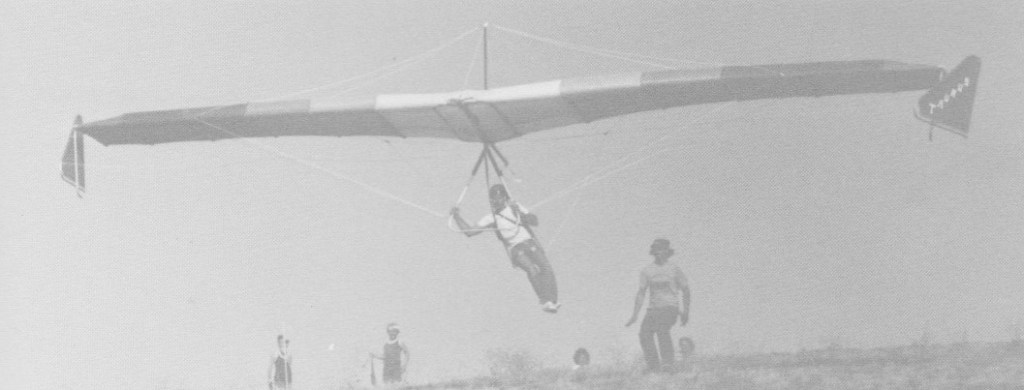
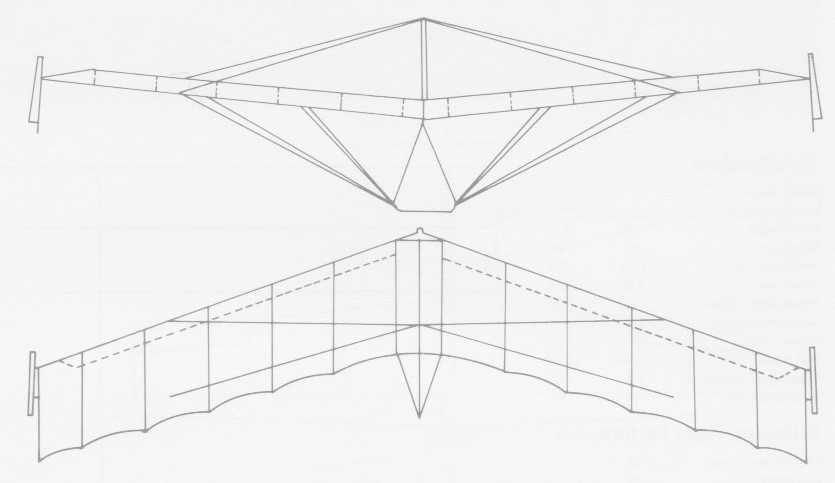
Birdman Sports Cherokee

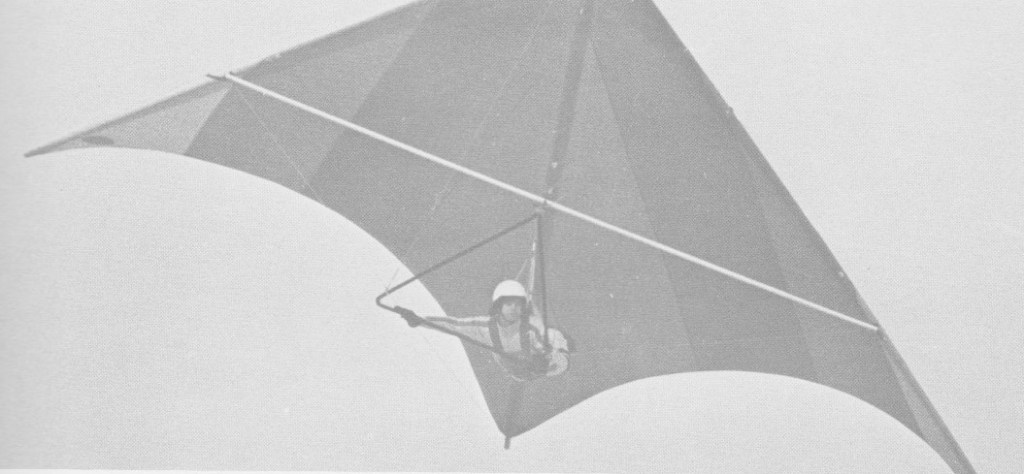
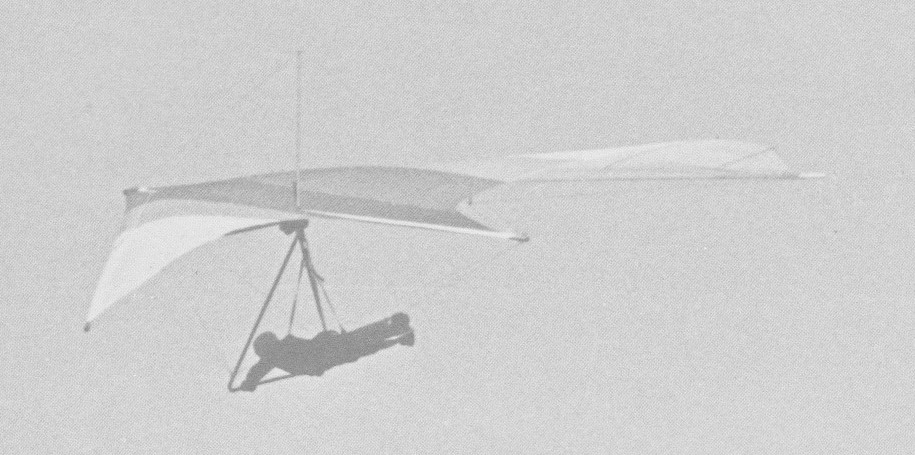
The Cherokee was a new machine in 1979 that has such mellow handling characteristics that it is suitable for intermediate right through to expert pilots.

The Cherokee sail is built in 3.8 oz material with 6 oz reinforcing panels. It is fully cambered and is the result of a constant R & D programme pursuing higher performance and better handling. The airframe is in 1 3/4 x 18 g HT30TF aluminium, inner and outer sleeved where appropriate. The control frame is 1 1/8 x 14 g and folds with the removal of a single button pin. A centre box system is used to allow quick and easy rigging.

The Cherokee was in its day a great, easy to handle, land and take off. Even many years on there were a few that still fly them on the sand dunes where they are right at home for the low slow flying. They also do not get sand build up inside their frame work.

Cherokee medium
Leading edge: 19 ft 4 in
Keel: 13 ft 2 in
Root chord: 10 ft 6 in
Sail area: 170 sq ft
Nose angle: 120 deg
Span: 30 ft 6 in
Aspect ratio: 5.47
Weight: 61 lb

Tandem
Wing area: 17 sq.m
Max pilot weight: 120kg

Birdman Enterprises Sky Raider

The Sky Raider was designed for advanced pilots. The glider came with a 60 inch control bar, adjustable wires for either seated or prone, J-wire, double deflexers, cambered keel, and seat assembly.

The airframe is made from 6061-T6 1 5/8in x .058 clear anodised seamless tubing. Spars and exterior sleeving are precision drilled. Crush proof stainless steel bushings, plastic end caps and plastic saddles are used. The keel is cambered by use of a J-wire.

Top and bottom rigging is 3/32in 7×7 PVC coated stainless steel aircraft cable. J-wire is 1/8in 7×7 stainless steel aircraft. Turnbuckles are used on J-wire, top rigging and deflexers. Tail rig quick pin is used on top rigging. All cable ends are double nico pressed.

Nose plate, tangs, kingpost bracket, control bar bracket and shackles are stainless steel. Nuts and bolts are aircraft quality.

The custom sail, 3.8oz stabilised Howe and Bainbridge dacron, was available in 11 colours. Stress points are reinforced with 10oz dacron. Seams are double zig-zag stitched. The tip cord extension is supported by fibreglass battens.

The seat is constructed with webing or 5/16in polypropelene rope. A backstrap was standard. A prone harness was available – Simpson or UP.

21×15
Leading edge: 21 ft
Keel length: 15 ft
Wing span: 32.5 ft
Wing area: 182 sq,ft
Aspect ratio: 5.9
Nose angle: 100˚
Sail billow: 1.5˚
Weight: 45 lb
Pilot weight: 120-155 lb
Takeoff speed: 12 mph
Stall speed: 16 mph
Max speed: 45 mph
Best glide ratio (L/D): 7-1
Best L/D speed: 22 mph
Min sink: 225 fpm

22 x 16
Leading edge: 22 ft
Keel length: 16 ft
Wing span: 34.5 ft
Wing area: 200 sq,ft
Aspect ratio: 6.0
Nose angle: 100˚
Sail billow: 1.8˚
Weight: 47 lb
Pilot weight: 150-200 lb
Takeoff speed: 12 mph
Stall speed: 16 mph
Max speed: 45 mph
Best glide ratio (L/D): 7-1
Best L/D speed: 22 mph
Min sink: 225 fpm

Birdman Enterprises Shadow

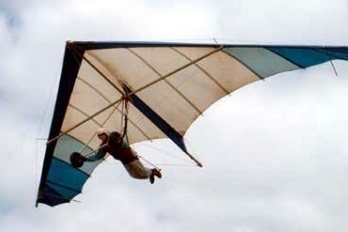
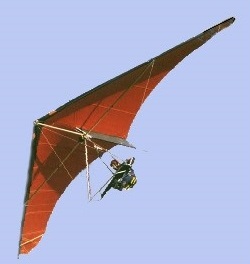
The circa 1972 Shadow was designed for beginner and advanced pilots, as a stable, easy to fly, glider.

The airframe is made from 6061-T6, 1 5/8in x .058 clear anodised seamless tubing. The spars are precisin drilled and the use of crush proof stainless steel bushings and plastic caps eliminate the need for wood dowelling. Cables are 3/32in 7×7 stainless aircraft and were available plain or PVC coated. The kingpost wires have turnbuckles and quick pin for assembly. All cable ends are nico pressed.

The nose plate, tangs, kingpost bracket, control bar bracket and shackles are stainless steel, and all nuts and bolts are aircraft grade.

The glider came equipped with a 50in control bar, adjustable wires for either seated or prone flying, and one piece waterproof bag. Deflexers, 60in control bar, J-wire, and vinyl-coated wires were optional.

Avialable in three sizes, the smallest was also used for towing. Stainless steel control bar with quick release, floats, fully battened sail, boat quick release and a 135 ft tow line were standard equipment on the 18×16 ft tow kite. A boat pylon was optional.

A custom sail was available in 11 different colours, made from 3.8oz stabilised dacron. All seamsdouble zig-zag stitched and cut for wing spar deflection. Tapered, applied leading edge pockets were standard.

The seat was constructed with webbing of 5/16in polypropelene rope, with a backstrap as standard. Simpson or P prone harnesses were available.

18×16
Leading edge: 18 ft
Keel length: 16 ft
Wing span: 25.5 ft
Wing area: 163 sq,ft
Aspect ratio: 3.84
Nose angle: 90˚
Sail billow: 4˚
Weight: 40 lb
Pilot weight: 100-150 lb
Takeoff speed: 12 mph
Stall speed: 15 mph
Max speed: 40 mph
Best glide ratio (L/D): 5-1
Best L/D speed: 24 mph
Min sink: 375 fpm
19×17
Leading edge: 19 ft
Keel length: 17 ft
Wing span: 27 ft
Wing area: 190 sq,ft
Aspect ratio: 3.84
Nose angle: 90˚
Sail billow: 4˚
Weight: 42 lb
Pilot weight: 130-180 lb
Takeoff speed: 12 mph
Stall speed: 15 mph
Max speed: 40 mph
Best glide ratio (L/D): 5-1
Best L/D speed: 24 mph
Min sink: 375 fpm
20×18
Leading edge: 20 ft
Keel length: 18 ft
Wing span: 28.5 ft
Wing area: 203 sq,ft
Aspect ratio: 3.84
Nose angle: 90˚
Sail billow: 4˚
Weight: 43 lb
Pilot weight: 160-210 lb
Takeoff speed: 12 mph
Stall speed: 15 mph
Max speed: 40 mph
Best glide ratio (L/D): 5-1
Best L/D speed: 24 mph
Min sink: 375 fpm
Birdman Enterprises Firebird

Firebird

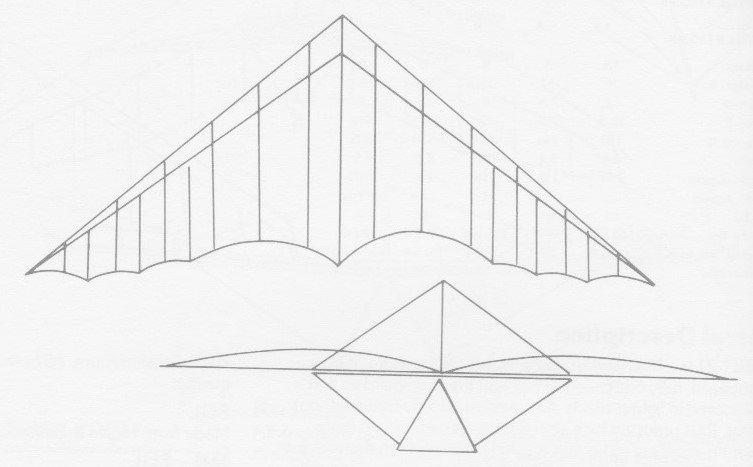
Made in 1976, the Firebird is capable of soaring in very low wind speeds and is capable of being rigged very quickly. The Firebird was offered as an intermediate glider in two sizes of leading edges 19 ft and 20 ft. The price was £265.00 in 1976.

Firebird S

Made in 1977, the Firebird ‘S’ was for new to intermediate pilots. A very easy handling glider, performance was as high as possible whilst retaining forgiving characteristics. Two sizes were available, 190 sq ft and 215 sq ft, with the 190 priced at £363.00 ex VAT. This glider replaced the existing Firebird.

Firebird S
Wing area: 190 sq.ft
Leading edge: 19 ft
Keel: 16 ft
Nose angle: 96 deg
Aspect ratio: 4.12
Span: 28 ft
L/D: 6.5:1
Min sink: 280 fpm

Firebird S
Wing area: 215 sq.ft

Bird Builders Taurus

The Taurus double-surface wing featured a cable-tensioned trailing edge. Control is through balanced wing tip drag rudders, operated by either swing seat or optional twist grips. Pitch control is through weight shift. It is fully collapsible and breaks down to a package approximately 14 ft x 10 ft x 20 ft 6 in long.

The leading edge spars are 1.75in x .049in 6063 T-832 and the trailing edge is 1.5in x .049in 6063 T-6. All other tubing is 1in 6061 T-6 of various wall thicknesses. The upper and lower ribs are .5in x .035 6061 T-6. The spars are sleeved at stress points and all joints are either wood dowelled or aluminium bushed.

Cables are 3/32in 7×7 stainless steel white vinyl coated. All thimbles are stainless steel and the cable ends have double nico press sleeves. All tangs have spar saddles. Wing root channels, shackles and tangs are all stainless steel. All other channels are anodised aluminium. Injection moulded saddles are used throughout. Nuts, bolts, turnbuckles and quickpins are all aircraft quality.

The Taurus has an adjustable kingpost for tight rigging, drag and anti-drag wires, as well as the cable-tensioning trailing edge, both fully adjustable. Prone flying was available as a special option.

The sail is Howe and Bainbridge 3.8 ox dacron in 11 standard colours. All stress points are reinforced. Stitching is boh zig-zag and straight, depending on application. The sail features .035in fibreglass sheet battens on the leading edge for smoothness. 2in velcon Velcro is used on the centre section panels.

The Taurus came standard with a supine harness and features individual leg straps and 4in wide back strap.

Leading edge: 19 ft
Chord length: 5 ft
Wing span: 34 ft
Wing area: 155 sq,ft
Aspect ratio: 7.6:1
Nose angle: 20˚
Weight: 70 lb
Pilot weight: 135-200 lb
Takeoff speed: 18 mph
Stall speed: 16 mph
Max speed: 60 mph
Best glide ratio (L/D): 10:1
Best L/D speed: 25 mph
Min sink: 180 fpm