CGS Spitfire

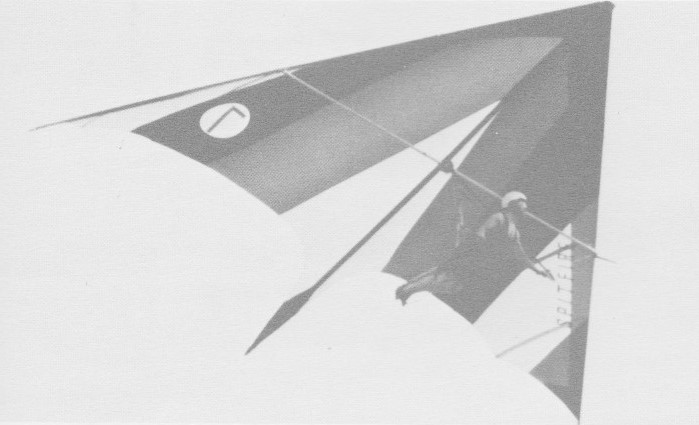
The Spitfire was one of the highest performing standard gliders of the time. Performance was equal to that of Intermediate gliders and some of high performance, with a glide ratio of 6.5-1. The Spitfire offered extreme stability with the performance.

The stinger tail give the directional stability at low speeds. The Spitfire has no tendency to spin off or drop a wing when landing.

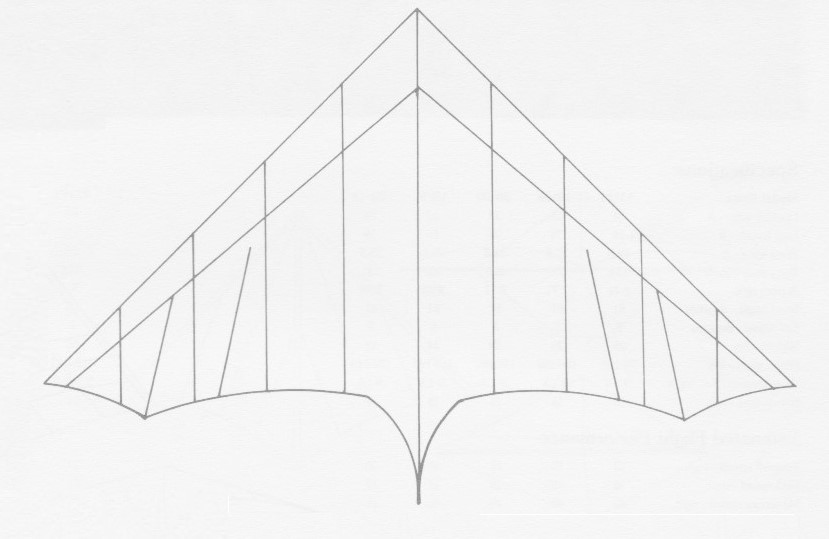
The Spitfire was available in two versions: Standard Set Up sets up like most other gliders having a one piece spar, with no tools necessary taking 8 minutes, Quickie Set Up opens like an umbrella, taking about 60 seconds. Nothing comes off the glider, not even the control bar. The Spitfire has a J-wire for defining the S-shaped keel, Dual rigging for either prone or seated flying, swing down deflexers for increased maneuverability, and holes for centre of gravity adjustment.

The airframe is made from 6063-T832 1.5in x .049 certified aluminium tubing, Reinforced sleeves are 6061-T6 1in x .058 tubing. All tubing is bright dipped and anodised. Spar saddles are used wherever there is tube to tube contact. All hardware is aircraft quality and all tags are stainless steel. Plastic king post fittings allow the kingpost to be plugged in or out for easy replacement. A stainless steel king post bracket is fitted.

Rigging is 3/32in 7×7 pastic coated stainless steel cable. Cable ends are double nico pressed utilising stainless steel thimbles. Cable tensioners are used on upper rigging.

The sail is Howe & Bainbridge 3.8oz stabilised dacron in eleven colours combination. 12in leading edge pockets tapered to 6in at the wing tips.

17×15
Leading edge: 17 ft
Keel length: 15 ft
Wing span: 23 ft
Wing area: 150 sq,ft
Aspect ratio: 3.5
Nose angle: 90˚
Sail billow: 3.5˚
Weight: 37 lb
Pilot weight: 100-130 lb
Takeoff speed: 14 mph
Stall speed: 16 mph
Max speed: 40 mph
Best glide ratio (L/D): 6.5-1
Best L/D speed: 24 mph
Min sink: 285 fpm
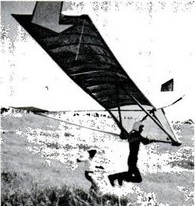
18×16
Leading edge: 18 ft
Keel length: 16 ft
Wing span: 25 ft
Wing area: 180 sq,ft
Aspect ratio: 3.5
Nose angle: 90˚
Sail billow: 3.5˚
Weight: 39 lb
Pilot weight: 130-160 lb
Takeoff speed: 14 mph
Stall speed: 16 mph
Max speed: 40 mph
Best glide ratio (L/D): 6.5-1
Best L/D speed: 24 mph
Min sink: 285 fpm
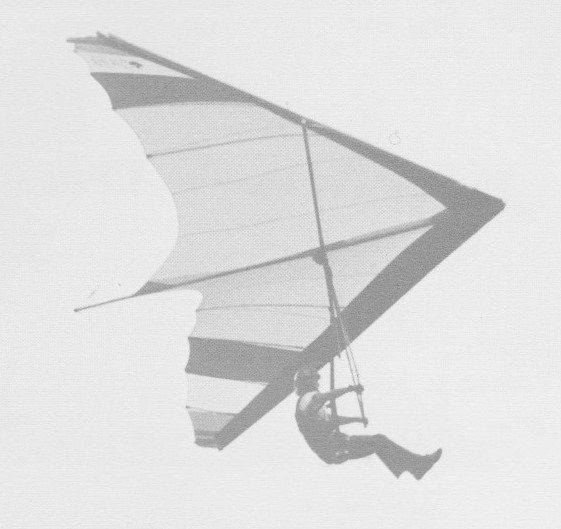
20×18
Leading edge: 20 ft
Keel length: 18 ft
Wing span: 28 ft
Wing area: 225.5 sq,ft
Aspect ratio: 3.5
Nose angle: 90˚
Sail billow: 3.5˚
Weight: 42 lb
Pilot weight: 150-210 lb
Takeoff speed: 14 mph
Stall speed: 16 mph
Max speed: 40 mph
Best glide ratio (L/D): 6.5-1
Best L/D speed: 24 mph
Min sink: 285 fpm
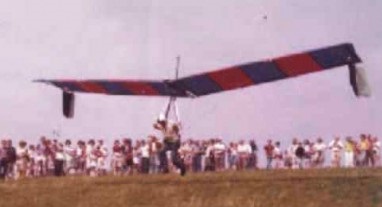
CGS Aviation

As an aeronautical engineer who had collaborated in programmes from such as Apollo X 15 and XB 70, Chuck Slusarczyk founded CGS (Chuck’s Glider Supplies) in 1972 and around 2000 hang gliders were sold in five years. This company was made famous by the creation and distribution of the first drive unit specifically designed for microlights, the famous Power Hawk.
In the early 1970’s, Chuck Slusarczyk designed, built, and sold hang gliders and various associated supplies. Shortly thereafter, he began experimenting with the powered hang glider, propelled at the time by small direct-drive go-kart engines. The propeller was bolted directly to the crankshaft of the engine and turned at high (5,000-6,000 rpm) speeds. Chuck realized that this design was not efficient.
With this shortcoming as impetus, Chuck successfully designed and produced a power system implementing a reduction drive to turn a larger-diameter, more efficient propeller. By 1977, Chuck’s Glider Supplies had become a leading manufacturer of hang gliders with a successful division producing power plants for a variety of ultralights. For his pioneering efforts, Chuck was awarded Patent No. 4.262.263, “Powered Hang Glider with Reduction Drive.” Slusarczyk declined to take legal action against his competition for patent infringement.
In October, 1979, Chuck’s Glider Supplies became CGS Aviation, Inc. In early 1980, CGS conducted a market study at Sun N Fun and also Oshkosh to determine the features of an ultralight most desired by pilots. The “Hawk” was the end result of that study. The first prototype took to the air in January 1982.
1982: CGS Aviation Inc, 1305 Lloyd Road, Wickliffe, Ohio 44092, USA.
1995-8: PO Box 470635, Broadview Heights, OH 44147, USA.
2009: CGS Aviation
9090 Louis Tillman Rd
Grand Bay, AL 36541-5210
CGS Aviaton came under new ownership. Due to health issues, Chuck Slusarczyk, the founder of CGS, passed on the Hawk design and daily manufacturing operations of the company. New owner and president, Danny Dezauche, Tony Warnock serve as Operations Officer and Steve Bensinger the Technical Director. Chuck continued to provide technical assistance as needed.

California Gliders Wind Gypsy

Wind Gypsy IV

The Wind Gypsy I is an elliptical enclosed truncated tip high performance glider for advanced pilots, featuring the Ram Air double surface leading edge.

The Wind Gypsy IV offered higher performance, power and maneuverability while still maintaining excellent yaw, roll and pitch stability. It is fitted with a three position control bar. Heart bolts are turret rigged, refined and reinforced for dynamic torsional loads, forming a frame with dihedral, washout and reflex.

The leading edges are 2024-T3 1.25in, control bar and kingpost are 2024-T3 1in, all anodised aluminium, and atainless steel Tesla bushings. The rigging cable is 3/32in 7 x 7 coated stailess steel, and top wire has quick release cable tensioners. All hardware is aircaft quality with a quick release hardware system.

The sail is made from 3.8oz stabilised dacron. The sail is cambered, scalloped and has air rammed leading edges. It is templated and patterned for exactness.

A prone or seated harness was available.

Wind Gypsy IV
Leading edge: 16.5 ft
Keel length: 12 ft
Wing span: 30.25 ft
Aspect ratio: 5.6
Nose angle: 111.4˚
Sail billow: 1.95˚
Weight: 41 lb
Pilot weight: 140-200 lb
Takeoff speed: 8 mph
Stall speed: 16 mph
Max speed: 45 mph
Best glide ratio (L/D): 7.25
Best L/D speed: 23 mph
Min sink: 227 fpm

Bright Star Gliders Valkyrie

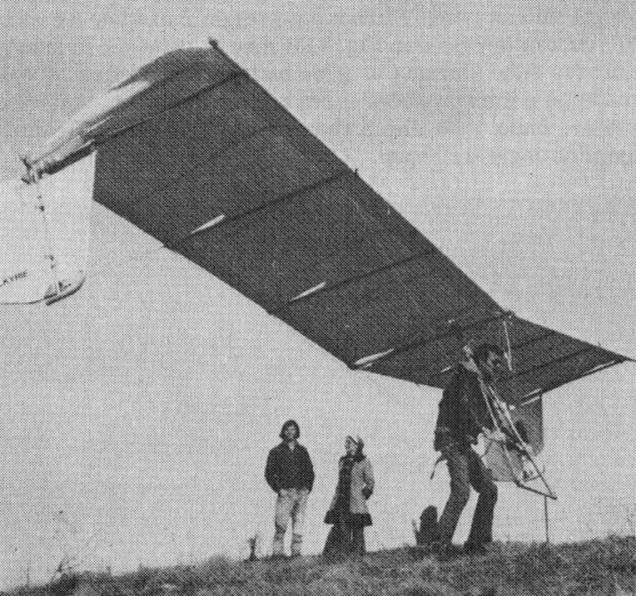
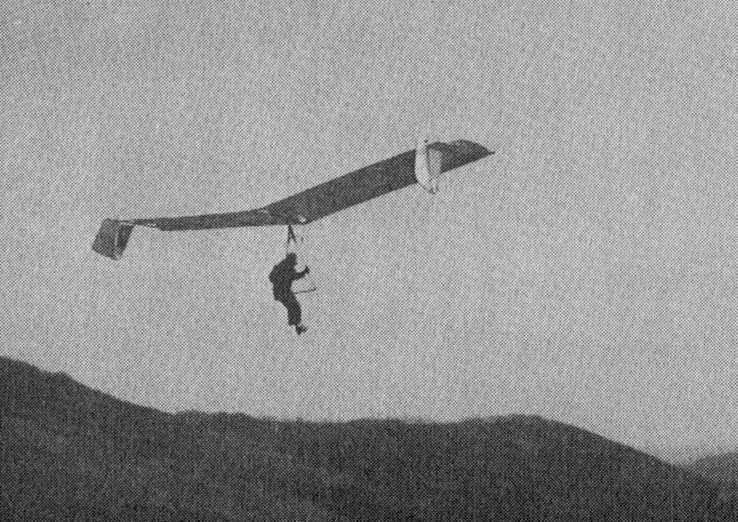
Designed by Bill Wolf of Columbus, Indiana, USA. It was easy to build with just the construction plan. But one big disadvantage: it could not be completely disassembled, only folded in half.

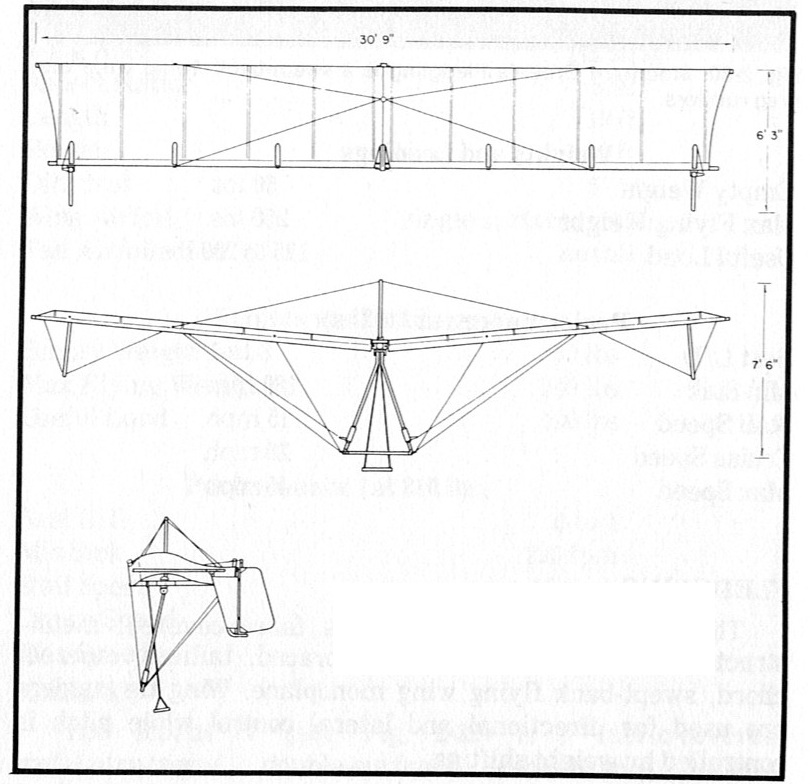
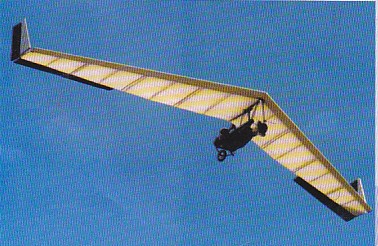
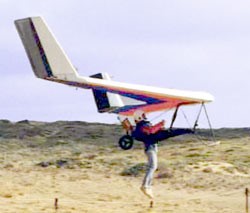
The Valkyrie is a fabric covered metal-structured, cable-braced, tailless, flying wing of constant chord and straight leading edge. Wingtip rudders are used for directional control, while pitch control is achieved solely by means of weight shifting. The tip rudders may be deflected to induce drag for either turning or glide path control. Deflecting one rudder at a time produces a turn and bank about the deflected rudder, while deflecting both rudders simultaneously causes the glide angle to steepen.

Take down / setup times are about 10 minutes without tools, and the Valkyrie should be carried on a special rack to minimise damage. Pilot suspension is via typical swing seat. It takes about 50 to 60 hours to build a kit.

Bill Wolf’s unique Valkyrie

Wing area: 12.82 m²
Wing span: 9.37 m
Aspect ratio: 6.8
Hang glider weight: 22 kg

Wing span: 30 ft 9 in
Wing area: 138 sq.ft
Aspect ratio: 6.8
Length: 6 ft 3 in
Height: 7 ft 6 in
Dihedral: 5 degrees
Wing Airfoil: single surface, reflex
Empty weight: 50 lb
Max flying weight: 250 lb
Useful load: 125-200 lb
Best L/D: 8-1
Min sink: 180 fpm
Stall: 15 mph
Cruise: 20 mph
Max speed: 45 mph