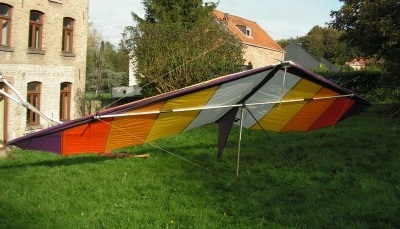
The Mini was made by Choucas in Switzerland.
The Mini was made by Choucas in Switzerland.
The Maxi hang glider was made by Choucas in Switzerland.
Wing area: 19.2 m²
Wing span: 10.4 m
Aspect ratio: 5.63
Hang glider weight: 27 kg
Minimum pilot weight: 65 kg
Maximum pilot weight: 140 kg
Packed length: 6.1 m
Number of battens: 14
Nose angle: 116°
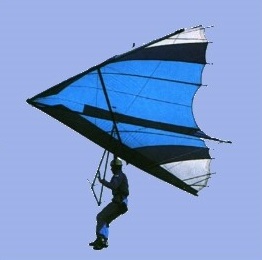
Made in 1978, the Vortex was Chargus’ first contribution to the intermediate glider market. The machine, which was supplied in two sizes, follows the Superscorpion deflexerless concept but with the addition of vortex generators. These are little holes cut in the wing tips just behind the leading edge to give a lower stalling speed than normal. Rigging utilised a difficult to assemble control frame and bolt-on cross booms, like the Mk 1 Superscorpion. Finish was good with lots of attention to details and all tubing is anodised matt black.
The performance of the Vortex is good at slow speeds where it really proves its slow flying, slow sink rate ability. The machine however becomes very light in roll at high speeds and will oscilate badly in rough air, particularly if the pilot is inexperienced and is overcorrecting.
In 1978 the Vortex 110 was priced at £397.00 inc bag and VAT, and the Vortex 120 at £415.00 inc bag and VAT.
Vortex 110
Leading edge: 19 ft 0 in
Keel: 12 ft
Sail area: 196 sq ft
Nose angle: 110 deg
Billow: 0.68 deg
Aspect ratio: 4.6
Span: 30 ft
Vortex 120
Leading edge: 19 ft 0 in
Keel 12 ft
Sail area: 204 sq ft
Nose angle: 120 deg
Billow: 0.68 deg
Aspect ratio: 5.23
Span: 32ft 8 in

The original Midas was superseded by the 1976 Midas E which was retrospectively re-titled as Midas C. the price including carrying bag, harness and VAT, was £ 450.00 in 1976
The 1977 Midas E was an excellent performing and popular glider. Its short chord at the keel is an unusual feature.


The 1978 Midas Super E has some special features, amongst which are an adjustable C of G strop, large diameter cross boom and short or long keel option. Triple tubular wing posts give greater strength to the airframe and more control to the canopy shape. Aircraft push pins are used for uncomplicated and rapid assembly. Another feature is the floating truncations which greatly contribute to the machine’s speed range, glide ratio and sink rate. The Midas Super E is constructed only of top grade materials and uses American Dacron sail cloth.
Midas C
Sail area: 166 sq.ft
Leading edge: 19 ft 3 in
Keel: 8ft. 3in
Nose angle: 110 deg
Billow 1.6 deg
Aspect ratio: 6.0
L/D: 8 to 1
Midas E
Leading edge 19 ft 11 in
Keel 8ft.3 in
Sail area 188 sq.ft
Nose angle 110 deg
Billow 1.6 deg
Aspect ratio 5.7
L/D 8.5 to 1
Midas Super E
Leading edge: 19 ft 10 in
Root chord: 8 ft
Sail area: 188 sq ft
\Nose angle: 110 degs
Aspect ratio: 5.7
L/D: 9.5:1
Mean chord: 5.74 ft
Keel: 17 ft 5 in
Span: 32 ft 9 in
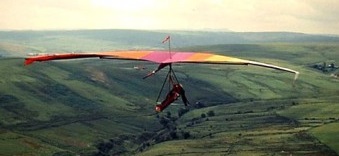
The Cyclone is a high aspect ratio machine which utilises a tight sail and preformed battens. The glider was designed purely for experienced pilots with cross country and competition flying in mind. The Cyclone has single deflexers and unusually a tip to control frame wire and is very sensitive to turning on the various turnbuckles. Handling is a little difficult until the pilot has adapted to the machine’s peculiarities. Pitch and roll on the small 165 model are fairly light which normally leads to quite a lot of pilot induced oscilation. On the large 180 model roll is much heavier, leading to possible discomfort in rough air. Performance is excellent and the sink rate of a well tuned 180 Cyclone is hard to beat. The glider was the fastest of the machines at the time; the large one being faster than the small model.
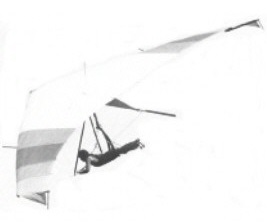
In 1980-81 the Chargus company brought out the Mk II Cyclone which features a floating keel which improves the handling.
Cyclone 180
Root: 7.66 ft
Sail area: 180 sq ft
Span: 36 ft
Aspect ratio: 7.2
Price: £595.00 inc bag VAT.
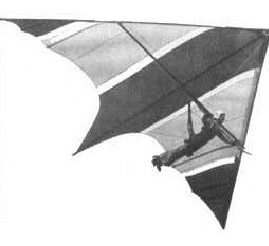
The 1976 Vega is an intermediate glider of the second generation. In November 1976 the price was quoted as £384.00 inc carrying bag, harness and VAT.
The Vega II, made in 1977 was offered in two sizes: ‘A’ 195 sq ft and ‘B’ 220 sq ft.
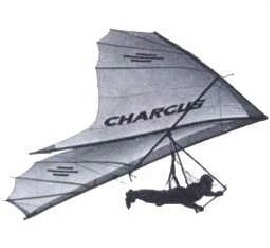
Vega
Sail area: 188 sq ft
Leading edges: 19 ft
Keel: 16 ft
Aspect ratio: 4.47
Billow: 2.75 deg,
L/D: 6.5:1
Nose angle 100 deg
Vega 11 ‘B’
Leading edge 19ft 8in
Keel 15ft. 7in
Sail area 220 sq.ft
Nose angle 100 deg
Billow 2.25 deg
Aspect ratio 4.09
Root chord 15 ft 3 in
L/D 7 to 1
1983: Chargus Gliding Co Ltd, Gawcott, Bucking¬ham, Bucks, UK.
Hang glider builder
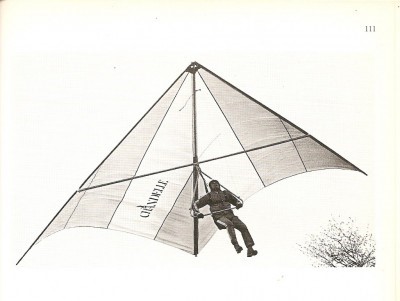
Built in the United States, the 1973 Chandelle Standard came in two models.
The Chandelle Comp had a design flaw and would stabilize in a dive and many pilots were killed before they stopped production.
Walt Nielsen
Chandelle compétition
Wing area: 20 m²
Hang glider weight: 17 kg
Minimum pilot weight: 75 kg
Packed length: 5.49 m
Nose angle: 90°
Chandelle standard
Wing area: 20.81 m²
Hang glider weight: 16 kg
Minimum pilot weight: 75 kg
Packed length: 5.49 m
Nose angle: 80°
The CGS Wind Gypsy was a hang glider for Intermediate pilots.
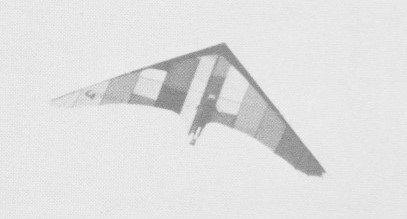
The Falcon V is a second generation high performance glider that features good penetration and high speed coupled with good low speed and low sink rate. It has no tendency to drop a wing in stalls and is very stable in slow speed landings. It tends to mush considerably before stalling.
The king post allows the king post tubing to be simply unplugges for replacement. The Falcon V incorporates and elliptical planform and the shape on the wing tips is maintained by use of radially arranged battens in the wing tips. A S-shaped keel adds camber and reflex to the sail. The control bar bracket allows the spar to fold up umbrella-type setup without requiring tools. Deflexers are used. Seat or harness were optional, as was negative or inverted deflexer blades.
The airframe is made from 6063-T832 1.5in x .049 or 1.75in x .049 (depending upon size and model) certified aluminium tubing, bright dipped and anodised for a chrome-like finish. Exterior sleeving is 6063-T832 1 5/8in x .058 or 1 7/8in x .058. Full bushings throughout with dowelings are used in high stress areas. Spar saddles are used.
Rigging cable is 3/32in 7×7 302 plastic coated stainless steel. Cable ends are double nico presses utilising stainless steel thimbles. Turnbuckles are aircraft grade. All hardware is aircraft quality, and all tangs, kingpost bracket, shackles, and rounded nose plate are stainless steel.
The sail is made from Howe & Bainbridge 3.8oz stabilised dacron, in 11 colours or combinations. All seams are double zig-zag stitched and stress points are reinforced. The sail is cut for wing spar deflection and has utilised keel pocket construction. A large leading edge pocket is 18in at the nose tapered to 6in at the wing tip.
The pilot support system has dual rigging for either prone or seated flying.
Leading edge: 20 ft
Keel length: 15 ft
Wing span: 32 ft
Wing area: 195 sq,ft
Aspect ratio: 5.25
Nose angle: 105˚
Sail billow: 1.7˚
Weight: 44 lb
Pilot weight: 140-200 lb
Takeoff speed: 14 mph
Stall speed: 15 mph
Max speed: 44 mph
Best glide ratio (L/D): 8-1
Best L/D speed: 23 mph
Min sink: 225 fpm
Leading edge: 22 ft
Keel length: 17 ft
Wing span: 34 ft
Wing area: 220 sq,ft
Aspect ratio: 5.25
Nose angle: 105˚
Sail billow: 1.7˚
Weight: 46 lb
Pilot weight: 170-225 lb
Takeoff speed: 14 mph
Stall speed: 15 mph
Max speed: 44 mph
Best glide ratio (L/D): 8-1
Best L/D speed: 23 mph
Min sink: 225 fpm
Leading edge: 18 ft
Keel length: 13 ft
Wing span: 29 ft
Wing area: 160 sq,ft
Aspect ratio: 5.25
Nose angle: 105˚
Sail billow: 1.7˚
Weight: 42 lb
Pilot weight: 110-140 lb
Takeoff speed: 14 mph
Stall speed: 15 mph
Max speed: 44 mph
Best glide ratio (L/D): 8-1
Best L/D speed: 23 mph
Min sink: 225 fpm

 All Aero