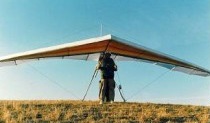
A 1985 hang glider.
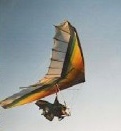
Mystic 155
Mystic 166
Mystic 177
A 1985 hang glider.
Mystic 155
Mystic 166
Mystic 177
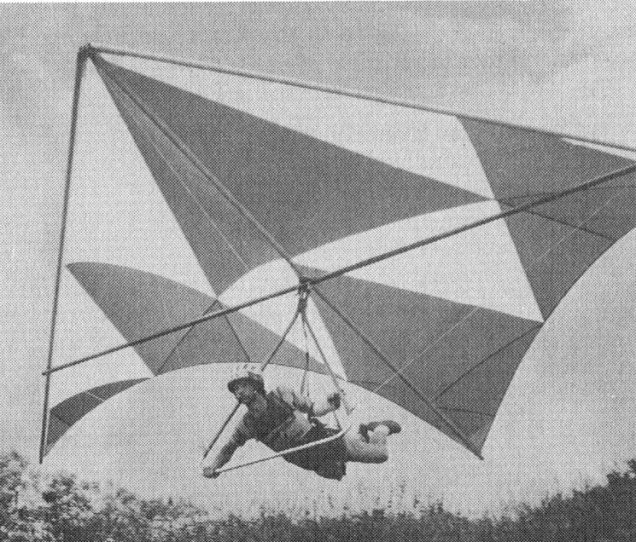
The Skytrek is a modified standard Rogallo for both foot launching and towing. It features reversible wires for seated and prone flying, a cambered keel, reinforced leading edges to eliminate wing warp and battens on tow kites. Its shorter keel, improved sail design, wide nose angle, and adjustable camber.
The spars are made from 6063-T832 clear anodised aluminium tubing, 1.5in .049 and 1 5/8in x .049 for the leading edges and keel and 1 5/8in x .058 for the crossbar.
Rigging cable is 3/32in 7×7 stainless steel. Cable ends are nico swedged and have protective coatings. No turnbuckles are used. Upper rigging uses cable tensioners.
The cross bar has special breakdown feature. The control bars are knurled. It may be set up for towing with optional stainless steel bolts and nuts, special 4030 chrome molley steel with precision release and floats.
All nuts and bolts are aircraft quality. Specially designed cable tensioners, saddles, bushings, wingposts, noseplates, brackets, tangs, and nut covers are fitted. Eye bolts are used to eliminate shackles.
The sail is custom sewn from 3.8oz Howe and Bainbridge stabilised dacron. There was a choice of 11 colours. All seams are double zig-zag stitched.
A seat, supine harness or prone harness were optional.
Leading edge: 18 ft
Keel length: 16 ft
Wing span: 25 ft 6 in
Wing area: 200 sq,ft
Aspect ratio: 3.24
Nose angle: 90˚
Sail billow: 4.5˚
Weight: 44 lb
Pilot weight: 140-180 lb
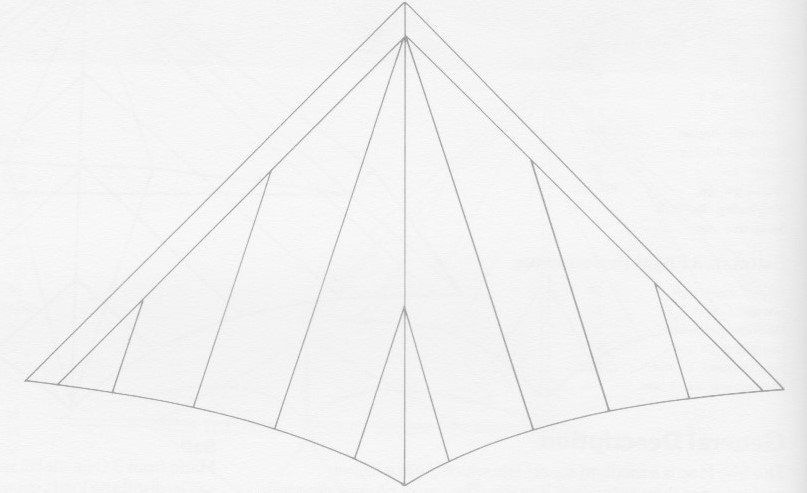
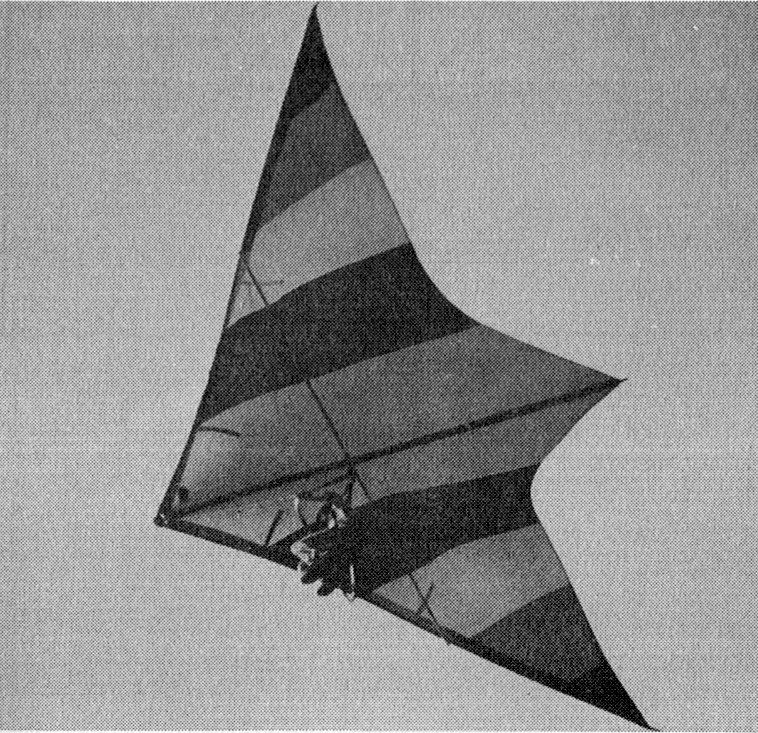
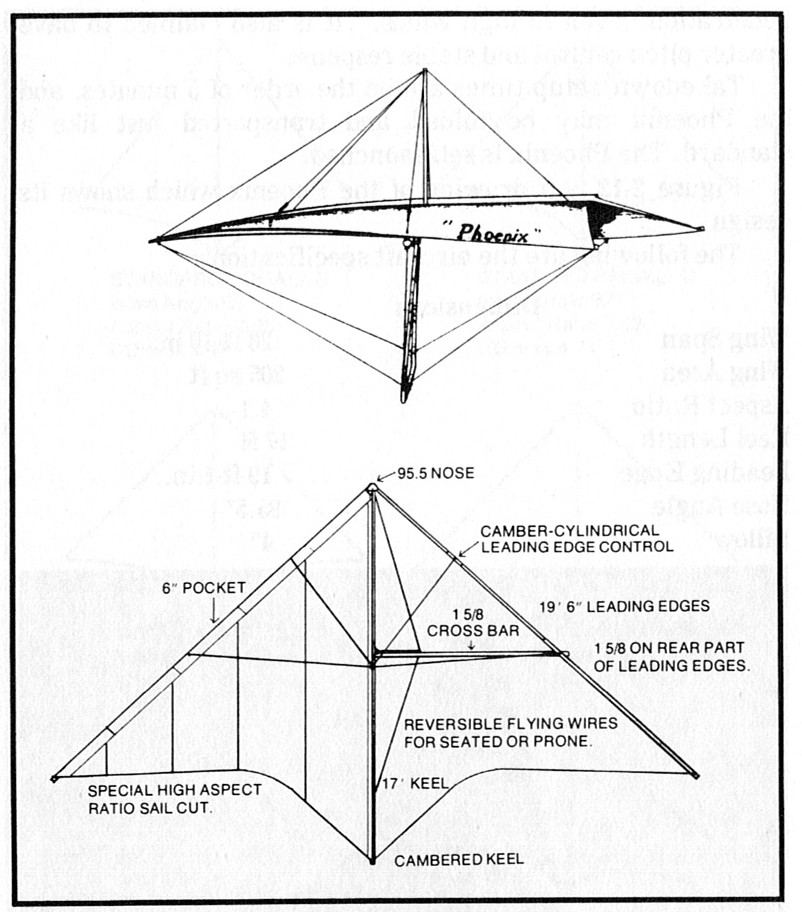
Designed by Dick Boone, the Phoenix is a medium aspect ratio Rogallo hybrid with a ‘fan tail’ sail cut, and cable tensed semi-cylindrical leading edges. It is controlled solely by means of weight shifting.
The Phoenix will perform better than a standard, but not as well as a high aspect ratio kite. It is characterised by a ‘fan tail’ cut trailing edge that is reported to increase the aspect ratio, provide for greater stability and eliminate sail flutter. It incorporates a typical trapeze bar and can be flown either seated or prone, depending on the arrangement of the lower longitudinal cables.
Take down / set up times are on the order of 5 minutes, and the Phoenix may be folded and transported.
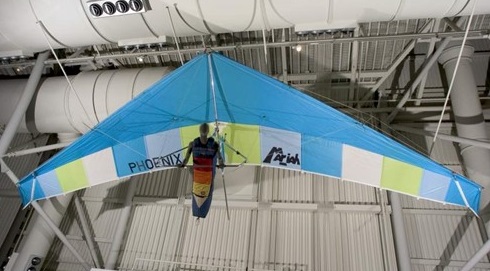
Early in 1977, Bennett asked Boone to design a new high performance Phoenix variant intended for experienced pilots. They named it the Mariah, and it introduced several radical features. The most significant change was yet another increase in aspect ratio. Wingspan increased and wing chord fell as the leading edge convergence angle grew to 120 degrees. Boone also incorporated wires supported by short posts along the wing leading edges. By applying tension to the wires, the pilot could deflect the wing to improve flying and stall characteristics. The wing was more responsive to pilot control inputs, but it was not as stable as previous gliders in the Phoenix line. Bennett and Boone believed that competent, experienced pilots could handle the high-performance wing with no trouble.
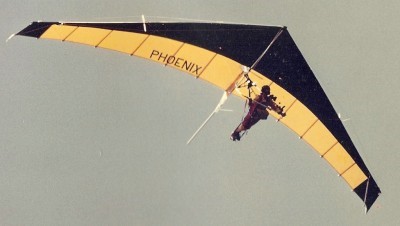
It would even be controversial after some doubtful tumblings and very questionable pitch stability. Unsafe in the wrong hands or circumstances. The first double surface with integrated cross-section. It was at the price of a multitude of cables: triple deflectors, transversal cable-stayed, etc. The success was very short after repeated tumblings for lack of batten in intrados. It was better not to have bought it.
Phoenix
Wing span: 28 ft 10 in
Wing area: 205 sq.ft
Aspect ratio: 4.1
Keel length: 17 ft
Leading edge: 19 ft 6 in
Nose angle: 95.5 degrees
Billow: 4 degrees
Empty weight: 42 lb
Max flying weight: 282 lb
Useful load: 240 lb
Best L/D: 6-1
Min sing: 300 fpm
Stall: 16 mph
Cruise: 24 mph
Mariah M-9
Wingspan: 11.4 m (37 ft 5 in)
Length: 2.5 m (8 ft 4 in)
Empty weight: 25 kg (55 lb)
Gross weight: 122 kg (270 lb)
Wing area: 14.1 m²
Wing span: 10.14 m
Aspect ratio: 7.4
Hang glider weight: 23 kg
Minimum pilot weight: 50 kg
Maximum pilot weight: 70 kg
Minimum speed: 24 km/h
Maximum speed: 55 km/h
Packed length: 5.8 m
Number of battens: 14
Nose angle: 120°
Wing area: 15.8 m²
Wing span: 10.82 m
Aspect ratio: 7.4
Hang glider weight: 23 kg
Minimum pilot weight: 70 kg
Maximum pilot weight: 80 kg
Minimum speed: 24 km/h
Maximum speed: 55 km/h
Packed length: 6.1 m
Number of battens: 14
Nose angle: 120°
Wing area: 17.65 m²
Wing span: 11.4 m
Aspect ratio: 7.4
Hang glider weight: 23 kg
Minimum pilot weight: 80 kg
Minimum speed: 24 km/h
Maximum speed: 55 km/h
Packed length: 6.4 m
Number of battens: 14
Nose angle: 120°
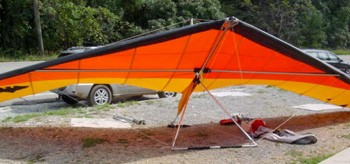
The Dream was a 1985 hang glider. Delta king kites and Gliders was bought by Teddy Mack in 1991 and renamed Air Sports International.
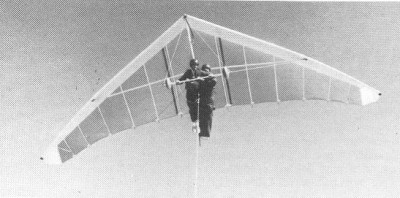
Air Sports manufactured the Dream line of gliders as hang gliders and trike wings in San Diego California from 1991 to 1997.
Dick Boone designed the 220 Dream specifically for tandem. It was the first HMGA certified for same. A very popular single surface trainer. The 220 was the de facto standard tandem glider for many years, a superb single surface glider. Very maneuverable, easy to launch, land and set up. They do have the tendency to drop the nose after landing flare.
A batch of Dreams 220 had an instability problem at low A.O.A. as some were made with less angle on the washout tubes. If the bar is pulled in a lot to speed, at first you feel great pressure but then, all of a sudden, the pressure vanishes and the bar wants to continue by itself. Only a short and healthy push restores the bars preassure. The heavier the pilot the faster you get to this occurrence. It seems that at low A.O.A luff lines and washout make the combined reflex effect and the change in the washout tubes produced this tendency to tuck at low A.O.A.
Delta Wing Dream 145
Delta Wing Dream 165
Delta Wing Dream 185
Sail area: 185 sq ft
Span: 34.4 ft
Nose Angle: 120 degrees
Weight of glider: 55 lbs
Pilot proficiency: Beginner / H-1
Pilot weight range: 140-210 lbs
Stall speed at max load: 28 mph
Max speed at min load: 38 mph
Number of battens, each side: 8 (grand total 17 includes nose batten)
Delta Wing Dream 205
Sail Area: 205 sq. ft.
Glider Weight: 55 lbs.
Pilot Hook-in Weight: 150 – 225 lbs.
Skill Level: Novice
SS/DS: Single Surface
KP/TL: Kingpost
VG: No
Leading Edge Color: Black
Undersurface Color: Orange
Main Body Color: Gold
Delta Wing Dream 220
Delta Wing Dream 240
Delta Wing Kites is a specialist in the sale of hang gliders, but then turned to the production of trikes intended for mounting under a standard hang glider wing without any modification to the latter in 1979.
1983: P.O. Box 483, Van Nuys, CA 91408, USA.
Delta king kites and Gliders was bought by Teddy Mack in 1991 and renamed Air Sports International.
The company manufactured The Dream line of gliders as hang gliders and trike wings in San Diego California from 1991 to 1997
A 1984 hang glider for Intermediate pilots.
Vision 137
Wing area: 13.75 m²
Wing span: 9 m
Aspect ratio: 5.89
Hang glider weight: 26 kg
Vision 159
Wing area: 15.9 m²
Wing span: 9.4 m
Aspect ratio: 5.55
Hang glider weight: 28 kg
Vision 176
Wing area: 17.6 m²
Wing span: 9.6 m
Aspect ratio: 5.23
Hang glider weight: 31 kg
A 1979 hang glider.
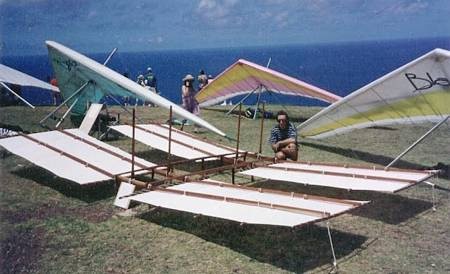
A replica of the Hargrave Tandem Monoplane Glider of 1894 built by Rob De Groot, photographed at the Hang Gliding World Championships of 1994 – the 100th anniversary of the glider designed and built by the Australian pioneer Lawrence Hargrave. As the originals only flight was unsuccessful, Hargrave shied away in his career from monoplanes, adopting instead the idea of biplanes (box-kite designs). The tandem wing monoplane however, became a concept Langley later saw fit to continue with his Aerodrome in 1903.

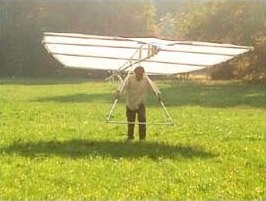
The d’Arrigo Da Vinci Volante Piume Glider is a 2003 realization of a glider design by Leonardo da Vinci of 1490–1496 which was found as a drawing and identified with the name “Piume” (Feather), only coming to light with the rediscovery in 1966 of the da Vinci Madrid Codices. The replica was designed by Angelo d’Arrigo, a hang glider pilot, who actually flew the aerodynamically-modified replica in 2003.
D’Arrigo was born in Catania, Sicily, April 3, 1961, but grew up from a very early age in Paris, as his parents emigrated there in search of work. He returned to Sicily after graduating from the university in Paris, and from his base on Mt. Etna gained a number of world records and world titles in the field of ultra light flying and free flying.
In 2001 he initiated a sequence of breath-taking events which saw him flying alongside various birds of prey as he attempted to learn from them their techniques for migratory flight by taking advantage of thermal air currents for long distance flight with low energy consumption.
In 2002 he crossed the Sahara and the Mediterranean with an eagle. His hang glider was launched from a microlight.
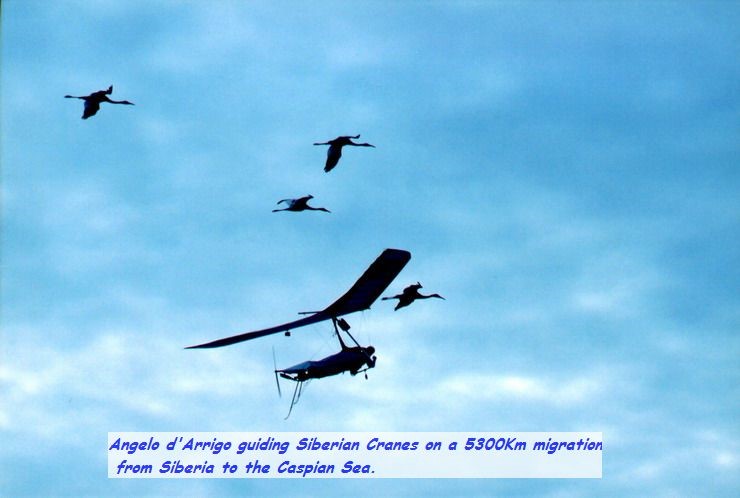
In 2003 he flew 5,500 kilometres from northern Siberia to the Caspian Sea in Iran in the company of a flock of Siberian cranes who had been born in captivity and, due to imprinting, considered him their parent. The bird is at risk of extinction, and, in order to try to save the species, Russian ornithologists hatched a plan. It called for having the eggs incubated under Angelo’s hang-glider, so the chicks saw this as they hatched. Angelo would then be with the chicks as they fledge. When they were ready to fly, they would fly alongside Angelo so they would consider him their mentor. That way, he could show them the traditional migratory route for their species. They had no other way to learn it. This approach was similar to the one taken in the movie Fly Away Home.
In 2004, he was aerotowed by Richard Meredith-Hardy and released over Mount Everest another world record. He reportedly made this flight over the summit of Everest with a trained Nepalese eagle. However, there were no eyewitnesses to this achievement, even though climbers saw and photographed Meredith-Hardy’s microlight aircraft. No evidence in the form of videos or photography has ever been brought forward, either, despite the fact that d’Arrigo’s hang-glider was equipped with three video cameras and two still cameras. The story is fully narrated in the documentary Flying Over Everest by director Fabio Toncelli.
In 2006 he followed the migratory routes of the condor over Aconcagua in the Andean Cordillera, the highest mountain in the Americas.
On March 26, 2006, he died in an accident during an airshow at Comiso, Italy, at the age of 44. A small Sky Arrow airplane, in which he was a passenger, fell 200 meters to the ground. Both d’Arrigo and the pilot, a general of the Italian Air Force and ex-test pilot, were killed on impact. At the time of his death, Angelo was engaged in planning an expedition to Peru to re-introduce two Andean condors bred in captivity and raised by d’Arrigo at his home on Mount Etna. A documentary about this was being made at the time. It was called “Born to Fly”.
In memory of her husband, his widow Laura instituted a charity, the Fondazione Angelo d’Arrigo, with the aim of helping children in Peru. Angelo d’Arrigo was posthumously given the alternative sportsperson’s award at the 2006 Laureus World Sports Awards.
 All Aero