A 1977 hang glider.
Hang-glider
Vulturelite Emu
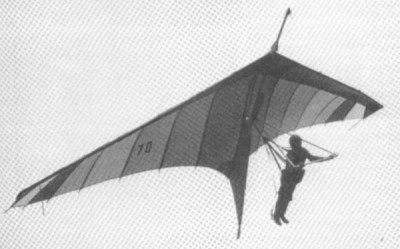
The 1979 Emu hang glider was described as with very light trim but that also made it a delight to fly as long as not in heavy air. There were reportedly inconsistencies in the manufacturing so they were not all the same but if you had a good one just magic.
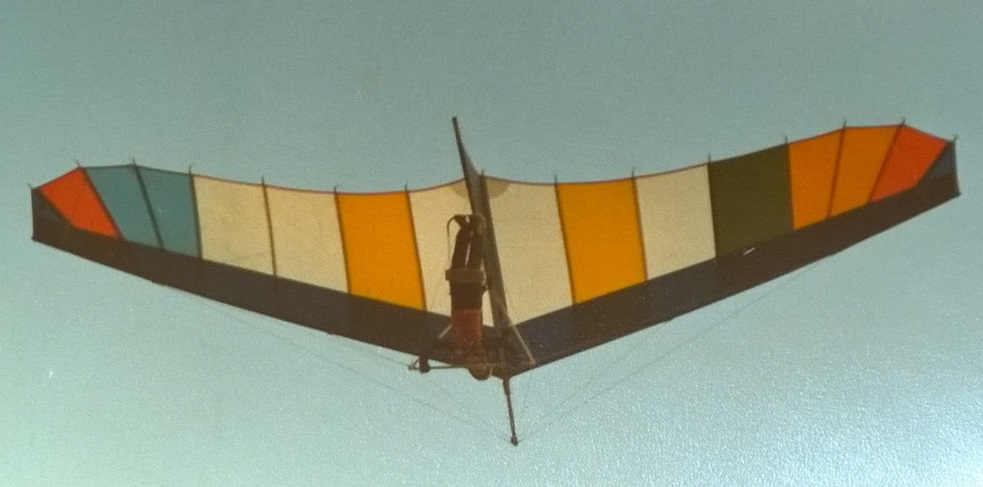
The 1979 Emu is a glider offering a genuine performance increase, while remaining easy and forgiving to fly, also being the first production glider to combine the advantages of a bowsprit type airframe with a flex-batten cambered sail.
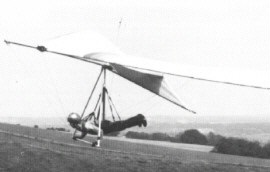
The absence of a crossbar together with the low drag aerofoil section achieve a considerable drag reduction and consequent performance increase throughout the Emu’s broad speed range. The sweep angle reduces induced drag at low speed, improving the sink rate and reducing tip stall tendencies. This combined with a short span and low roll inertia gives an extremely quick roll rate and a circling ability unequalled in any other flexwing glider, allowing efficient confident soaring in the roughest of thermals. Pitch stability and control is excellent a result of advanced sail camber and flexible battens, allowing the sail to blow down at negative angle of attack adopting a reflexed section. This augments the positive pitching action of the defined tips without the potential danger of preformed ribs near the leading edge.
Emu S
Wing area: 15.3 m²
Wing span: 9.9 m
Aspect ratio: 6.4
Hang glider weight: 22 kg
Nose angle: 140°
Emu L
Wing area: 17.5 sq.m / 195 sq ft
Wing span: 10.5 m / 35 ft
Aspect ratio: 6.3
Leading edge: 17ft 6in
Hang glider weight: 23 kg / 52 lb
Pilot weight: 10-15 st
Nose angle: 140°
Price: 533.00 +VAT
Volmer VJ-12
The 1971 Volmer Jensen VJ-12 was a hang glider conventionally controlled from aileron to elevator.
Volmer VJ-24 SunFun

The VJ-24 is Volmer Jensen’s hang glider design built from aluminum. This motorglider is constructed of aluminum tubing plus fabric, and originated as a foot-launched glider. SunFun is made from pop riveted aircraft aluminium with the wings leading edge formed in styrene foam. Covering is polyester aircraft fabric doped. Control is by aileron, elevator and rudder. A permanent seat is built into the hanger structure.
The VJ-24 was first flown in about 1975 and showed excellent controllability with a joystick. Plans were available from Volmer Aircraft for $100.00. Materials have been estimated at $2400, with a building time of 250 hours.
The VJ-24 uses pip pins and thumb screws to assemble in 10 minutes without tools.
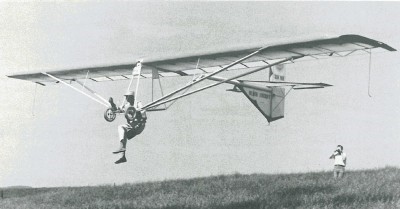
Designated the VJ-24E, the Sunfun is essentially a simplified version of the Swingwing hang glider or powered hang glider. The wings are fabric-covered aluminum tube and are a rectangular-planform type braced by V struts. The two wheels are for ground handling only, so the Sunfun is foot-launched and foot-landed. A 10-hp engine and fuel tank are installed beneath the wing and behind the pilot so that takeoff can be performed without benefit of a steep hill. Wingspan is 36 feet 6 inches, and total weight is 110 pounds. The Volmer VJ 24E Sunfun has a useful load of about 200 pounds, burns about 1.5USG per hour.
A minimum powered glider, the VJ-24W is a modified version of VJ-24E Sun Fun hang glider with wheeled landing gear, tractor engine, independent rudder control, manufactured by Airway Aircraft Inc., 905 Airway Ave., Glendale, CA 91201, USA.
Fairing behind pilot cuts drag. Independent three-axis controls. Construction is all metal with Dacron cover. Yamaha KT100 or McCulloch 101 engine. Two main wire wheels, tail skid undercarriage.
VJ-24
Wingspan: 36 ft
Wing chord: 4 ft 6 in
Wing area: 160 sq.ft
Empty weight: 110 lb
Speed range: 18-25 mph
VJ-24
Speed max: 40 mph
Cruise: 30 mph
Range: 30 sm
Stall: 17 mph
ROC: 350 fpm
Take-off dist: 100 ft
Landing dist: 100 ft
Engine: Yamaha, 15 hp
Fuel cap: 1.5 USG
Weight empty: 210 lbs
Gross: 410 lbs
Height: 5.75 ft
Length: 198.5 ft
Wing span: 36 ft
Wing area: 163 sq.ft
Seats: 1
Landing gear: tail wheel
VJ-24W Sun Fun
Wing span: 36.5 feet
Wing area: 163 square feet
Empty weight: 165 pounds
Max gross weight: 345
Engine: Yamaha KT-100, 97.6cc, 15 hp.
Reduction unit: 2,75:1
Prop: 57 in
Wingspan: 36 ft
Wing area: 160sq.ft
Aspect ratio: 8:1
Length 18’
Empty weight 200 lbs
Payload 200 lbs
Gross weight 400 lbs
Wing loading 2.5 lbs/sq.ft
L/D 10:1
Cruise speed 30mph
Stall speed 18mph
Vmax 40 mph
Takeoff run 100’
Landing roll 100’
Climb Rate 350 fpm
Fuel Capacity 1.5 USG
Chord length: 4.5 ft
Wing span: 36.5 ft
Wing area: 163 sq,ft
Aspect ratio: 6.75
Weight: 110 lb
Pilot weight: 160-200 lb
Takeoff speed: 13 mph
Stall speed: 15 mph
Max speed: 30 mph
Best glide ratio (L/D): 9.5
Best L/D speed: 17 mph
Min sink: 158 fpm

Volmer VJ-23 Swingwing

Designed by Volmer Jensen and Irv Culver, its cost Jensen roughly $400 in supply in 1971. The total construction time is estimated at three months of construction in free time. Culver is an aerodynamic engineer who designed the profile of the VJ 23 SwingWing and made the fatigue study.
Volmer VJ-23 Swingwing Article
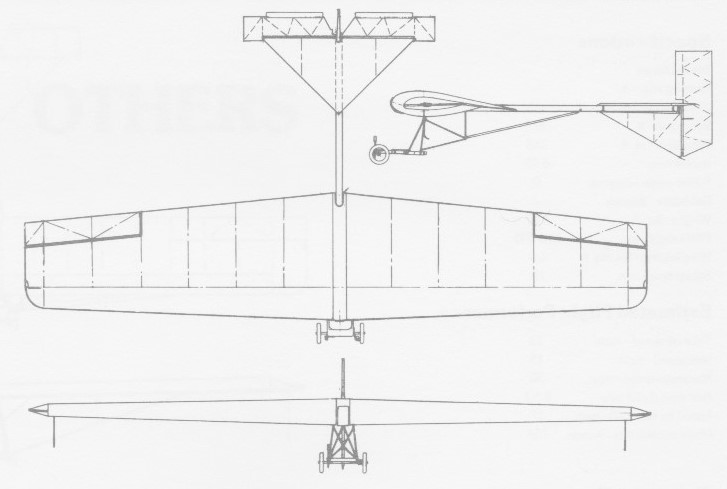
The cantilever wing has a relative thickness of 16%, thus eliminating the reinforcement by cables or struts. The disassembled craft is designed to be assembled in 30 minutes.
The cantilever wing is largely built from spruce and plywood with a fabric covering. The wing is constructed in two parts of 4.88 meters and able to be assembled with three bolts. The wings, which weigh 15 kilos each, with a limit load factor of 2G and an ultimate load factor of 3G. The leading edge of the wing is made with a 1mm backing, and the leading edge ribs are 1cm thick marine plywood, with spruce for the ribs of the tail unit, and rods for the spar of the wing. Jensen does not use epoxy for the VJ23, preferring white glue that he has been trusted for years. The wings and tails are covered with Ceconite, a light fabric of 1.8oz / sqrd. The tail boom is an aluminum tube of diameter 10 cm and 4m long.
Apply the fabric without stretching it, then apply a coating to ensure waterproofing. The fabric can then be stretched with an iron.
The VJ-23 features padded arm rests and wheels. It is controlled by a joystick. The kit came with an airspeed indicator.
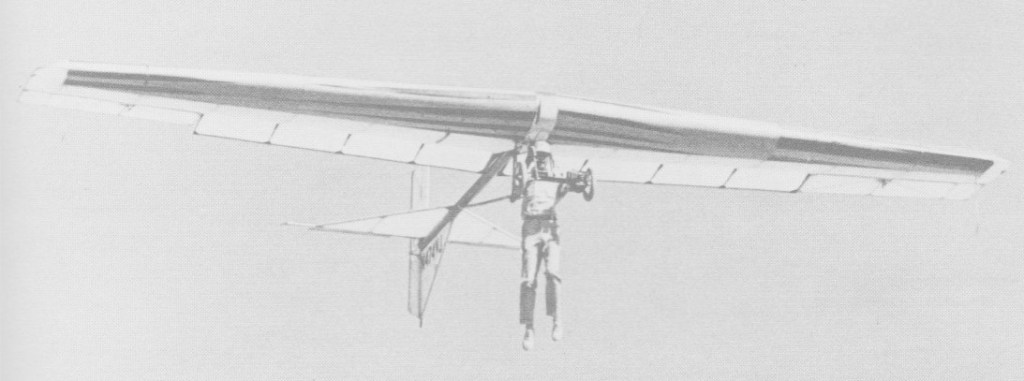
It was originally available in kit form only.
The airframe is made from 6061-T6 1.25in x .035 aluminium tubing. The 15 ft boom is made from 6061-T6 4in x .035 tubing. The ribs are wood truss. A permanent seat is built into the hanger structure.

What distinguishes SwingWing is its unusual ability to stay in the air. With a modest wind of about 30 km / h, the pilot takes off in less than two or three steps and then flies as long as he can stay in the ascending part. For short-term flights, the pilot is suspended by leggings, but a seat harness can be used with a seat for longer flights.
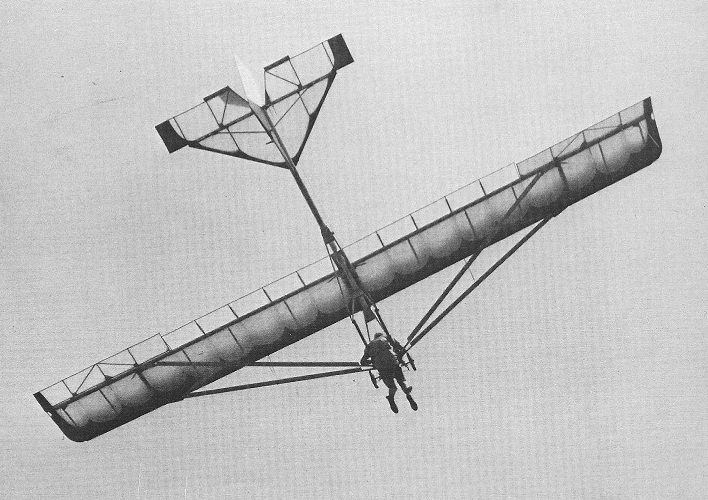
During a demonstration of SwingWing, Jensen remained in the air for more than 40 minutes, flying along and before a dune at an altitude of 35 ft (10 m) with a length of 300 yards. The 23° slope seemed to have an excellent performance for dynamic flight. The speed of cruising is between 25 and 40 km / h. The landing takes place in one or two steps.
Although the VJ23 prototype carries Federal Aviation Administration registration number N474VJ, registration is not required.
In 1978, David Cook became the first hang glider pilot to fly over the English Channel in one hour, flying at an altitude of 1000 feet in a powered Swingwing.
A motorized version has been built as the VJ-23E.
The VJ 23 was never built factory, but designed for amateur construction, very many plans were sold.
Designed in the early 1970s by Volmer Jensen, the Swingwing is essentially a powered hang glider. Empty weight without engine is 100 pounds, and the gross weight is 300 pounds. The Swingwing is built from aircraft plywood, spruce, steel tubing and fabric covering. Control surfaces include ailerons, elevators and rudder.
In 1978, David Cook became the first hang glider pilot to fly over the English Channel in one hour, flying at an altitude of 1000 feet in a powered Swingwing.

VJ-23
Wing span: 9.88 m
Length: 4.96 m
Wing area: 16.65 sq.m
Aspect ratio: 5.88
Airfoil: Irv Culver
Empty Weight: 45 kg / 100 lb
Gross Weight: 136 kg / 300 lb
Wing Load: 7.9 kg/sq.m
Vzmin: 1.1 m/sec
Glide Ratio: 12 @ 62 kph
Takeoff distance: 31 m
L/DMax: 12 32 kph
MinSink: 0.96 m/s 30 kph (18-20 mph)
Seats: 1
Cruise: 16-25 mph
Stall: 15 mph
Chord length: 4.7 ft
Wing span: 32.6 ft
Wing area: 179 sq,ft
Aspect ratio: 6.9
Wing sweep: 2˚
Weight: 100 lb
Pilot weight: 160-200 lb
Takeoff speed: 13 mph
Stall speed: 15 mph
Max speed: 25 mph
Best glide ratio (L/D): 9-1
Best L/D speed: 18 mph
Min sink: 176 fpm
Volmer VJ11 So-Lo

Construction of the VJ-11 was commenced in 1940 and completed in 6 weeks spare time and test flown the following week end. During the war they were not permitted to fly any aircraft within 150 miles from the coast and the hang glider was only going to slide down the hill.
A Chanute type glider, the VJ-11 had three-dimensional controls on it. Jensen installed elevators and ailerons, controlled by the right hand with a device shaped like a + sign and a rudder by the left hand, using a short rudder bar.
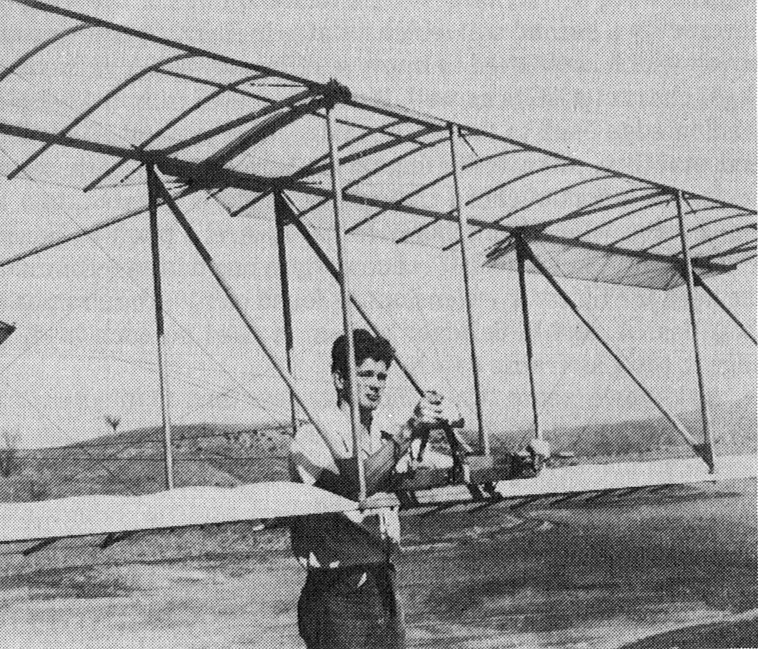
Many glider pilots tried it including John Robinson, National Soaring Champion for 3 years, and Irv Culver, Lockheed aerodynamicist who helped on the stress analysis, and even fellows with no previous flying experience.
It could take off in 3 steps down the hill and sometimes land by just bending knees. On some flights it even gained altitude.
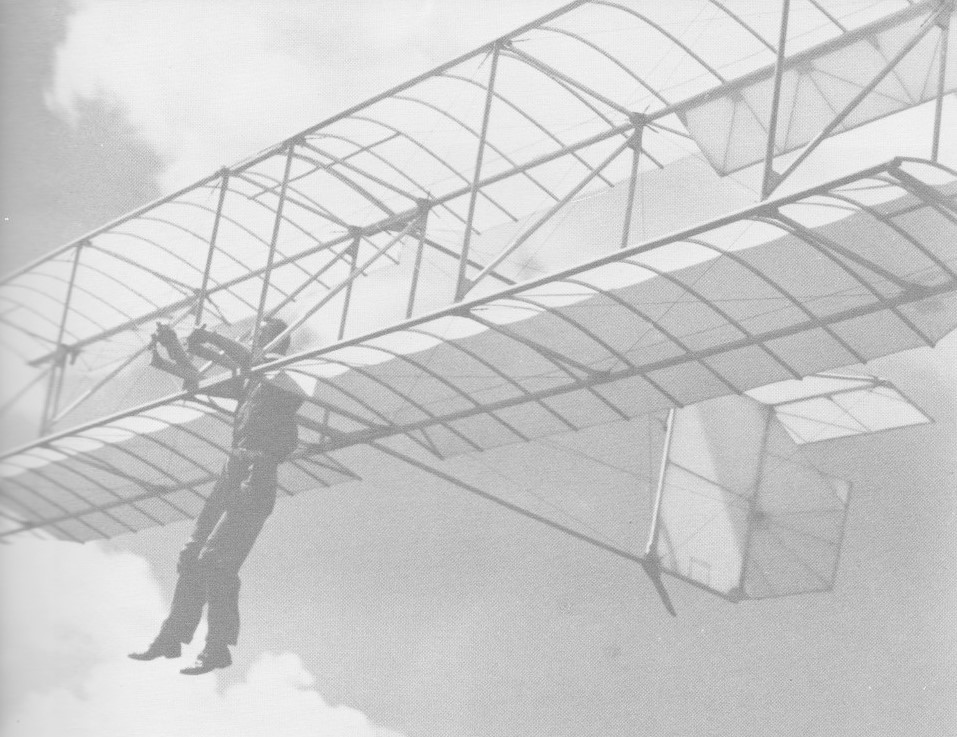
Complete set of blueprints — 8 photographs and full scale rib layout were made available with the cost of materials approximately $400.00. Kits or materials were never supplied.
Wing span: 28 ft
Wing area: 225 sq.ft
Aspect ratio: 6.97
Length: 15 ft 5 in
Height: 5 ft
Dihedral: 0 degrees
Wing: single surface, uncambered
Tail Airfoil: flat
Empty weight: 100 lb
Max flying weight: 280 mph
Useful load: 180 lb
Best L/D: 6-1 at 20 mph
Min sink: 300 fpm
Stall: 15 mph
Cruise: 20 mph

Volmer Aircraft
Volmer S. Jensen was born in Milwaukee in 1909. He began to design and build sailplanes in 1925 at age 16. using plans published in the Boy Mechanic Magazine. He built a second one the following year from additional plans from the same source, and in 1927 he built his first glider with aerodynamic controls, an enclosed cockpit and a wheeled landing gear. The latter was based on the MIT glider Eddie Allen had taken to Europe in the mid-20s to compete against the Germans.
Volmer had moved to Seattle in 1925 to serve an apprenticeship as a machinist, and in 1928 he built a cantilever wing glider for a wealthy sportsman named Thomas Stimson. Volmer called it his VJ-4 and would utilize that numbering system for the remainder of his long aircraft design and construction career.
Throughout the late 1920s and 1930s his designs consisted of a series of increasingly sophisticated gliders, including the VJ-10 he built in 1939 which was the first two-place, side-by-side sailplane in the United States. During this period, Volmer was employed by a succession of aircraft companies, including Boeing, Consolidated, and Northrop, so his glider design and building were done in his spare time.
1946: Acquired Jarvis Aircraft Co assets.
Plans and component kits marketed by Herr Engr Corp, Lakeland FL.
To EAA members he is best known as the designer of the Volmer VJ-22 Sportsman, the first amphibian made available for home construction. To sailplane enthusiasts, he is revered as one of the pioneers of U. S. glider design and construction, with his first original design dating back to 1928. Hang glider pilots are amazed to learn that he built his first weight-shift biplane glider in 1925 when he was 16 … and ultralight pilots recall that he added an engine to his Sunfun hang glider in 1975.
Produces plans to construct VJ-22 Sportsman two-seat amphibian (first flown 1958) and VJ-24W SunFun single-seat open microlight (earlier VJ-23 Swingwing is recognised as having been the first modern microlight).
1995-8: Box 5222, Glendale, CA 91201, USA.
Volmer Jensen was the builder of the model of the Starship Enterprise that was used in the filming of the TV series and movies! (although it was designed by cabin Waco owner, Matt Jeffries.)
Volmer Jensen,
Burbank CA.
USA
Volantes Tantal Sinusoide
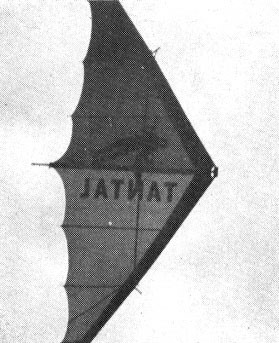
A 1979 hang glider.
Wing area: 16.8 m²
Aspect ratio: 5
Hang glider weight: 25 kg
Minimum pilot weight: 60 kg
Maximum pilot weight: 75 kg
Packed length: 6 m
Number of battens: 8
Volantes Squale
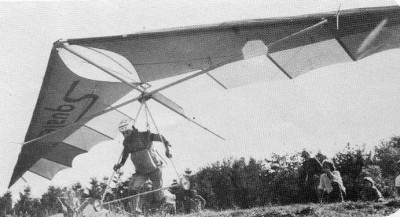
A 1979 hang glider. The two rounded indentations which can be seen between the nose and the point of attachment of the trapezium were nothing but air inlets whose role was to inflate the double profile during the flight. These air intakes which made it possible to put the wing to the right profile according to the incident angle were simply taken over by all the manufacturers of paragliders.
The behavior is pretty stable, manoeuvering and performances good as well. According to the tests of VLM at the time, the maneuverability of this machine was pretty bad.
Volantes Eden
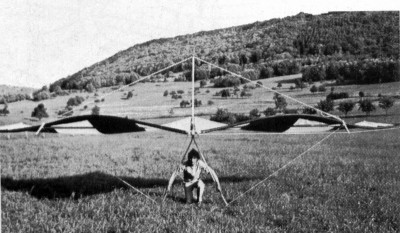
A 1977 hang glider.
Wing area: 18.5 m²
Wing span: 9.08 m
Aspect ratio: 4.46
Hang glider weight: 21 kg
Minimum pilot weight: 60 kg
Maximum pilot weight: 90 kg
Packed length: 6 m
Nose angle: 100°
 All Aero