Eclipse SK90 / Eclipse SK96 / Eclipse SK98

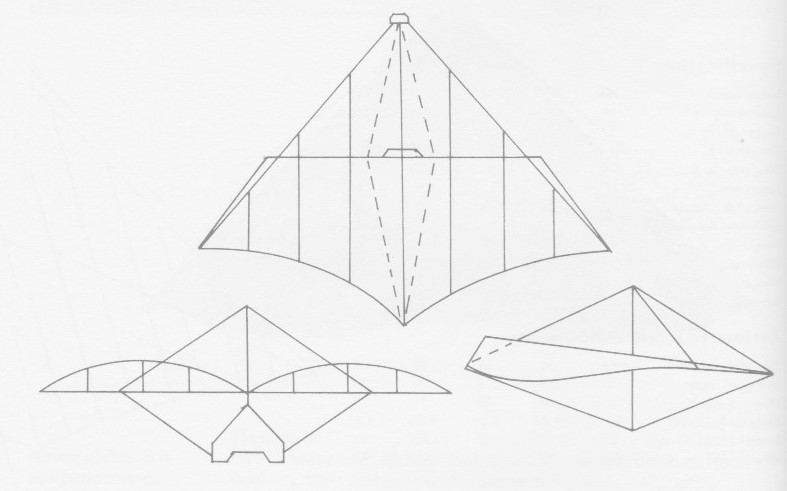
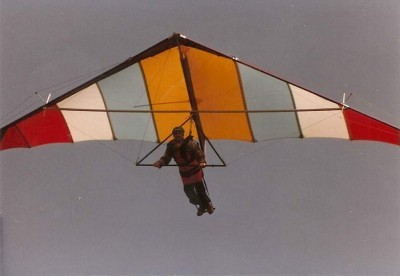
Made in 1976, the SK90 was the first glider designed and manufactured by Eclipse Gliders. A number of ’90s’ were built and mostly sold locally. The company policy was to continuously build improvements into its products thus giving rise to numerous designations.

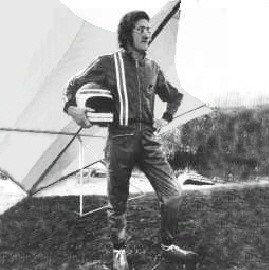
Also made in 1976, it is believed that only one SK96 was constructed. The design incorporates a wider nose angle than usual, reduced billow and radial tip battens. Its owners were Simon Murphy (photo), Graham Rock, Andy White and Peter Kerr. The machine was later fitted with a cambered keel which reportedly improved the handling. The last owner landed the glider in the sea – end of SK96.

SK96

Several SK98 were built.

Eclipse Zenith

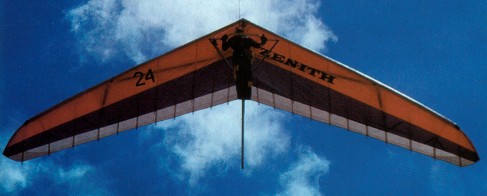
The Zenith is a topless model.

Zenith 125

Zenith 130
Hang glider circa 1998.
Wing area: 13 sq.m
Pilot weight: 55-70 kg
Wing span: 10 m
Nose Angle: 132 degs
Aspect ratio: 7.4
Price (1998) 27000 Fr

Zenith 135
Hang glider circa 1998.
Wing area: 13.5 sq.m
Pilot weight: 665-80 kg
Wing span: 10.1 m
Nose Angle: 132 degs
Aspect ratio: 7.5
Price (1998) 27000 Fr

Zenith 140
Hang glider circa 1998.
Wing area: 14 sq.m
Pilot weight: 70-90 kg
Wing span: 10.4 m
Nose Angle: 132 degs
Aspect ratio: 7.8
Price (1998) 27000 Fr

Zenith Sans Mat
Hang glider circa 1998.
Wing area: 13.5 sq.m
Pilot weight: 65-80 kg
Wing span: 10.1 m
Nose Angle: 132 degs
Aspect ratio: 7.5

Zenith Sans Mat 14
Hang glider circa 1998.
Wing area: 14 sq.m
Pilot weight: 70-90 kg
Wing span: 10.4 m
Nose Angle: 132 degs
Aspect ratio: 7.8

Eclipse Twist      

Twist 13
Hang glider circa 1998.
Wing area: 13 sq.m
Pilot weight: 40-60 kg
Wing span: 9.2 m
Nose Angle: 120 degs
Aspect ratio: 6.5
Price (1998) 13800 Fr

Twist 15
Hang glider circa 1998.
Wing area: 15.5 sq.m
Pilot weight: 55-75 kg
Wing span: 9.2 m
Nose Angle: 120 degs
Aspect ratio: 6.5
Price (1998) 13800 Fr

Twist 16
Hang glider circa 1998.
Wing area: 16.5 sq.m
Pilot weight: 70-90 kg
Wing span: 10 m
Nose Angle: 120 degs
Aspect ratio: 6.1
Price (1998) 13800 Fr

Eclipse Fuji

Fuji 13
Hang glider circa 1998.
Wing area: 13.5 sq.m
Pilot weight: 40-60 kg
Wing span: 9.2 m
Nose Angle: 122 degs
Aspect ratio: 6.3
Price (1998) 16900 Fr

Fuji 14
Hang glider circa 1998.
Wing area: 14 sq.m
Pilot weight: 55-75 kg
Wing span: 10 m
Nose Angle: 122 degs
Aspect ratio: 7.1
Price (1998) 16900 Fr

Fuji 15
Hang glider circa 1998.
Wing area: 15.5 sq.m
Pilot weight: 70-85 kg
Wing span: 10 m
Nose Angle: 122 degs
Aspect ratio: 6.6
Price (1998) 16900 Fr

Eclipse First

First 13
Hang glider circa 1998.
Wing area: 13.5 sq.m
Pilot weight: 60-80 kg
Wing span: 9.6 m
Nose Angle: 132 degs
Aspect ratio: 7
Price (1998) 23500 Fr

First 14
Hang glider circa 1998.
Wing area: 14 sq.m
Pilot weight: 75-100 kg
Wing span: 10.4 m
Nose Angle: 132 degs
Aspect ratio: 7.5
Price (1998) 23500 Fr

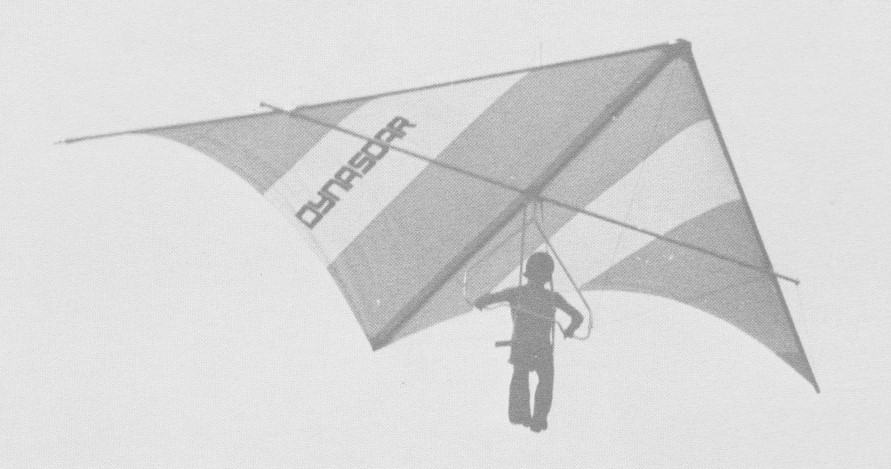
Dyna Soar Standard          

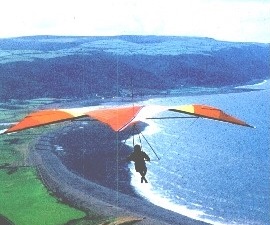
The Dyna Soar Standard is a standard Rogallo which features a “Dyna-pin” which consists of a hitch pin, stainless steel spring, and quick release pin for quick assembly of the leading edges to the cross spar. The flying wires can be interchanged to move the control bar from seat to prone to supine position. Wing stabiliser minimise leading edge distortion at higher loading. The keel reflex, standard n all models, improves the L/D and compliments the wing stabilisers for a more stable flight.

The airframe is made from 6063-T832 1.5 in x 0.058 anodised alumingium tubing, and the rigging is aircraft quality 3/32in 7×7 plastic coated. All nuts and bolts are aircraft quality, and tangs are stainless. The sail is Howe and Bainbridge 3.8 oz stabilised dacron. All seams are double zig zag stiched and stress points are reinforced.

It can be adapted for towing.

15×15
Leading edge: 15 ft 6 in
Keel length: 15 ft 6 in
Wing span: 20 ft 6 in
Wing area: 155 sq,ft
Aspect ratio: 3.75
Nose angle: 83˚
Sail billow: 3.5˚
Weight: 34 lb
Pilot weight: 90-140 lb
Takeoff speed: 15 mph
Stall speed: 14 mph
Max speed: 21 mph
Best glide ratio (L/D): 5:1
Best L/D speed: 20 mph
Min sink: 450 fpm
15×17
Leading edge: 17 ft 6 in
Keel length: 17 ft 6 in
Wing span: 23 ft 2.5 in
Wing area: 210 sq,ft
Aspect ratio: 3.75
Nose angle: 83˚
Sail billow: 3.5˚
Weight: 41 lb
Pilot weight: 150-200 lb
Takeoff speed: 15 mph
Stall speed: 14 mph
Max speed: 21 mph
Best glide ratio (L/D): 5:1
Best L/D speed: 20 mph
Min sink: 450 fpm
15×18
Leading edge: 18 ft 6 in
Keel length: 18 ft 6 in
Wing span: 24 ft 6 in
Wing area: 240 sq,ft
Aspect ratio: 3.75
Nose angle: 83˚
Sail billow: 3.5˚
Weight: 45 lb
Pilot weight: 170-240 lb
Takeoff speed: 15 mph
Stall speed: 14 mph
Max speed: 21 mph
Best glide ratio (L/D): 5:1
Best L/D speed: 20 mph
Min sink: 450 fpm
Dinger Wings Sting Ray

The 1976 String Ray was a copy of UP’s Dragon Fly. The String Ray was on the market within weeks of first seeing the Dragon Fly at the Nationals at Escape Country. Russ Hansen played the curious spectator, asking UP’s pilots about various aspects of their new glider so as to ease Dinger Wings re-creation.

Manufactured by Dean Aldinger Sacramento Ca in the 70’s, the sting ray had clipped tips, but no battens, the prototype was dark blue with red leading edges/tips and only had one deflector pointed down at a 45* angle.

He didn’t make a lot of that model and the tips were heavy IMO. This model is not one considered very safe except under the mildest conditions. It was high performance for its time but not especially stable. This glider wasn’t stable, which is why he stopped making it. He made a lot of innovations incorporated into later models.

Dean was a great hang glider builder but lost some friends that were flying his hang gliders and quit building.

Nose angle: 105°