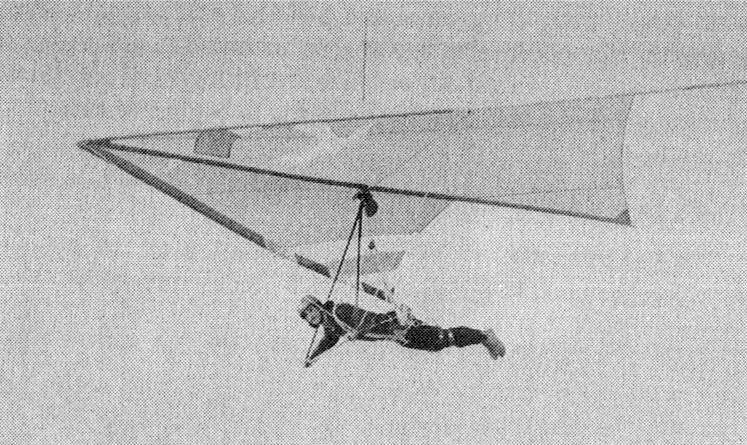
A standard Rogallo.
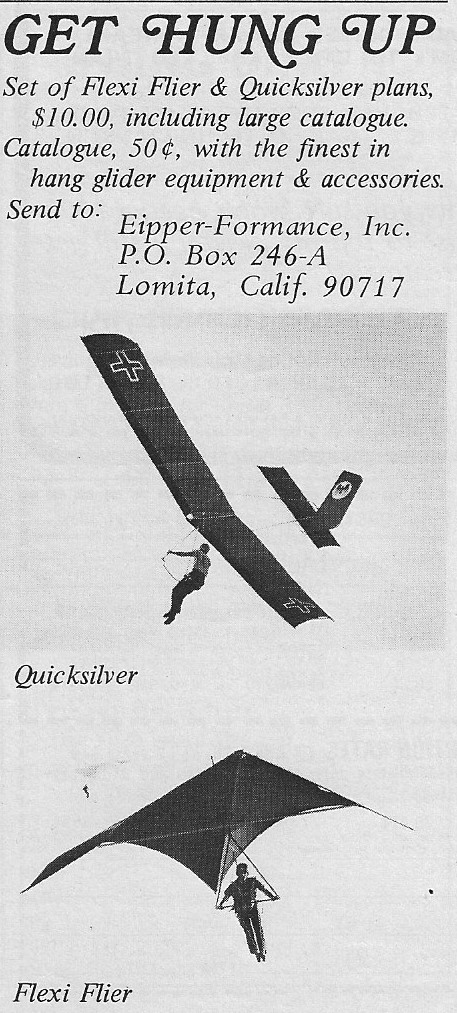
L/D: 4.5-1.
Cruise: 18 25 mph.
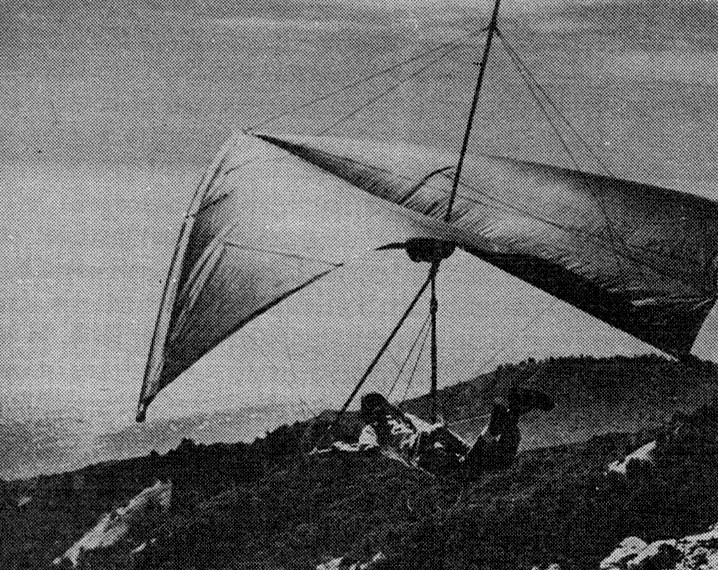
A standard Rogallo.
L/D: 4.5-1.
Cruise: 18 25 mph.
1974
Eipper-Formance Inc
Box 246
Lomita
Califirnia 90717
USA
Previously called Eipper‑formance, after Dick Eipper, this San Marcos company was renamed Eipper Aircraft in October 1982.
1982: Eipper Aircraft, 1080 Linda Vista Drive, San Marcos, California 92069, USA.
In 1983 the plant moved to larger quarters in Temecula, California, to accommodate increased production, a worldwide dealer network and more than 100 employees.
1995: PO Box 1572, Temecula, CA 92593, USA.
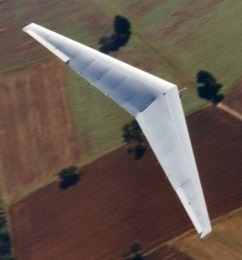
A 1998 hang glider for Advanced pilots.
E 1
Wing area: 14 m²
Wing span: 11 m
Aspect ratio: 9
Hang glider weight: 49 kg
Minimum speed: 35 km/h
Nose angle: 130°
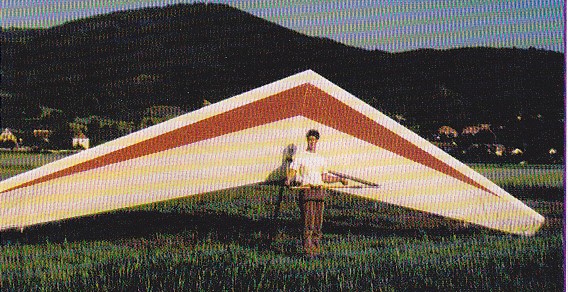
Hang-glider circa 1998. The Phonix is a rigid wing, which has a boxed leading edge but retains a cross-boom and lower rigging. With no moving flying surfaces, the pilot warps the wingtips by weight shift while flying prone.
A 1994 hang glider for Advanced pilots.
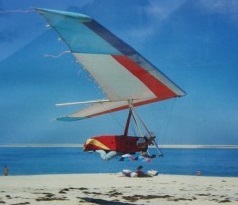
Prototype
Wing area: 13.5 m²
Wing span: 11.4 m
Aspect ratio: 9.6
Hang glider weight: 36 kg
Minimum speed: 30 km/h
Nose angle: 132°
Weight: 33 kg
Wing span: 11.4 m
Wing area: 13.5 sq.m
Vne: 110 km
Stall: 32 km
Vzmin: 0.85 m/sec
Glide Ratio: 15 @ 62 kph
Price (1998) 14950 DM
1998: Neckarauerweg 82, D-68199 Mannheim, GERMANY
Hang-glider builder
A 1985 hang glider.
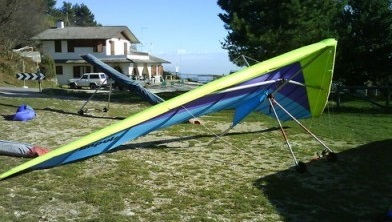
A 1989 hang glider. The Impuls 17 was designed as a beginner and school wing for flight training and is certified as DHV Class 2.
The aircraft is made from aluminum tubing, with the wing covered in Dacron sailcloth. Its 10 m (32.8 ft) span wing is cable braced from a single kingpost. The nose angle is 120° and the aspect ratio is 5.7:1. Pilot hook-in weight range is 60 to 121 kg (132 to 267 lb).
Impuls 14
Impuls 17
Wingspan: 10 m (32 ft 10 in)
Wing area: 17.4 sq.m (187 sq ft)
Aspect ratio: 5.7:1
Crew: one
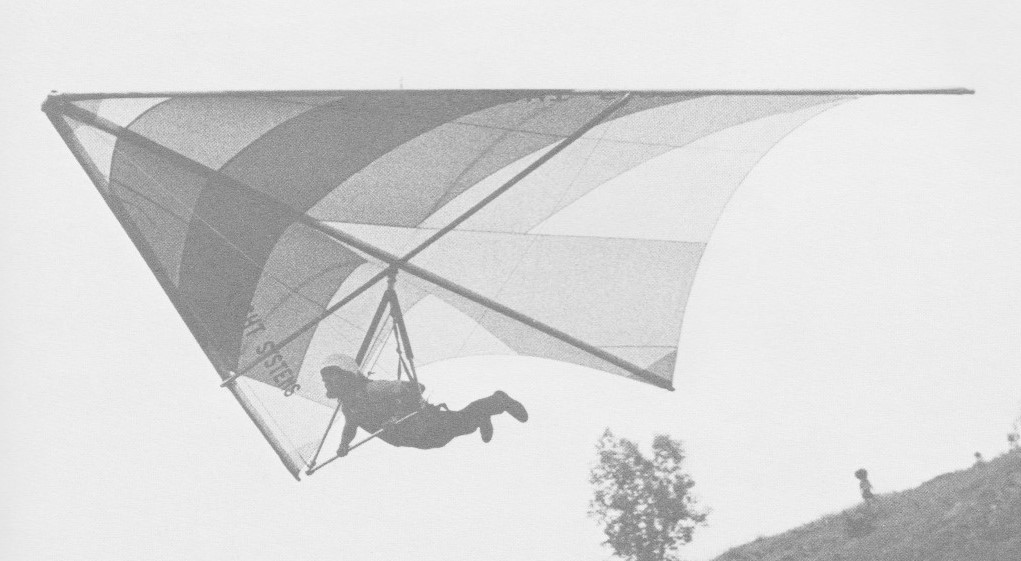
The Eco-Flight Systems Standard rogallo main tubes are 6061-T6 1.5 in x 0.058 aluminium, sleeved and plugged at all stress points. Full bushings throughout. The rigging is all 3 3/32 in 7×7 cable, with double nico press fittings at all connections. Front flying wires are vinyl coated. All nuts, bolts and turnbuckles are aircraft quality. Nylon saddles are at tube junctions. The tangs are stamped stainless steel.
The sail is 3.8 oz Howe and Bainbridge stabilised dacron, guaranteed not to flutter or wrinkle at normal flying speeds.
Special features were an anadised 5in kingpost and 4in wide control bar.
The pilot support options were swing seat or prone harness.
15×15
Leading edge: 15 ft
Keel length: 15 ft
Wing span: 19 ft 6 in
Wing area: 141 sq,ft
Aspect ratio: 2.6
Nose angle: 80˚
Sail billow: 8˚
Weight: 37 lb
Pilot weight: 70-100 lb
Takeoff speed: 14 mph
Stall speed: 16 mph
Max speed: 40 mph
Best glide ratio (L/D): 4.5:1
Best L/D speed: 22 mph
Min sink: 450 fpm
16×16
Leading edge: 16 ft
Keel length: 16 ft
Wing span: 20 ft 9 in
Wing area: 159 sq,ft
Aspect ratio: 2.6
Nose angle: 80˚
Sail billow: 8˚
Weight: 38 lb
Pilot weight: 100-120 lb
Takeoff speed: 14 mph
Stall speed: 16 mph
Max speed: 40 mph
Best glide ratio (L/D): 4.5:1
Best L/D speed: 22 mph
Min sink: 450 fpm
17×17
Leading edge: 17 ft
Keel length: 17 ft
Wing span: 22 ft 0 in
Wing area: 180 sq,ft
Aspect ratio: 2.6
Nose angle: 80˚
Sail billow: 8˚
Weight: 39 lb
Pilot weight: 120-150 lb
Takeoff speed: 14 mph
Stall speed: 16 mph
Max speed: 40 mph
Best glide ratio (L/D): 4.5:1
Best L/D speed: 22 mph
Min sink: 450 fpm
18×18
Leading edge: 18 ft
Keel length: 18 ft
Wing span: 23 ft 3 in
Wing area: 201 sq,ft
Aspect ratio: 2.6
Nose angle: 80˚
Sail billow: 8˚
Weight: 40 lb
Pilot weight: 150-180 lb
Takeoff speed: 14 mph
Stall speed: 16 mph
Max speed: 40 mph
Best glide ratio (L/D): 4.5:1
Best L/D speed: 22 mph
Min sink: 450 fpm
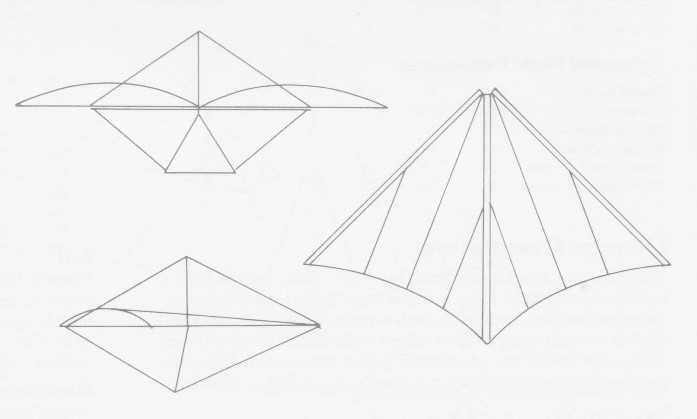
It is believed that Phil Fouracre, a well known West Country pilot was the owner of a 1978 Super Eagle. He lost faith in the machine after spinning it whilst flying over the Quantocks.
Eclipse were offering the Super Eagle 79 at the price of £433.00.
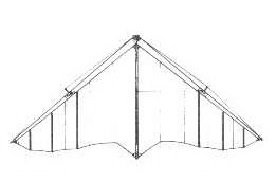
The 1977 Eagle 210 was developed from the SK90 series. The machine was recommended as an ideal trainer, but is also a good performer for experienced pilots.
Also made in 1977, the Eagle 2 glider was intended for the more experienced pilot, but was still very easy to fly and has no nasty characteristics. The unusual cambered keel pocket gives the sail a graduated dihedral effect across its chord, which helped to give good stability and light positive control. The glider has three deflexers, folding A frame, reversible rigging for seated or prone flight. Quite a few of this model were sold in small and medium sizes.
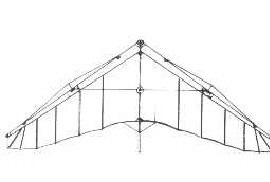
Eagle 210
Leading edge: 19 ft 8 in
Keel: 15 ft 6 in
Sail area: 221.5 sq ft
Nose angle: 99 deg
Billow: 1.75 deg
Aspect ratio: 4.395
Span: 31.2 ft
Eagle 2 (medium)
Leading edge: 20 ft 6 in
Keel 10 ft 0 in
Sail area: 199.3 sq ft
Nose angle: 109.2 deg
Billow: 0.4 deg
Aspect ratio 5.664
Span: 33.6 ft
 All Aero