1984 hang glider
Intermediate pilots
Cumulus 140
Wing area: 14.1 m²
Wing span: 10.76 m
Aspect ratio: 8.2
Hang glider weight: 34 kg
1984 hang glider
Intermediate pilots
Cumulus 140
Wing area: 14.1 m²
Wing span: 10.76 m
Aspect ratio: 8.2
Hang glider weight: 34 kg

1985 hang glider
Advanced pilots
Cosmic 150
Wing area: 15.1 m²
Wing span: 11.10 m
Aspect ratio: 8.15
Hang glider weight: 35 kg

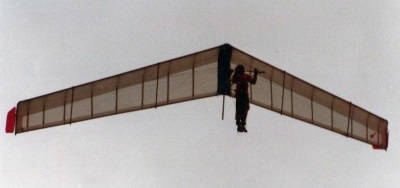
A 1979 hang glider, the Ewen Fagan EF6 has advantages over the modern glider mostly due to the variable glide angle due to rudders and superb controllability.
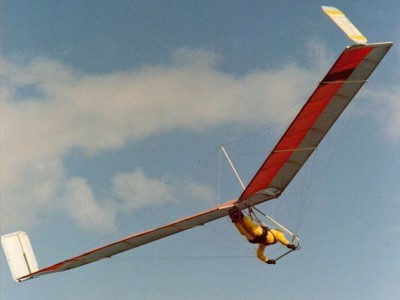
A 1977 hang glider, the EF5 is an Australian rigid designed by Ewen Fagan. Very similar to Manta Fledging, it was sold as a plan and kit by its designer. It was later (early 80’s) sold by Skyland Kites, Qld, Australia. It was sold as a kind of kit, you could buy the machined parts, the cables and the sewn sails. The aluminum tubes had to be purchased on site.
Graham John had the company Skyland Kites and manufactured and sold a range of hang gliders from about 1975 to 1980 on the Gold Coast of Australia. He had an EF5 in his shop and may have manufactured a few.
Piloting similar to Fledge. The EF5 was mostly a Manta Fledge copy with a few modifications. Like all the older tip rudder controlled rigid wings it was a bit difficult to ground handle in wind as rudder application dragged the tips back – not down. Also roll lagged yaw a bit – ie the wing would yaw first then roll. But in the air it was much more responsive than the flex wings of the day (pre billow shift). It is reactive in pitching and quickly accelerates in dive. Put it in dynamic stall with a rudder engaged and one will spin: engage the other rudder and it comes out. If you gradually put it in stall with both rudders engaged, it will stop and descend vertically – a good way to lose altitude fast enough without gaining speed. When flying along the terrain with a wing close to the ground, using the opposite control automatically raises the wing close to the ground, with a control wing tips that does not have a conventional delta.
The EF5 12 metre could be chopped down to a 10 metre around. It liked the fast descent you could do by pulling both rudders on at once. It could do a breathtakingly fast dive and interesting spins.
EF5-12M
Wing span: 12 m
EF5
Wing area: 13 m²
Wing span: 9.8 m
Aspect ratio: 7.3
Hang glider weight: 30 kg
Nose angle: 150°
Dihedral: 7°
Washout: 7°
LD: ≈11:1

A 1977 hang glider Ewen Fagan.
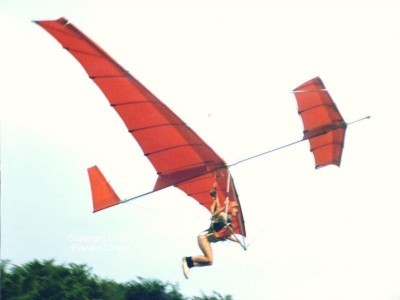
A 1980 hang glider.
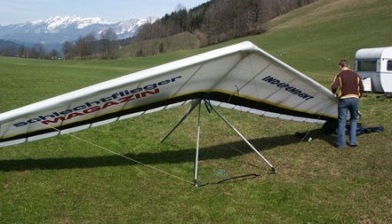
The Europe Sails Independent is a hang glider for Advanced pilots. The glider itself is easily within the (2006-2007) range of performance of similar topless gliders. With only 2-3 gliders/year made by the company they use parts from other manufacturers. Carbon parts are made in-house. This glider features unique Carbon wing-tips which are big, extremely stable and – affordable. The manufacturer makes the setup of the glider according to the personal experience and wishes of the pilot.
Performance and Flight characteristics depend on the setup: The sail can be stretched up to drumhead hardness for competitive and high performance gliding.
Independent 13
Wing area: 13 m²
Wing span: 10 m
Aspect ratio: 7.6
Hang glider weight: 31 kg
Minimum pilot weight: 56 kg
Maximum pilot weight: 90 kg
Packed length: 5 m
Packed length short: 3.95 m
Number of battens: 28
Nose angle: 127°
Independent 14
Wing area: 14.3 m²
Wing span: 10.35 m
Aspect ratio: 7.4
Hang glider weight: 34 kg
Minimum pilot weight: 75 kg
Maximum pilot weight: 110 kg
Packed length: 5.14 m
Packed length short: 4.08 m
Number of battens: 28
Nose angle: 127°
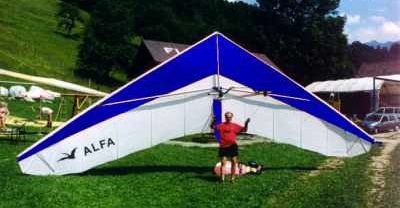
A 1979 hang glider for Novice pilots.
Wing area: 15.80 m²
Wing span: 9.75 m
Aspect ratio: 6
Hang glider weight: 22 kg
Minimum pilot weight: 50 kg
Maximum pilot weight: 88 kg
Minimum speed: 24 km/h
Maximum speed: 80 km/h
Packed length: 5.8 m
Packed length short: 3.8 m
Nose angle: 120°
 All Aero