Firebird Skysports CX

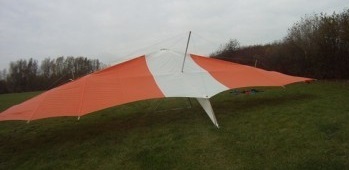
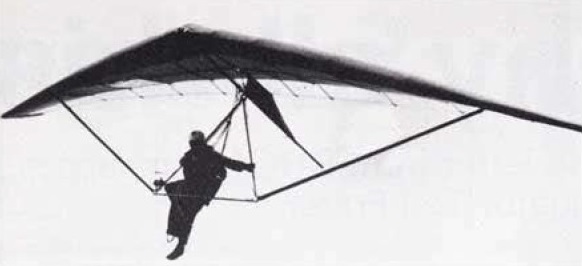
In an effort to reduce the drag as much as possible in the 1982 Firebird CX, the suppresson of the kingpost and all the top rigging is eliminating a good part of the profile drag but brought problems for the pitch stability and the structural strength in negative.

For pitch stability, three solutions were found: the truncated tips assure sail washout, a small keel post inside the keel pocket keeps the centre chord in place and the battens are reflexed at the back.

For strength in negative G there is an 8 inch long king post inside the profile and two carbon fibre compresson struts instead of side cables. With fairngs, the produce less drag than the to rigging would.

The control frame is wider than usual to keep the carbon fibre compression struts as short as possible.
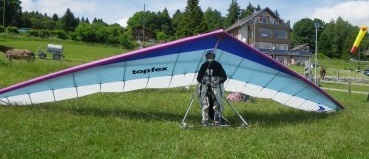
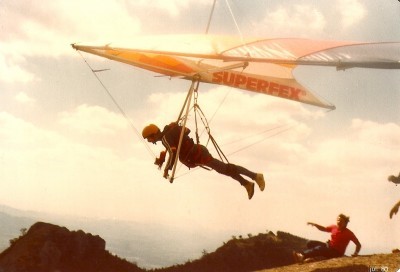
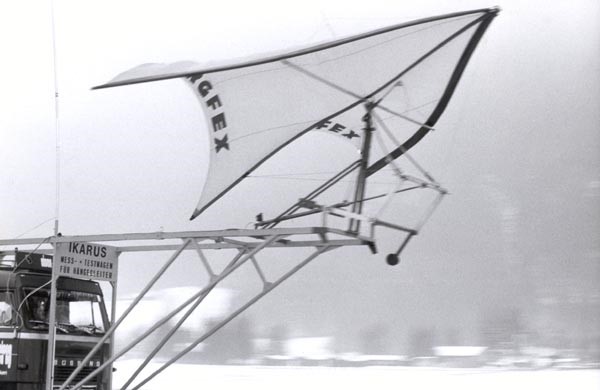
Finsterwalder Topfex

The 1984 Topfex is just a good hang glider for intermediate pilots, a little heavy to control.

Topfex 160
Wing area: 16.1 m²
Wing span: 10.4 m
Aspect ratio: 6.71
Hang glider weight: 25 kg
Minimum pilot weight: 65 kg
Maximum pilot weight: 105 kg
Packed length: 5.8 m
Packed length short: 2.2 m
Number of battens: 29
Nose angle: 127°

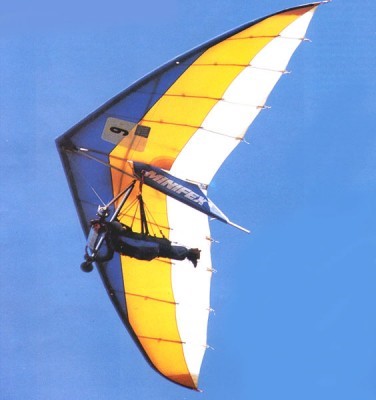
Finsterwalder Minifex

1984

There are two versions of this glider, the 1984 Minifex and, since 1985, produced Minifex M2. The 1984 is DHV3 and the M2 is DHV2 for advanced pilots.

Both versions can be extra short packed at about 1.65m. This is done by tiling the front leading tube into 3 pieces and using fibre glass for the outer wing tips.

Minifex
1984
Wing area: 14.1 m²
Wing span: 8.95 m
Aspect ratio: 5.68
Minimum speed: 26 km/h
Maximum speed: 80 km/h
Packed length: 4.45 m
Packed length short: 1.67 m

Minifex M2 140
1985
Wing area: 14.1 m²
Wing span: 9 m
Aspect ratio: 5.74
Hang glider weight: 20 kg

Finsterwalder Bergfex

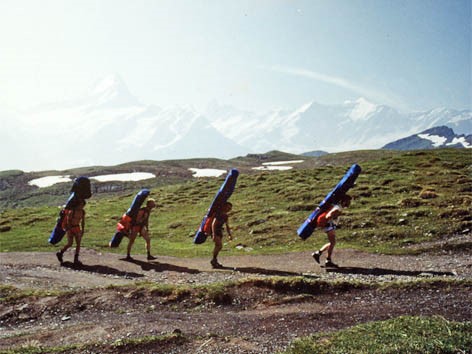
Thomas Finsterwalder develops a glider of his own design. With specially developed high-strength super light-weight and large diameter tubing, the “Bergfex” (mountain freak) weighed a mere 11 kg and could be dismantled in 8 minutes down to a length of 1.80 m without the use of tools, by means of snap fasteners. The sail weighed only 1 kg and was made from spinnacker nylon 32 g/m².

Mountaineering pilots were excited to try them and more than 300 Bergfexes flew accident-free.

The federal aviation authority issued the airworthiness certification.

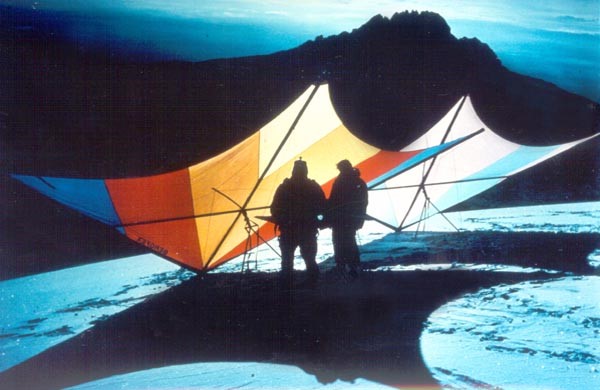
In 1976, Thomas Finsterwalder and two companions climbed to the top of 5895 m high Kilimandscharo. From the summit they flew Bergfex type hang gliders back to the plains below. The flight over a distance of around 25 kilometers took 50 minutes; they had taken three days to make the ascent.

1976: Mt. Kilomanjaro, Tanzania

First appearance in 1976, in 1978 the Superfex came as a successor.

Wingspan: 7.9 m
Span: 19.2 m
Nose angle: 90°
Weight: 11 kg
Maximum glide ratio: ca. 15 at 45 km/h
Maximum sink rate: 2 m/s at 32 km/h

Finsterwalder Windfex

First buit in 1983, a hang glider for intermediate pilots. Lightweight, simple to assemble, stowed under the bed, is transported to motorcycle. Slats are plastic electrician tube

Replaced by the Funfex.

Windfex 190
1984
Wing area: 19.6 m²
Wing span: 9.6 m
Aspect ratio: 5.55
Hang glider weight: 22 kg

Wing area: 16 sq.m
Hang glider weight: 21kg
Short fold: 2.1 m

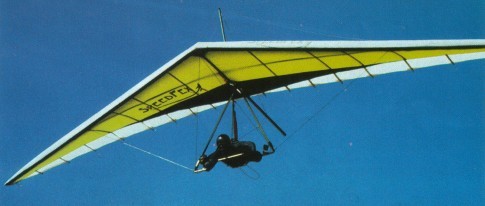
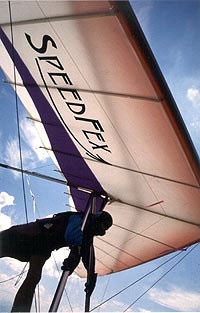
Finsterwalder Speedfex

Hang glider from 1997 featuring a 90% double surface.
Capable of being folded into a 2m long bag for carrying.

Wing area: 14 sq.m
Certification: DHV 2
Pilot weight: 70-110 kg
Wing span: 10 m
Nose Angle: 127 degs
Aspect ratio: 7.1
Hang glider weight: 30 kg
Minimum speed: 30 km/h
Maximum speed: 100 km/h
Max glide ratio (L/H): 12
Packed length: 5.8 m
Packed length short: 2 m
Price (1998) 8580 DM

Finsterwalder Perfex

A Primary Single Surface Hang glider from 1990.

In the air it’s not oversensitive. In the final flare, due the positions of the uprights, there is a great authority and the glider can be stoped easily.

The gliding ratio less than a modern (2011) paraglider but very good although Finsterwalder Charly should invest a few hours to write a modern manual.

The assembly is very fast. The glider can be extra-short packed to 1.95 m and takes 10 minutes extra. With excellent manufacturing quality, lightweight, very low stall-speed, easy handling, and quite fast setup also from ultra-short packing.

Wing area: 16 sq.m
Certification: DHV 1-2
Pilot weight: 70-105 kg
Wing span: 9.4 m
Nose Angle: 120 degs
Aspect ratio: 5.5
Hang glider weight: 22 kg
Minimum speed: 22 km/h
Maximum speed: 80 km/h
Max glide ratio (L/H): 10
Minimum sink rate: 1 m/s
Packed length: 5.5 m
Packed length short: 3.8 m
Number of battens: 15
Price (1998) 4750 DM

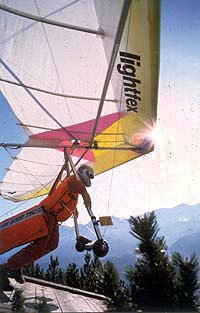
Finsterwalder Lightfex

Hang glider from 1990. Primary Single Surface and capable of being folded into a 2m long bag for carrying.
A very light wing, handles quite well and stable, the counter in thermal goes well if one puts of the weight in the trapezium.

Wing area: 14 sq.m
Certification: DHV 2
Pilot weight: 45-75 kg
Wing span: 9 m
Nose Angle: 120 degs
Aspect ratio: 6.3
Hang glider weight: 20 kg
Minimum speed: 24 km/h
Maximum speed: 80 km/h
Packed length: 5.2 m
Packed length short: 3.75 m
Price (1998) 4750 DM