Based Kumeu, New Zealand
Anton Lawrence & Geoff Green & Steve Elliot
Hang glider builder
Based Kumeu, New Zealand
Anton Lawrence & Geoff Green & Steve Elliot
Hang glider builder
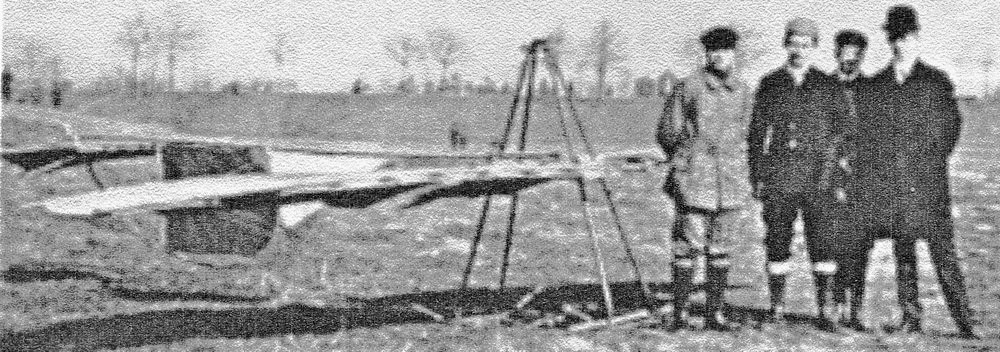
This glider, which was later designated Focke A II, was actually built by three high school students: Henrich Focke, Frido Kirchhoff and Carl Tiemann. It was flown in late 1909 at the Osterdeich in Bremen.
Hang glider
Wing area: 16.5 m²
Wing span: 8.5 m
Hang glider weight: 17 kg
Minimum pilot weight: 64 kg
Maximum pilot weight: 92 kg
Packed length: 5.5 m
Packed length short: 3 m
Nose angle: 107°
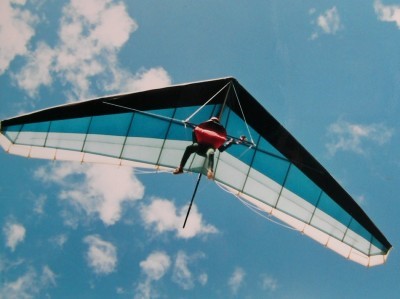
A 1981 hang glider for advanced pilots designed by Warren Bird with help from Bob Martin. The Shark was produced by Flight Sails NZ in New Zealand probably in 1982 and 1983. It had no keel pocket and the double surface was 90%, not sewn on the top surface. The keel was fully enclosed between both surfaces. The king post holds the keel which is not sewn into the top surface. The wing contained 30 battens.
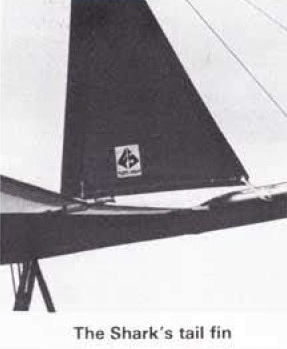
Only a few were made and it was never fully developed. From the first production Shark they were gradually de-tuned from then on to try to improve the handling.
Distributed in England, it cost just over £1000 in 1982.
Performance was good but handling was not. Great in a straight line but really hard to turn. Sometimes it would turn and sometimes it wouldn’t. Turning was improved by upper wing spoilers which also could be used for air brakes.
This was the first Delta to beat the Manta Fledgling when flown by Graeme Bird at the 1981 World Champs in Japan.
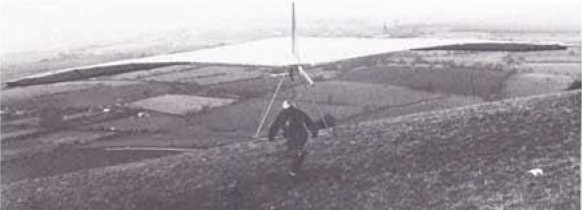
Reportedly the Shark made one awesome trike wing in the 80’s. With a British Tri-pacer trike, 330cc motor, Graeme Henderson flew his across Foveaux Strait, New Zealand, in the first crossing by a microlight in 1981.
The Shark was built in New Zealand by Warren Bird of Flight Sails NZ.
Flight Sails sometimes made sails for Pacific Kites
Hang glider builder
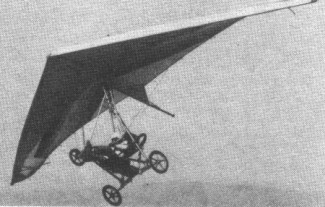
Single seat single engined flex wing aircraft with weight shift control. Rogallo wing with keel pocket. Pilot suspended below wing in trike unit, using bar to control pitch and yaw/roll by altering relative positions of trike unit and wing. Wing braced from above by kingpost and cables, from below by cables; rigid cross tube construction; 60% double ¬surface enclosing cross tube; pre formed ribs. Undercarriage has three wheels in tricycle formation; steel spring suspension on nose¬wheel and bungee suspension on main wheels. Push right go left nosewheel steering indepen¬dent from yaw control. Brakes on main wheels. Aluminium tube trike unit, without pod. Engine mounted below wing driving pusher propeller. Wing has foam insert in leading edges.
Flight Designs Jetwing ATV Article
The Jetwing ATV (All Terrain Vehicle) is an original concept: it is not purely a trike in the conventional sense, because its wheels can be replaced by floats. By removing the wing and fitting the rear of the floats with a triangular tubular structure supporting a large rudder, the Jetwing can be transformed into a speedboat. Using its pusher propeller it can be turned into a go kart by refitting the wheels but leaving the wing off, while also available as an option are skis.
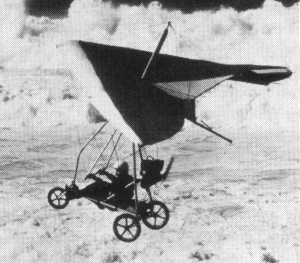
The price of the trike unit was US$3000 in 1982 and bought together with the Demon hang glider wing it costs a total of US$4995. Flight Designs does not recommend the use of any other Rogallo with its trike unit and it is worth noting that its Demon Rogallo is not related to the British wing of the same name, made by Hiway.
The later Jetwing ATVs had a belt reduction drive of 2.2/1 ratio, with a max static thrust of 220 lb (100 kg).
Engine: Kawasaki TA440, 30 hp at 5500 rpm.
Prop¬eller diameter and pitch 36 x 16 inch, 0.91×0.40 m.
No reduction. Power per unit area 0.17hp/sq.ft, 1.8hp/sq.m.
Fuel capacity 5.0 US gal, 4.2 Imp gal, 18.9 litre.
Length overall 12.0 ft, 3.65 m.
Height overall 12.0ft, 3.65m.
Wing span 33.5ft, 10.18m.
Mean chord 5.3ft, 1.60m.
Total wing area 175 sq.ft, 16.27 sq.m.
Wing aspect ratio 6.3/1.
Nosewheel diameter overall 16 inch, 40 cm.
Main wheels diameter overall 20 inch, 50 cm.
Empty weight 216 lb, 98 kg.
Max take off weight 480 lb, 218 kg.
Payload 264 lb, 120 kg.
Max wing loading 2.74 lb/sq.ft, 13.4 kg/sq.m.
Max power loading 16.0 lb/hp, 7.3kg/hp.
Load factors; +4.0, 2.0 ultimate.
Max level speed 47 mph, 76 kph.
Never exceed speed 52 mph, 84kph.
Max cruising speed 37mph, 60kph.
Stalling speed 22 mph, 35 kph.
Max climb rate at sea level 400 ft/min, 2.0 m/s.
Min sink rate 350 ft/min at 23 mph, 1.7 m/s at 37 kph.
Best glide ratio with power off 7/1 at 25 mph, 40 kph.
Take off distance 50 ft, 15 m.
Landing distance 75ft, 23 m.
Service ceiling 10,000ft, 3050 m.
Range at average cruising speed 160 mile, 257 km.
A 1981 hang glider with cambered aluminum ribs.
It is pretty easy on the handling side and the speed trim is real nice hands off. This glider was really nice to fly on a 15-20 mph day. An easy landing trainer.
It was available in two models: Javelin 168 and Javelin 208.
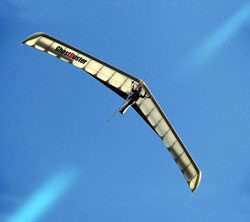
A 1999 hang glide for advanced pilots.
Wing area: 12.6 m²
Wing span: 13 m
Aspect ratio: 13.4
Hang glider weight: 35 kg
Minimum pilot weight: 90 kg
Maximum pilot weight: 150 kg
Minimum speed: 30 km/h
Maximum speed: 110 km/h
Max glide ratio (L/H): 17.60
Max glide ratio speed: 55 km/h
Minimum sink rate: 0.7 m/s
Packed length: 5.9 m
Nose angle: 150°
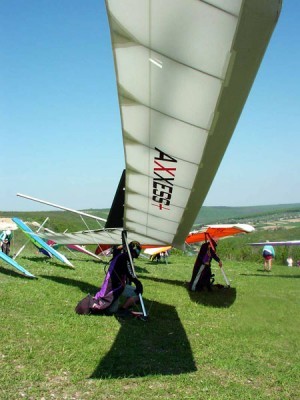
A 2002 rigid wing hang glider for advanced pilots.
The rigid AXXESS is super stable in flight (calm and turbulent) and has a formidable landing facility, with well dimensioned flaps. The assembly with integrated slats is easy. The decoupling of the wings facilitates the transport.
Flight Design no longer produces wings and rigid. But fliegerboehm continues the manufacture of rigid Axxess.
Axxess
Wing area: 13.5 m²
Wing span: 13.1 m
Aspect ratio: 12.7
Hang glider weight: 39 kg
Minimum pilot weight: 90 kg
Maximum pilot weight: 115 kg
Packed length: 6.3 m
Nose angle: 127°
Axxess +
Wing area: 12.6 m²
Wing span: 13.1 m
Aspect ratio: 13.6
Hang glider weight: 39 kg
Minimum pilot weight: 90 kg
Maximum pilot weight: 115 kg
Packed length: 6.3 m
Nose angle: 127°
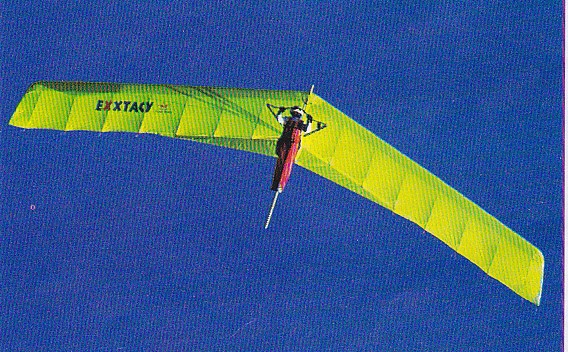
A rigid wing light hang glider from 1996. Very safe to fly, sink rate below 0.8m/s, glide ratio above 16, speed range from 32 to more than 110 km/h.
Handling at take off is typical rigid wing stuff: does not require any assistance in strong winds, as the spoiler will lift up and bring the wings level without any pilot input. Normal cruising speed is about 35km/h in thermals, 50 km/h straight.
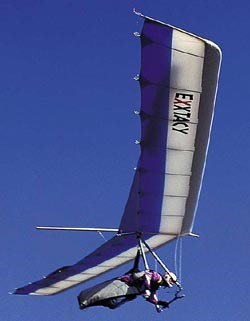
Very light in turns and very stable trajectory at speed hence excellent for aero-towing. In thermals, its stability in roll requires sensitive pilot input to climb well. Not much affected by turbulence, only in pitch. Landing is easier than on a flex wing.
When folded, the weight and bulk can be problematic but splitting the wing in two halves helps.
Flight Design no longer produces wings and rigid. But fliegerboehm continues the manufacture of rigid Exxtacy.
From 1999 the Exxtacy was improved: reduced weight 35kg / 38 kg; length of the large model: 570 cm and the weight of the mini / maxi 100 kg / 160 kg.
Tthere is a biplace model.
Exxtacy 135
Wing area: 13.8 m²
Wing span: 11.4 m
Aspect ratio: 9.4
Hang glider weight: 39 kg
Minimum pilot weight: 90 kg
Maximum pilot weight: 140 kg
Minimum speed: 36 km/h
Max glide ratio (L/H): 17.5
Minimum sink rate: 0.75 m/s
Packed length: 6.2 m
Nose angle: 127°
Exxtacy BI 160
Wing area: 14.8 m²
Wing span: 12.2 m
Aspect ratio: 10.05
Hang glider weight: 39 kg
Minimum pilot weight: 100 kg
Maximum pilot weight: 160 kg
Vne: 100 kph
Minimum speed: 30 km/h
Max glide ratio (L/H): 17.5
Minimum sink rate: 0.75 m/s
Packed length: 6.2 m
Nose angle: 127°
Price (1998) £ 5500
 All Aero