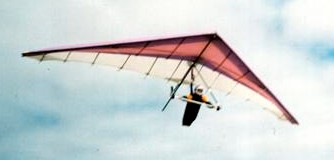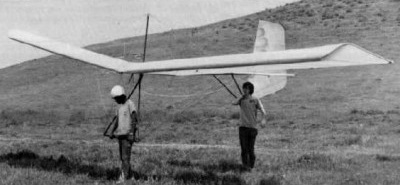
Fronius Pacific I / Quickarus

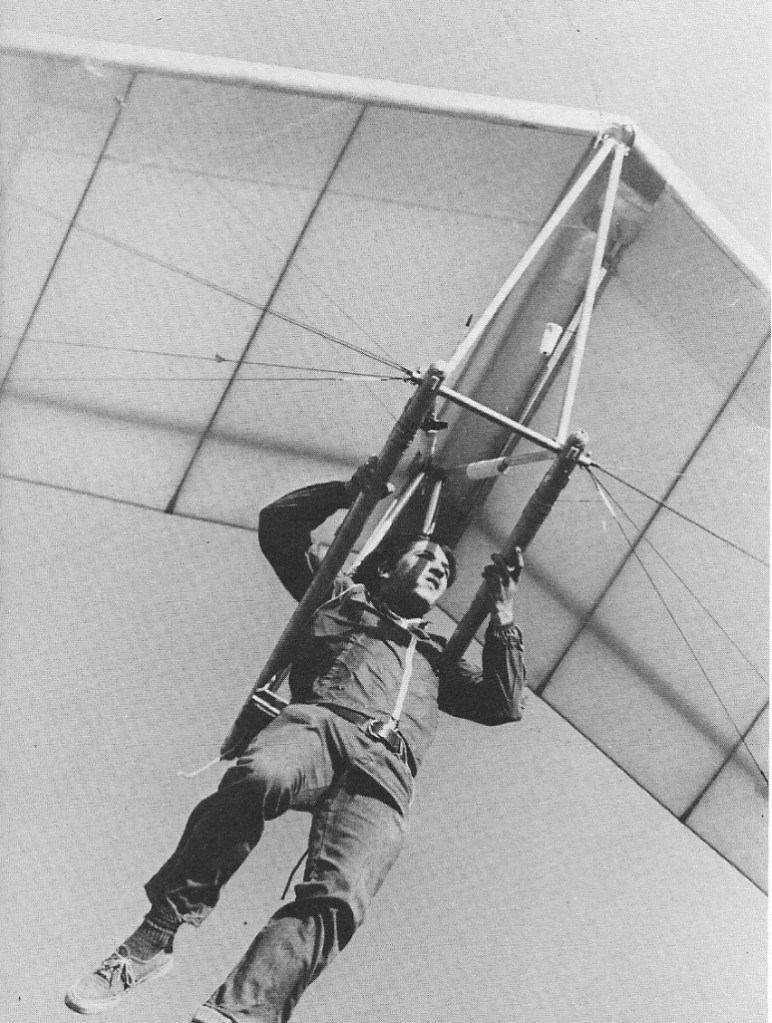
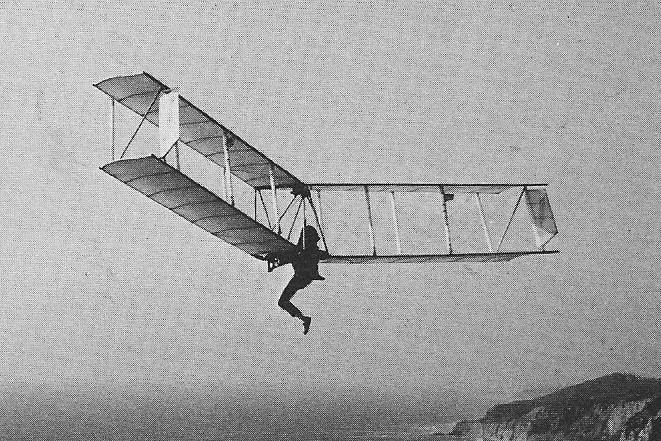
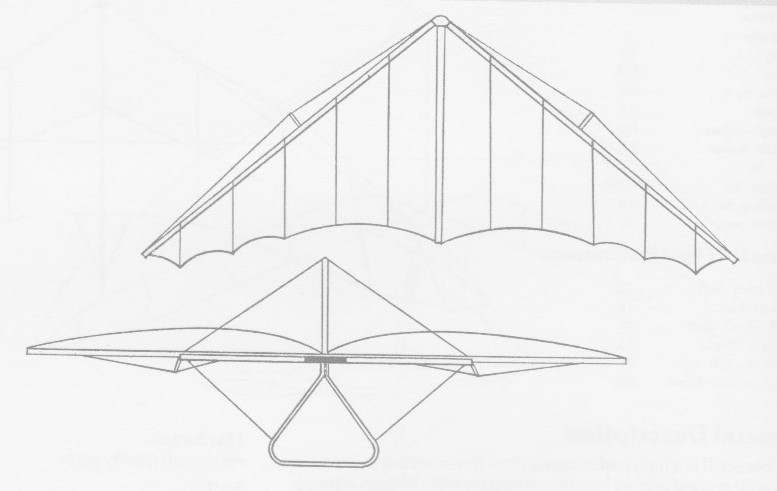
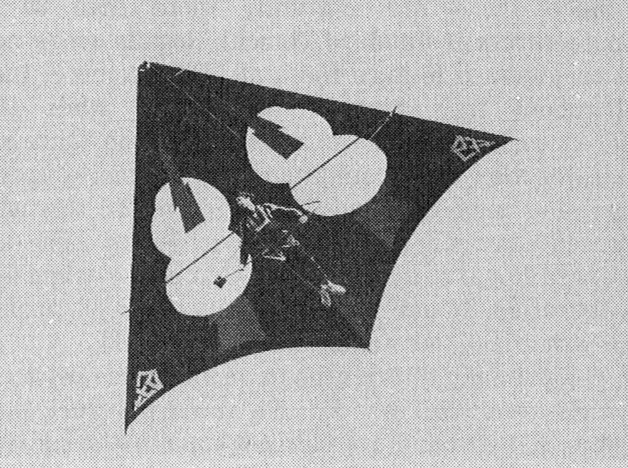
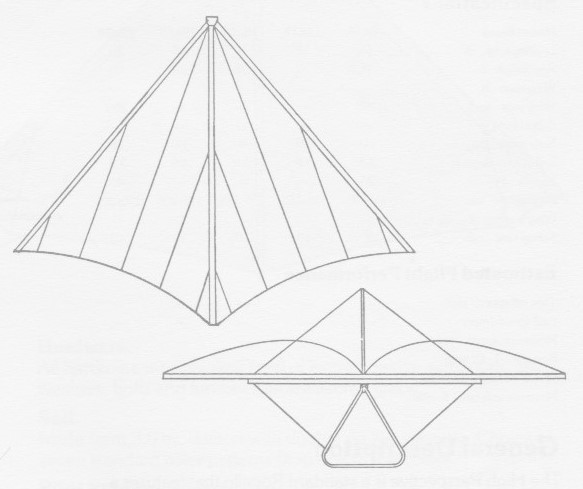
The Pacific I is a high performance glider designed by Doug Fronius and built by John Lasko. The basic goals were that is should offer competitive performance at the Icarus V level while being much simpler and less expensive to buid.

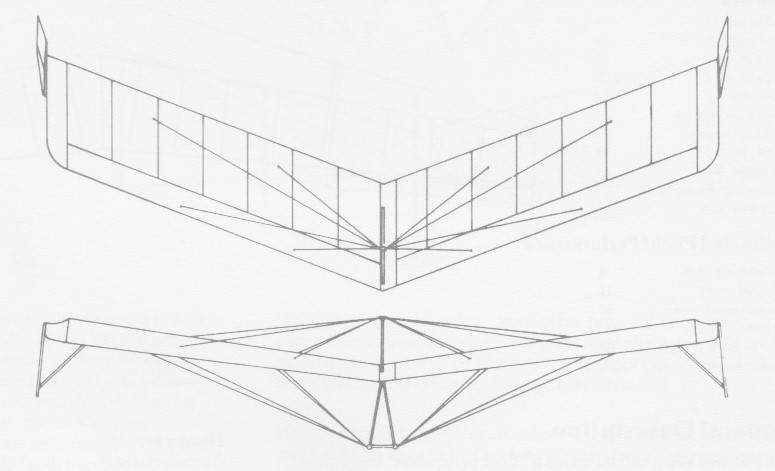
The glider was first conceived in late summer/early fall of 1974. An important design goal was that a Quicksilver’s basic structure (everything but the sail and wing ribs) could be converted into a Pacific I with very few modifications. A Quicksilver would need a better airfoil for more lift and better streamlining. More lift was provided by a modified Liebck section from the Icarus V. A rear spar was put at the trailing edge and eliminate the use of any secondary structures. The 1in trailing edge could be put in latter with foam, paper, or whatever.

To reduce the drag, all surfaces were covered on both sides with 1.8oz dacron glued and shrunk in place. Gussets and pop rivets relace bolts and machined fittings. The only machied parts ae standard bar corner fittings. The calculated desin weight was 48 lb however some larger tubin increased the weight by about 4 lb. The completed machine came in at 53 lb.

It has no turnbuckles, as it has a homemade threaded expandable kingpost to take up the rigging slack after assembly. It can be assembled by one person in under 5 minutes.

The wing ribs are made out of 1.2lb foam with spruce capstrips and weigh 3 oz each. Foam blocks are glued between the ribs to the high point of the airfoil, covered by a thin layer of cardboard under the dacron.

The rigging uses double leading and trailing edge wires top and bottom, and a set of extra tail brace wires running from the stabiliser leading edge bolt to the first compression member on the wing.

The prototype Pacific I cost about $225 to build.
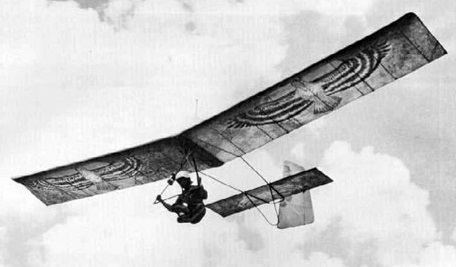
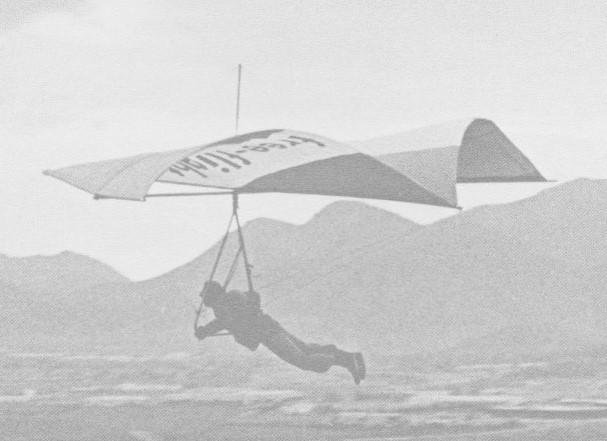
The only major changes to the prototype was the pilots suspension system to allow supine flying. It was flown to 3rd place in the rigid wing class at the 1975 Tellurise Championships.

There was a need for better roll control and/or glide path control.
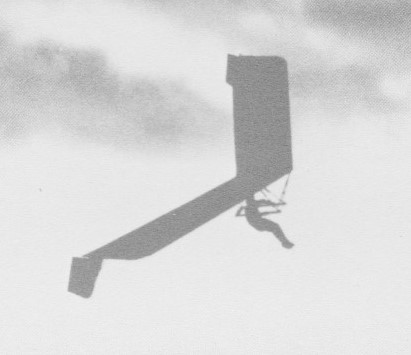
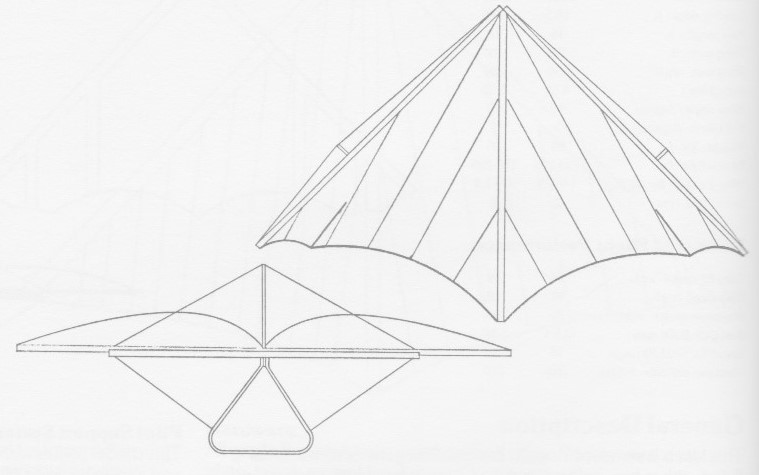
Free Flight Icarus V / Icarus Aircraft Icarus V

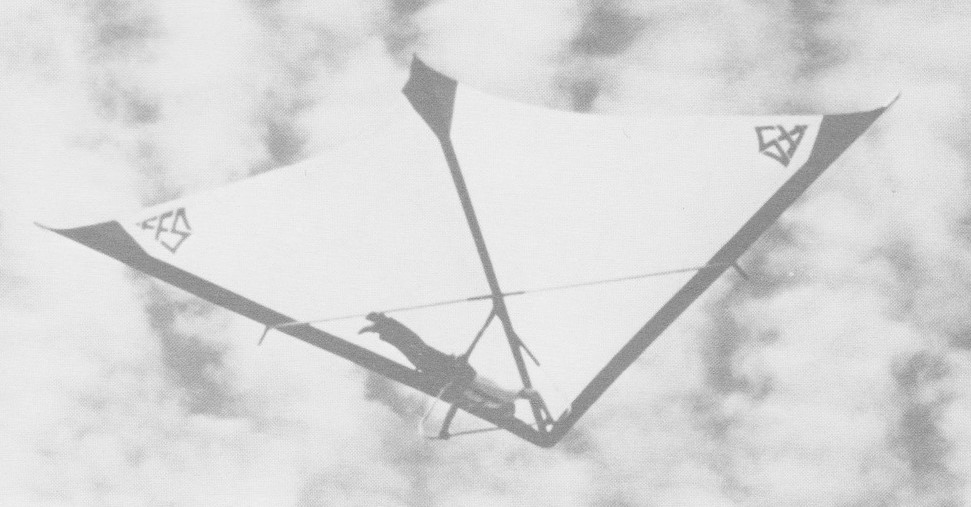
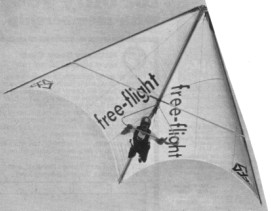
Developed by Taras Kiceniuuk, the Ikarus V swept wing monoplane hang glider utilised independently actuated wing tip rudders allowing continuous 60 degree banked turns and easy, controlled landings.

Free Flight Icarus V Article

Tip rudders, individually worked by twist grips, provide lateral control. The pilot rides in a cage and can pull his feet up during flight to reduce drag. The glider disassembles along the centreline for car-top transportation.

The wing has a foam sheet leading edge with doped fabric covering, and is stressed for a maximum of 6.5G.

The airframe is made from 6061-T6 and 2024-T3 aluminium tubng. All exposed parts are bright dip gold anodised or cadium plates. Rigging is stainless steel 3/32in 7 x 7 aircraft quality, all vinyl coated.

A hardware is aircraft quality stainless steel, aluminium, and some 4130 chromoly steel. The wing covering is 1.7oz dacron, shrunk and doped. It was available in white only.

The pilot has a parallel hang tube/swing seat combination.

Gallery

Chord length: 5 ft
Wing span: 32 ft
Wing area: 160 sq,ft
Aspect ratio: 6.4
Wing sweep: 20˚
Weight: 72 lb
Pilot weight: 120-220 lb
Takeoff speed: 15 mph
Stall speed: 16 mph
Max speed: 60+ mph
Best glide ratio (L/D): 12-1
Best L/D speed: 21 mph
Min sink: 150 fpm

Icarus Aircraft Icarus V
Wing span: 32 ft
Wing sweep: 20 deg
Wing chord: 5 ft
Empty weight: 66 lb
Stall: 16 mph
Max glde: 10-1
Min sink: 180 fpm
Plans price (1974): $12.95

Free Flight Sierra

Sierra II

The Sierra II has an adjustable centre of gravity plate, skid late, adjustable wing stiffeners, 5ft control bar and a ‘shur-lok’ quick release spreader bar tha allows for speedy folding of the wing without tools.

The airframe is made from 6061-T6 1.5in x .058 aluminium tubing. All airframe parts are anodised in gold or black, fully sleeved and doweled.

The rigging is stainless steel 3/32in 7×7 aircraft qualiy, all vinyl coated. All harwre is aircraft quality stainless steel and aluminium.

The sal is 3.8oz Howe & Bainbridge stabilised dacron that wasin 11 colours. It has 8in reinforced wing pockets and a non-symetrically cut trailing edge. A prone harness was included.

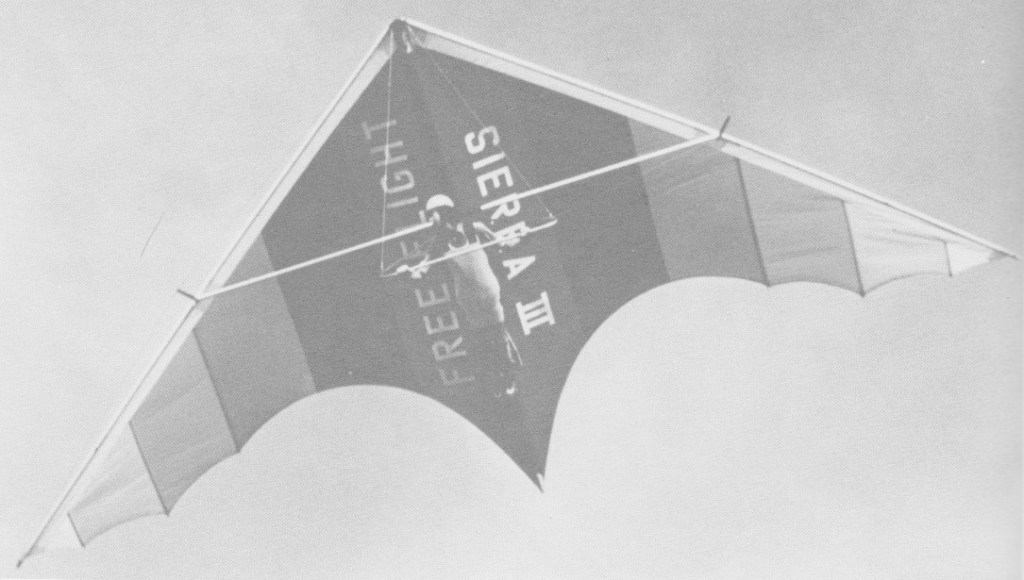
The Sierra III was a high performance glider with a deep scalloped centre section cambered keel. It was for advanced pilots only because of its very fast handling and long glide ratio. This model has an adjustable centre gravity plate, skid plate, 5 ft control bar, and a “shur-lok” quick release spreader bar that allows for speedy folding of the wings without tools.

Sierra III

The Sierra III airframe is made from 6051-T6 1.5in x .058 aluminium tubing. All airframe parts are anodised in gold or black, fully sleeved and doweled. Rigging is stainless steel 3/32 in 7 x 7 aircraft quality, all vinyl coated, and the hardware is all aircraft quality stainless steel and aluminium parts.

The sail is made from 3.8oz Howe and Bainbridge stabilisd dacron in a choice of 11 colours. He sail has tapered leading edge pockets, triple flared wing tips to increase the tip chord, and three tapered tubular fibreglass batten per side. A prone harness was included.

Sierra II 19×17
Leading edge: 19 ft
Keel length: 17.5 ft
Wing span: 26.9 ft
Wing area: 185 sq,ft
Aspect ratio: 3.9
Nose angle: 90˚
Sail billow: 3.5˚
Weight: 40 lb
Pilot weight: 105-150 lb
off speed: 12 mph
Stall speed: 14 mph
Max speed: 50 mph
Best glide ratio (L/D): 6-1
Best L/D speed: 26 mph
Min sink: 300 fpm

Sierra II 20×18
Leading edge: 20 ft
Keel length: 18.5 ft
Wing span: 28.2 ft
Wing area: 208 sq,ft
Aspect ratio: 3.9
Nose angle: 90˚
Sail billow: 3.5˚
Weight: 45 lb
Pilot weight: 130-80 lb
off speed: 12 mph
Stall speed: 14 mph
Max speed: 50 mph
Best glide ratio (L/D): 6-1
Best L/D speed: 26 mph
Min sink: 300 fpm

Sierra II 21×19
Leading edge: 21 ft
Keel length: 19.5 ft
Wing span: 29.8 ft
Wing area: 230 sq,ft
Aspect ratio: 3.9
Nose angle: 90˚
Sail billow: 3.5˚
Weight: 48 lb
Pilot weight: 180-240 lb
Takeoff speed: 12 mph
Stall speed: 14 mph
Max speed: 50 mph
Best glide ratio (L/D): 6-1
Best L/D speed: 26 mph
Min sink: 300 fpm

Sierra III
Leading edge: 20 ft
Keel length: 12 ft
Wing span: 32 ft
Wing area: 187 sq,ft
Aspect ratio: 5.8
Nose angle: 105˚
Sail billow: 1.5˚
Weight: 45 lb
Pilot weight: 110-210 lb
Takeoff speed: 15 mph
Stall speed: 15 mph
Max speed: 45 mph
Best glide ratio (L/D): 7-1
Best L/D speed: 28 mph

Sierra II
Sierra III

Free Flight Standard

The computer designed Free Flight Standard beginners’ hang glider incorporates a deep scollop 3.8 oz Howe & Bainbridge stabilised dacron sail in a choice of 11 colours.

A prone harness was included. Controls were available in 40in, 48in, and 60in widths. Each rigging wire had a tang, and a storage cover was included.

The airframe is made from 6061-T6 1.5in x .058 aluminium tube and all airframe parts are anodised in gold or black. Fully sleeved and doweled. Stainless steel cables are 3/32in 7×7 aircraft quality.

15 x 15
Leading edge: 15 ft
Keel length: 15 ft
Wing area: 143 sq,ft
Aspect ratio: 2.6
Nose angle: 80˚
Sail billow: 3.5˚
Weight: 35 lb
Pilot weight: 90-130 lb
Takeoff speed: 14 mph
Stall speed: 15 mph
Max speed: 40 mph
Best glide ratio (L/D): 4.1
Best L/D speed: 25 mph
Min sink: 400 fpm

16 x 16
Leading edge: 16 ft
Keel length: 16 ft
Wing area: 157 sq,ft
Aspect ratio: 2.6
Nose angle: 80˚
Sail billow: 3.5˚
Weight: 37 lb
Pilot weight: 120-160 lb
Takeoff speed: 14 mph
Stall speed: 15 mph
Max speed: 40 mph
Best glide ratio (L/D): 4.1
Best L/D speed: 25 mph
Min sink: 400 fpm

17 x 17
Leading edge: 17 ft
Keel length: 17 ft
Wing area: 179 sq,ft
Aspect ratio: 2.6
Nose angle: 80˚
Sail billow: 3.5˚
Weight: 38 lb
Pilot weight: 140-170 lb
Takeoff speed: 14 mph
Stall speed: 15 mph
Max speed: 40 mph
Best glide ratio (L/D): 4.1
Best L/D speed: 25 mph
Min sink: 400 fpm

18 x 18
Leading edge: 18 ft
Keel length: 18 ft
Wing area: 202 sq,ft
Aspect ratio: 2.6
Nose angle: 80˚
Sail billow: 3.5˚
Weight: 39 lb
Pilot weight: 150-200 lb
Takeoff speed: 14 mph
Stall speed: 15 mph
Max speed: 40 mph
Best glide ratio (L/D): 4.1
Best L/D speed: 25 mph
Min sink: 400 fpm

19 x 19
Leading edge: 19 ft
Keel length: 19 ft
Wing area: 227 sq,ft
Aspect ratio: 2.6
Nose angle: 80˚
Sail billow: 3.5˚
Weight: 40 lb
Pilot weight: 190-220 lb
Takeoff speed: 14 mph
Stall speed: 15 mph
Max speed: 40 mph
Best glide ratio (L/D): 4.1
Best L/D speed: 25 mph
Min sink: 400 fpm

20 x 20
Leading edge: 20 ft
Keel length: 20 ft
Wing area: 260 sq,ft
Aspect ratio: 2.6
Nose angle: 80˚
Sail billow: 3.5˚
Weight: 42 lb
Pilot weight: 220+ lb
Takeoff speed: 14 mph
Stall speed: 15 mph
Max speed: 40 mph
Best glide ratio (L/D): 4.1
Best L/D speed: 25 mph
Min sink: 400 fpm

Free Flight Windrider

The Windrider hang glider kit was a standard rogallo that features: double zig zag stitched all white sail, 48in wide control bar with replaceable downtubes, 6061 T6 1.5in x 0.058in aluminum airframe, deep scalloped sail, completely pre fin¬ished rigging and airframe tubes, prone flight harness, and a clear concise set of plans that allows assembly in 1 hour.

Wingspan: 16 ft.
Pilot wt: 100 130 lbs.

Wingspan: 17 ft.
Pilot wt: 130 160 lbs.

Wingspan: 18 ft.
Pilot wt: 150 185 lbs.

Free Flight K1

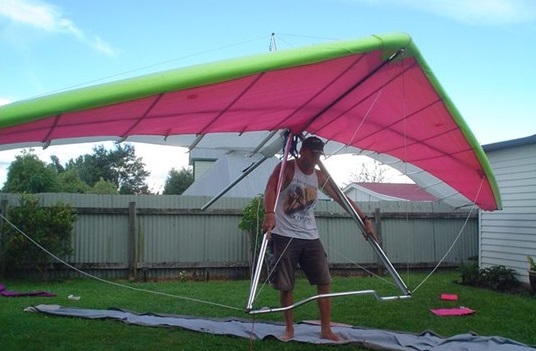
The Free Flight K1 ZK-JFW was originally a “K 1” hang-glider but has been converted to a Trike powered by a Rotax 447 with a Bing carburettor and a three-blade adjustable propeller. It also has a ballistic parachute mounted above the wing for emergency use. Its first flight was at Murawai Beach, New Zealand, by Karl Hoffman.

Engine: Rotax 447.