Wings 156 Wing area: 15.6 m² Wing span: 9.7 m Aspect ratio: 6 Hang glider weight: 18 kg Minimum pilot weight: 60 kg Maximum pilot weight: 85 kg Maximum speed: 64 km/h Max glide ratio (L/H): 11 Packed length short: 3.65 m Number of battens: 8 Nose angle: 112°
Wings 172 Wing area: 17.2 m² Wing span: 9.7 m Aspect ratio: 5.5 Hang glider weight: 18 kg Minimum pilot weight: 70 kg Maximum pilot weight: 85 kg Maximum speed: 64 km/h Max glide ratio (L/H): 11 Packed length short: 3.65 m Number of battens: 8 Nose angle: 112°
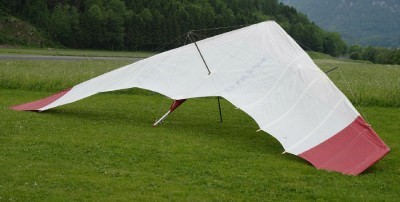
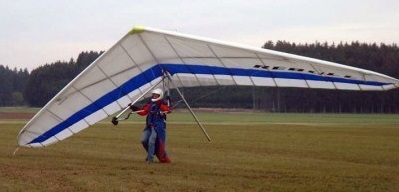
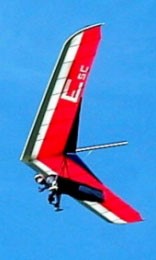
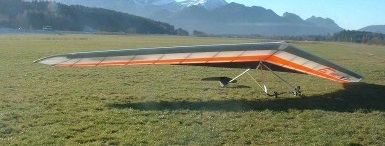
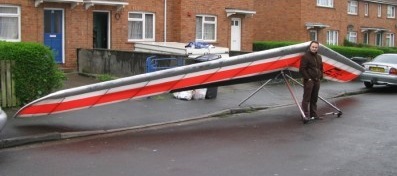
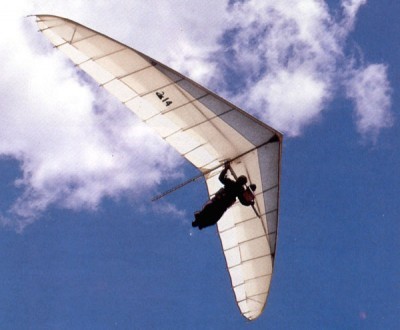
The 2000 Guggenmos ESC glider for Advanced pilots is very quick to rig and can be flat rigged. The twist, washout is manufactured into the leading edges combined with fixed tips and slighty more sweep then other rigids makes for a very stable platform.
The glider has the more usual spoilers for roll and a closed loop control system with no nose wires. The flaps split in two, length wise for derigging that enables them to be large, yet not impact on the folding up of the wing. The rib trailing edge junction is quick to attatch as are the fixed tips.
Very good roll control, quick to roll in and a little slower to roll out, pitch is light but positive. The landing is no harder then a sky floater. A very easy glider to fly.
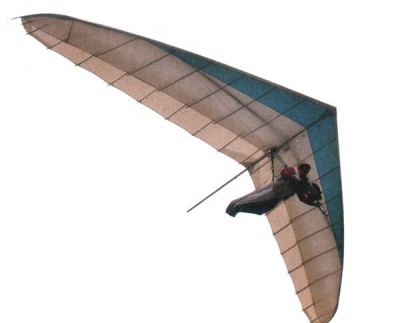
The ESC XT for Advanced pilots appeared in 2006.
ESC XT
The ESC-C appeared in 2002.
ESC-C
ESC 2001 Wing area: 13.4 m² Wing span: 12.1 m Aspect ratio: 11.1 Minimum pilot weight: 70 kg Maximum pilot weight: 104 kg Nose angle: 127°
ESC 2002 Wing area: 13.4 m² Wing span: 12.1 m Aspect ratio: 11.1 Hang glider weight: 32 kg Minimum pilot weight: 70 kg Maximum pilot weight: 104 kg Minimum speed: 42 km/h Number of battens: 2 Nose angle: 127°
ESC-C 2002 Wing area: 12.1 m² Wing span: 11.2 m Aspect ratio: 10.5 Minimum pilot weight: 66 kg Maximum pilot weight: 90 kg Nose angle: 127°
The E 7 by Joe Guggenmos (ex World HG Champ) at first glance looks similar to the Exxtacy, however it has a tapered wing (both chord and D-Cell cross section) using separate right and left moulds. It has control bar activated spoilers, is 152 sq.ft, 10.43 aspect, 39ft span, spoilers and flaps fold up with the glider, 18.5ft (5.6m) long in the bag and weighs just 68 lbs (31 kg). Joe claims a glide of over 17:1, a sink rate of 137 ft/min and handling better than other rigids. The spoilers are mounted at the high point of the airfoil, pre empting any nose up movement when they are deployed.
The E 7 carbon fibre rigid wing was first built in August 1998 and he has been flying and testing it ever since. It was DHV certified and in production at the Guggenmos factory in Germany.
Wing area: 13.8 m² Wing span: 11.9 m Hang glider weight: 32 kg Minimum speed: 30 km/h Number of battens: 12
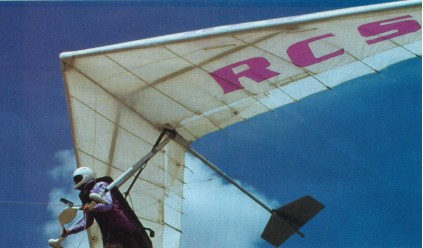
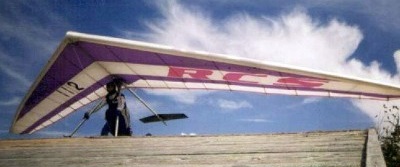
Joe Guggenmos makes the Bullet glider series and the RCS Topless. In 1997 Guggenmos equipped his topless RCS with anti-vortex wingtip fairings.
Bullet RCS
Bullet RCS Hang glider circa 1998. Wing area: 13.2 sq.m Certification: DHV 2-3 Pilot weight: 70-98 kg Wing span: 10.9 m Nose Angle: 133 degs Aspect ratio: 3 Price (1998) 10800 DM
Bullet RCS Wing area: 13.2 m² Wing span: 10.9 m Aspect ratio: 3 Hang glider weight: 32 kg Minimum pilot weight: 70 kg Maximum pilot weight: 98 kg Nose angle: 127°
Bullet RCS-M Hang glider circa 1998. Wing area: 11.3 sq.m Certification: DHV 2-3 Pilot weight: 62-79 kg Wing span: 10.15 m Nose Angle: 130 degs Aspect ratio: 9 Price (1998) 10800 DM
Bullet RCS M Wing area: 11.3 m² Wing span: 10.15 m Aspect ratio: 9 Hang glider weight: 30 kg Minimum pilot weight: 62 kg Maximum pilot weight: 79 kg Minimum speed: 32 km/h Number of battens: 29 Nose angle: 127°
Joe Guggenmos makes the Bullet glider series and the RCS Topless. The Bullet C was a 1984 hang glider for Advanced pilots.
The Bullet Competition appeared in 1984.
Bullet Competition
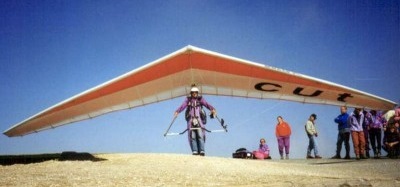
Guggenmos realized that the 2 meter extra wingspan of the Bullet 12 were not very efficient, so he designed afterwards a cut down version of it with a 10 meter wingspan, the Bullet Cut.
Bullet Cut
The Bullet Easy was a 1985 version.
The Bullet Novum was for Intermediate pilots.
Bullet Novum
The Bullet Racing is a 1983 version.
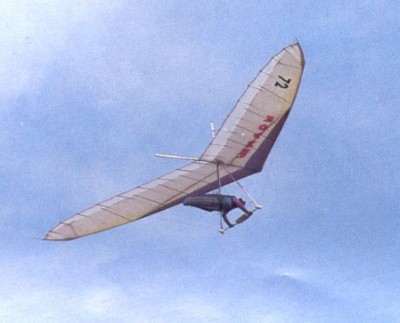
The Bullet SP is an intermediate glider. The SP is difficult to land because of very narrow flare window. It is stiff to fly but rises beautifully in thermals.
Bullet SP
Bullet C 14
Bullet C 16 Hang glider circa 1998. Wing area: 16 sq.m Certification: DHV 2-3 Pilot weight: 65-104 kg Wing span: 10.7 m Nose Angle: 132 degs Aspect ratio: 7.2 Price (1998) 8400 DM
Bullet C 85
Bullet C 150 Wing area: 15.2 m² Wing span: 11 m Aspect ratio: 8.6 Hang glider weight: 28 kg
Bullet C 160 Wing area: 16 m² Wing span: 9.68 m Aspect ratio: 5.85 Hang glider weight: 25 kg Minimum pilot weight: 60 kg Maximum pilot weight: 85 kg Packed length: 5.6 m Packed length short: 4 m Number of battens: 28 Nose angle: 127°
Bullet Cut Hang glider circa 1998. Wing area: 13.2 sq.m Certification: DHV 2-3 Pilot weight: 72-97 kg Wing span: 10.9 m Nose Angle: 133 degs Aspect ratio: 9 Price (1998) 8600 DM
Bullet Cut Wing area: 13.2 m² Wing span: 10.9 m Aspect ratio: 9 Hang glider weight: 28 kg Minimum pilot weight: 72 kg Maximum pilot weight: 97 kg Packed length: 6.1 m Packed length short: 4.1 m Number of battens: 31 Nose angle: 127°
Bullet Cut S Hang glider circa 1998. Certification: DHV 2-3 Pilot weight: 62-79 kg Wing span: 10.15 m Nose Angle: 130 degs Aspect ratio: 9 Price (1998) 8400 DM
Bullet Cut S Wing area: 11.3 m² Wing span: 10.15 m Aspect ratio: 9.3 Hang glider weight: 28 kg Minimum pilot weight: 55 kg Maximum pilot weight: 75 kg Packed length: 5.8 m Packed length short: 3.9 m Number of battens: 26 Nose angle: 127°
Bullet Novum Hang glider circa 1998. Wing area: 14.9 sq.m Certification: DHV 3 Pilot weight: 68-98 kg Wing span: 10.5 m Nose Angle: 130 degs Aspect ratio: 7.4 Price (1998) 8300 DM
Bullet Novum Wing area: 14.9 m² Wing span: 10.5 m Aspect ratio: 7.4 Hang glider weight: 26 kg Minimum pilot weight: 68 kg Maximum pilot weight: 96 kg Packed length: 5.6 m Packed length short: 4 m Number of battens: 28 Nose angle: 127°
Bullet SP 11 Hang glider circa 1998. Wing area: 12.3 sq.m Certification: DHV 3 Pilot weight: 60-85 kg Wing span: 10.9 m Nose Angle: 133 degs Aspect ratio: 9.9 Price (1998) 8300 DM
Bullet SP 11 Wing area: 12.3 m² Wing span: 10.3 m Aspect ratio: 9.9 Hang glider weight: 26 Minimum pilot weight: 60 kg Maximum pilot weight: 85 kg Packed length: 5.7 m Packed length short: 3.9 m Number of battens: 30 Nose angle: 127°
Bullet SP 12 Wing area: 13.8 m² Wing span: 12 m Aspect ratio: 10.4 Hang glider weight: 31 Minimum pilot weight: 70 kg Maximum pilot weight: 94 kg Packed length: 6.2 m Packed length short: 4.2 m Number of battens: 31 Nose angle: 127°
 All Aero