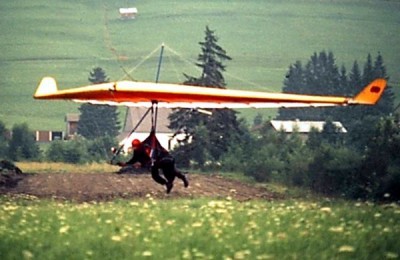
The 1984 Hiway Hang Gliders Explorer glider had wire for the leading edge. They had pitch problems when the wire flipped at low angles of attack.
Wing area: 14.5 m² Wing span: 10.4 m Aspect ratio: 7.45 Hang glider weight: 32 kg Minimum pilot weight: 57 kg Maximum pilot weight: 89 kg Packed length short: 3.2 m Nose angle: 136°
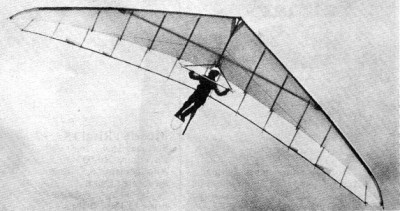
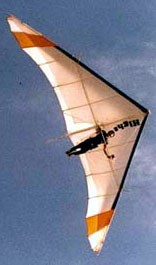
This Excalibur was Hiway’s 1984 high performance glider-distinguished on British hills by being the only model in production at the time with elliptical tips. It was developed to give the best possible compromise between minimum sink rate and best glide angle, making it a natural cross country machine.
The glass fibre tips allow the sail greater movement in response to weightshift, producing nimble handling and an ability to shrug off turbulence. The Excalibur was produced in two sizes, 180 and 165 sq ft.
Wing area: 16.7 m² Aspect ratio: 6.9 Hang glider weight: 32 kg Minimum pilot weight: 70 kg Maximum pilot weight: 115 kg Minimum speed: 20 km/h Maximum speed: 90 km/h Max glide ratio: 10 Minimum sink rate: 0.9 m/s Nose angle: 135°
Excalibur (medium) Sail area: 165 sq ft Leading edge: 16 ft 4 in+ fiber tips, 10 ft 8 in Span: 34 ft 8 in Nose angle: 140 deg
Designed by Bill Pain for Hiway and Joe Binns helped with test flying. The 1st prototype was a 135, then the 145 which flew and handled really well. Then the 150 which never worked. It was originally just a research vehicle but Hiway pushed to have it developed
Hiway cancelled the project. Binns brought prototypes.
Joe Binns did take the 3rd or 4th prototype to the 1982 XC Classic in Owens Valley. Owens had crashed and bent a leading edge without realising it so it did not perform well.
The 135 handling was a compromise between high performance and handling, both of which demanded critical handling techniques. The carbon fibre tensioners on the wingtips were designed and rigged such that washout and trailing edge flexibility were minimal. Consequently, turning her into a strong thermal would demand huge effort and concentration. Max gliding to the next lift would require very precise attitude setting or performance would be seriously degraded. It proved to be a very sturdy machine and would wingover past 90deg without any nasty frighteners.
The larger version was very docile but had very little to offer in performance. The larger machine was more awkward to rig, having had a detachable ‘A’ frame, was infinitely more manageable in all conditions though struggled to make the most of available lift. It was less competitive than the 135. It only flew it a handfull of times.
Alan Monks bought the ‘Yellow Budgie’ from Paul Farley back in ’84’ for a hundred and fifty quid and considered it the best money ever spent at the time. It was exceptionally difficult to hook into a big thermal and could be a handful in turbulence. However she’d go up well once established in lift but the sink rate would let her down in the transit. In smooth air she handled like a dream and was very controllable and inherent stability in all axes was dead positive. The budgie faded into retirement in 89/90 and was stored under-cover for a number of years before released to the hang glider museum. The 135 model was donated to the hang glider museum based in Weston-Super-Mare, Somerset, in 2000 or there abouts by Alan Monks.
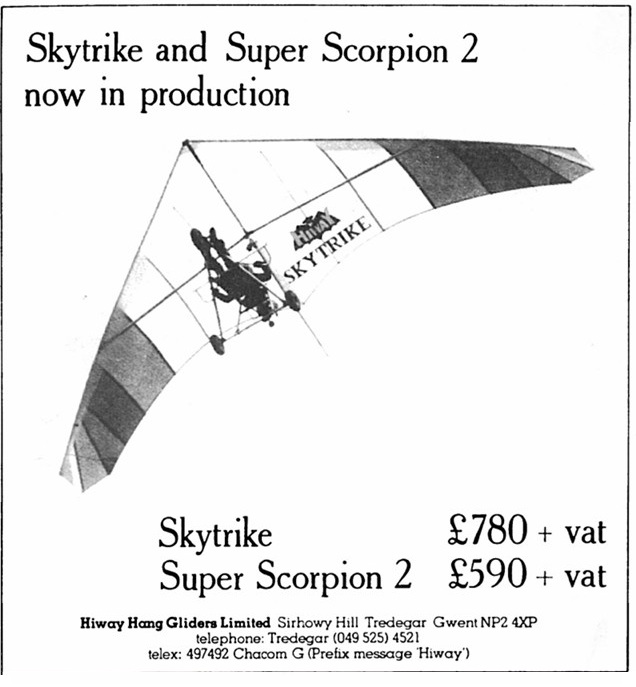
Hiway decided to return to simplicity for a new range of gliders, with no wing wires. Hiway designed the airframe to fles in a particular way under flight loads, and then sew the sail to fit the shape exactly. The first of the range were 1) Super Scorpion, a cross-country hang glider. 2) Spectrum, intermediate glider. 3) Gemini, purpose designed two-place glider. 4) Harrier, primary and training glider. The Scorpion was a 1977 hang glider from Hiway Hang Gliders.
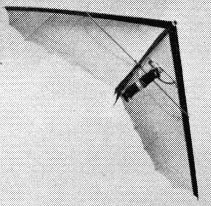
The Scorpion is a high-aspect ratio Rogallo hybrid with tip extensions (also referred to as truncated tips), a deeply scalloped trailing edge, finite aft sail extension, and tapered leading-edge pockets. It is controlled solely by means of weight shifting.
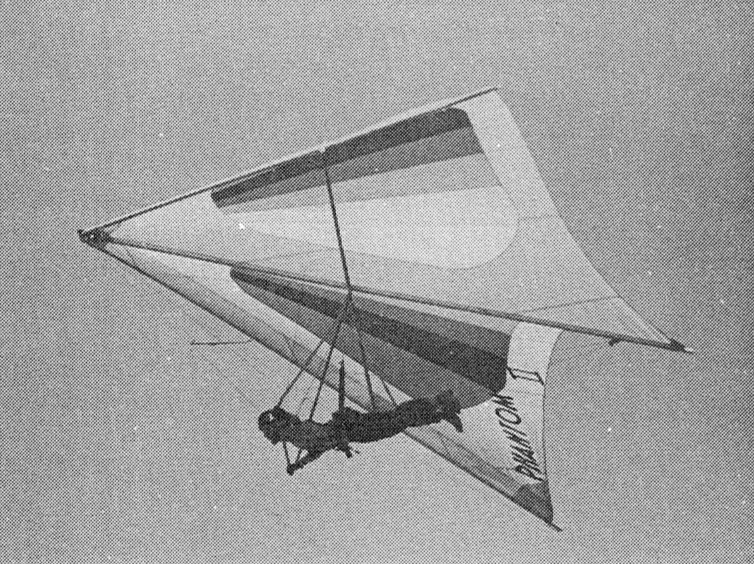
Phantom II
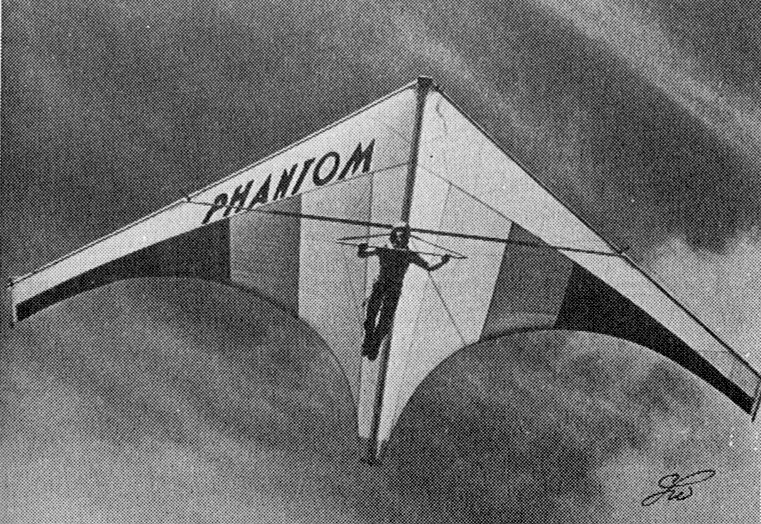
It is characterised by a unique aft sail extension which ought to mean improved longitudinal stability. It also has what the manufacturer calls a ‘keel sail equaliser’ that allows for the sail to adjust under the changing air pressure distribution in a turn. A typical trapeze bar / harness arrangement is used. Its wing loading is about the same as a standard Rogallo, thus, coupled with the greater efficiency of the high aspect ratio wing, it has a very low stall speed. This may limit its speed range. At the stall, one wing tip will tend to drop. Pitch and roll response are reported adequate just above stall. Take down / set up times should be within 10 minutes, and the Scorpion may be folded and transported.
Phantom Scorpion
The 1977 Scorpion had a very low sink rate and could also be flown at very high angles of attack. This facilitates circling more easily in small thermals. Cross country thermaling flights on Scorpions were a common occurrence. The low stall speed made take-offs and landing a delight, and top landing could be made in lighter winds.
1977 Scorpion
A and B Scorpions have 1 3/4 inch cross spars, C and D have 1 7/8 inch. The Scorpion has a totally folding A frame with a removeable bottom bar. The cross spar is split to facilitate storage and carriage. The usual Hiway quick release nose catch is retained and the wing posts simple push into bushed apertures in the leading edges. Knock down versions were available where the leading edges fold. Scorpions were available as either prone or seated and in four sizes, priced at £464.00 in 1977.
The Superscorpion (released the same day as the Spectrum), first appearing on the market in early 1978, is the first machine to have fully cambered sail and an absence of deflexers. The Mk 1 has a very simple airframe which is strong, reasonably light and easy to rig. The control frame uprights have a curve at the top and rigging is achieved by swinging out one upright which locates with a spring button. As the uprights are of 1 1/8 inch x 17 g they are quite easily damaged. The early Superscorpions are extremely easy to fly, being light in both pitch and roll, but with just the right amount of damping. One of the main virtues of the glider’s handling is the ease with which the glider will roll, even without any pitch co-ordination. This allows moderately flat turns and 360s to be achieved easily. It will fly very slowly indeed and still retain good roll control which makes it ideal for scratching on light wind days or in light thermal. The 1978 Super Scorpion glider had lightest handling ever made, but an abysmal sink rate at speed and tail heavy balance that can feel cumbersome at take off (but often useful for landing). In stronger winds however, anything over 25 mph, the machine becomes very frustrating to fly due to its lack of penetration.
The glider was supplied in sizes ‘B’ pilot weight up to 10 st and ‘C’ for heavier pilots.
Paddy Monro was one of the many test pilots for Hiway and considered the Super Scorpion was an improvement on the Scorpion. The “C “was the best version. Best glider and best seller in its day.
The Super Scorpion C was top rated for manuverability and sink rate at its time. A very easy and safe wing, even withou lufflines. The downside was a lack of speed: over 40 km/h, it sank like a rock and a tendency to skid serious if turned with too little speed.
The Super Scorpion had a further 1980 development called the Super Scorpion II. The Mk II has a similar airframe set up to the Vulcan with a sliding centre-box system. And improved nose catch assembly makes for easier and more secure use. Visually the difference was the II had completely straight 13 g uprights. The earlier version I own has curves on each upright at the very top so that they end up parrallel to each other where connected. This glider is very sweet to fly having very pleasant handling qualities. The Mk.II is marginally faster than the Mk I, although the handling has suffered slightly due to the less flexible airframe, making roll just a little less responsive.Its only real drawback was a lack of penetration compared to some other gliders.
Super Scorpion 2
1977
Phantom Scorpion Wing span: 32 ft Wing area: 200 sq.ft Aspect ratio: 5 Keel length: 16 ft Leading edge: 19 ft Nose angle: 110 degrees Billow: 2.75 degrees Empty weight: 47 lb Max flying weight: 242 lb Useful load: 195 lb Best L/D: 7-1 Min sink: 254 fpm Stall: 14 mph Cruise: 24 mph
Scorpion A Wing area: 15 m² Wing span: 9.6 m Aspect ratio: 6 Hang glider weight: 20 kg Minimum pilot weight: 40 kg Maximum pilot weight: 55 kg Packed length: 5.86 m Packed length short: 3.3 m Number of battens: 10 Nose angle: 112°
Scorpion B Wing area: 17.5 m² Wing span: 10.2 m Aspect ratio: 5.6 Hang glider weight: 21 kg Minimum pilot weight: 50 kg Maximum pilot weight: 70 kg Packed length: 6.16 m Packed length short: 3.6 m Number of battens: 10 Nose angle: 112°
Scorpion C Wing area: 20.5 m² Wing span: 10.6 m Aspect ratio: 6.38 Hang glider weight: 25 kg Minimum pilot weight: 70 kg Maximum pilot weight: 90 kg Packed length: 6.38 m Packed length short: 3.77 m Number of battens: 10 Nose angle: 112°
Scorpion C Leading edge: 20 ft 11 in Keel: 10 ft 9 in Sail area: 220 sq ft Aspect ratio: 5.3 Weight: 56 lb Pilot weight range 11-14 st
Scorpion D Wing area: 22.5 m² Wing span: 10.8 m Aspect ratio: 6.6 Hang glider weight: 27 kg Minimum pilot weight: 90 kg Maximum pilot weight: 110 kg Packed length: 6.6 m Packed length short: 3.95 m Number of battens: 10 Nose angle: 112°
Super Scorpion A Wing area: 13.6 m² Wing span: 8.5 m Aspect ratio: 5.5 Hang glider weight: 18 kg Minimum pilot weight: 50 kg Maximum pilot weight: 70 kg Packed length: 5.1 m Packed length short: 3.75 m Nose angle: 120°
Super Scorpion B Wing area: 16 m² Wing span: 9.35 m Aspect ratio: 5.6 Hang glider weight: 21 kg Minimum pilot weight: 57 kg Maximum pilot weight: 82 kg Packed length: 5.6 m Packed length short: 4.05 m Nose angle: 120°
Super Scorpion B Leading edge: 18 ft 0 in Keel: 12 ft 1 in Sail area: 173 sq ft Nose angle: 120 deg Aspect ratio: 5.6 Weight 46 lb Span 30 ft 7 in Pilot weight range: 9 to 13 st.
Super Scorpion C Wing area: 18.4 m² Wing span: 10.2 m Aspect ratio: 5.7 Hang glider weight: 24 kg Minimum pilot weight: 70 kg Maximum pilot weight: 90 kg Packed length: 6.1 m Packed length short: 4.35 m Number of battens: 7 Nose angle: 120°
The 1980 Demon was the first double surface wing produced by the Hiway company. Produced in three sizes, 150, 175 and 195 (between 80 and 83) the Demon was regarded as an excellent performer which has mellow handling. A distinguishing feature is the use of a foam insert in the leading edge as opposed to mylar sheet used by competitors.
A 165 which was a 198 prototype Demon had extremely light handling and ‘suspicious’ in pitch but production gliders were fine in this respect. All Demons had foam-backed leading edges as opposed to Mylar. Later models also had blue ‘painted’ rather than anodised tubing.
It was quite heavy at the time.
The Demon (for advanced pilots) was also made under license from Hiway by Flight Designs of Salinas, California. The American version also served as the wing for the “Jetwing” trike also produced by Flight Designs. After Flight Designs was bought out by Pioneer Parachute in 1982, some sails were made by the latter company. These were highly inferior to the original versions, and can be identified by the use of straight-stitch seams rather than zig-zag seams.
1980 Demon medium Leading edge: 19 ft Root chord: 8 ft 5 in Span: 33 ft 6 in Nose angle: 130 deg approx. Weight: 72 lb
1980 Demon large Weight 68 lb
Demon 160 Wing area: 14.8 m² Wing span: 9.73 m Aspect ratio: 6.4 Hang glider weight: 29 kg Minimum pilot weight: 54 kg Maximum pilot weight: 69 kg Minimum speed: 25 km/h Max glide ratio (L/H): 8.6 Max glide ratio speed: 29 km/h Minimum sink rate: 0.9 m/s Packed length: 5.57 m Packed length short: 4.25 m Nose angle: 125°
Demon 175 Wing area: 16.26 m² Wing span: 10 m Aspect ratio: 6.2 Hang glider weight: 33 kg Minimum pilot weight: 63 kg Maximum pilot weight: 91 kg Max glide ratio speed: 30 km/h Packed length: 5.67 m Packed length short: 4.25 m Nose angle: 125°
Demon 195 Wing area: 18.12 m² Wing span: 10.6 m Aspect ratio: 6.3 Hang glider weight: 32 kg Minimum pilot weight: 82 kg Maximum pilot weight: 100 kg Max glide ratio speed: 32 km/h Nose angle: 125°
Made in 1975, the Hiway Cloudbase was a second generation glider which incorporated battens and deflexers. At this time battens became the norm. Early models had two radial battens whilst later ones, as pictured, have chordwise battens. The Cloudbase can be slowed down without the nose or wing dropping. On light marginal days this gives the pilot time to put the kite back on the top when the wind drops momentarily, instead of having to go down. On stronger days the higher aspect ratio ensures that the glider can use parts of the sky that other machines simply cannot reach. The Cloudbase was supplied in three sizes to cover pilot weights from 7 to 18 st.
Cloudbase model 20 medium 10-15 st Leading edge 20 ft 2 in Keel 18 ft 2 in Sail area 220 sq ft Aspect ratio 4 Weight 43 lbs Price 1975 £378.00
Hiway, founded by John Ievers and Steve Hunt, first produced a standard Rogallo, in 1973.
Hiway Hang Gliders Ltd Sirhowy Hill Tredegar Gwent NP2 4XP UK
27/35 Bernard Rd Brighton UK
Hiway decided to return to simplicity for a new range of gliders, with no wing wires. Hiway designed the airframe to fles in a particular way under flight loads, and then sew the sail to fit the shape exactly. The first of the range were 1) Super Scorpion, a cross-country hang glider. 2) Spectrum, intermediate glider. 3) Gemini, purpose designed two-place glider. 4) Harrier, primary and training glider.
Hiway hang gliders was re-floated as Hiway (83) Ltd. under the directorship of Jim Bowyer, Rod Macdonald and John Ievers (one of the original founders). Glider designs which have been carried over to the new company were as follows: Excalibur, a high performance CFX with flexible tips. Price £1141.95. Vision. double surface intermediate. £897.00. Explorer .Advanced rigid wing with aerodynamic controls. These were made to fulfill a German contract.Price £1581.25. Superscorpion 2. Post P1 .Price £747.50.(Manufactured 83 to 85).Stubby. Training glider.
The Highster was built in Oakland Ca. by Mike Giles 1978. It was a 90% double surface glider with triple deflexers (wing truss wires). These wires where adjusted with out turnbuckles. They where adjusted by turning over the outer tangs which would tighten the winding of one cable and lossen the other. For increased strenth, the cross bar was inner sleeved with out pop rivets. Later versions had a floating cross bar. Highster used Manta hardware and was considered the flex wing side of Manta when Manta swithched over to making the Fledge. Highster was named after a fork lift because it was a “Heavy Lifter”.
The most common size was 190 square feet. During peak demand for the Highster, some where manufactured in Sacramento, Ca.
It was easy to set up, with all the Manta hardware, good static balance, but a bit stiff to fly. The floating cross bar helped the handling. Glide was poor for a 90% double surface glider due to the triple set of wires out in front of the leading edge. The glider could be easliy spun and this was an accepted thermalling practice when the pilot was tired.
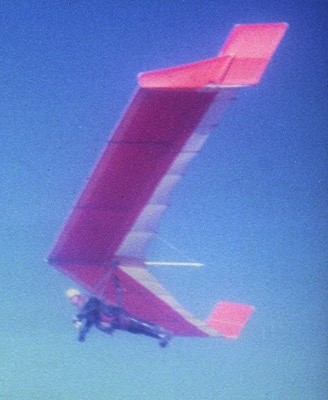
Klaus Hill designed the Manta Fledglings. When Manta made the Fledgling-II, Klaus was not happy with the results, so he did it better: this was the Voyager.
Klaus combined the Kasper wingtip gates and Fledgling rudders to make effective NASA winglets for the Fledgling hang glider.
Klaus Hill was killed on 10 October 1978 while testing the Voyager, a hang glider of his own design, which he had just motorised.
 All Aero