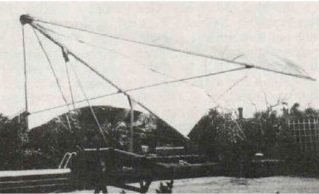
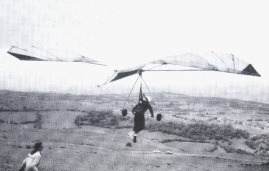
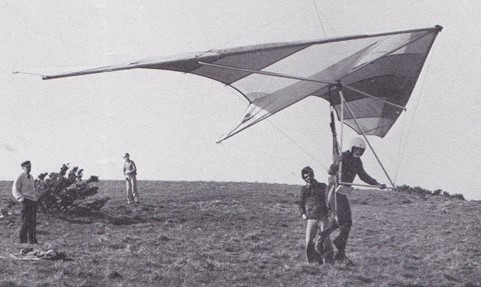
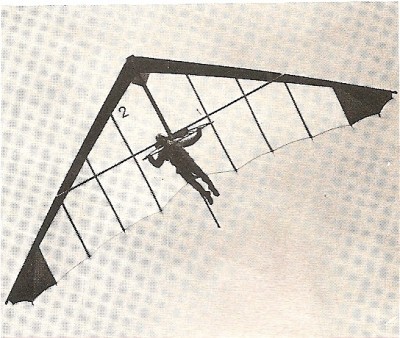
James Hobson of Tarzana, California, took only 11days to produce his Rogallo Wing Hang-Glider in 1962. It cost about $50.
Hobson was producer-director for the Welk TV show and it was used in a musical sequence.
James Hobson showed his 1962 Rogallo Wing Hang Glider at Dockweiler flying site, to editor of E.A.A. sports aviation magazine, and on the Lawrence Well Show for national and international audiences.
Wngspan: 20 ft Length: 13 ft 2 in Capacity: one person
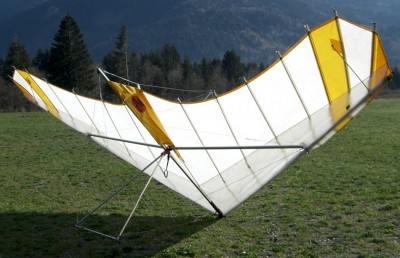
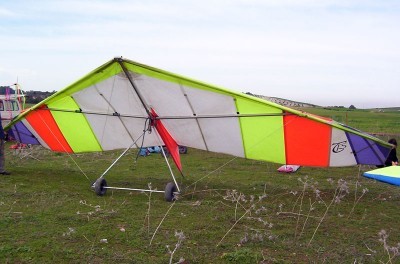
The Hiway Hang Gliders Eclipse (5th Gen.) is a glider which has taken its engineering from original Pacific Windcraft Eclipse. The first Eclipse had the original Pacific windcraft sail, with Hiway airframe including sliding top A frame to allow flat rigging. Subsequent gliders had Hiway sails and Airframe. Total number made by Hiway rumoured around 7. Handling concerns effected UK sales.
In 1987, the American Eclipse was replaced in the Pacific Windcraft product line by their Vision Mark IV (a version of which Airwave UK marketed, with Magic hardware, as the “Calypso”). That same year, Pacific Windcraft was absorbed into Pacific Airwave, which in turn was absorbed into its parent company, Airwave Gliders in 1994.
The 170 sq ft had 15 top surface battens, 4 lower, no keel pocket just strap and rear wire, no tip anti dive rods.only 4 reflex lines, nylon balls at floatng wing tips with tuning achieved by lengthening the leading edges at tips.
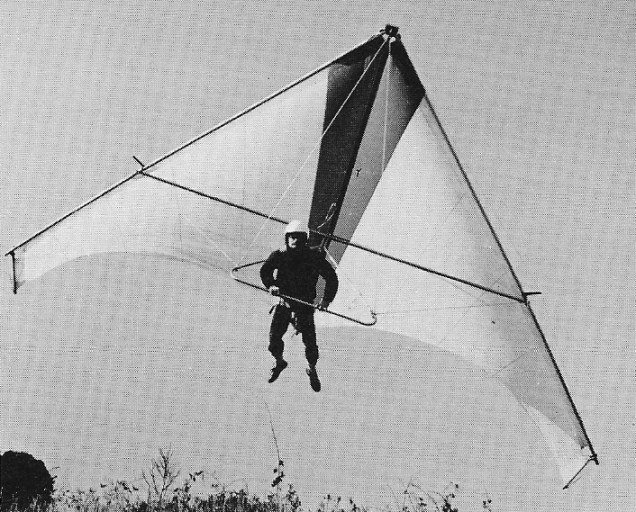
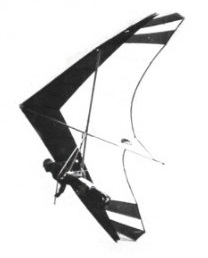
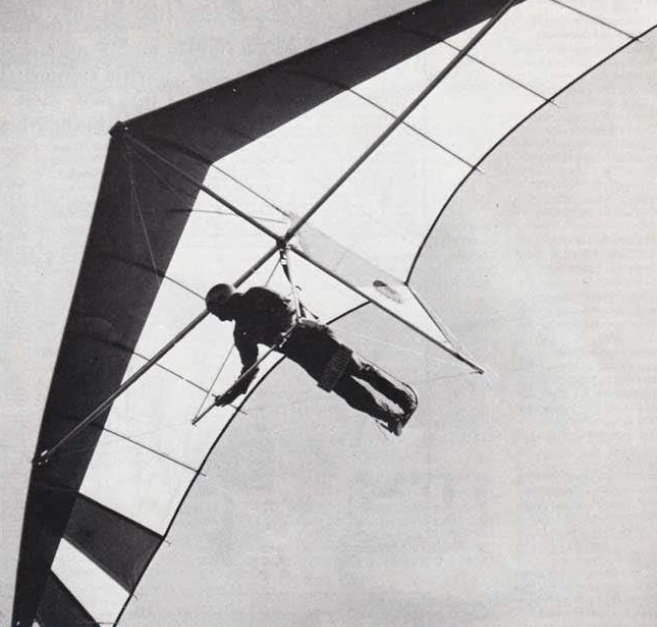
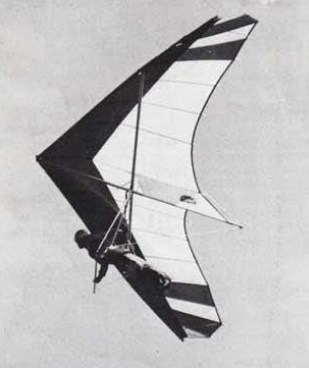
The 1979 Vulcan was designed to supercede the Super Scorpion. It is much like a Super Scorpion to look at but has a higher aspect ratio, much tighter sail and more double surface. Unlike other fourth generation machines, the Vulcan does not use preformed battens. Performance is not quite as good as the other machines of this generation, although min-sink is as good as its predecessor and the top speed much improved.
1979 Vulcan
Handling is very pleasant although there is a delay between pulling the bar in and the glider speeding up, this is probably due to the huge control frame. The size of the control frame also makes ground handling tricky but with any wind the glider is easily launched with the harness straps tight.
The 1980 Vulcan has high performance and especially penetration. The 128° nose angle, a hyper-tensioned trailing edge, a 30% lower leading edge sleeve and a highly worked sail give it a very high speed range. Molded umbrella folding, an original system of transverse link – leading edge and intelligent hooking of the cables below the nose make it simple and very fast assembly.
The Vulcan was the first hang glider that gained a C of A before release to the public. The high aspect rato and low twist wing gives good penetration for competition and coss-country. The cross boom is moved into the slower moving air closer to the sail reducing drag, as does the lack of deflexors. For de-rigging, a sliding centre box leaves the cross booms permanently attached to the leading edges. A removable king post prevent tangled wires.
Very light on all axes, but what inertia! In fact this lightness was given artificially by trapezoidal uprights of 1,80m which facilitate efforts. Very good in thermal, but bad to shave the walls. The big model was so much surfaced that it supported the bi.
Unfortunately maneuverability has decreased considerably but the finishing is impeccable and the sail impeccable.
1979 Vulcan Leading edge: 19 ft 8 in Span: 34 ft 5 in Nose angle: 180 deg Aspect ratio: 8:1 Root chord: 9 ft 2 in Sail area: 184 sq ft Aspect ratio 6.45 Packed length: 20 ft Knockdown length: 14 ft Weight: 57 lb Pilot weight range: 11.5-17 st Strength rating: 1575 lb Price: £640.00
1980 Vulcan Wing area: 17.1 m² Aspect ratio: 6.5 Hang glider weight: 26 kg Minimum pilot weight: 70 kg Maximum pilot weight: 100 kg Packed length short: 3.9 m Nose angle: 127°
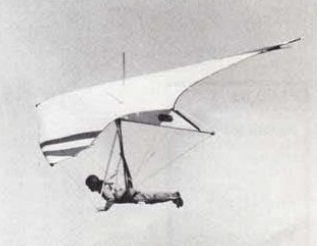
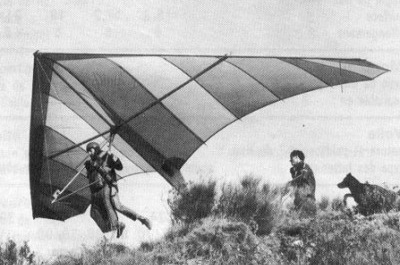
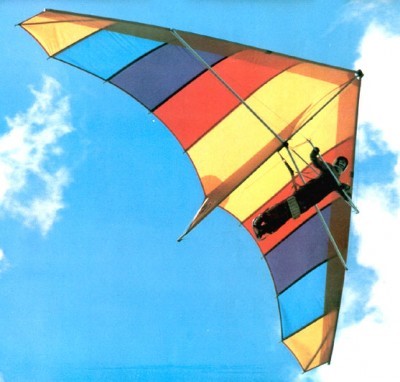
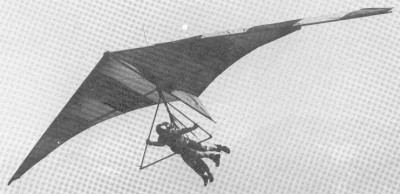
The 1978 Spectrum (released same day as Superscorpion) is a sporty machine, complying with FAI Class 1 Competition regulations. Although an intermediate with a conservative 105 deg nose angle, it generates a lot of lift. The Spectrum’s turning ability was second to none and 360’s were self balancing. Pitch is light and very high speeds are attainable. It also has a low stall speed facilitating top landings in light winds.
Hiway decided to return to simplicity for a new range of gliders, with no wing wires. Hiway designed the airframe to fly in a particular way under flight loads, and then sew the sail to fit the shape exactly. The first of the range were 1) Super Scorpion, a cross-country hang glider. 2) Spectrum, intermediate glider. 3) Gemini, purpose designed two-place glider. 4) Harrier, primary and training glider.
The Spectrum complies with FAI Competition regulations as an Intermediate glider. Turns are self balancing and very high speeds are attainable, and it has a low stall speed.
The Spectrum was available in two sizes and could be rigged for seated or prone. A “B” bar accessory converts from prone to seated.
The Hiway Spectrum was regarded as easy to handle although it had a reputation for tip-stalling.
The Gemini two place glider is an enlarged and strengthened version of the Spectrum.
Small Wing span: 26 ft 10 in / 8.2 m Wing area: 165 sq,ft / 15.3 sq.m Aspect ratio: 4.45 Leading edge: 17 ft / 5.15 m Keel length: 13 ft 3 in / 4 m Nose angle: 105˚ Weight: 45 lb / 20 kg Pilot weight: 50-76 kg Packed length: 17 ft 3 in / 5.25 m Knockdown length: 14 ft / 4.25 m
Large Leading edge: 18 ft 6 in / 8.66 m Keel length: 15 ft / 4.5 m Wing span: 29 ft 5 in / 9 m Wing area: 193 sq,ft / 17.9 sq.m Aspect ratio: 4.45 Nose angle: 105˚ Weight: 51 lb / 23 kg Pilot weight: 57-90 kg Packed length: 18 ft 10 in / 5.75 m Knockdown length: 14 ft 3 in / 4.35 m
Hiway decided to return to simplicity for a new range of gliders, with no wing wires. Hiway designed the airframe to fles in a particular way under flight loads, and then sew the sail to fit the shape exactly. The first of the range were 1) Super Scorpion, a cross-country hang glider. 2) Spectrum, intermediate glider. 3) Gemini, purpose designed two-place glider. 4) Harrier, primary and training glider.
The 1979 Hiway Hang Gliders Harrier B was for novice pilots and Harrier C for intermediate pilots.
Harrier B Wing area: 17.5 m² Wing span: 9.04 m Aspect ratio: 4.25 Hang glider weight: 18 kg Minimum pilot weight: 50 kg Maximum pilot weight: 70 kg Packed length: 4 m Number of battens: 12 Nose angle: 100°
Harrier C Wing area: 20.4 m² Wing span: 9.34 m Aspect ratio: 4.25 Hang glider weight: 20 kg Minimum pilot weight: 70 kg Maximum pilot weight: 90 kg Packed length: 4 m Number of battens: 12 Nose angle: 100°
Hiway decided to return to simplicity for a new range of gliders, with no wing wires. Hiway designed the airframe to fles in a particular way under flight loads, and then sew the sail to fit the shape exactly. The first of the range were 1) Super Scorpion, a cross-country hang glider. 2) Spectrum, intermediate glider. 3) Gemini, purpose designed two-place glider. 4) Harrier, primary and training glider.
The Gemini two place glider is an enlarged and strengthened version of the Spectrum.
 All Aero